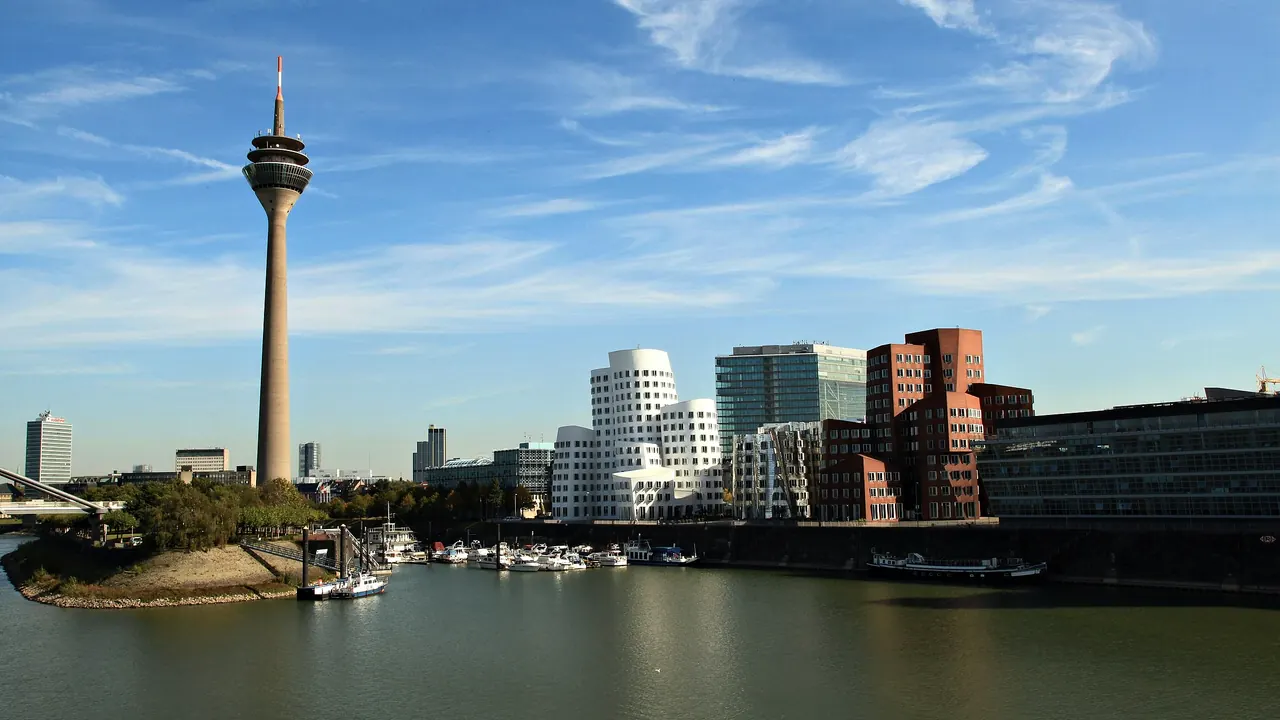
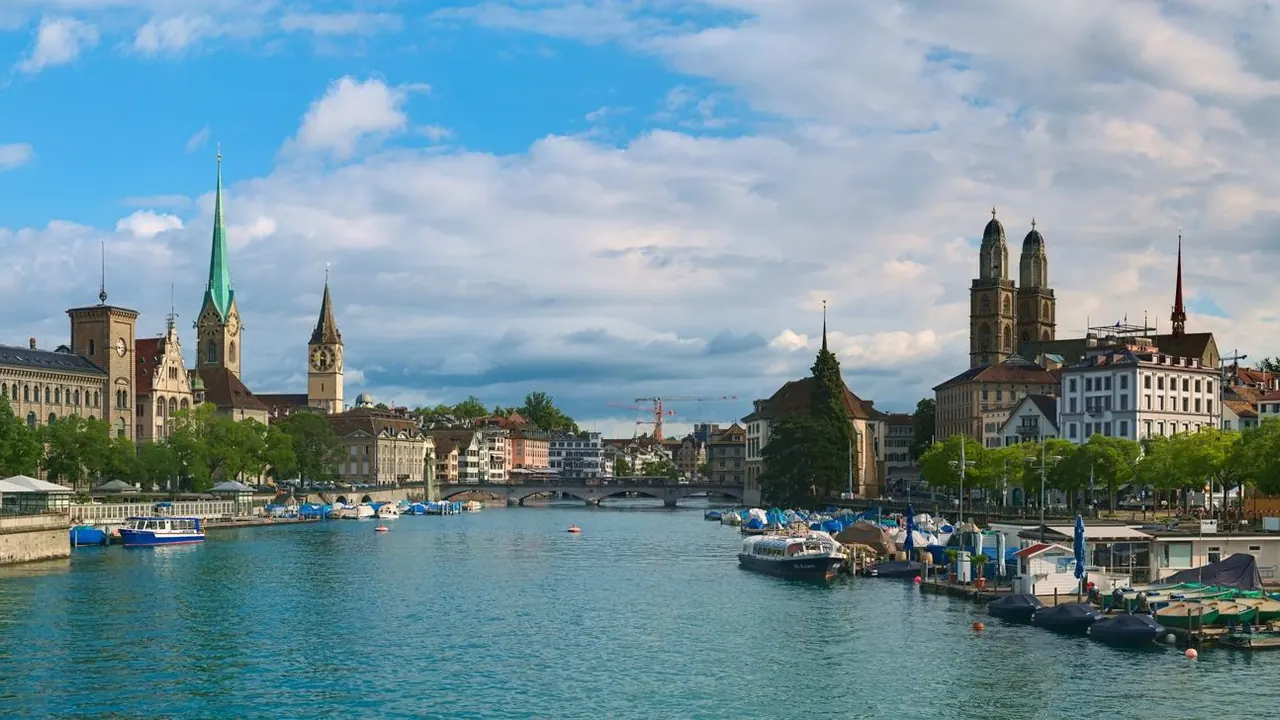
Photos: Dusseldorf by Frank Vincentz, CC BY-SA 3.0, cropped; Zurich by Daniel Kraft, CC BY-SA 3.0, cropped.
Dusseldorf or Zurich?
Our verdict in twelve categories, each scored against the same fixed benchmark cities, and the climate month by month, so you can choose for your trip.
Choose Dusseldorf for
- prices
- food and drink
- shopping
Düsseldorf suits a traveller who wants a relaxed German city built around art, brewhouses and the Rhine, and who would rather spend on experiences than on the hotel bill. It costs far less than Zurich day to day, its Japanese quarter and Altbier tradition make it the more rewarding place to eat, and Cologne, the Ruhr and Aachen are all a short train ride away.
Choose Zurich for
- beaches
- nature and the outdoors
- getting around
Choose Zurich when the landscape matters as much as the city. Clean lake water for summer swimming, a hill of its own and the Alps within an hour make it far stronger for active days and for families, and its transport is close to faultless. The catch is the cost, which is steep at every level and is the main reason to think twice.
Scoreboard
Twelve categories on one fixed scale from 0 to 100. The shaded stretch is the gap between the two.
Your match
Pick a travel style or drag the sliders, and both match scores follow your weighting.
Wins on prices and food and drink with your weighting.
Wins on beaches and nature and the outdoors with your weighting.
What matters to you?
Category by category
What the scores mean for a trip.
Beaches & swimming
Neither city has a beach, but Zurich at least gives you a proper swim. In summer its clean lake is lined with wooden bathing houses and lawned lidos, and the Letten river baths let you float down the Limmat. You swim from piers and grass rather than sand, and only for a short season.
Düsseldorf cannot match that. The Rhine is too dangerous for swimming despite its sandy banks, so a dip means a trip out to Unterbacher See or one of the gravel-pit lakes on the edge of town.
Food & drink
Düsseldorf is the more interesting place to eat. Its Altstadt brewhouses pour Altbier until you cover your glass, with hearty Rhineland plates and sharp local mustard, and the Japanese quarter around Immermannstrasse adds ramen, izakaya and bakeries of real quality. Carlsplatz market rounds it off.
Zurich is polished and reliable rather than exciting: veal in cream with rösti, fondue in wood-panelled guild houses, and chocolate and Luxemburgerli that are the true highlight. It has little street food or market life, and every meal costs a lot.
Culture & sights
The two are evenly matched, but they reward different interests. Düsseldorf is an art city above all, with K20's Klee collection, the net under the dome at K21 and the Kunstpalast, yet its Altstadt is largely rebuilt and its finest historic site, Benrath Palace, lies out in the suburbs.
Zurich has the better-preserved old town, with the Grossmünster where the Swiss Reformation began, the Chagall windows of the Fraumünster and guild houses along the Limmat. The Kunsthaus and the Swiss National Museum make it the stronger choice for history, Düsseldorf the stronger for modern and contemporary art.
Nightlife
Both cities go out well, but in very different ways. Düsseldorf's night is a pub crawl turned street party, with crowds drinking Altbier outside the packed Altstadt bars, and Carnival, when the whole city turns out in costume, is the year's peak. Its clubs are modest.
Zurich is a clubbing city. Venues in Kreis 4 and 5 and Zurich West run electronic music until morning, and the Street Parade brings techno to the lake shore every August. Summer drinks in the bathing houses are a pleasure, but prices tend to keep nights shorter.
Nature & outdoors
Here Zurich is in another league. The lake, with the snow-capped Glarus Alps at its far end, is right in the city, the Uetliberg ridge is a short train ride away, and real high-mountain hiking and skiing at places such as Flumserberg lie within about an hour.
Düsseldorf's outdoors is gentle and flat: grassy Rhine meadows with long cycle paths to Kaiserswerth, the Grafenberg forest and the Neandertal valley. The Bergisches Land and Siebengebirge are fine for a walk, but there is nothing dramatic.
Day trips
Both make excellent bases without a car, and the difference lies in what you see. From Düsseldorf it is a dense run of cities: Cologne cathedral in under half an hour, Bonn, the Brühl palaces, the industrial heritage of Zollverein, Aachen and even Maastricht across the Dutch border.
Zurich's excursions are more scenic. Lucerne's wooden bridges, the Rhine Falls with Stein am Rhein, Bern's arcades and a boat up the lake to Rapperswil mix towns with water and mountains, and the Swiss rail network makes each one easy.
Good for families
Both are safe, orderly cities where buggies are no trouble, but Zurich gives children more. Its zoo, with the Madagascar rainforest hall and the elephant park, is a major day out, the lake lidos have shallow areas and lawns, and the Technorama and the Swiss Museum of Transport are easy trips.
Düsseldorf has the Aquazoo, the tilted windows of the Rheinturm and the free game park in Grafenberg. Its one real advantage is that Phantasialand and Movie Park are within an hour, which Zurich cannot offer.
Getting around
Düsseldorf's centre is flat and compact, so the Altstadt, the Königsallee, the Hofgarten and the Japanese quarter are all an easy walk apart along the riverside. Its trams and light rail join a regional network that reaches Cologne and the Ruhr, though the fare zones take some puzzling out at first.
Zurich goes a step further and makes getting around almost effortless. Trams, S-Bahn trains, funiculars, the Uetliberg railway and even the lake boats all run on one ticket, on time and with clear signs. From the main station you can carry straight on across the country.
Shopping & style
The two are closely matched, each built around one great luxury street. Düsseldorf's Königsallee, along its canal, is backed by big department stores, Flingern's design boutiques and the stationery and homeware shops of the Japanese quarter.
Zurich's Bahnhofstrasse runs from the station to the lake and is above all about watches, with chocolate as the souvenir. The viaduct arches in Zurich West and the summer flea markets add variety, but everything costs noticeably more than in Düsseldorf.
Affordability
The gap here is wide, and it shapes the whole trip. In Düsseldorf the hotel is the real expense. Rooms are high for a city of its size and climb sharply when a trade fair is on, so check the fair calendar before you book. After that, everyday spending is in line with other well-off German cities, and some museums let you in free or at a reduced rate at times.
Zurich costs more than Düsseldorf on almost every item, from a simple room to a glass of wine or a museum ticket, and over a few days the difference adds up quickly. A visitor card that bundles transport and museum entry takes the edge off. Still, this is a city to budget for generously, not one where careful spending stretches very far.
Live music & performing arts
Opera is what separates them. Düsseldorf has a steady season of opera and ballet at the Deutsche Oper am Rhein beside the Hofgarten, and symphony concerts in the Tonhalle, a domed former planetarium. It also has a long tradition of political cabaret, and its proudest claim is in music history, as the birthplace of Kraftwerk and early German electronic music.
Zurich's Opernhaus on the lake shore is the more distinguished house, with a reputation across Europe, and the Tonhalle Orchestra plays in a finely restored nineteenth-century hall. For jazz, indie and electronic acts there are the old Rote Fabrik factory and the venues of Kreis 4 and 5. In both cities the Schauspielhaus is among the leading German-language theatres, but it offers little to anyone who doesn't speak German.
Wellness & relaxation
Zurich is the easier place to unwind. Its thermal bath in the stone vaults of the old Hürlimann brewery has a rooftop pool, the wooden lake bathing houses turn into saunas in the colder months, and the hot springs of Baden are only twenty minutes away.
Düsseldorf has no springs of its own. Relaxing means the mixed, swimwear-free saunas of its public baths, a trip of about an hour to a thermal complex or to Aachen, and slow walks through the Hofgarten and the Japanese garden in Nordpark.
When should you go?
Pick your month. The climate figures are measured averages, not a forecast.
Dusseldorf in July
Zurich in July
Daytime high, °C
Rainfall in the month, mm
Temperature and rainfall are climate normals, averaged over the years shown. Dusseldorf: 1991-2020 normals, Düsseldorf (8.3 km from centre). Zurich: 1991-2020 normals, Zurich Town / Ville. (2.2 km from centre).
Both cities follow a similar curve of temperature, warmest in July and August at around 25°C in Düsseldorf and 24°C in Zurich, with May, June and September pleasant for walking in either. Rain is where they part. Düsseldorf's rain is spread fairly evenly across the year, peaking in August at 77mm, while Zurich gets much of its rain in late spring and summer, with May to July each bringing about 128mm, often as showers and thunderstorms.
Zurich has slightly more summer sunshine and is the place for a swim, though the lake season runs only from about June to early September. Winter is colder there, with highs around 4°C in December and January and fog often lying over the lake, so those months suit a ski day or a sauna more than sightseeing. Düsseldorf stays a degree or two milder, but its winters are grey and short of sunshine, and February is lively only because of Carnival.
Which traveller are you?
On a trip on a tight budget, Düsseldorf is the clear choice. Brewhouse meals, Japanese noodle bars and fairly priced transport keep costs in check, while Zurich is among the dearest places in Europe, where even supermarket picnics only partly soften things.
For an outdoors trip, Zurich wins easily. The Uetliberg is a short train ride away, the lake has paths along both shores, and Rigi, Pilatus and the ski slopes are about an hour off. Düsseldorf offers only flat Rhine cycling and gentle wooded valleys.
On a family trip with children, Zurich has the edge. Its zoo with the Madagascar rainforest hall, shallow lake lidos and boat trips, and transport that is easy at every turn suit young families. Düsseldorf answers with theme parks nearby and its Grafenberg game park.
Before you go
| Measure | Dusseldorf | Zurich |
|---|---|---|
| Official language | German | French, German, Italian, Romansh |
| Currency | Euro (EUR) | Swiss Franc (CHF) |
| Sockets | CF230 V, 50 Hz | CJ230 V, 50 Hz |
| Driving side | Right | Right |
| Time zone | UTC+1, UTC+2 in summer | UTC+1, UTC+2 in summer |
| Emergency number | 112 | 112 |
| Elevation | 38 m | 408 m |
| Main airport | Düsseldorf Airport (DUS)7 km from centre182 non-stop destinations | Zürich Airport (ZRH)9 km from centre226 non-stop destinations |
| Public holidays this year | 11 days | 10 days |
By the numbers
| Measure | Dusseldorf | Zurich |
|---|---|---|
| City population | 619,444 | 440,935 |
| People per km² | 2,849 | 5,016 |
| Museums within 10 km | 25 | 63 |
| UNESCO World Heritage sites within 50 km | 4 | 1 |
Where else could you go?
Every comparison below shares a destination with this one, so you can follow Dusseldorf or Zurich somewhere new.