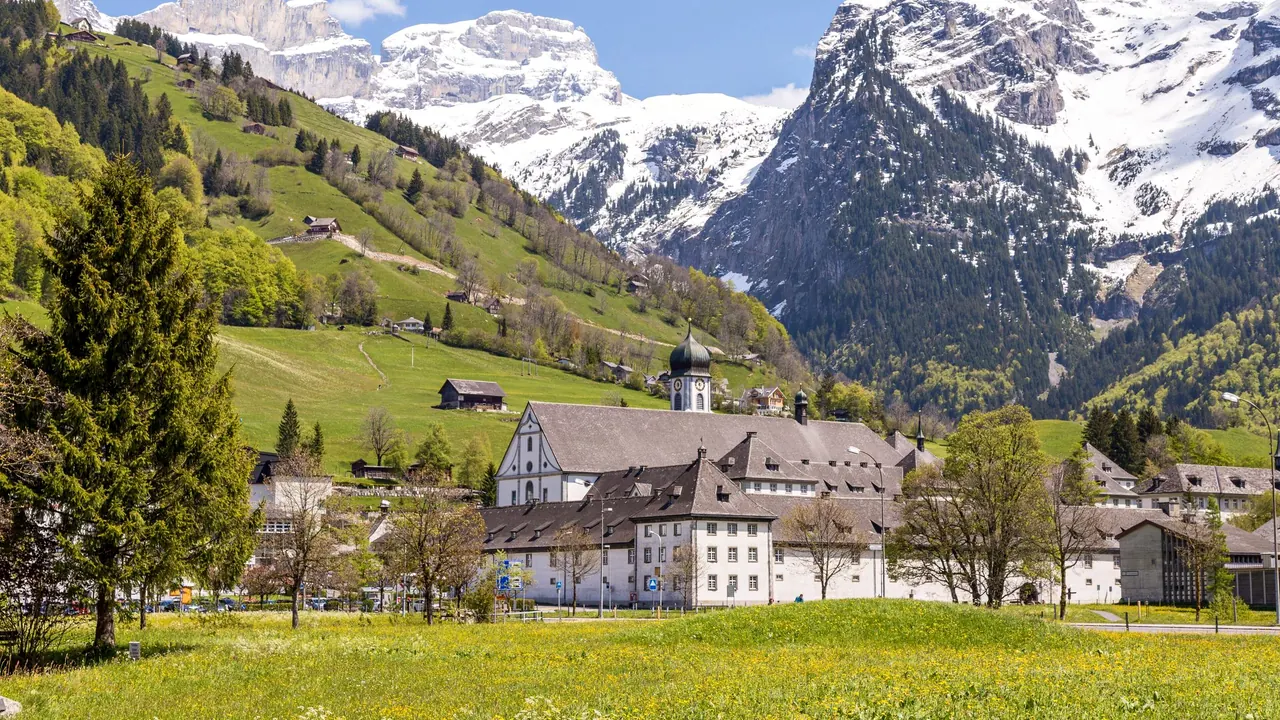
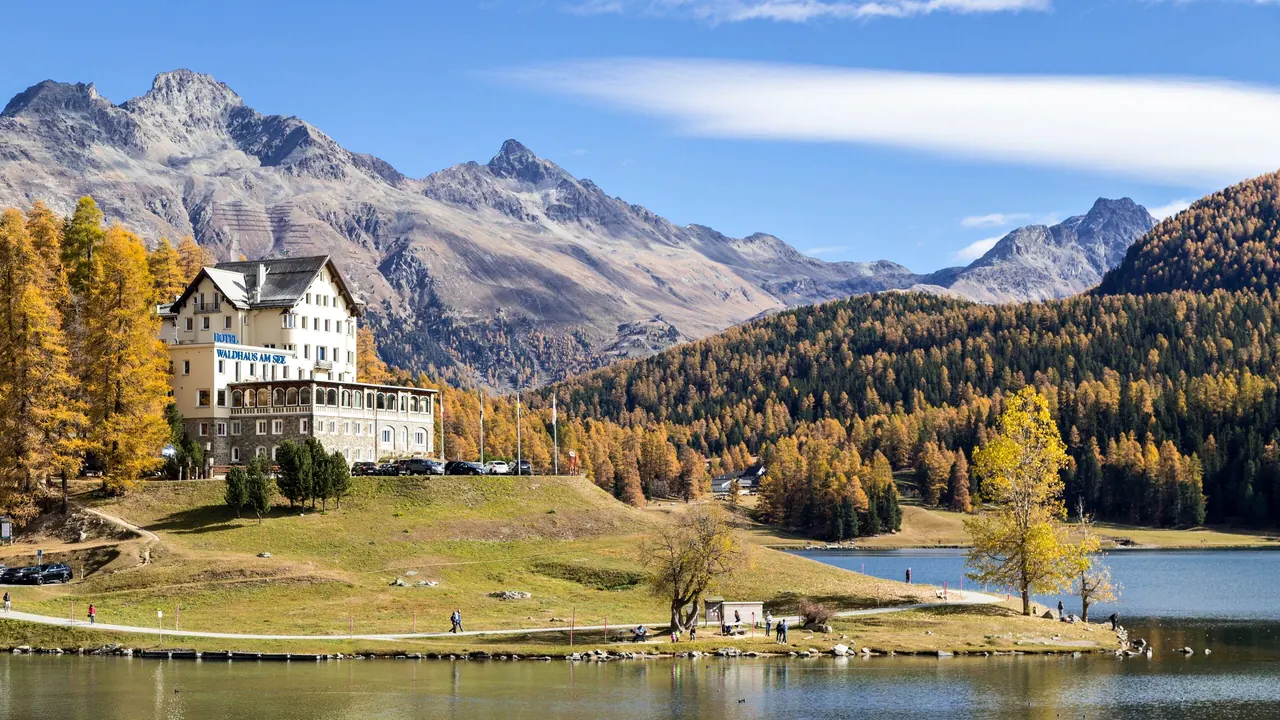
Photos: Engelberg by JoachimKohler-HB, CC BY-SA 4.0, cropped; St. Moritz by JoachimKohler-HB, CC BY-SA 4.0, cropped.
Engelberg or St. Moritz?
Our verdict in twelve categories, each scored against the same fixed benchmark cities, and the climate month by month, so you can choose for your trip.
Choose Engelberg for
- day trips
- families
- beaches
Engelberg suits travellers who want glacier scenery close at hand and a city within easy reach. Families do especially well here, because both mountains are set up for children, and freeriders come for the steep north faces of Titlis. Lucerne and its lake are under an hour down the valley, which gives a wider choice of day trips. The village also costs a little less, although it is still far from cheap.
Choose St. Moritz for
- shopping
- food and drink
- wellness
For a more polished mountain stay, St. Moritz is the better pick. Its wide, sunny lake valley gives more variety outdoors, and its hotel spas and old mineral-spring bath make it the stronger place to unwind. Its fine dining, luxury boutiques, seasonal festivals and glamorous winter evenings go well beyond what Engelberg offers. It is best for adults with a generous budget and less suited to young children or anyone counting costs.
Scoreboard
Twelve categories on one fixed scale from 0 to 100. The shaded stretch is the gap between the two.
Your match
Pick a travel style or drag the sliders, and both match scores follow your weighting.
Wins on day trips and families with your weighting.
Wins on shopping and food and drink with your weighting.
What matters to you?
Category by category
What the scores mean for a trip.
Beaches & swimming
Neither is a swimming destination, but Engelberg offers the easier escape. In midsummer the train takes about an hour down to Lake Lucerne, where lidos and lakeside meadows have clear water warm enough for a proper swim. Up in the village, the Trübsee is for walking round, not for bathing.
St. Moritz has nothing like that within easy reach. Lej da Staz, a forest lake you can walk to from town, has a lawn and a few short weeks of bracing bathing, while Lake St. Moritz belongs to windsurfers in wetsuits. In both places, most swims happen in a hotel pool or an indoor pool.
Food & drink
St. Moritz is the better place to eat, mostly because of its top end. The grand hotels and smart mountain restaurants hold far more serious kitchens than a town this size would suggest. Engadine dishes such as capuns, pizzoccheri and nut tart give the local cooking its own character, with an Italian accent from over the border.
Engelberg sticks to a short Alpine menu of fondue, rösti and Älplermagronen, served in wood-panelled rooms and mountain huts. Its most distinctive stop is the monastery's show cheese dairy. Both towns offer long terrace lunches with a view, and neither has street food or markets.
Culture & sights
Neither has more than an afternoon of sights, and what there is differs in kind. Engelberg's is religious: the Benedictine abbey founded in 1120, with its bright baroque church and one of Switzerland's largest organs, plus a handful of Belle Époque hotels from the grand-resort era.
St. Moritz offers art and sporting history instead. There is the Segantini Museum with its great triptych, and painted Engadine interiors in the Engadin Museum. There is also the story of two Winter Olympics, told by the Cresta Run and the bobsleigh track, both still in use.
Nightlife
Both towns go quiet when the ski season ends, but St. Moritz offers the fuller winter night out. Between Christmas and early March it has grand hotel bars, après-ski on terraces at the foot of the slopes and a couple of exclusive late clubs. It is dressy and expensive rather than rowdy.
Engelberg's winter scene is younger and more casual. Freeriders and seasonal workers fill a couple of late bars and a small club at weekends. In summer, an evening in either place usually ends with a drink on a terrace after dinner.
Nature & outdoors
Both are first-rate Alpine bases, and the difference lies in the shape of the landscape. Engelberg is a deep, enclosed valley dominated by one mountain. Titlis has a glacier, an ice cave and steep north faces that draw freeriders, and across the valley lie the gentler Brunni area and the Four Lakes walk over the Jochpass.
St. Moritz opens onto a wide, sunny high valley of lakes and larch forest, with three ski areas and celebrated cross-country trails on the valley floor. There is also kitesurfing on Lake Silvaplana, and the Swiss National Park is within an hour. It suits people who want variety and drier weather, while Engelberg suits those drawn to glacier and steep snow.
Day trips
Every outing from Engelberg starts back down the same valley, but that valley leads to Lucerne in under an hour. From there you have the covered bridges, the old town, paddle steamers to the lake villages, and Einsiedeln, Schwyz and Zurich further on. A real city and its lake are within easy reach on any day.
St. Moritz has the more spectacular ride, the Bernina line over the pass to Poschiavo and Tirano, but its destinations are villages. Sils Maria, Soglio, and the sgraffito houses of Guarda and Zuoz are charming, but there is no city among them.
Good for families
Engelberg is the more child-friendly of the two. The village is compact and flat, and both of its mountains are set up for children. Brunni has stepping stones and rafts at the Härzlisee, the Trübsee has boats and a playground, and there is snow on Titlis in midsummer. Lucerne's transport museum covers a wet day.
St. Moritz has ski schools, sledging and natural-ice skating, but its tone is adult luxury and little is built for children away from the slopes. Families with small children often end up in the calmer villages further along the valley.
Getting around
Neither needs a car, and both are small. Engelberg is flat and easy on foot, with a free shuttle in the ski season. It sits at the head of its valley, though, so every journey out begins with the same train to Lucerne.
St. Moritz takes more effort within town, because it is split between hillside Dorf and lakeside Bad. Escalators and a lift help with the climb, and the pavements can be icy in winter. In return, the Rhaetian Railway and regional buses link it to the whole Upper Engadine, from Maloja to Zuoz, which makes the wider valley easy to explore.
Shopping & style
St. Moritz is the place to shop, as long as you want luxury. Via Serlas and the streets around it hold fashion, watch and jewellery boutiques, furriers and high-end ski wear on a scale unusual for a mountain town. For something local there is Engadine woodwork and linen.
Engelberg has well-stocked outdoor and rental shops and a few watch shops aimed at tour groups. Its best buys are edible, from monastery cheese to dried meats and chocolate.
Affordability
Neither is a place to save money, but Engelberg is the less punishing of the two. Below the hotel dining rooms it has wood-panelled village restaurants and mountain huts, and because the whole trip runs on the valley railway from Lucerne, a Swiss travel pass and a kitchen of your own make a real difference. The one cost that is hard to avoid is the ride up to the Titlis glacier.
In St. Moritz the gap shows most in the evening, when the dining and the bars are pitched at luxury and there is little underneath. Timing matters more here: a summer or shoulder-season stay is clearly lighter on the wallet, and hotel rooms then often include the local lifts and buses. The valley also allows a saving that Engelberg, alone at the head of its valley, does not really offer: you can sleep in a plainer guesthouse in one of the neighbouring Engadine villages and come in by regional train.
Live music & performing arts
St. Moritz has more to plan a trip around, though only in season. It has a long-running summer jazz festival in intimate rooms, the Engadin Festival's chamber concerts in churches and hotel halls across the valley, and a winter classical series.
In Engelberg, music means organ recitals and concerts in the abbey church, plus a small classical festival in summer. Its practical advantage is Lucerne, whose concert halls are less than an hour away by train.
Wellness & relaxation
St. Moritz is the better choice for a restful stay. Its iron-rich spring still supplies a medical bath in St. Moritz Bad, and its hotel spas are among the most elaborate in the Alps, with pools facing the peaks. The thermal baths at Scuol are a train ride away.
Engelberg also began as a health resort and keeps its clean air and quiet, but wellness there comes down to hotel saunas and the village pool, with no springs and no bathing tradition. In both places the real calm comes in early summer and quiet weeks, not at the peak of the ski season.
When should you go?
Pick your month. The climate figures are measured averages, not a forecast.
Engelberg in July
St. Moritz in July
Daytime high, °C
Rainfall in the month, mm
Where the figures come from
Engelberg has no weather station within reach, so its figures come from a gridded climate model rather than a measured record, and read a broad area rather than one spot.
St. Moritz has no rain gauge within 25 km of the centre, so its rainfall comes from a gridded climate dataset read at the destination rather than from a gauge further away.
Temperature and rainfall are climate normals, averaged over the years shown. Engelberg: 2001-2020 normals, NASA POWER reanalysis grid, no weather station within 90 km. St. Moritz: 2015-2025 (rainfall 1991-2020) normals, Samedan (5.5 km from centre).
Both places are built for summer and winter, with quieter, greyer weeks between the seasons. Engelberg is generally the warmer of the two, with highs around 21°C in July and August. Its summers are wet, though, with about 150mm a month from May to August, so you need to be flexible about walking days. Winter highs stay close to freezing, which is good for the snow but cold for strolling round the village.
St. Moritz is a few degrees cooler for most of the year. It peaks near 20°C in July and stays below freezing in January. It is clearly drier in winter, spring and summer, when even its wettest months stay at about 100mm, but in autumn the two get much the same rain. Neither is ever warm enough for a beach trip, so for a swim the better bet is a midsummer day from Engelberg down to Lake Lucerne. In both places, July to September is the most comfortable time for hiking.
Which traveller are you?
On a family trip with young children, choose Engelberg. Its mountains are planned around children rather than merely putting up with them, distances in the village are short, and a wet day has an easy answer down the valley in Lucerne.
For a relaxing and wellness trip, St. Moritz is the better base. Taking the waters is part of its history as a spa town, its sunnier, drier valley invites slow days outdoors, and its hotels treat the spa as a centrepiece rather than an extra.
On a food and nightlife trip, St. Moritz wins, at least in winter. Its evenings revolve around serious dinners and dressy hotel bars, while Engelberg offers hearty Alpine meals and a younger, more casual après-ski crowd. Bring a generous budget.
Before you go
| Measure | Engelberg | St. Moritz |
|---|---|---|
| Official language | French, German, Italian, Romansh | French, German, Italian, Romansh |
| Currency | Swiss Franc (CHF) | Swiss Franc (CHF) |
| Sockets | CJ230 V, 50 Hz | CJ230 V, 50 Hz |
| Driving side | Right | Right |
| Time zone | UTC+1, UTC+2 in summer | UTC+1, UTC+2 in summer |
| Emergency number | 112 | 112 |
| Elevation | 1,015 m | 1,822 m |
| Main airport | Zürich Airport (ZRH)72 km from centre226 non-stop destinations | Zürich Airport (ZRH)145 km from centre226 non-stop destinations |
| Public holidays this year | 13 days | 9 days |
By the numbers
| Measure | Engelberg | St. Moritz |
|---|---|---|
| Population | 4,181 | 5,027 |
| People per km² | 56 | 175 |
| Museums within 10 km | 0 | 7 |
| UNESCO World Heritage sites within 50 km | 2 | 2 |
Where else could you go?
Every comparison below shares a destination with this one, so you can follow Engelberg or St. Moritz somewhere new.
- Andermattvs Engelberg
- Lenzerheidevs St. Moritz
- Arosavs St. Moritz
- Davosvs St. Moritz
- Grindelwaldvs Engelberg
- Klostersvs St. Moritz