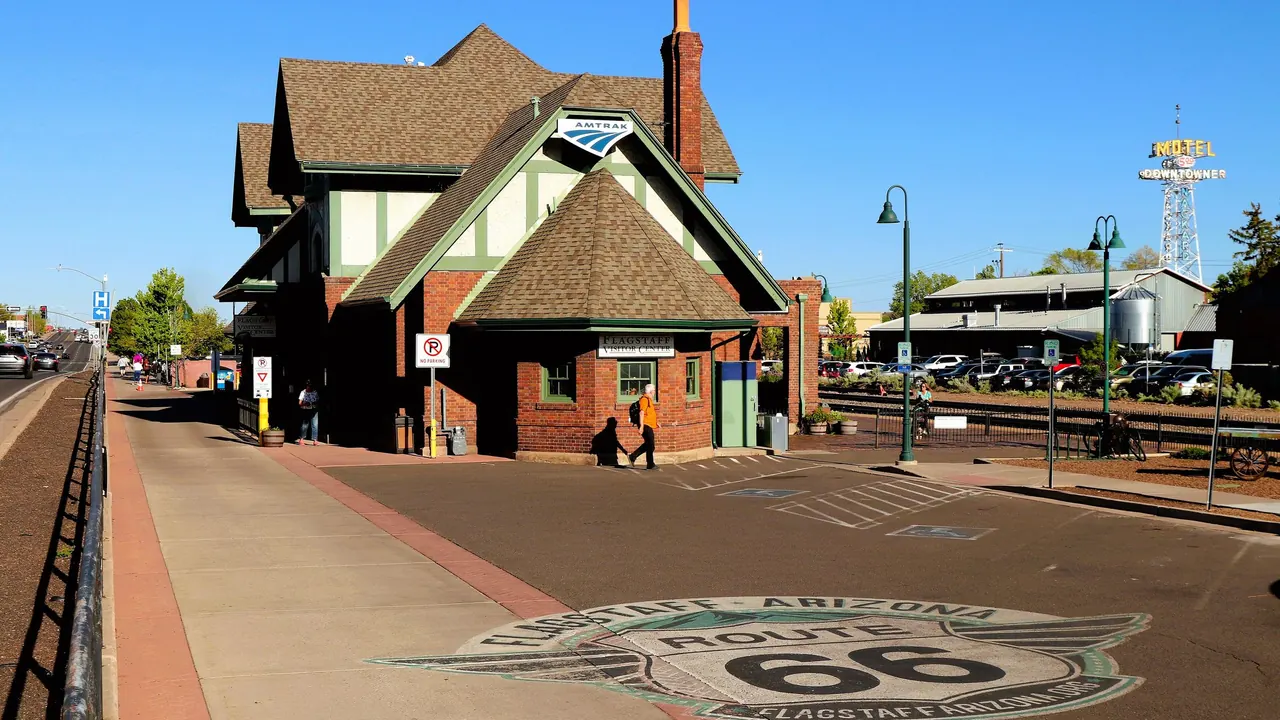
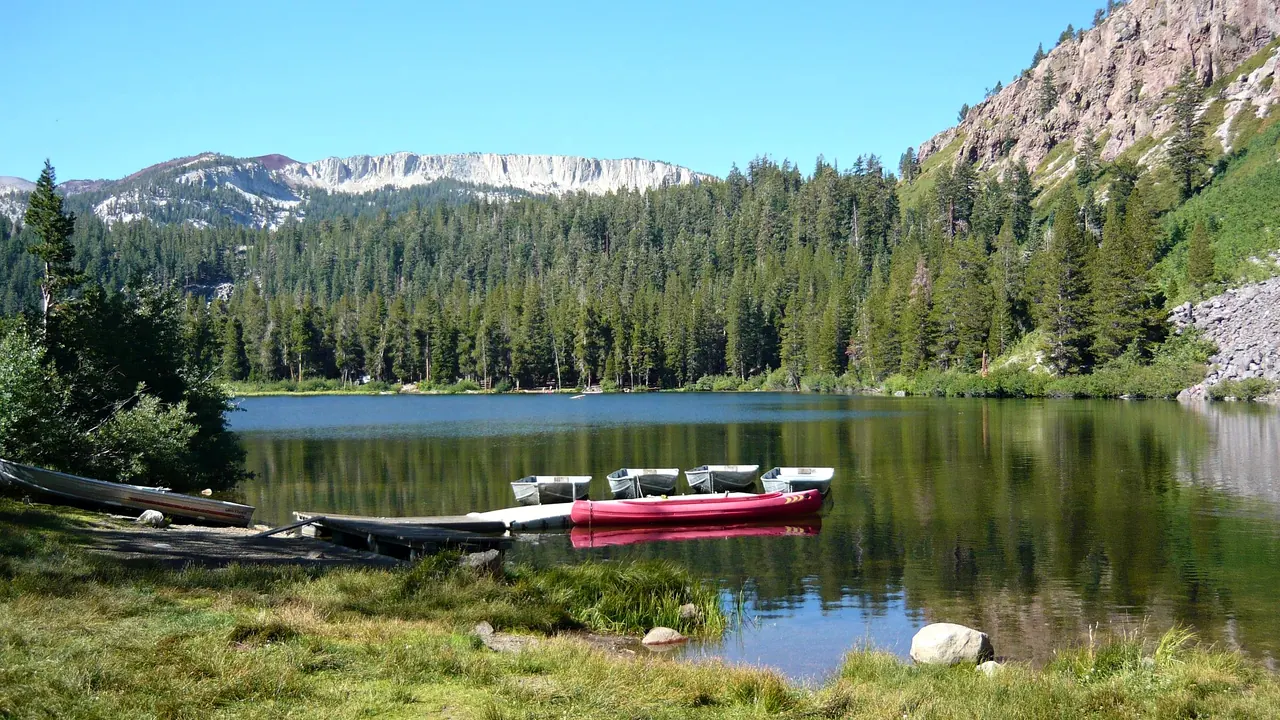
Photos: Flagstaff by Thank You (25 Millions) views, CC BY 2.0, cropped; Mammoth Lakes by Dr. Al. K. Lisch, CC BY-SA 3.0, cropped.
Flagstaff or Mammoth Lakes?
Our verdict in twelve categories, each scored against the same fixed benchmark cities, and the climate month by month, so you can choose for your trip.
Choose Flagstaff for
- culture and sights
- prices
- day trips
Flagstaff suits the traveller who wants a mountain base with a town attached. Its brick downtown on old Route 66, the Lowell Observatory and the Museum of Northern Arizona give the evenings and the bad-weather days something to do. The Grand Canyon, Sedona's red rock and the ancient pueblo sites are all within a drive, and rooms and meals cost noticeably less, which matters on a longer road trip.
Choose Mammoth Lakes for
- wellness
- getting around
- beaches
Mammoth Lakes is the pick when the mountain itself is the whole point. One of North America's biggest ski areas sits above the town, and in summer the granite lakes, wilderness trails and the Yosemite high country take its place. Natural hot springs in the sagebrush are there for tired legs at the end of the day. There is little to see in town and it is expensive, but for skiing, hiking and quiet evenings it gives more of the high Sierra than Flagstaff gives of its plateau.
Scoreboard
Twelve categories on one fixed scale from 0 to 100. The shaded stretch is the gap between the two.
Your match
Pick a travel style or drag the sliders, and both match scores follow your weighting.
Wins on culture and sights and prices with your weighting.
Wins on wellness and getting around with your weighting.
What matters to you?
Category by category
What the scores mean for a trip.
Beaches & swimming
Neither town is anywhere near a coast, but Mammoth Lakes has the slightly better swimming. In July and August you can take a cold dip in Horseshoe Lake in the Lakes Basin just above town, or in the slightly warmer Crowley Lake reservoir.
Flagstaff's swimming means a drive down Oak Creek Canyon to Slide Rock and the creek pools, which are slippery and crowded at weekends. Otherwise it comes down to a hotel pool.
Food & drink
Both towns serve hearty, casual food with no cuisine of their own, and neither is worth choosing for its restaurants. Flagstaff's strong point is its cluster of craft breweries downtown and on the Southside, plus regional touches such as Navajo tacos and green chile.
Mammoth Lakes cooks ski-town food: big breakfasts, steakhouses and a few better kitchens around the Village. The range is wider than you would expect because it feeds a large winter crowd, but some places cut back in spring and autumn.
Culture & sights
This is where the two towns differ most. Flagstaff's sights are few but good. You can look through the historic telescopes at the Lowell Observatory, see the Native American collections at the Museum of Northern Arizona and walk around the Riordan Mansion and the railroad-era downtown, which together fill a day or two.
Mammoth Lakes is a ski resort of modern lodges and condominiums. Its small mining museum is about the only sight in town, so anyone who wants history has to drive an hour or more.
Nightlife
A night out in Flagstaff is a stroll between brewery taprooms, cocktail bars and old Route 66 saloons downtown and on the Southside, all a few minutes apart. It is the better of the two for an evening out, and in term time university students keep weekends busier than you would expect in a town this size.
Mammoth Lakes is at its busiest at four in the afternoon rather than at midnight. Après-ski fills the Village and the bars by the lifts, and long weekends in the ski season can run late. Outside winter the town is quiet early. Neither town has a real club scene.
Nature & outdoors
Both are first-rate outdoor bases, but the landscapes are very different. Around Flagstaff you get the volcanic San Francisco Peaks, a huge ponderosa forest, the lava flows of Sunset Crater and dark night skies, with the Grand Canyon and Sedona's red rock within reach. It is canyon and desert country seen from a cool plateau.
Mammoth Lakes is high-alpine. A big ski mountain becomes a bike park in summer, the Lakes Basin is ringed with granite, and trails lead into the Ansel Adams and John Muir wildernesses. Devils Postpile, Mono Lake's tufa towers and the Tuolumne high country across Tioga Pass are all close.
Day trips
Flagstaff has many more places to drive to. Sedona and the hillside mining town of Jerome are close, and so are the cliff dwellings at Montezuma Castle and the Sinagua ruins at Walnut Canyon and Wupatki. Further afield are the historic railway from Williams to the Grand Canyon and the Hopi mesas.
From Mammoth Lakes, the outings are mostly back into the mountains. The ghost town of Bodie and the Manzanar internment camp are the two strong historic trips, each over an hour away, and winter pass closures shrink the options further.
Good for families
Both towns are relaxed and suit active children, and both share the same altitude tiredness for the first day or two. Flagstaff has the edge on a cold or wet day, with the observatory's telescope evenings, the dinosaurs at the museum and the steam train to the Grand Canyon.
Mammoth Lakes is better for snow and water. It has a large ski school, a tubing hill, rowing boats and trout fishing in the Lakes Basin, and condominiums with kitchens, but nothing indoors when the weather turns.
Getting around
Mammoth Lakes is the easier place to manage without driving, at least for its main activity. In winter, free shuttles and the gondola from the Village get skiers to the lifts, and in summer a trolley and a shuttle reach the Lakes Basin and Reds Meadow.
Flagstaff has a walkable downtown, a paved trail network, a local bus and a long-distance train station. But the Grand Canyon, Sedona and the monuments are out of reach of public transport. In practice both towns need a car for exploring further.
Shopping & style
Flagstaff has something worth buying: Navajo rugs, Hopi kachina carvings, pottery and turquoise jewellery from downtown galleries, the museum shop and trading posts. Buying from established dealers is the way to be sure the work is authentic.
Mammoth Lakes is good only for gear. Its ski, climbing and fly-fishing shops are well stocked, but beyond those there is little more than photography galleries and Village souvenirs.
Affordability
Flagstaff is the clearly cheaper base. Chain motels along Route 66 keep rooms affordable outside summer weekends, brewery meals are reasonable, and staying there costs far less than staying at the canyon rim or in Sedona.
Mammoth Lakes charges major-resort prices, especially in winter, when lift tickets, rental and lodging all add up fast. A summer or shoulder-season trip, self-catering in a condominium, is the way to keep it under control.
Live music & performing arts
The Flagstaff Symphony Orchestra and the university music school give the town proper concerts in the campus hall, and the restored Orpheum Theater downtown brings in touring folk and indie bands. Community theatre runs through the year, and summer adds concerts and festivals in the pines.
Mammoth Lakes works on a smaller scale. A resident community theatre company plays on the college campus, and summer brings a long-running jazz festival and chamber music in meadows with the mountains behind. It makes a pleasant evening, but with no hall for touring acts there is much less to choose from.
Wellness & relaxation
Mammoth Lakes is the better place to unwind. Its volcanic ground feeds primitive hot springs in the sagebrush with the Sierra across the valley, and the big lodges have spas and hot tubs for legs sore from skiing.
Flagstaff has no hot springs and few spas. Its calm comes from pine air and starry nights, and anyone wanting treatments drives down to Sedona's resorts.
When should you go?
Pick your month. The climate figures are measured averages, not a forecast.
Flagstaff in July
Mammoth Lakes in July
Daytime high, °C
Rainfall in the month, mm
Where the figures come from
Flagstaff has no rain gauge within 25 km of the centre, so its rainfall comes from a gridded climate dataset read at the city rather than from a gauge further away.
Mammoth Lakes's station stands 227 m below the city centre, so the centre is likely a little cooler than the figures say.
Mammoth Lakes has no rain gauge within 25 km of the centre, so its rainfall comes from a gridded climate dataset read at the city rather than from a gauge further away.
Temperature and rainfall are climate normals, averaged over the years shown. Flagstaff: 1991-2020 normals, Flagstaff / Fort Tuthill (7.4 km from centre). Mammoth Lakes: 2008-2020 (rainfall 1991-2020) normals, Mammoth / Whitmore Hot Springs (12 km from centre).
The two towns follow almost the same temperature curve, both cold in winter with daytime highs around 6°C and both mild in high summer at about 27°C, so neither is ever too hot for walking. Where they differ is the rain. Mammoth Lakes gets its moisture in winter, with around 80mm in January, most of it falling as snow on the ski mountain. Its summers are almost completely dry, so July to September is the long, settled stretch for the lakes, the trails and a cold dip.
Flagstaff is driest in late spring and early summer, with June close to rainless, and then the monsoon arrives. July and August bring the wettest weeks of its year as afternoon thunderstorms, so hikers there plan early starts. That makes May, June, September and October its best months for the outdoors. Winter brings snow to both, but Mammoth Lakes gets far more of it.
Which traveller are you?
On a culture and arts trip, Flagstaff is clearly the better choice. It has the observatory where Pluto was found, a serious museum of Hopi, Navajo and Zuni art, Sinagua ruins nearby and a small concert calendar, while Mammoth Lakes offers one log-cabin history museum.
For a relaxing and wellness trip, Mammoth Lakes is the one to choose. Primitive hot springs out in the sagebrush, hotel spas and hot tubs, and slow lakeside mornings give it a restorative side that Flagstaff, without hot springs and with only a few spas, cannot match.
Skiers should head to Mammoth Lakes. Its mountain is one of the largest ski areas on the continent, with a season that often runs into early summer, plus free shuttles and a gondola from the Village. Flagstaff's slopes are a pleasant local hill by comparison.
Before you go
| Measure | Flagstaff | Mammoth Lakes |
|---|---|---|
| Currency | US Dollar (USD) | US Dollar (USD) |
| Sockets | AB120 V, 60 Hz | AB120 V, 60 Hz |
| Driving side | Right | Right |
| Time zone | UTC-7 | UTC-8, UTC-7 in summer |
| Emergency number | 911 | 911 |
| Elevation | 2,106 m | 2,402 m |
| Main airport | Flagstaff Pulliam Airport (FLG)7 km from centre2 non-stop destinations | Reno Tahoe International Airport (RNO)217 km from centre25 non-stop destinations |
| Public holidays this year | 12 days | 13 days |
By the numbers
| Measure | Flagstaff | Mammoth Lakes |
|---|---|---|
| City population | 76,831 | 7,191 |
| People per km² | 464 | 110 |
| Museums within 10 km | 1 | 0 |
| UNESCO World Heritage sites within 50 km | 0 | 0 |
Where else could you go?
Every comparison below shares a destination with this one, so you can follow Flagstaff or Mammoth Lakes somewhere new.
- Sedonavs Flagstaff
- South Lake Tahoevs Mammoth Lakes
- Page, Arizonavs Flagstaff
- Scottsdalevs Flagstaff
- Phoenixvs Flagstaff
- San Josevs Mammoth Lakes