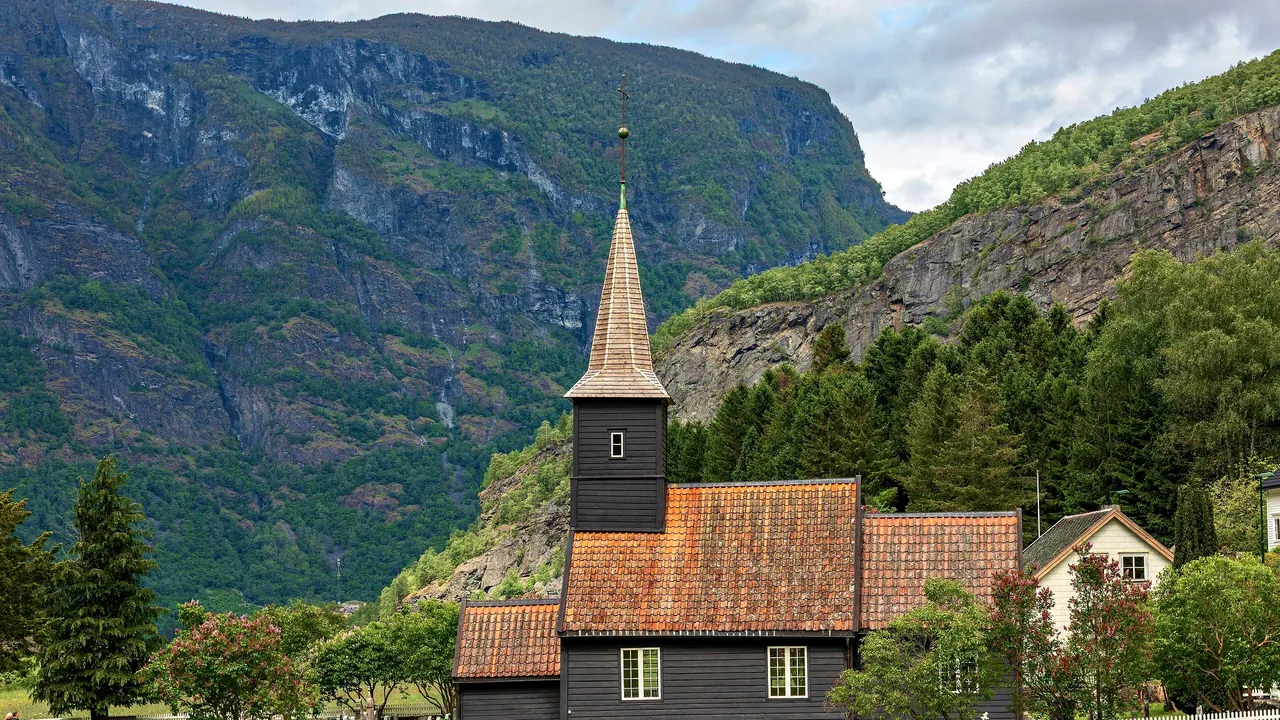
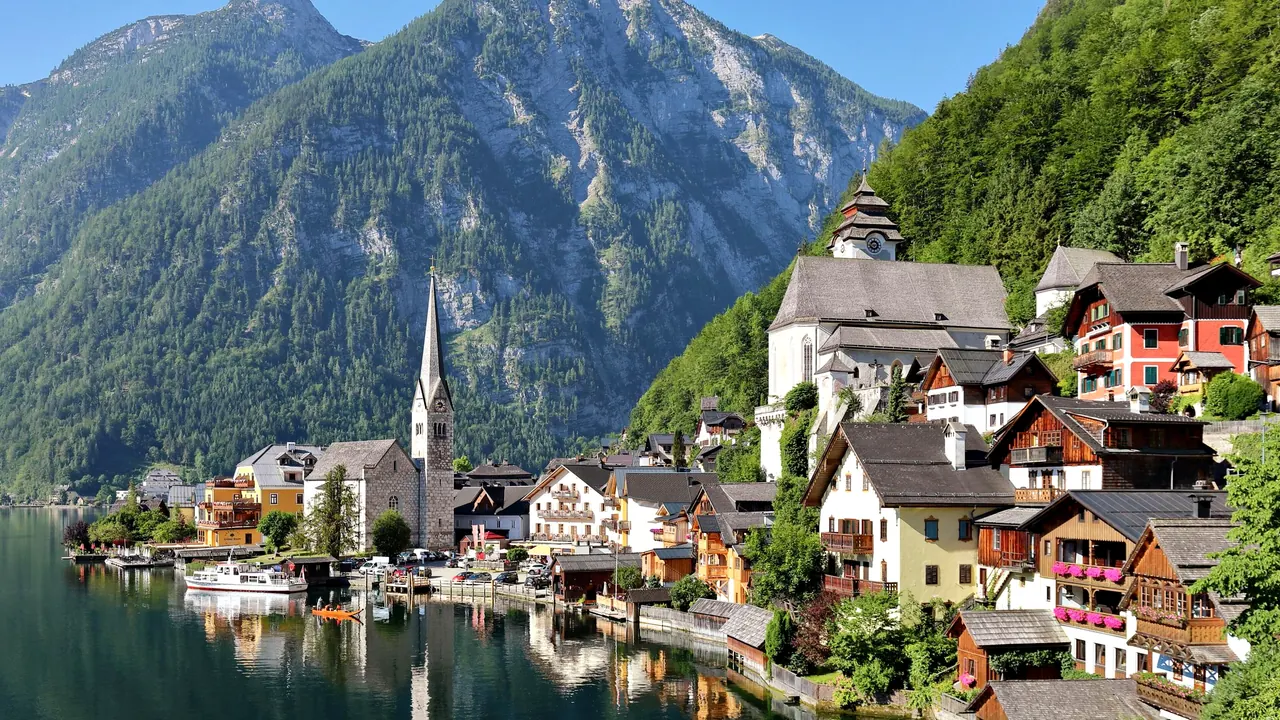
Photos: Flåm by Ximonic (Simo Räsänen), CC BY-SA 4.0, cropped; Hallstatt by C.Stadler/Bwag, CC BY-SA 4.0, cropped.
Flåm or Hallstatt?
Our verdict in twelve categories, each scored against the same fixed benchmark cities, and the climate month by month, so you can choose for your trip.
Choose Flåm for
- getting around
- food and drink
- nightlife
Flåm suits travellers who come for the landscape itself and for the journey through it. That means the mountain railway down from Myrdal, boats into the narrow Nærøyfjord, a kayak on the water or a bike on the Rallarvegen. Rail, boat and bus all meet in the village, so it works well without a car, and on a long summer evening the fjord is about as still as anywhere gets. Expect almost nothing to see in the village itself, and the higher bill of the two.
Choose Hallstatt for
- culture and sights
- day trips
- prices
Choose Hallstatt if you want mountain scenery with history attached. The salt mine, the prehistoric finds and the painted skulls of the Beinhaus give you a day of sightseeing that Flåm cannot match. Around it the Salzkammergut has far more to visit, from imperial Bad Ischl to Salzburg. It is also the easier of the two to keep affordable, by sleeping in a neighbouring lake village. Be ready for summer rain and for a crowded lane at midday.
Scoreboard
Twelve categories on one fixed scale from 0 to 100. The shaded stretch is the gap between the two.
Your match
Pick a travel style or drag the sliders, and both match scores follow your weighting.
Wins on getting around and food and drink with your weighting.
Wins on culture and sights and day trips with your weighting.
What matters to you?
Category by category
What the scores mean for a trip.
Beaches & swimming
Neither is a swimming destination, but Hallstatt at least has a proper place to bathe. Flåm's shore is rock, shingle and quayside on fjord water chilled by snowmelt, so a swim there is a quick plunge, usually after the sauna.
Hallstätter See is cold too, but in high summer it warms enough for a real swim. You can go in from the lawn and jetty at the north end of the village or from the lido at Obertraun. For lazier lake days, the warmer Wolfgangsee is within a drive, and Flåm has nothing like it.
Food & drink
Both feed visitors simply, and neither is worth the trip for its tables. The difference is the produce. Flåm leans on fjord salmon, valley lamb, cured meats and the goat cheeses of Undredal, and its brewery pub is the focus of the evening.
Hallstatt serves Austrian guesthouse cooking, with char and whitefish from the lake as the local touch and coffee and cake in the square. It also has the better fallback, in the old patisseries of Bad Ischl half an hour away.
Culture & sights
Here Hallstatt is well ahead. The village is a sight in itself, painted houses on a ledge above the lake at the heart of a UNESCO landscape. The salt mine, the Museum Hallstatt and the Beinhaus with its painted skulls fill a day with a story that goes back to the Iron Age.
Flåm has a small railway museum and the painted wooden church of 1670 up the valley, and little else. Its stave churches and old villages are outings, not things on the doorstep.
Nightlife
Neither offers a night out in any usual sense, and both go quiet once the day crowds have left. Flåm has slightly more to drink in, with its brewery pub and hotel bars, and summer light keeps people outside by the fjord late into the evening. Hallstatt's evening is a long dinner, a glass of wine on a lakeside terrace and a walk by the water in the dark.
Nature & outdoors
Both are among the most striking settings in Europe, and the difference is in kind. Flåm is about water and sheer rock walls. There are the Aurlandsfjord and the narrow Nærøyfjord, best seen by boat or kayak, the Stegastein platform high above, the railway up to Myrdal and long routes such as Aurlandsdalen and the Rallarvegen.
Hallstatt is high Alpine country under the Dachstein. You have the Krippenstein cable car to the Five Fingers, the giant ice caves, via ferratas and the walk to the Gosausee. It also keeps going in winter, with ski touring and pistes near Gosau, while Flåm's walking largely winds down.
Day trips
Hallstatt has far more within a day's reach. The Salzkammergut lake towns are close by, with Bad Ischl and its Kaiservilla about half an hour away and St Wolfgang, Gmunden and Altaussee further on. Salzburg makes a full but rewarding day out.
Flåm's outings are rural: Undredal, Aurland and the Viking village at Gudvangen, plus Lærdalsøyri and the Borgund stave church through the Lærdal tunnel. Bergen is too far for a comfortable return trip, so there is no real city outing.
Good for families
Both suit active families better than those with toddlers, and both have midday crowds to dodge. In Flåm the highlights for children are on the move: the steep railway that stops by a waterfall, the fjord boats and the Viking village at Gudvangen, all in a village with little traffic.
Hallstatt has the salt mine, with its wooden miners' slides and underground lake, and the ice caves for older children. Its steep single lane is hard going with a pushchair, though, and many families stay in Obertraun instead.
Getting around
Both villages are tiny and quick to cross on foot. In Flåm the railway, boats and buses all start a short walk from your bed, and the line meets the Oslo to Bergen railway at Myrdal, so many visitors do the whole region without a car.
Hallstatt's lanes are steep and climb in steps, and its station is across the lake, reached by a small boat. Buses around the Salzkammergut are sparse enough that a car earns its keep. In both places, services thin out outside summer.
Shopping & style
Flåm's shops around the station and harbour are stocked for the train and cruise crowds: trolls, Norwegian knitwear and outdoor gear, with Undredal goat cheese and cured meat as the most local things on the shelves. Hallstatt's lane of souvenir shops has the better keepsake, salt from the mine above the village, sold in grinders and bath mixes, along with carved wood, dirndl accessories and schnapps. In either village the shopping fills half an hour of browsing and is no reason to go.
Affordability
Flåm is the dearer of the two, and much of the reason is the country. Almost everything in Norway costs a lot by most visitors' standards, a beer above all. In Flåm the main sights are also paid journeys: the railway up to Myrdal and the boats into the Nærøyfjord are the trip itself, not optional extras. A small village with few beds and a short summer season does the rest.
Hallstatt's high prices have a more local cause. They come from its worldwide fame and the shortage of rooms on its narrow ledge, not from Austria as a whole, so the premium fades a few kilometres along the lake. The salt mine, funicular and Dachstein cable car add up over a stay, but the lake shore, the walks and the view cost nothing.
Live music & performing arts
Neither has a stage of its own. In Flåm you may at most find a musician in the pub on a summer night, and Bergen is the nearest place with a real programme. Hallstatt has a little more local colour, with the brass band on feast days and the odd church concert, and Bad Ischl's summer operetta and Salzburg's season are both within reach.
Wellness & relaxation
Both are restful in the same way: quiet at the start and end of the day, crowded around midday. In Flåm the ritual is the floating sauna and a plunge into the cold fjord, followed by a long summer evening that never quite gets dark.
Hallstatt has its misty mornings on the lake, and it has a deeper spa tradition nearby. Bad Ischl has brine baths and a thermal complex, and Bad Aussee and Bad Goisern have spas of their own.
When should you go?
Pick your month. The climate figures are measured averages, not a forecast.
Flåm in July
Hallstatt in July
Daytime high, °C
Rainfall in the month, mm
Where the figures come from
Flåm's temperatures are measured 59 km from the centre, at Evanger.
Flåm has no rain gauge within 25 km of the centre, so its rainfall comes from a gridded climate dataset read at the city rather than from a gauge further away.
Hallstatt's temperatures are measured 56 km from the centre, at Salzburg.
Hallstatt has no rain gauge within 25 km of the centre, so its rainfall comes from a gridded climate dataset read at the city rather than from a gauge further away.
Temperature and rainfall are climate normals, averaged over the years shown. Flåm: 2010-2025 (rainfall 1991-2020) normals, Evanger (59.3 km from centre). Hallstatt: 1991-2020 normals, Salzburg (55.5 km from centre).
Both are summer destinations, but Flåm stays cool. Highs reach about 21°C in July and sit near freezing through the winter. Its driest stretch runs from April into July, and the rain then builds again from late summer into the dark months. June to August is the time for hiking and boats. From November to March the village is cold and dark, and suits only those who want silence and snow on the slopes.
Hallstatt runs several degrees warmer, around 25°C in July and August, which is the only realistic window for a swim in the lake. Summer is also its wettest season, though, with about 178mm in July, when Flåm gets well under half that. The same months bring the most sunshine of the year, so expect bright spells between downpours. Late spring and September are mild and good for walking, and in winter the snow on the Krippenstein draws ski tourers.
Which traveller are you?
On an outdoors trip, both are outstanding, so choose by landscape. Flåm suits those who want fjords and rail: kayaking the Nærøyfjord, cycling the Rallarvegen and walking down from Myrdal, all without a car. Hallstatt is for Alpine peaks and ice caves.
For a culture and arts trip, Hallstatt is the clear choice. Seven thousand years of salt mining, a museum that tells the Iron Age story well, the Beinhaus skulls and easy outings to Bad Ischl and Salzburg give it a depth that Flåm lacks.
On a tight budget, neither is cheap, but Hallstatt is easier to manage. You can stay in Obertraun, Bad Goisern or Bad Ischl and come in for the day. In Flåm, Norwegian prices leave cabins, the campsite and the supermarket as your main savings.
Before you go
| Measure | Flåm | Hallstatt |
|---|---|---|
| Official language | Norwegian, Nynorsk, Bokmål, Sámi | German, Austrian Sign Language |
| Currency | Norwegian Krone (NOK) | Euro (EUR) |
| Sockets | CF230 V, 50 Hz | CF230 V, 50 Hz |
| Driving side | Right | Right |
| Time zone | UTC+1, UTC+2 in summer | UTC+1, UTC+2 in summer |
| Emergency number | Police 112, ambulance 113, fire 110 | 112 |
| Elevation | 49 m | 511 m |
| Main airport | Bergen Airport, Flesland (BGO)121 km from centre64 non-stop destinations | Salzburg Airport (SZG)55 km from centre64 non-stop destinations |
| Public holidays this year | 13 days | 16 days |
By the numbers
| Measure | Flåm | Hallstatt |
|---|---|---|
| City population | 293 | 741 |
| People per km² | - | 12 |
| Museums within 10 km | 0 | 3 |
| UNESCO World Heritage sites within 50 km | 1 | 2 |
Where else could you go?
Every comparison below shares a destination with this one, so you can follow Flåm or Hallstatt somewhere new.
- Salzburgvs Hallstatt
- Bergenvs Flåm
- Bledvs Hallstatt
- Grazvs Hallstatt
- Cesky Krumlovvs Hallstatt
- Cortina d'Ampezzovs Hallstatt