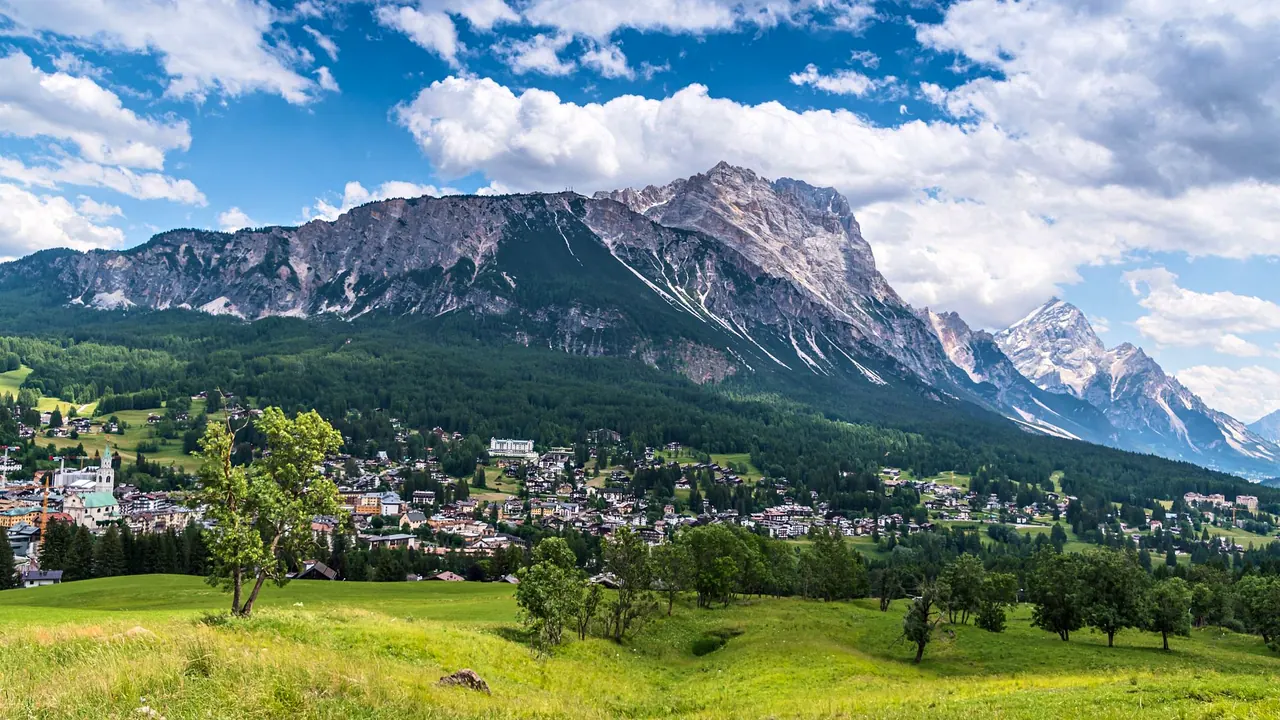
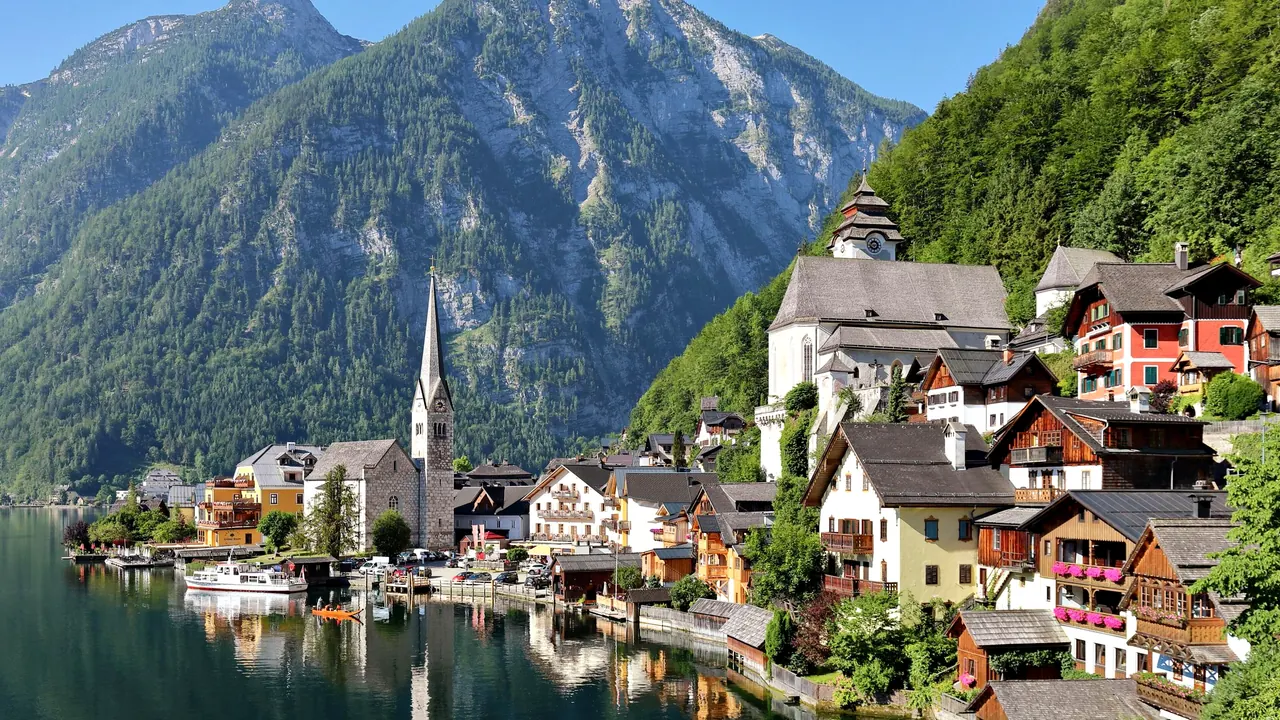
Photos: Cortina d'Ampezzo by Andreas Neubauer, Pexels License; Hallstatt by C.Stadler/Bwag, CC BY-SA 4.0, cropped.
Cortina d'Ampezzo or Hallstatt?
Our verdict in twelve categories, each scored against the same fixed benchmark cities, and the climate month by month, so you can choose for your trip.
Choose Cortina d'Ampezzo for
- shopping
- food and drink
- nightlife
Cortina d'Ampezzo is for travellers who want the mountains to be the whole point of the trip. Lifts climb from town into the Dolomites, the Dolomiti Superski network covers the winter and hut-to-hut routes fill the summer. It also suits people who like their comfort alongside the mountains: better food, après-ski, smart shopping on the Corso Italia, and the budget to pay for all of it.
Choose Hallstatt for
- beaches
- day trips
- culture and sights
Hallstatt rewards a slower, more curious visitor. The village packs in a remarkable depth of history, from the salt mine to the Beinhaus, and the Salzkammergut lake towns and Salzburg make easy outings, partly by train and boat. Stay overnight to see it quiet, and be ready for wetter weather and evenings with very little to do.
Scoreboard
Twelve categories on one fixed scale from 0 to 100. The shaded stretch is the gap between the two.
Your match
Pick a travel style or drag the sliders, and both match scores follow your weighting.
Too close to call, 1 point apart
Wins on shopping and food and drink with your weighting.
Wins on beaches and day trips with your weighting.
What matters to you?
Category by category
What the scores mean for a trip.
Beaches & swimming
Neither is a swimming destination, but Hallstatt at least has a lake you can actually swim in during high summer. There is a bathing lawn at the north end of the village and a lido at Obertraun, with water near 20°C in July and August. Cortina's snowmelt lakes, Ghedina and Pianozes, are for walking round, the Adriatic is more than two hours away, and for most people a swim there means a hotel pool.
Food & drink
Cortina eats noticeably better. Its wealthy visitors keep a few ambitious kitchens and wood-panelled stube dining rooms going. The Ampezzan dishes, beetroot casunziei with poppy seeds and polenta with game, are worth seeking out, and so is lunch on a rifugio terrace.
Hallstatt offers a short list of guesthouse classics, schnitzel, goulash and dumplings, saved by char and whitefish from the lake. Kitchens close early once the day visitors leave, and for more choice you go to Bad Ischl's patisseries. Neither place is varied or cheap, but Cortina gives you more reason to linger at the table.
Culture & sights
Hallstatt has far more history for its size. Salt has been mined here for seven thousand years, and the Iron Age burial ground gave its name to a whole early European culture. You can see that story in the mine, reached by funicular, in the Museum Hallstatt and in the painted skulls of the Beinhaus, all inside a UNESCO landscape.
Cortina's sights in town are slighter: the basilica and its bell tower, painted houses, the 1956 Olympic ice stadium and the Rimoldi art collection. Its most moving heritage, the First World War tunnels and trenches on Lagazuoi and the Cinque Torri, lies up in the mountains and takes a full day to reach.
Nightlife
Cortina at least has evenings. There is après-ski when the lifts close and a passeggiata along the Corso Italia, and in the peak winter weeks a few smart bars and a club or two stay open late. Hallstatt has nothing like that. After the tour groups leave, a night out means dinner, a glass of wine on a terrace and a walk by the lake in the dark. Even so, summer in Cortina is almost as quiet.
Nature & outdoors
Both are among the finest mountain settings in the Alps, and Cortina has the edge in scale. A full ring of Dolomite peaks surrounds the valley, lifts start in town, and the Tre Cime and Lago di Misurina are close. The Alta Via 1, historic via ferratas and the Dolomiti Superski network give you months of hiking and skiing.
Hallstatt's landscape is smaller and wetter, with more water in it: a glacial lake beneath the Dachstein, the Five Fingers platform on the Krippenstein, the ice and mammoth caves, and the walk to the Gosausee. Its winter is more about freeride and ski touring than big lift-served pistes, and mist can hang over the lake for days.
Day trips
Hallstatt is much better placed for outings. Bad Ischl and the Habsburg Kaiservilla are half an hour away. The lake towns of St Wolfgang, St Gilgen and Gmunden are a little further on, and Salzburg makes a full day by car.
From Cortina, most excursions head into the mountains themselves. San Candido, Dobbiaco and Brunico in South Tyrol are pleasant, Bolzano and its Iceman are two hours off, and Venice means a long day on the coach. These towns are nice extras but rarely a reason to choose Cortina.
Good for families
Neither is built for children, and both work best for families who enjoy being outdoors. Cortina suits skiing families, with ski schools for all ages, beginner slopes at Socrepes and public skating, plus gentle hut walks and a rope park in summer, all from a calm, flat centre.
Hallstatt's appeal comes from a few big outings: the slides and underground lake in the salt mine, the ice caves and rowing on the lake. The steep, crowded lane is hard going with a pushchair, so many families stay in Obertraun and visit for a few hours.
Getting around
Hallstatt is the easier of the two without a car. There is a railway station across the lake with a boat over to the village, and regional buses run to Obertraun, Gosau and Bad Ischl, though services are thin outside summer. On foot the village is tiny but steep, with steps up to the church.
Cortina's flat centre takes minutes to cross, and in winter ski buses link the lifts, but the town has had no railway since 1964. You arrive by coach from Venice or after a long drive, buses up to the passes are limited, and most visitors end up hiring a car.
Shopping & style
Cortina has real shopping, even if it is all on one short street. The Corso Italia has luxury fashion, jewellers and upmarket mountain wear, along with the many-floored Cooperativa, founded in 1893, and shops selling wood carving and filigree. In Hallstatt you get souvenir shops along the lane, where salt from the mine, in bags, grinders and bath mixes, is the one thing worth taking home.
Affordability
Cortina is the dearer of the two by some way. It charges luxury-resort rates in the winter peak and in August, restaurant bills match, and lift passes and equipment hire come on top. Hallstatt is expensive for Austria, with few rooms, and the salt mine, funicular and cable car all add up, but the overall bill is lower.
The way round it is the same in both: sleep somewhere cheaper nearby and travel in, Obertraun, Bad Goisern or Bad Ischl for Hallstatt and a neighbouring valley for Cortina. In Cortina, rifugio meals and early summer or late September also ease the cost.
Live music & performing arts
Both are thin on evening culture, in different ways. Cortina's offer is its summer chamber and classical festivals, some held in mountain settings, plus talks and a few concerts around Christmas. Hallstatt has its brass band on feast days and the odd church concert, but Bad Ischl's summer operetta and Salzburg's season are within reach, and Cortina has nothing like them nearby.
Wellness & relaxation
Relaxation takes a different form in each. In Cortina it happens inside the hotels, in Alpine spas with hay baths, saunas and pools after a day on the slopes, and the valley is calmest in June, September and the quieter winter weeks. Hallstatt sits in an old brine-spa region, with Bad Ischl's thermal complex half an hour away, and the village is at its most peaceful early in the morning and in the evening, once the midday crowds have gone.
When should you go?
Pick your month. The climate figures are measured averages, not a forecast.
Cortina d'Ampezzo in July
Hallstatt in July
Daytime high, °C
Rainfall in the month, mm
Where the figures come from
Hallstatt's temperatures are measured 56 km from the centre, at Salzburg.
Hallstatt has no rain gauge within 25 km of the centre, so its rainfall comes from a gridded climate dataset read at the city rather than from a gauge further away.
Temperature and rainfall are climate normals, averaged over the years shown. Cortina d'Ampezzo: 1991-2020 normals, Dobbiaco (22.5 km from centre). Hallstatt: 1991-2020 normals, Salzburg (55.5 km from centre).
Cortina is a snow destination in winter. Daytime highs stay around freezing from December to February, and this is also its driest stretch, which makes for good skiing. Summer is mild for walking, with highs of about 22°C in July and August, but July is also the wettest month at about 130mm. June and September are cooler and drier than midsummer, and make good hiking months.
Hallstatt is a few degrees warmer all year and reaches about 25°C in midsummer, the only time the lake is pleasant for a swim. It is much wetter, with heavy rain in every month and the most in July, close to 178mm. Summer also brings the most sun, about 200 hours a month from May to August, with July and August the brightest. Winter there is grey and short of light, so late spring to early autumn is the time to go.
Which traveller are you?
For a food and nightlife trip, Cortina is the clear choice. Ampezzan dishes, long lunches at the rifugi and a few ambitious kitchens beat Hallstatt's short menu of schnitzel and lake fish. Après-ski and the Corso Italia passeggiata give the evenings a social life Hallstatt lacks.
On a culture and arts trip, Hallstatt has more to offer. Its salt mine, prehistoric museum and painted skulls in the Beinhaus tell a story seven thousand years long, and Salzburg and imperial Bad Ischl are close by. Cortina's town sights fill little more than a rainy afternoon.
On a tight budget, neither is easy, but Hallstatt costs less. Rooms in Obertraun or Bad Ischl are cheaper, and buses and the railway reach the lake. In Cortina, luxury prices, lift passes and the near-need for a car stretch any budget.
Before you go
| Measure | Cortina d'Ampezzo | Hallstatt |
|---|---|---|
| Official language | Italian | German, Austrian Sign Language |
| Currency | Euro (EUR) | Euro (EUR) |
| Sockets | CFL230 V, 50 Hz | CF230 V, 50 Hz |
| Driving side | Right | Right |
| Time zone | UTC+1, UTC+2 in summer | UTC+1, UTC+2 in summer |
| Emergency number | 112 | 112 |
| Elevation | 1,224 m | 511 m |
| Main airport | Venice Marco Polo Airport (VCE)116 km from centre103 non-stop destinations | Salzburg Airport (SZG)55 km from centre64 non-stop destinations |
| Public holidays this year | 13 days | 16 days |
By the numbers
| Measure | Cortina d'Ampezzo | Hallstatt |
|---|---|---|
| City population | 5,546 | 741 |
| People per km² | 22 | 12 |
| Museums within 10 km | 3 | 3 |
| UNESCO World Heritage sites within 50 km | 1 | 2 |
Where else could you go?
Every comparison below shares a destination with this one, so you can follow Cortina d'Ampezzo or Hallstatt somewhere new.
- Salzburgvs Hallstatt
- Innsbruckvs Cortina d'Ampezzo
- Venicevs Cortina d'Ampezzo
- Bledvs Hallstatt
- Grazvs Hallstatt
- Veronavs Cortina d'Ampezzo