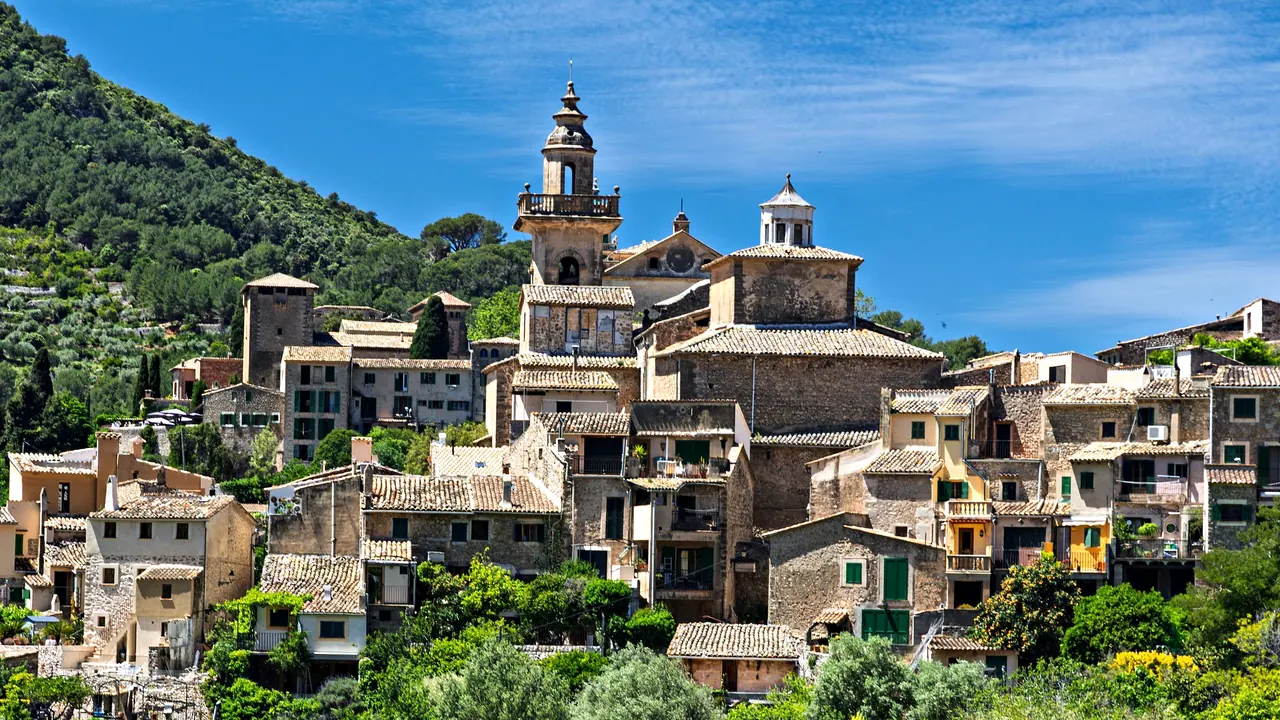
Photos: Mallorca by Guerrero De la Luz, Pexels License.
Formentera or Mallorca?
Our verdict in twelve categories, each scored against the same fixed benchmark cities, and the climate month by month, so you can choose for your trip.
Choose Formentera for
- beaches
Formentera is for travellers who want a beach vacation and very little else, and want that beach at its finest. The white sand of Ses Illetes and Migjorn and the clarity of the shallows beat almost anything on its larger neighbour. The island is flat and small enough to cycle, and evenings end early. It suits couples and friends who will pay for that simplicity and accept a ferry crossing, few sights and a small restaurant scene.
Choose Mallorca for
- culture and sights
- nightlife
- nature and the outdoors
Choose Mallorca when the trip has to do more than one thing. Palma adds a Gothic cathedral, museums, markets, bars and proper island cooking. The Tramuntana offers serious walking and road cycling, and the family resorts in the north bays make it much easier with children. Its beaches are excellent if a step behind Formentera's, and it is the cheaper of the two, above all in the package resorts and inland.
Scoreboard
Twelve categories on one fixed scale from 0 to 100. The shaded stretch is the gap between the two.
Your match
Pick a travel style or drag the sliders, and both match scores follow your weighting.
Wins on beaches with your weighting.
Wins on culture and sights and nightlife with your weighting.
What matters to you?
Category by category
What the scores mean for a trip.
Beaches & swimming
Both islands have the same clear, warm water and the same swimming season, but on Formentera the beaches are the whole point. Ses Illetes is a thin spit of white sand with turquoise shallows on both sides, wilder Llevant lies just across it, and Migjorn runs for kilometres of sand and dune. The island is small enough that you can pick each day's beach by the wind.
Mallorca has more coast and more variety. There are the southeastern calas such as Caló des Moro and Cala Mondragó, the undeveloped dunes of Es Trenc, the long shallow bays of Alcúdia and Pollença, and pebble coves under the Tramuntana. Its prettiest coves are small, though, and fill early in summer.
Food & drink
On Formentera, food means a long lunch over the water: grilled fish, rice dishes and lobster stew at the chiringuitos, with island specialities such as peix sec in ensalada payesa and flaó for dessert. Away from those beach tables the choice thins out quickly, and many kitchens close when the season ends.
Mallorca has a fuller kitchen built on pork, olive oil and vegetables, from sobrassada and tumbet to an ensaïmada at breakfast. It also has the market life and wine that Formentera lacks: tapas bars in Santa Catalina, the Mercat de l'Olivar, vaulted cellers in Inca and Sineu, and local wine from Binissalem.
Culture & sights
Formentera's heritage takes one day to see, fitted around the beaches: the fortified church in Sant Francesc, the lighthouses at Cap de Barbaria and La Mola, and the Bronze Age tomb of Ca na Costa.
Mallorca offers enough for a proper sightseeing trip. In Palma, La Seu stands over the sea wall beside the Almudaina palace, and there are also the round Bellver Castle, Es Baluard and the Miró foundation. Beyond the city are Chopin's charterhouse in Valldemossa, Alcúdia's walls, and talaiotic villages that are far larger than Formentera's single megalithic tomb.
Nightlife
A night out on Formentera means sunset drinks on the west coast and a few late bars on the Es Pujols seafront. Anyone wanting clubs has to take the ferry to Ibiza and plan the trip back.
Mallorca has every kind of night out. Palma has wine and cocktail bars in the old town and clubs on the Paseo Marítimo that run until dawn in summer, and Magaluf and Playa de Palma are large party resorts. The north coast and the mountain villages stay as quiet as Formentera after dinner, so the choice of base decides the evenings.
Nature & outdoors
Formentera's landscape is low and bright, with salt pans, dunes and juniper scrub. Its best outdoor moments are gentle ones: flamingos on the Estany Pudent, snorkelling over the seagrass, and sunset walks on the La Mola cliffs.
Mallorca has real mountains. The Tramuntana rises to about 1,400m, the GR221 links its villages, and the Torrent de Pareis gorge and the Formentor cliffs make serious day walks. Cycling shows the difference best: easy green routes on Formentera, and the climbing hairpins to Sa Calobra on Mallorca.
Day trips
Formentera has two outings. Ibiza is about half an hour away by fast ferry, for Dalt Vila and the villages of the north, and the uninhabited islet of Espalmador makes a half day.
Mallorca has a week's worth of outings without leaving the island. You can take the wooden train to Sóller, visit Deià and Fornalutx, spend market days in Sineu and Santanyí, and walk the walled town of Alcúdia. Boats run to the Cabrera archipelago, and a ferry from Alcúdia reaches Menorca for a long day in Ciutadella.
Good for families
Formentera works for families who want nothing but the beach. The sheltered water at Ses Illetes is calm and shallow, and older children love the flat cycle routes. Beyond that there is nothing made for children, there is little shade on the sand, and the ferry adds a step after the flight.
Mallorca is built for family vacations. The bays of Alcúdia and Pollença and the beach at Cala Millor shelve gently, and the resorts around them have pools, kids' clubs and flat promenades. For days off the beach there are water parks, an aquarium near Palma and the boat ride across the underground lake in the Caves of Drach.
Getting around
Getting to Formentera means a ferry from Ibiza into La Savina, but once you are there the island is only about 20km end to end. A bicycle or scooter covers it on quiet, flat roads, and one bus line links the villages.
Mallorca is easier to reach, with flights straight to Palma, and regional buses and a few rail lines connect the main towns and resorts. That covers a single-resort stay. To explore the coves and mountain villages, though, you will want a car, and in summer that means narrow, slow roads and car parks that fill early.
Shopping & style
Shopping on Formentera is a pleasant evening's browse: linen and sandals in the boutiques of Sant Francesc, handmade leather and silver at the El Pilar de La Mola market, and crafts on the Es Pujols seafront.
Mallorca offers real shopping. Palma has fashion on the Passeig des Born and independent shops and delicatessens in the old town. The island's own crafts are leather and shoes from Inca, pearls from Manacor and striped roba de llengües cloth, and the weekly markets in Sineu and Santanyí sell ceramics and baskets.
Affordability
Both islands cost more than mainland Spain in summer, but Formentera has no cheap way in. Rooms are scarce, beach lunches are priced for the resort, and the ferry and hire vehicle add to the bill.
Mallorca has the cheap options Formentera lacks. Package resorts in the north bays and on the east coast, set lunch menus and the village cellers keep costs down, though the boutique hotels near the coves are just as expensive. On both islands, May, June and late September ease the bill without giving up warm water.
Live music & performing arts
Live performance on Formentera comes down to musicians at the La Mola market, sunset sets at a few beach bars and the odd small festival. The island has no theatre or concert hall.
Mallorca has a modest but genuine programme, and Palma holds most of it, with opera and theatre at the Teatre Principal and the Balearic Symphony Orchestra through the winter. In summer, as well as concerts in the courtyard of Bellver Castle, the music spreads across the island: classical festivals in Valldemossa and in Pollença's cloister, and ball de bot at village fiestas.
Wellness & relaxation
The two islands are about equal for rest, but they offer it in different ways. On Formentera the calm comes with the island: it is low-rise, with no big resorts, and days end in early nights, with yoga and massage easy to find in summer but only small spas.
On Mallorca you have to choose your calm. There are good spas in upmarket hotels, the Font Santa thermal spring near Es Trenc, country estates among olive and almond groves, and retreats in spring and autumn. All of this sits well away from the resort strips, which are anything but restful in midsummer.
When should you go?
Pick your month. The climate figures are measured averages, not a forecast.
Formentera in July
Mallorca in July
Daytime high, °C
Rainfall in the month, mm
Temperature and rainfall are climate normals, averaged over the years shown. Formentera: 1991-2020 normals, Ibiza / Es Codola (17.7 km from centre). Mallorca: 1991-2020 normals, Palma De Mallorca (3.6 km from centre).
The two islands share almost the same weather. On both, the sea is warm enough to swim from June to October and peaks at about 26°C in August. July and August reach around 30°C, which is ideal on the sand but hard going for walks in the middle of the day. Summer is almost dry. The rain arrives in September and lasts through the autumn, and it falls more heavily on Mallorca, which gets about 74mm in October, than on Formentera.
April, May and late September into October are the months for walking and cycling on both islands. That matters more on Mallorca, where the mountains are the main outdoor draw. Winter highs of about 16°C are too cool for the beach. A winter trip suits Palma's streets and museums much better than Formentera, where the year revolves around the sea. Mallorca also gets a little more sunshine from May to August.
Which traveller are you?
On a beach and sun trip, Formentera is the purer choice. The whole island turns towards the sea, the sand is finer and the shallows clearer than along most of Mallorca's coast, and since nothing else competes, every day can belong to the water.
For a culture and arts trip, Mallorca is the clear pick. A historic capital, old hill towns and a summer of concerts can fill a week of sightseeing. Formentera's few monuments take an afternoon between swims, and it has no stage to speak of.
On a family trip with young children, Mallorca makes life easier. Whole resorts are designed around families, and there are plenty of days out away from the sand within a short drive. Formentera suits older children who are happy with the beach all day.
Before you go
| Measure | Formentera | Mallorca |
|---|---|---|
| Official language | Spanish | Spanish |
| Currency | Euro (EUR) | Euro (EUR) |
| Sockets | CF230 V, 50 Hz | CF230 V, 50 Hz |
| Driving side | Right | Right |
| Time zone | UTC+1, UTC+2 in summer | UTC+1, UTC+2 in summer |
| Emergency number | 112 | 112 |
| Main airport | Ibiza Airport (IBZ)89 non-stop destinations | Palma de Mallorca Airport (PMI)201 non-stop destinations |
| Public holidays this year | 13 days | 13 days |
By the numbers
| Measure | Formentera | Mallorca |
|---|---|---|
| Population | 11,661 | 949,047 |
| People per km² | 140 | 262 |
| Swim season, months above 21 °C | 5 months | 5 months |
Where else could you go?
Every comparison below shares a destination with this one, so you can follow Formentera or Mallorca somewhere new.
- Ibizavs Formentera
- Costa Blancavs Formentera
- Ibizavs Mallorca
- Menorcavs Mallorca
- Barcelonavs Mallorca
- Costa Bravavs Mallorca