
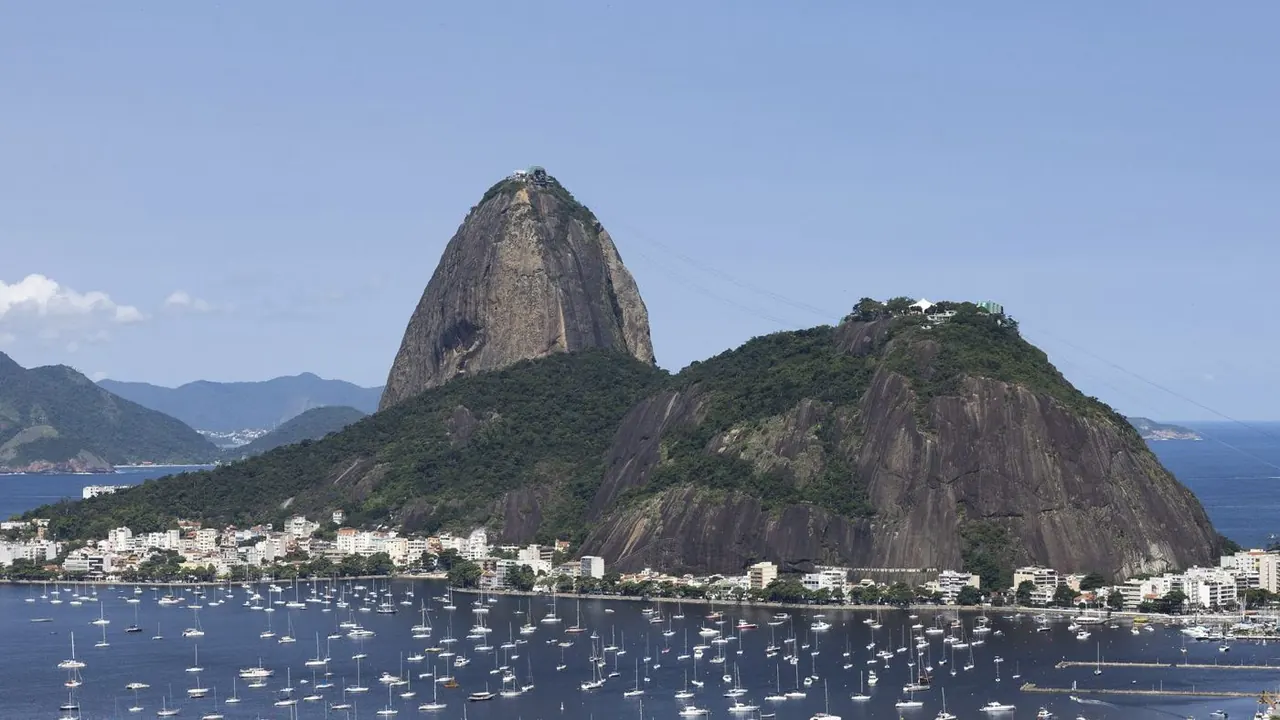
Photos: Foz do Iguacu by Gabriel Resende Veiga, CC BY-SA 4.0, cropped; Rio de Janeiro by Arne Müseler, CC BY-SA 3.0 DE, cropped.
Foz do Iguacu or Rio de Janeiro?
Our verdict in twelve categories, each scored against the same fixed benchmark cities, and the climate month by month, so you can choose for your trip.
Choose Foz do Iguacu for
- families
- prices
Foz do Iguaçu is built around one thing: the falls, seen from both Brazil and Argentina, with the rainforest, the boat rides into the spray and the bird park around them. It suits travellers, families especially, who want two or three days at one of the world's great natural sights and are happy with a quiet dinner afterwards. Beyond the falls, the town has little to keep you.
Choose Rio de Janeiro for
- beaches
- live music and the arts
- nightlife
Rio has a landscape just as dramatic, with forested granite peaks rising straight from the sea, and it is also a real city. You get proper beaches, samba in Lapa, nights out on the street until dawn and an old centre worth a day of walking. Go for a week rather than a long weekend, and go if you want your evenings to count as much as your days.
Scoreboard
Twelve categories on one fixed scale from 0 to 100. The shaded stretch is the gap between the two.
Your match
Pick a travel style or drag the sliders, and both match scores follow your weighting.
Wins on families and prices with your weighting.
Wins on beaches and live music and the arts with your weighting.
What matters to you?
Category by category
What the scores mean for a trip.
Beaches & swimming
This is the widest gap between the two. Foz lies deep in the interior. The nearest swimming is at lake beaches on the Itaipu reservoir, half an hour or more away by car, so most visitors swim in the hotel pool.
In Rio the sea is at the end of the street. Copacabana, Ipanema and Leblon are within walking distance of the hotels, and Prainha and Grumari further west have surf and cleaner, quieter sand. On the open beaches, swim near the lifeguard posts, and leave the beaches inside the bay for looking at.
Food & drink
Neither is a city to visit for food alone, but Rio offers more. Foz has the churrascarias and pay-by-weight buffets found across Brazil. What sets it apart is the esfihas and kibbeh of its Lebanese community, and an evening of grilled meat and Malbec across the bridge in Puerto Iguazú.
Rio adds the boteco, a neighbourhood bar with draught beer and plates of pastéis to share. It also has Saturday feijoada, juice bars on the corners, snacks and caipirinhas from beach vendors, and modern restaurants in Leblon, Ipanema and Botafogo.
Culture & sights
Foz has a few unusual and memorable sights rather than a full cultural programme. There is the tour inside the Itaipu dam, the white-domed mosque and the Buddhist temple looking towards Paraguay, and the obelisk where three countries meet. There is no old town.
Rio fills several full days. Christ the Redeemer and Sugarloaf come first. Then there is the gilded São Bento monastery, the Real Gabinete Português de Leitura reading room, the museums on Praça Mauá, and the walk through Santa Teresa down to the Selarón steps.
Nightlife
Foz goes to bed early. There is a short strip of bars and terraces in the centre, a few clubs at weekends and casinos across the borders, and most visitors have been out at the falls since early morning.
In Rio, going out starts late and happens largely on the street. Crowds gather under the Lapa arches, Botafogo's bars spread across the pavements, Leblon has smarter cocktail bars, and before Carnival the street parties called blocos take over whole neighbourhoods. Take taxis between districts after dark.
Nature & outdoors
Both are outstanding, but in very different ways. Foz is one overwhelming sight. Some 275 cascades fall through the rainforest, seen from the cliff-edge walkway on the Brazilian side and the trails to the Devil's Throat on the Argentine side, with boats into the spray and toucans and coatis close by.
In Rio, nature runs through the city itself. There is the Tijuca forest, short steep climbs up Dois Irmãos and Pedra da Gávea, hang-gliding down to the sand at São Conrado, and surf at Arpoador. Rio gives you more variety, and Foz gives you the bigger spectacle.
Day trips
From Foz, the day trips are border crossings: to Puerto Iguazú and the Argentine side of the falls, and to Ciudad del Este for shopping. The Jesuit missions are too far for a day out.
Rio has more choice. Petrópolis, where the emperors spent their summers, is up in the hills. A ferry crosses the bay to Niterói for the Niemeyer museum and the view back. Inland there are quiet old coffee towns. Paraty and Ilha Grande are better as overnight stays.
Good for families
Foz is the easier family trip, even with young children. The main walkway on the Brazilian side is short and gentle, with a lift at the end, and the roar of the water and the coatis on the path keep small children happy. The walk-through aviaries of the bird park are right by the park entrance, and older children can add the boat ride into the spray and the tour inside the Itaipu dam. The tiring parts are the car journeys between sights, the border queues and the summer mosquitoes.
Rio takes more effort with children, and the trip is built around the beach. Younger swimmers are better off in the calmer water at Leme, Praia Vermelha and Barra. The Sugarloaf cable car, the cog railway up Corcovado, AquaRio and the BioParque zoo fill the other days. Heavy traffic, uneven pavements and the need to watch your belongings make it hard going, and there is no theme park to fall back on. Summer heat is tiring for children in both cities.
Getting around
In both cities you ride more than you walk, and in Foz a little more so. Its small centre is walkable, but the falls are 20km out on a direct bus, Itaipu is across town, and the Argentine side usually means a taxi or transfer through two border posts.
Rio's metro runs straight through the districts visitors use, from the centre to Leblon, and the beachfront is flat and easy on foot. Santa Teresa, Tijuca and the western beaches still need a taxi, and traffic through the tunnels can be slow.
Shopping & style
In Foz, shopping means bargain hunting across the border, in the crowded discount galleries of Ciudad del Este and the duty-free shops. In town there is little beyond a mall and gemstone souvenirs.
Rio has things worth buying in their own right. The boutiques of Ipanema and Leblon sell Brazilian swimwear, linen and resort clothes. There is also the Sunday hippie fair in Ipanema and the cheap fabric and Carnival costume streets of Saara downtown.
Affordability
Day to day, the two cost about the same, with cheap buffet lunches and inexpensive ride-hailing in both. Where the money goes is different.
In Foz, rooms and meals are cheap, but park entry, boat rides, the bird park and the Itaipu tours soon add up. In Rio the beaches and forest trails are free, but hotels near the sand are expensive, and much more so around Carnival and New Year.
Live music & performing arts
Foz offers little beyond dinner shows of Latin American folk dance put on for tour groups.
Rio has samba most nights: in Lapa's old houses, at neighbourhood rodas de samba, where musicians play around a table, and at the samba schools' rehearsals before Carnival. There are also small bossa nova venues, and opera and ballet at the Theatro Municipal.
Wellness & relaxation
Neither city has a spa or bathing tradition, so in both, relaxing mostly means your hotel or the outdoors. In Foz that means a resort hotel on the falls road, with a pool and gardens for a rest day between sights.
In Rio it means the sea, yoga on the sand and an evening walk along the promenade or around the lagoon. For real quiet, go up into the cooler hills of Santa Teresa.
When should you go?
Pick your month. The climate figures are measured averages, not a forecast.
Foz do Iguacu in July
Rio de Janeiro in July
Daytime high, °C
Rainfall in the month, mm
Where the figures come from
Rio de Janeiro has no weather station within reach, so its figures come from a gridded climate model rather than a measured record, and read a broad area rather than the city itself.
Temperature and rainfall are climate normals, averaged over the years shown. Foz do Iguacu: 1992-2020 (sunshine 1991-2020, rainfall 1991-2020) normals, Foz Do Iguacu Aeroporto (2.6 km from centre). Rio de Janeiro: 2001-2020 normals, NASA POWER reanalysis grid, no weather station within 90 km.
Foz is hot for most of the year, with highs around 33°C in January, and no month is dry. October to January bring the heaviest rain, and those months also see the river at its fullest and the forest at its greenest. For walking the trails in comfort, May to August are best. Highs drop to around 23°C, July is the driest month, and there is less sunshine than in summer.
Rio stays much steadier, warm rather than scorching all year. November to March are the wet months, and June to August are the driest, with as little as 45mm of rain a month. The sea is about 25°C through summer and cools to around 21°C by August and September, so the warmer half of the year is better for swimming. The drier winter is better for hikes and sightseeing.
Which traveller are you?
On a beach and sun trip, Rio is the only real choice. Copacabana, Ipanema and Leblon lie right beside the hotels and the Atlantic is warm. Foz is far inland, with hotel pools and lake beaches on the reservoir.
On a family trip with young children, Foz is easier. The walkway at the falls is short and gentle, and the coatis and spray hold children's attention. The bird park's aviaries are by the park entrance, and big hotels with pools make a calm base.
For a food and nightlife trip, choose Rio. You get boteco tables, Saturday feijoada, late nights in Lapa and Botafogo and live samba. Foz has a short strip of bars, and most visitors end the day with a long dinner after the falls.
Before you go
| Measure | Foz do Iguacu | Rio de Janeiro |
|---|---|---|
| Official language | Portuguese | Portuguese |
| Currency | Brazilian Real (BRL) | Brazilian Real (BRL) |
| Sockets | CN60 Hz | CN60 Hz |
| Driving side | Right | Right |
| Time zone | UTC-3 | UTC-3 |
| Emergency number | Police 190, ambulance 192, fire 193 | Police 190, ambulance 192, fire 193 |
| Elevation | 164 m | 31 m |
| Main airport | Cataratas International Airport (IGU)12 km from centre10 non-stop destinations | Rio de Janeiro Galeão – Tom Jobim International Airport (GIG)12 km from centre54 non-stop destinations |
| Public holidays this year | 14 days | 14 days |
By the numbers
| Measure | Foz do Iguacu | Rio de Janeiro |
|---|---|---|
| City population | 285,415 | 6,211,223 |
| People per km² | 462 | 4,930 |
| Museums within 10 km | 1 | 69 |
| UNESCO World Heritage sites within 50 km | 1 | 3 |
| Swim season, months above 21 °C | - | 12 months |
Where else could you go?
Every comparison below shares a destination with this one, so you can follow Foz do Iguacu or Rio de Janeiro somewhere new.
- Puerto Iguazuvs Foz do Iguacu
- Buziosvs Rio de Janeiro
- Paratyvs Rio de Janeiro
- Sao Paulovs Rio de Janeiro
- Florianopolisvs Foz do Iguacu
- Florianopolisvs Rio de Janeiro