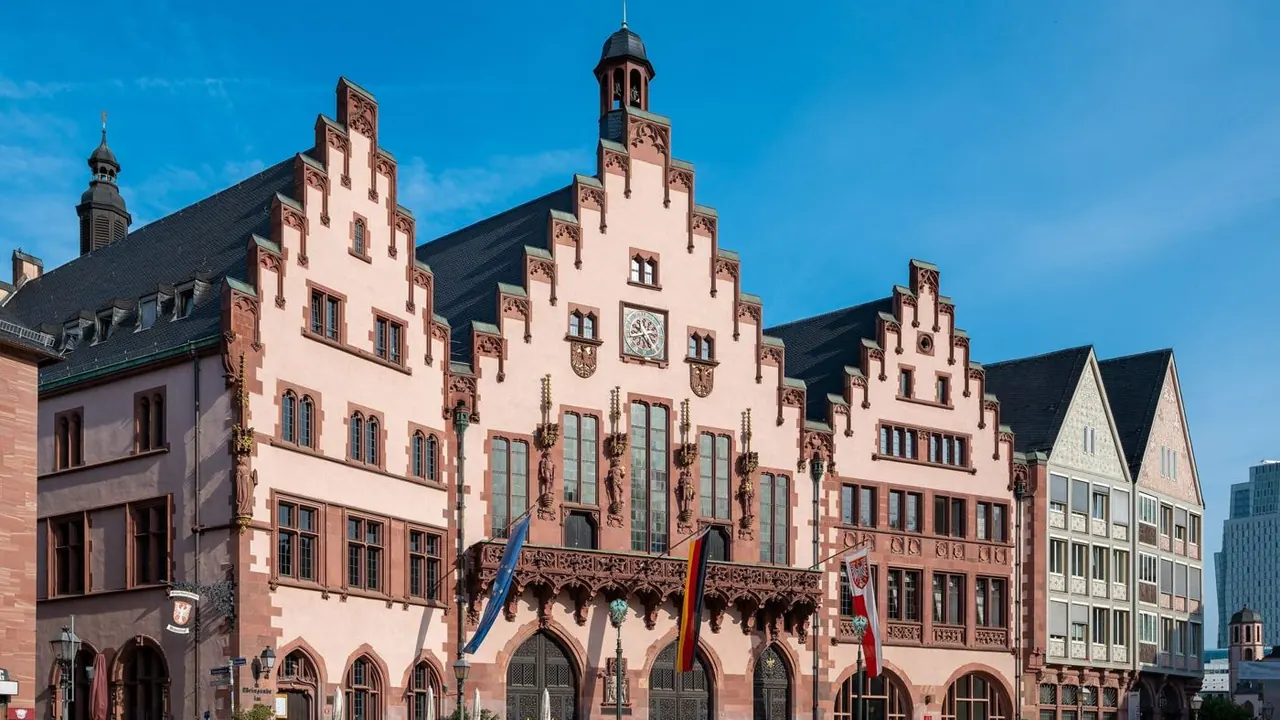
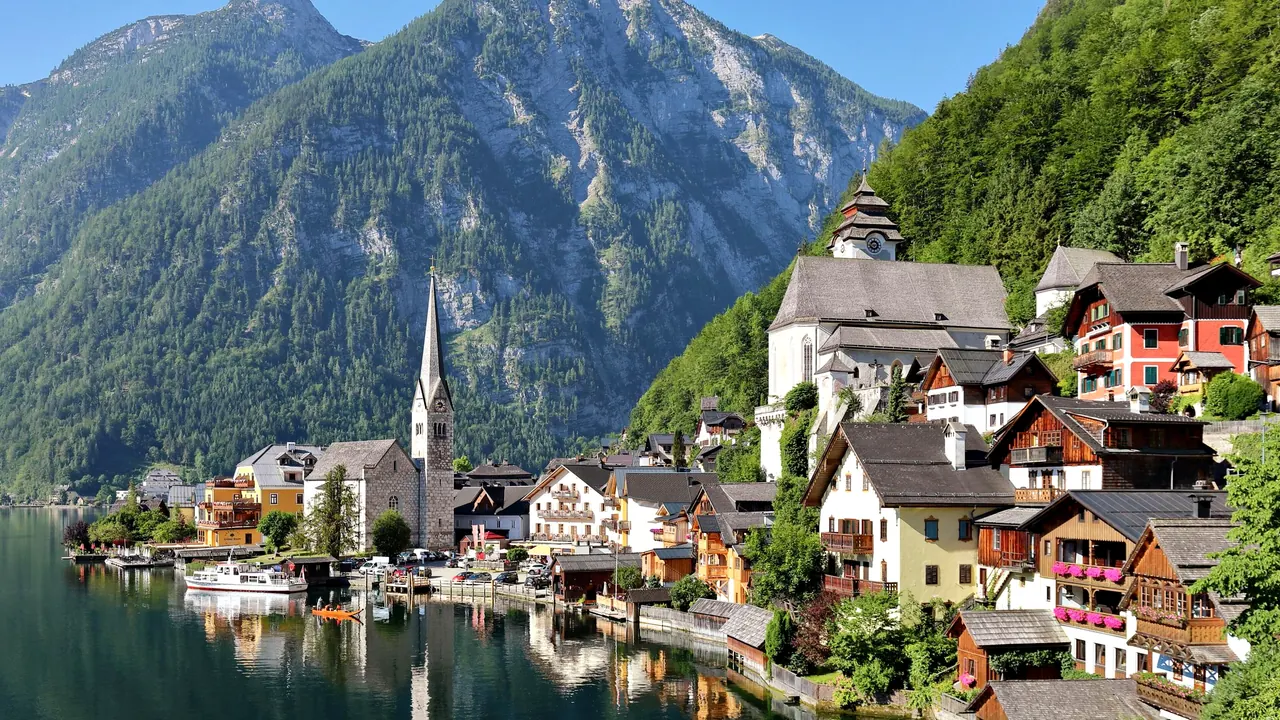
Photos: Frankfurt by Thomas Wolf, CC BY-SA 3.0 DE, cropped; Hallstatt by C.Stadler/Bwag, CC BY-SA 4.0, cropped.
Frankfurt or Hallstatt?
Our verdict in twelve categories, each scored against the same fixed benchmark cities, and the climate month by month, so you can choose for your trip.
Choose Frankfurt for
- live music and the arts
- nightlife
- shopping
Frankfurt suits travellers who want plenty to do from morning to late evening. The Städel and the other museums along the Museumsufer, a respected opera house, apple-wine taverns in Sachsenhausen and a weekend club scene give it the range of a real city. Its rail hub puts Heidelberg, the Rhine Gorge and Cologne within easy reach without a car. It is also the easier choice with children, and a little kinder to the budget.
Choose Hallstatt for
- nature and the outdoors
- beaches
Hallstatt is the choice for mountains and a lake. People come for the Dachstein massif, the ice caves, the walk to the Gosausee and the quiet of the village once the day visitors have gone, and nothing near Frankfurt is like them. The trade-offs are simple food, no nightlife and expensive rooms, so plan the stay around hiking, the water and slow mornings.
Scoreboard
Twelve categories on one fixed scale from 0 to 100. The shaded stretch is the gap between the two.
Your match
Pick a travel style or drag the sliders, and both match scores follow your weighting.
Wins on live music and the arts and nightlife with your weighting.
Wins on nature and the outdoors and beaches with your weighting.
What matters to you?
Category by category
What the scores mean for a trip.
Beaches & swimming
Neither is a beach destination, but Hallstatt at least has its lake right by the houses. The bathing lawn at the northern end of the village and the lido at Obertraun give you a clear, cold swim, around 20°C at best in high summer. It is a good way to end a hike.
Frankfurt has nowhere to swim in the centre, and the Main banks are for sitting. Summer swimming means an outdoor pool or a trip out to gravel-pit lakes such as the Langener Waldsee. Its sandy shores and warmer water are pleasant, but you have to make a special trip to get there.
Food & drink
Frankfurt gives you far more to eat. There are the cider taverns of Sachsenhausen, with Grüne Soße and Handkäs at shared tables, the Kleinmarkthalle's sausages and cheese, and the Turkish, Italian and Asian kitchens of an international city. Together they make several days of varied meals.
Hallstatt has a few guesthouse dining rooms serving schnitzel, goulash and dumplings, and the one dish worth seeking out is char or whitefish from the lake. Kitchens close early, so for patisserie and more choice you go to Bad Ischl.
Culture & sights
One is a city of museums, the other a village that is the sight in itself. Frankfurt's Museumsufer lines both banks of the Main with more than a dozen institutions, led by the Städel's old masters and modern painting, the Schirn's major exhibitions and the Senckenberg. A short walk away are the rebuilt Römer, the Paulskirche and Goethe's birthplace, with enough between them for two or three days.
In Hallstatt you look at painted houses on a ledge between cliff and lake, with seven thousand years of salt mining in the mountain above. The salt mine, the small museum telling the story of the Iron Age burial ground that named the Hallstatt culture, and the painted skulls of the Beinhaus make a remarkable day, but not a longer stay.
Nightlife
This is one of the widest gaps between the two. Frankfurt has cocktail bars in the Bahnhofsviertel, rowdy taverns in Alt-Sachsenhausen and relaxed bars along Berger Straße. It also has a techno and house tradition shared with Offenbach that comes alive on Friday and Saturday.
In Hallstatt, the evening is dinner, a glass of wine on a terrace and a walk by the lake. Most people who stay overnight come for exactly that silence.
Nature & outdoors
Frankfurt's countryside is green and gentle. There is the Stadtwald on the city's edge, flat cycle paths along the Main, beech forest and Roman frontier trails in the Taunus, and vineyard walks in the Rheingau, all easy to reach by S-Bahn and bus. It is good walking and cycling country, though never dramatic.
Hallstatt has real mountains at the door, and for anyone who wants to climb it is far the stronger choice. The Dachstein massif rises straight from the lake, with the Five Fingers platform over a sheer drop, the Giant Ice Cave and the waterfalls of the Echerntal. Summer brings via ferratas and rowing on the still water, and winter brings ski touring on the Krippenstein, though mist and rain can close in for days.
Day trips
Frankfurt is by far the better base, thanks to its high-speed rail network. Heidelberg, the castles of the Rhine Gorge and Cologne Cathedral are each about an hour by train, and Mainz, Wiesbaden and Würzburg's Residenz are close behind.
Hallstatt's outings are lovely but slower to reach. Bad Ischl's Kaiservilla, St Wolfgang and the Wolfgangsee towns are close, and Salzburg makes a long day. Without a car, though, the buses and the lakeside railway take careful planning.
Good for families
Frankfurt works better for a family stay. The Senckenberg dinosaurs, a central zoo, the Palmengarten and boat trips past the skyline are all an easy tram ride away, even with a pushchair.
Hallstatt has a few memorable outings: above all the salt mine, with its miners' slides and underground lake, and the ice caves for older children. But the single steep lane is crowded at midday and awkward with a pushchair, so families often stay in Obertraun instead.
Getting around
Frankfurt is much easier to get around. In the compact centre, the Römer, the cathedral, the Zeil and the Museumsufer are a few minutes apart on foot, and bridges lead across to Sachsenhausen. U-Bahn, S-Bahn, trams and buses share one ticket network that reaches the Taunus, Wiesbaden and Mainz, and the airport is about a quarter of an hour away by train. The zones take some learning, but you will never need a car.
Hallstatt is only a few minutes' walk from end to end, though the lane is steep and narrow in places, with steps up to the church. Arriving is the harder part. The railway station is on the far shore, and a small boat carries you across to the village. Buses to Obertraun, Gosau and Bad Ischl are limited, especially outside summer, so many visitors find a car worth having.
Shopping & style
Frankfurt is a proper shopping city, with the Zeil's department stores and malls, luxury houses around Goethestraße and independent shops on Berger Straße and Schweizer Straße. Hallstatt has a single lane of souvenir shops, where salt from the local mine is the one thing worth taking home.
Affordability
Neither place is cheap, but Frankfurt gives you more ways to save. Hotels are expensive during trade fairs but often cheaper at weekends and in summer. Tavern meals, Turkish grills and the Museumsufer pass keep daily costs down.
Hallstatt has few rooms and visitors from all over the world, so rooms and meals are priced at Alpine resort level, and the tickets for the mine and the cable car add up. The usual way round it is to sleep in Obertraun, Bad Goisern or Bad Ischl.
Live music & performing arts
Frankfurt has a full opera season, concerts at the Alte Oper, German-language drama at the Schauspiel, contemporary dance and cellar jazz clubs, although things quieten down in summer.
Hallstatt has its brass band on feast days and the odd church concert. For a proper night of music, you would go to Salzburg or catch the summer operetta in Bad Ischl.
Wellness & relaxation
For proper spa bathing, both places rely on nearby spa towns rather than baths of their own. Frankfurt has slightly the stronger choice, all reachable by train: Wiesbaden's Art Nouveau Kaiser-Friedrich-Therme, the thermal complex in Bad Homburg and old spa towns such as Bad Nauheim.
Hallstatt's calm comes mostly from its setting: mist on the lake at dawn and an empty village at dusk, with the brine baths of Bad Ischl half an hour away. At midday the lane is crowded, so a slow stay means spending those hours on the water or in the hills.
When should you go?
Pick your month. The climate figures are measured averages, not a forecast.
Frankfurt in July
Hallstatt in July
Daytime high, °C
Rainfall in the month, mm
Where the figures come from
Hallstatt's temperatures are measured 56 km from the centre, at Salzburg.
Hallstatt has no rain gauge within 25 km of the centre, so its rainfall comes from a gridded climate dataset read at the city rather than from a gauge further away.
Temperature and rainfall are climate normals, averaged over the years shown. Frankfurt: 1991-2020 normals, Frankfurt Westend (2 km from centre). Hallstatt: 1991-2020 normals, Salzburg (55.5 km from centre).
Through the year the two places have similar temperatures. Summer highs reach about 25°C to 26°C in both, and winter days are only a few degrees above freezing. The big difference is rain. Hallstatt sits against the Alps and gets two to three times as much, wettest from May to August, with about 178mm in July against Frankfurt's 68mm. Frankfurt also gets more summer sunshine, while Hallstatt sees a little more sun in the winter months.
In Frankfurt, late April to September is the comfortable time for walking the streets and sitting by the Main, and the lakes outside the city are only warm enough for swimming in July and August. In Hallstatt, June to September is the season for hiking and a cold lake swim. September is noticeably drier than high summer, which makes it a good choice. Winter is for snow on the Krippenstein rather than sightseeing.
Which traveller are you?
For an outdoors trip, Hallstatt is the clear pick. The Dachstein cable car, the high karst plateau, hut-to-hut routes and the walk to the Gosausee are serious Alpine country. Frankfurt has gentle Taunus forest and flat cycle paths along the river.
On a culture and arts trip, Frankfurt wins comfortably. The Städel and a dozen more museums on the Museumsufer, a respected opera company and concerts at the Alte Oper fill several days. Hallstatt's salt mine, Beinhaus and village make one rich day.
For a food and nightlife trip, Frankfurt is the only real option. Apple-wine taverns, the Kleinmarkthalle, late bars in the Bahnhofsviertel and weekend techno clubs keep you busy. Hallstatt offers lake fish, an early night and a walk along the dark shore.
Before you go
| Measure | Frankfurt | Hallstatt |
|---|---|---|
| Official language | German | German, Austrian Sign Language |
| Currency | Euro (EUR) | Euro (EUR) |
| Sockets | CF230 V, 50 Hz | CF230 V, 50 Hz |
| Driving side | Right | Right |
| Time zone | UTC+1, UTC+2 in summer | UTC+1, UTC+2 in summer |
| Emergency number | 112 | 112 |
| Elevation | 101 m | 511 m |
| Main airport | Frankfurt Main Airport (FRA)13 km from centre281 non-stop destinations | Salzburg Airport (SZG)55 km from centre64 non-stop destinations |
| Public holidays this year | 10 days | 16 days |
By the numbers
| Measure | Frankfurt | Hallstatt |
|---|---|---|
| City population | 760,656 | 741 |
| People per km² | 3,063 | 12 |
| Museums within 10 km | 53 | 3 |
| UNESCO World Heritage sites within 50 km | 4 | 2 |
Where else could you go?
Every comparison below shares a destination with this one, so you can follow Frankfurt or Hallstatt somewhere new.
- Salzburgvs Hallstatt
- Heidelbergvs Frankfurt
- Bledvs Hallstatt
- Grazvs Hallstatt
- Stuttgartvs Frankfurt
- Colognevs Frankfurt