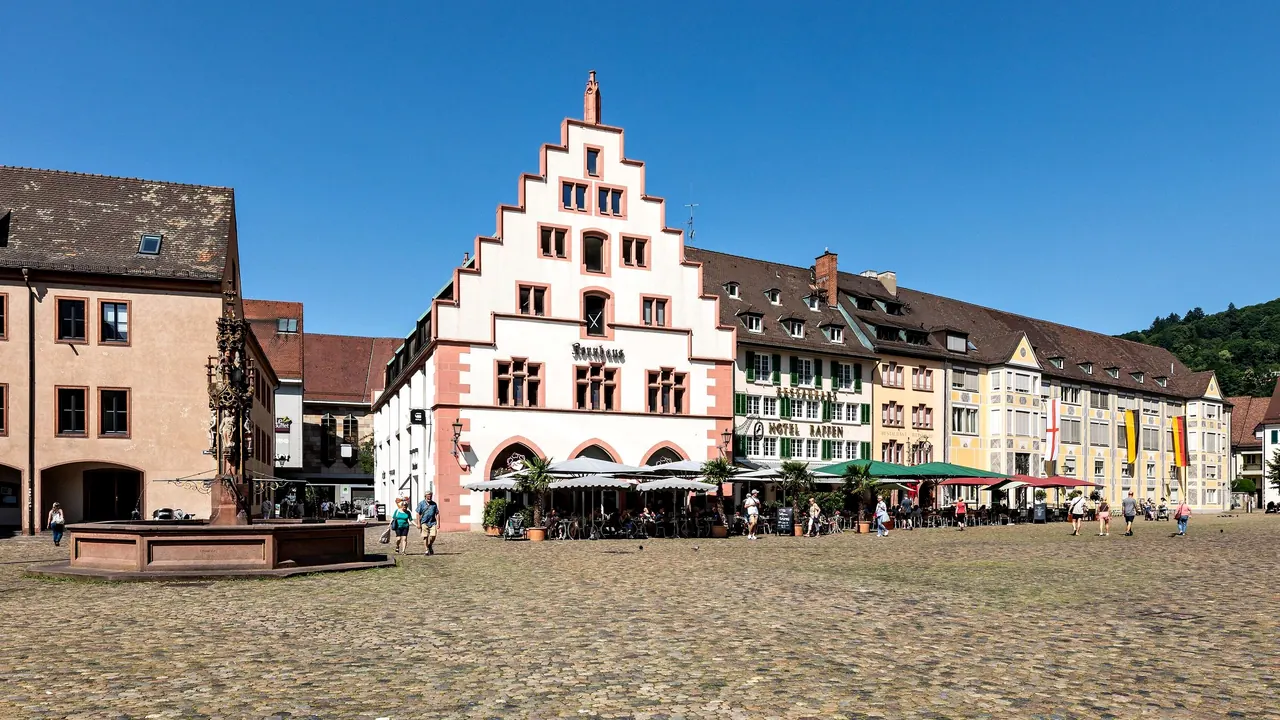
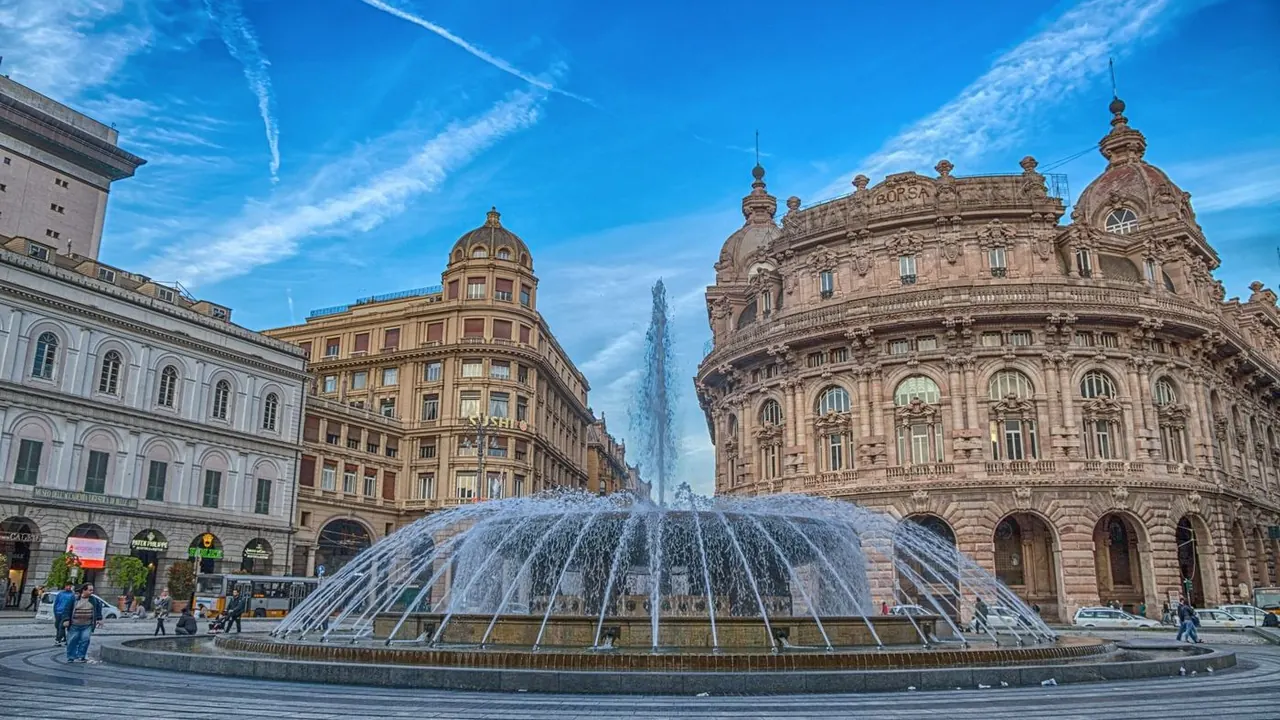
Photos: Freiburg by Dietmar Rabich, CC BY-SA 4.0, cropped; Genoa by Faber1893, CC BY-SA 4.0, cropped.
Freiburg or Genoa?
Our verdict in twelve categories, each scored against the same fixed benchmark cities, and the climate month by month, so you can choose for your trip.
Choose Freiburg for
- wellness
- getting around
- families
Freiburg is the better pick for a calm, green trip that is easy to run. The Black Forest begins at the edge of town, thermal baths and wine villages are a short ride away, and the small, flat, largely car-free centre makes it simple with children or on a bike. It suits walkers, cyclists, families and anyone who wants to slow down, with France and Switzerland close enough for a day each.
Choose Genoa for
- beaches
- culture and sights
- food and drink
Travellers who want the sea, a deep old town and food worth the journey should go to Genoa. Its maze of medieval lanes and palace museums gives you far more to explore, the cooking is pesto, focaccia and seafood eaten where it was invented, and the Riviera is close enough for a swim most afternoons. Expect steep streets, stairs and a busy port instead of quiet, but your money goes further.
Scoreboard
Twelve categories on one fixed scale from 0 to 100. The shaded stretch is the gap between the two.
Your match
Pick a travel style or drag the sliders, and both match scores follow your weighting.
Wins on wellness and getting around with your weighting.
Wins on beaches and culture and sights with your weighting.
What matters to you?
Category by category
What the scores mean for a trip.
Beaches & swimming
With no coast, Freiburg can offer only a cooling swim: warm gravel-pit lakes with grassy banks on the Rhine plain, and the colder, scenic waters of Titisee and Schluchsee an hour away. The outdoor pools take the summer crowds.
Genoa has a real sea within the city limits, from the pebble cove at Boccadasse to the bathing establishments on Corso Italia and the rocks below Nervi. The train brings you to Camogli, Sestri Levante and the sandier bays at Varazze. Expect pebbles, rented loungers and busy weekends, but a warm swim on most summer afternoons.
Food & drink
Freiburg's cooking is Baden with a French touch: Flammkuchen, Schäufele, Black Forest ham and mountain trout, with Pinot from the Kaiserstuhl. The daily market at the Münster and its grilled sausage rolls are the best of it, but the choice narrows quickly once you leave the taverns. The surrounding region does have stronger fine dining than Genoa.
Genoa is where you eat better day to day. Pesto with trofie, focaccia at breakfast, farinata and fried fish by the slice from old-town friggitorie, and seafood in the harbour trattorias give it a food identity that is all its own. The Mercato Orientale shows off the Ligurian produce.
Culture & sights
Genoa has much more to see. Its caruggi make up one of Europe's largest medieval quarters, and the Rolli palaces along the Strade Nuove hold Van Dyck, Rubens and Paganini's violin under painted ceilings. Add San Lorenzo cathedral, the Lanterna and Staglieno's marble cemetery, and a long stay never runs short.
Freiburg is smaller in scale. The red sandstone Münster and its climbable tower, the Historisches Kaufhaus and the medieval gates are handsome, but much of the centre was rebuilt after the war, and a day or two covers it.
Nightlife
Evenings are much the same size in both cities, but the mood is different. In Freiburg the nights belong to students: pubs and wine bars around the Martinstor, beer gardens, summer crowds along the Dreisam, and a few clubs for techno and indie, all noticeably quieter between terms.
Genoa leans towards aperitivo and a late glass in a medieval square around Piazza delle Erbe, with waterfront bars at the Porto Antico. In summer the evenings move to the beach clubs on Corso Italia. Weeknights are subdued in both cities.
Nature & outdoors
Both put serious outdoors right on the doorstep, but the landscapes could hardly differ more. Freiburg means forest and mountains: the Schauinsland cable car to about 1,280m, Feldberg hiking and winter skiing, the Ravenna gorge, gentle cycling in the Kaiserstuhl vineyards and excellent mountain biking.
Genoa's outdoors run along the coast. Ridge trails link the old fortresses above the port, cliff paths cross the Portofino promontory to San Fruttuoso, the Cinque Terre trails are a train ride away, and boats head out for whales and dolphins. Only Freiburg has snow, and only Genoa has the sea.
Day trips
Both are excellent bases, and the choice comes down to range against coastline. From Freiburg you can reach three countries: Basel in under an hour, Colmar and the Alsace wine villages by car, Strasbourg, and Baden-Baden by fast train, with Staufen and Breisach close to home.
Genoa's best trips line up along one railway: Camogli, Portofino and Sestri Levante, then the Cinque Terre, with quieter Finale Ligure and Noli to the west. Milan and Turin are close enough for a museum day, and you will not need a car for any of it.
Good for families
Freiburg is the easier city with children. It is small, flat and safe, children love the Bächle channels, and the free Mundenhof animal park and the Schauinsland cable car fill easy days. Europa-Park at Rust, Germany's largest theme park, is about 40 minutes away. Its weak point is rainy days.
Genoa's family offer is concentrated at the Porto Antico, where the aquarium, the science centre and the Galata museum's submarine can fill a full day under cover. Outside the harbour, steep, dark lanes, endless stairs and little green space make life with a pushchair hard.
Getting around
Freiburg is far simpler to get around. The car-free old town takes about twenty minutes to cross on foot, trams reach the suburbs and the cable car, cycle lanes run everywhere, and regional trains climb the Höllental or follow the Rhine to Basel.
Genoa is walkable, but only in a vertical sense: the lanes are a maze and the city climbs steeply from the water. Funiculars, a rack railway and public lifts help, as does the single metro line, but buses crawl. The coastal railway is the link that matters most.
Shopping & style
Neither is a shopping destination, but Genoa has more character. The arcades of Via XX Settembre and the Galleria Mazzini carry the Italian labels, and the old town has long-established shops for candied fruit, olive oil and pesto, plus workshops making silver filigree and coral.
In Freiburg, Kaiser-Joseph-Strasse is mostly chains. The Gerberau quarter's independent boutiques, the market's schnapps and ham, and cuckoo clocks make better souvenirs, and serious shoppers head to Basel.
Affordability
Genoa is the cheaper stay. Central hotels cost less than in Italy's best-known cities, focaccia and farinata make for very cheap meals, and the funiculars and lifts cost little. Costs rise only in the Riviera resorts and with lounger hire on beach days.
Freiburg's problem is beds: rooms are scarce and expensive for a city its size, so some visitors stay in Black Forest villages instead. After that it is kinder, with cheap market snacks, free entry to the Münster and reasonable taverns, though trips into Switzerland cost noticeably more.
Live music & performing arts
Genoa has a little more on stage, built around the Teatro Carlo Felice's season of opera, ballet and symphonic concerts. Paganini concerts and small clubs that keep alive its singer-songwriter tradition add to it, though the Teatro Nazionale's drama is in Italian.
Freiburg's highlight is the Freiburger Barockorchester, a leading period-instrument ensemble, at the Konzerthaus. Theater Freiburg runs opera and dance in repertory, and in summer the Zelt-Musik-Festival brings tent concerts. In both cities it makes a good evening out rather than a reason to visit.
Wellness & relaxation
Freiburg sits in German spa country. There is a thermal bath on the city's eastern edge, Bad Krozingen's warm outdoor pools and saunas are twenty minutes south, Badenweiler pairs a modern bath with Roman ruins, and Baden-Baden is an hour away by train.
Genoa has no bathing tradition of its own. Spas are mostly in the better hotels, and the nearest thermal waters are at Acqui Terme, over an hour inland. For calm, go to Nervi's villa gardens or have a long lunch in a Riviera village.
When should you go?
Pick your month. The climate figures are measured averages, not a forecast.
Freiburg in July
Genoa in July
Daytime high, °C
Rainfall in the month, mm
Where the figures come from
Genoa has no rain gauge within 25 km of the centre, so its rainfall comes from a gridded climate dataset read at the city rather than from a gauge further away.
Genoa's sunshine is measured 80 km from the centre, at Capo Mele.
Temperature and rainfall are climate normals, averaged over the years shown. Freiburg: 1991-2020 normals, Freiburg (0.6 km from centre). Genoa: 1991-2020 normals, Genova / Sestri (6.7 km from centre).
Freiburg has a real winter, with daytime highs around 6°C in January, so the months for walking and hiking run from April to October. Summer is warm and the sunniest part of its year, though May to August also bring the most rain. The lakes are pleasant from late June to August, and in winter there is snow on the higher slopes.
Genoa is milder all year, still about 12°C in January, so winter is a reasonable time to explore the lanes. The sea is warm enough to swim from June to September and peaks around 25°C in August. July is dry and very sunny, with only 27mm of rain. Autumn is Genoa's weak point: heavy rain arrives in September and peaks in October at about 212mm, far wetter than Freiburg's autumn. For walking the city, spring and early summer are Genoa's safest bet.
Which traveller are you?
For a beach and sun trip, Genoa is the clear choice. It has the Mediterranean, clear water, swimming platforms at Nervi and a train line to the Riviera coves. Freiburg's swimming means gravel-pit lakes and cool Black Forest waters, which are fine for a dip but not a beach vacation.
On a culture and arts trip, Genoa gives far more. Its huge medieval quarter, the UNESCO palaces on Via Garibaldi, Staglieno cemetery and the opera house can fill several days. Freiburg's Münster, Bächle-lined streets and Augustinermuseum make a rewarding day or two.
For a relaxing and wellness trip, choose Freiburg. Thermal baths at Bad Krozingen and Badenweiler are close by, Baden-Baden is an hour away by train, and the city has an unhurried pace. Genoa's port, traffic and crowded lanes are stimulating, not restful.
Before you go
| Measure | Freiburg | Genoa |
|---|---|---|
| Official language | German | Italian |
| Currency | Euro (EUR) | Euro (EUR) |
| Sockets | CF230 V, 50 Hz | CFL230 V, 50 Hz |
| Driving side | Right | Right |
| Time zone | UTC+1, UTC+2 in summer | UTC+1, UTC+2 in summer |
| Emergency number | 112 | 112 |
| Elevation | 278 m | 20 m |
| Main airport | EuroAirport Basel–Mulhouse–Freiburg (BSL)50 km from centre112 non-stop destinations | Genoa Cristoforo Colombo Airport (GOA)7 km from centre25 non-stop destinations |
| Public holidays this year | 12 days | 13 days |
By the numbers
| Measure | Freiburg | Genoa |
|---|---|---|
| City population | 238,299 | 558,745 |
| People per km² | 1,558 | 2,325 |
| Museums within 10 km | 13 | 51 |
| UNESCO World Heritage sites within 50 km | 2 | 1 |
| Swim season, months above 21 °C | - | 4 months |
Where else could you go?
Every comparison below shares a destination with this one, so you can follow Freiburg or Genoa somewhere new.
- Portofinovs Genoa
- Colmarvs Freiburg
- Baselvs Freiburg
- Strasbourgvs Freiburg
- La Speziavs Genoa
- Zurichvs Freiburg