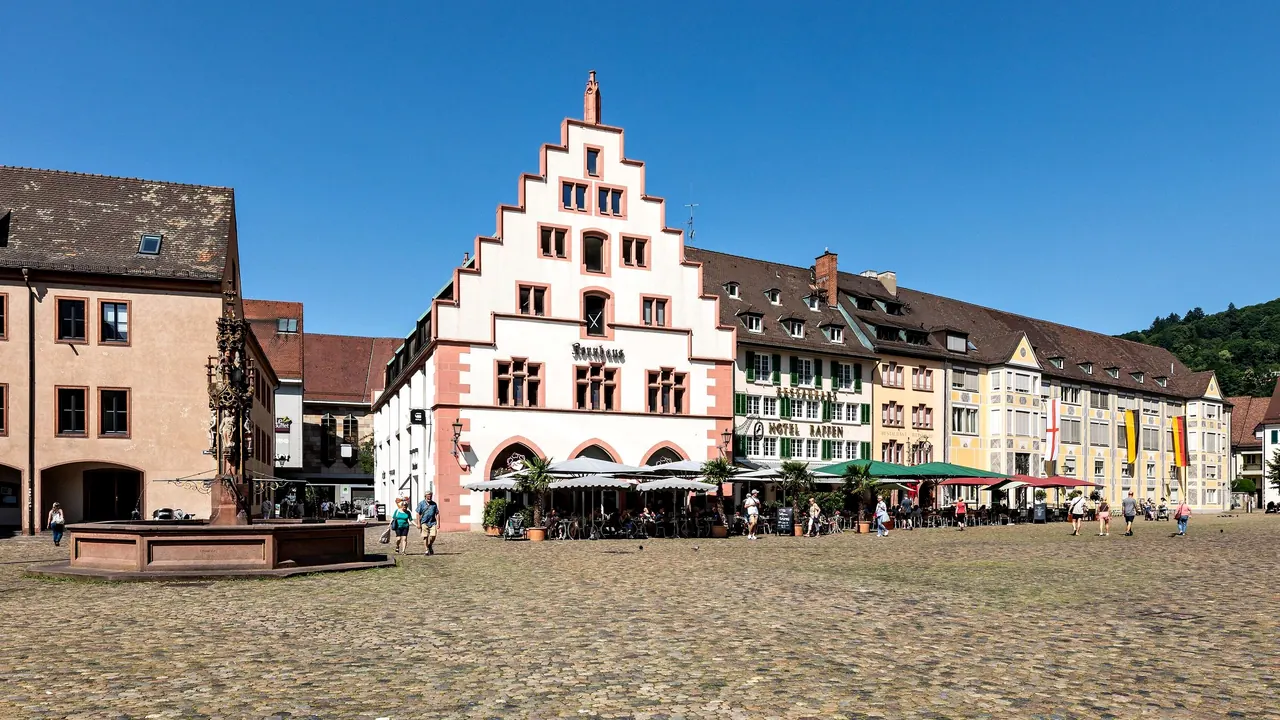
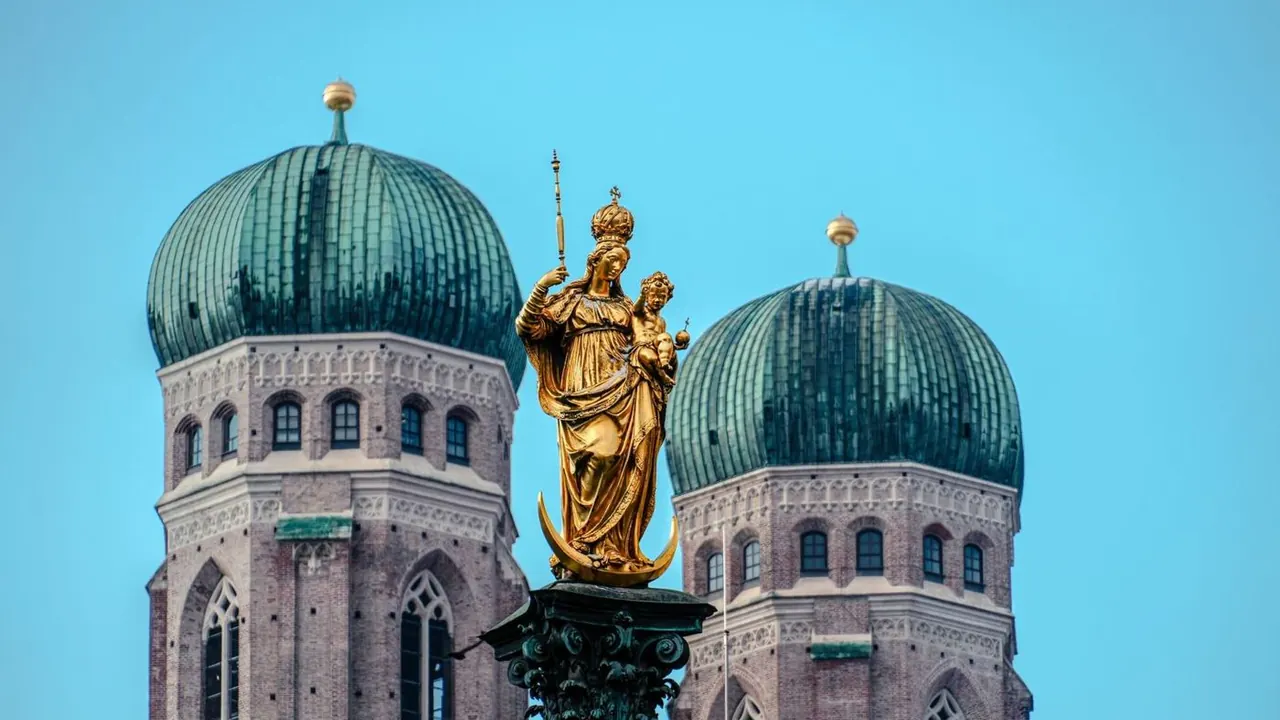
Photos: Freiburg by Dietmar Rabich, CC BY-SA 4.0, cropped; Munich by 0xd1ma, Pexels License.
Freiburg or Munich?
Our verdict in twelve categories, each scored against the same fixed benchmark cities, and the climate month by month, so you can choose for your trip.
Choose Freiburg for
- prices
- wellness
Freiburg suits travellers who want a small, easy city where the countryside starts at the end of the street. The Black Forest rises behind the old town, the Kaiserstuhl vineyards are a short ride west, and France and Switzerland are close enough for a morning in Basel or an afternoon in the Alsace wine villages. It is the better pick for walkers, cyclists and wine drinkers, and it is a little gentler on the wallet.
Choose Munich for
- live music and the arts
- shopping
- culture and sights
Munich is the stronger choice when the city itself is the point. Its royal art collections, palaces and the Deutsches Museum, a world-class opera house and three serious orchestras give it a depth of culture Freiburg cannot match. Add luxury and Tracht shopping, livelier nights and a longer list of excursions by train, from Salzburg to Neuschwanstein, and it rewards visitors who want plenty to do and are willing to pay for it.
Scoreboard
Twelve categories on one fixed scale from 0 to 100. The shaded stretch is the gap between the two.
Your match
Pick a travel style or drag the sliders, and both match scores follow your weighting.
Wins on prices and wellness with your weighting.
Wins on live music and the arts and shopping with your weighting.
What matters to you?
Category by category
What the scores mean for a trip.
Beaches & swimming
Neither city has a coast, but Munich makes a better job of summer swimming. The Starnberger See and the Ammersee are under an hour away by S-Bahn, with lawns, jetties and clear water, and closer in, locals sunbathe on the Isar's gravel banks at the Flaucher.
Freiburg's swims are more improvised: flooded gravel pits on the Rhine plain reached by bike, warmer but grassy rather than sandy, or the cooler Black Forest lakes of Titisee and Schluchsee about an hour off. In both cases a swim is a break in the trip rather than a reason to go.
Food & drink
The two eat about equally well, but they eat very differently. Freiburg is wine country with a French accent: Flammkuchen, mountain trout, spring asparagus and Black Forest ham, with Pinot Gris and Pinot Noir from the Kaiserstuhl, and a morning market around the Münster.
Munich is built around beer. Its brewery halls and chestnut-shaded beer gardens serve roast pork with crackling, white sausage and pretzels, and the Viktualienmarkt is the snacking stop. Munich also has a slightly wider spread of Italian, Turkish and Balkan cooking when the hearty Bavarian food starts to feel heavy.
Culture & sights
Here Munich is in another league. The Kunstareal alone, with the Alte Pinakothek's old masters, the Glyptothek and the Blue Rider painters in the Lenbachhaus, could fill several days, before the Residenz, Nymphenburg Palace and the vast Deutsches Museum on its Isar island.
Freiburg's sights fit comfortably into a day or two: the red sandstone Münster with its climbable lace tower, the oxblood Historisches Kaufhaus, the medieval gates and the Bächle running through the lanes, plus medieval art in the Augustinermuseum. Both old towns were largely rebuilt after wartime bombing.
Nightlife
Munich offers more choice after dark. Evenings often begin in a beer hall, then move to the cocktail and gay bars of the Glockenbachviertel and Gärtnerplatz, and a few serious techno and house clubs run until morning at weekends. The Oktoberfest, from late September, turns the whole city over to the tents for just over two weeks.
Freiburg's nights are shaped by its students: pubs and wine bars around the Martinstor, summer crowds on the squares and along the Dreisam, and a few clubs. It is friendly and relaxed, and noticeably quieter in the semester break.
Nature & outdoors
Both are superb bases for the outdoors, and the difference is one of distance and scale. In Freiburg the forest begins at the edge of town: you can walk up the Schlossberg from the old town, ride the cable car to the Schauinsland ridge, or cycle among the Kaiserstuhl's volcanic vineyard terraces.
Munich's mountains are higher but further off, with the Zugspitze, the Wetterstein and Tegernsee about an hour or more away by train for alpine hiking and skiing. In town it has the English Garden, with surfers on the Eisbach wave, and the Five Lakes country for sailing and gentle cycling.
Day trips
Munich's list of excursions is longer and runs almost entirely on trains: Augsburg in half an hour, Nuremberg and Regensburg, baroque Salzburg across the Austrian border, and the royal castles of Neuschwanstein and Herrenchiemsee. Innsbruck and the painted villages of Oberammergau add still more.
Freiburg's appeal is the three-country corner. Basel is a short train ride, Strasbourg and Colmar lie across the Rhine, and Breisach and Staufen are close by, but the half-timbered Alsace wine villages such as Riquewihr are much easier with a car.
Good for families
Both are safe, green and easy with children, and they differ in what fills the days. Freiburg's big card is Europa-Park, Germany's largest theme park, about 40 minutes away, along with toy boats in the Bächle, the free Mundenhof animal park and the cable car, though there is little to do indoors when it rains.
Munich is better on wet days, with the children's area of the Deutsches Museum, the transport museum and a Sea Life aquarium. The Hellabrunn zoo and beer gardens with playgrounds round it out, and Legoland is a longer drive than Europa-Park.
Getting around
Munich has the edge thanks to its integrated U-Bahn, S-Bahn, tram and bus network, which reaches Nymphenburg, the Olympic Park, the airport and the lakes without fuss, though delays on the central S-Bahn line are a familiar nuisance.
Freiburg works on a smaller scale. Nearly everything is within a twenty-minute walk of the car-free old town, trams and bikes cover the rest, and many regional hotels give guests a card for local buses and trains. Only the Alsace villages really call for a car.
Shopping & style
Munich is far ahead for shopping. Maximilianstrasse and the Theatinerstrasse arcades hold the luxury houses, Neuhauser Strasse carries the department stores, and its distinctive buy is tailored Tracht. Its long-established delicatessens and December Christmas markets add to that.
Freiburg is pleasant but modest: chains on Kaiser-Joseph-Strasse, independent boutiques and organic shops in the Gerberau, and local wine, schnapps and carvings at the Münster market. For anything more ambitious, people go to Basel.
Affordability
Freiburg is the cheaper of the two, though not cheap. Rooms are scarce for the demand, and some visitors stay in nearby Black Forest villages instead, but market snacks, student-quarter taverns and largely free sights keep daily spending modest.
Munich is Germany's most expensive city, with hotel prices that climb further during the Oktoberfest and trade fairs, and restaurant bills to match. A picnic in a beer garden, the free parks and lakes, and token Sunday museum entry are the ways to soften it.
Live music & performing arts
For live music and stage, Munich is one of Europe's great cities. The Bavarian State Opera in the National Theatre ranks among the world's leading companies, three orchestras of real standing play the Herkulessaal and the Prinzregententheater, and the rococo Cuvilliés Theatre stages chamber opera.
Freiburg offers a solid evening rather than a reason to travel: opera, drama and dance at Theater Freiburg, the internationally respected Freiburger Barockorchester at the Konzerthaus, and the summer Zelt-Musik-Festival in its tent village.
Wellness & relaxation
The two are evenly matched for slowing down, but they go about it differently. Freiburg is surrounded by spa towns: Bad Krozingen's warm outdoor pools twenty minutes south, Badenweiler beside its Roman bath ruins, and Baden-Baden's grand bathhouses an hour away.
Munich's highlight is in the city itself, the Art Nouveau Müller'sches Volksbad with its Roman-style steam bath, and the huge Erding thermal complex is about forty minutes out. Long afternoons on the English Garden lawns give it a calm that Freiburg finds along the Dreisam.
When should you go?
Pick your month. The climate figures are measured averages, not a forecast.
Freiburg in July
Munich in July
Daytime high, °C
Rainfall in the month, mm
Temperature and rainfall are climate normals, averaged over the years shown. Freiburg: 1991-2020 normals, Freiburg (0.6 km from centre). Munich: 1991-2020 normals, München (1.9 km from centre).
The two cities share a central European rhythm, with cold, grey winters and warm summers, but Freiburg runs a degree or two warmer through the year, reaching about 27°C in July against Munich's 25°C. Summer is lake season in both, roughly June to early September. Munich's summers are noticeably wetter, with around 121mm of rain in June against 89mm in Freiburg, so thundery afternoons are more likely to interrupt a day out there. Freiburg's wettest month comes earlier, in May.
For walking the streets and the hills, late April to early June and September into October are the sweet spots in both, mild and reasonably sunny. From November to February daytime highs sit only a few degrees above freezing, down to about 4°C in Munich in January, and sunshine is scarce. That suits the ski slopes and the thermal baths more than sightseeing.
Which traveller are you?
On a trip with a tight budget, Freiburg goes further. Hotels are not cheap, but market sausages, student-quarter taverns and a free cathedral keep daily costs down, while Munich is Germany's most expensive city and its room rates bite all year.
On a culture and arts trip, Munich is the clear choice. Freiburg's Münster and Augustinermuseum fill a rewarding day or two, while the Alte Pinakothek, the Residenz and Nymphenburg take several, and evenings belong to the Bavarian State Opera or three leading orchestras.
For a shopping trip, Munich again comes out well ahead. Freiburg has pleasant boutiques in the Gerberau and cuckoo clocks, but serious shoppers head to Basel, while Munich offers Maximilianstrasse's luxury houses, tailored dirndls and lederhosen, and independent design in Glockenbach.
Before you go
| Measure | Freiburg | Munich |
|---|---|---|
| Official language | German | German |
| Currency | Euro (EUR) | Euro (EUR) |
| Sockets | CF230 V, 50 Hz | CF230 V, 50 Hz |
| Driving side | Right | Right |
| Time zone | UTC+1, UTC+2 in summer | UTC+1, UTC+2 in summer |
| Emergency number | 112 | 112 |
| Elevation | 278 m | 519 m |
| Main airport | EuroAirport Basel–Mulhouse–Freiburg (BSL)50 km from centre112 non-stop destinations | Munich Airport (MUC)29 km from centre210 non-stop destinations |
| Public holidays this year | 12 days | 12 days |
By the numbers
| Measure | Freiburg | Munich |
|---|---|---|
| City population | 238,299 | 1,505,036 |
| People per km² | 1,558 | 4,844 |
| Museums within 10 km | 13 | 75 |
| UNESCO World Heritage sites within 50 km | 2 | 1 |
Where else could you go?
Every comparison below shares a destination with this one, so you can follow Freiburg or Munich somewhere new.
- Colmarvs Freiburg
- Baselvs Freiburg
- Strasbourgvs Freiburg
- Zurichvs Freiburg
- Baden-Badenvs Freiburg
- Innsbruckvs Munich