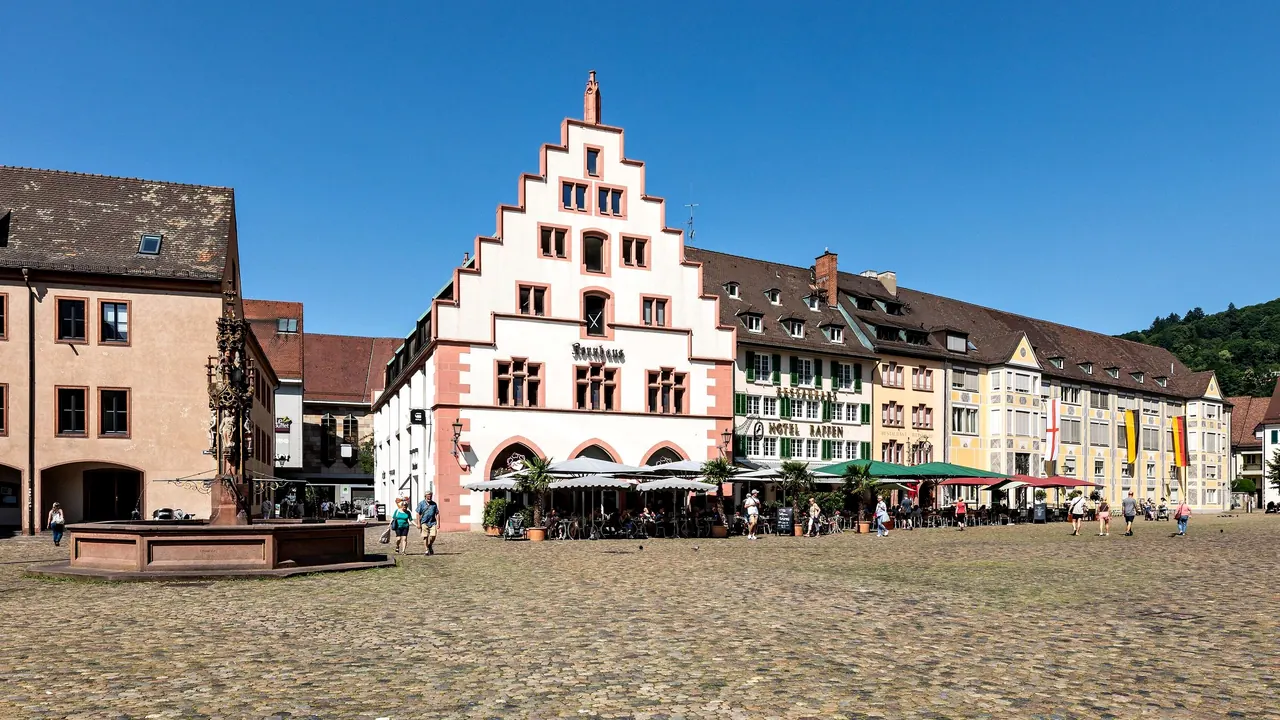
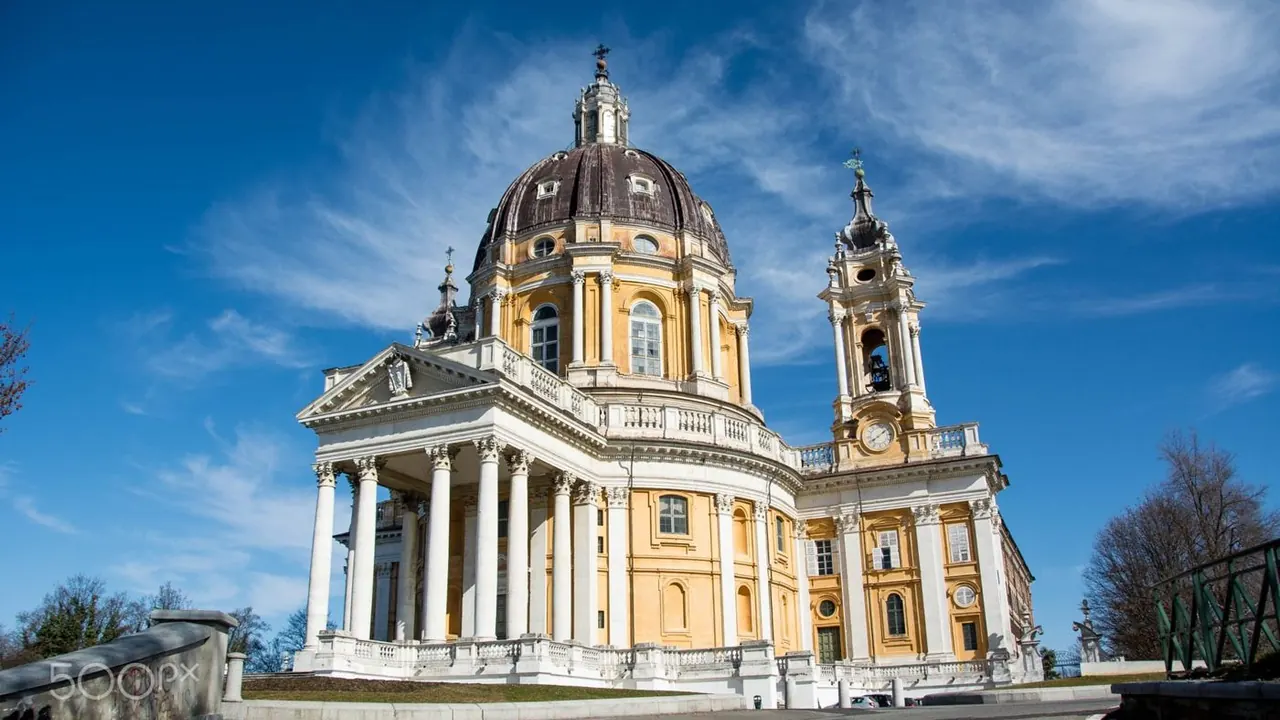
Photos: Freiburg by Dietmar Rabich, CC BY-SA 4.0, cropped; Turin by Konstantin Dacosta, CC BY 3.0, cropped.
Freiburg or Turin?
Our verdict in twelve categories, each scored against the same fixed benchmark cities, and the climate month by month, so you can choose for your trip.
Choose Freiburg for
- wellness
- families
- getting around
Freiburg suits a slower, greener trip, and it is especially good with children. The old town is small and largely car-free, easy to cross on foot or by bike, and the Black Forest begins at the edge of town. Thermal baths are a short ride away and Europa-Park is close by. Choose it if you want mountain air, cycling and wine villages more than big sights, and if an easy pace matters more than a long list of things to see.
Choose Turin for
- food and drink
- culture and sights
- shopping
Turin is the stronger pick for a trip built around eating, museums and evenings out. It is a former royal capital with the Museo Egizio, a ring of Savoy palaces and a proper opera house. Piedmontese cooking and Langhe wines are among the best in Italy, and the aperitivo gives each evening a shape. It is also cheaper to stay in, though public transport takes more effort and there is less for small children.
Scoreboard
Twelve categories on one fixed scale from 0 to 100. The shaded stretch is the gap between the two.
Your match
Pick a travel style or drag the sliders, and both match scores follow your weighting.
Wins on wellness and families with your weighting.
Wins on food and drink and culture and sights with your weighting.
What matters to you?
Category by category
What the scores mean for a trip.
Beaches & swimming
Neither city is a swimming destination, but Freiburg makes a cooling dip slightly easier. Warm gravel-pit lakes lie a short bike ride away on the Rhine plain, and Titisee and Schluchsee are an hour into the Black Forest, though their water stays cool.
From Turin, the Ligurian coast at Savona or Varazze is the nearest sea. It is close to two hours away, so a beach day there means a long journey. Locals who stay in town in summer use small lakes such as Avigliana and Viverone instead.
Food & drink
Turin is one of Italy's great eating cities, and food is reason enough to choose it. Agnolotti del plin, vitello tonnato, bollito misto and white truffles from the Langhe in autumn come with Barolo and Barbaresco. The arcaded cafés serve bicerin and gianduiotti, and the aperitivo began here.
Freiburg eats well in a more limited way. Baden cooking with a French touch, Kaiserstuhl Pinot and the sausage stalls at the Münster market are real pleasures. After a few days of taverns, though, the menus start to repeat, which Turin's kitchens never do.
Culture & sights
Turin has far more to see. The Museo Egizio alone draws visitors from around the world, and around it stand the Royal Palace, Palazzo Madama, the Shroud cathedral and the UNESCO-listed Savoy residences such as Venaria. Add the Cinema Museum, the car museum and the Castello di Rivoli for contemporary art.
Freiburg's appeal is compact and pictorial. It has the red sandstone Münster with its climbable tower, the medieval gates, the Bächle channels and the Augustinermuseum's medieval sculpture. Much of the centre was rebuilt after the war, and a day or two covers it well.
Nightlife
Turin has the fuller evening, and it starts early with an aperitivo where the food can replace dinner. After that you can choose between wine bars in the Quadrilatero Romano, pavement crowds in San Salvario, a more alternative mix in Vanchiglia and the Murazzi along the Po in summer.
Freiburg's nights are student pubs, wine bars and beer gardens around the Martinstor, with a few clubs and summer evenings by the Dreisam. Both cities are relaxed rather than wild, and both go quiet when the universities break.
Nature & outdoors
Both are excellent bases for the outdoors, but they offer different kinds of landscape. In Freiburg, the forest begins at the edge of town. You can walk up the Schlossberg from the old town, take a cable car up the Schauinsland, and the Feldberg is an hour away for hiking or skiing. The Kaiserstuhl vineyards and the Rhine plain are made for easy cycling.
Turin looks out on far higher mountains: the Gran Paradiso with its ibex, the Susa valley and the Sestriere ski slopes. These are serious Alpine terrain, but they are an hour or more away, and the city itself sits on a flat plain.
Day trips
Both are first-rate bases, and Turin has slightly more depth close by. The Langhe and Roero, with Alba, Barolo and La Morra, could fill several days on their own. Milan is about an hour away by fast train, and Genoa, Aosta and the Sacra di San Michele add more variety.
Freiburg's strength is its corner of three countries. Basel is under an hour by train, and Colmar, the Alsace wine villages and Strasbourg are within easy reach. Staufen, Breisach and Baden-Baden are closer to home.
Good for families
Freiburg is much easier with children. It is small, safe and green, with the Bächle to splash in, the free Mundenhof park, the Schauinsland cable car, summer lakes and Europa-Park, Germany's largest theme park, close by. The weak spot is rainy days, when there is little to do indoors.
Turin has the opposite strength. Its arcades and museums work well in bad weather, and older children enjoy the Mole's glass lift, the car museum and the mummies. There is no zoo or theme park in the city, however, and Zoom Torino really needs a car.
Getting around
Freiburg is simpler to get around. Nearly everything is within a twenty-minute walk, trams are frequent, the bike lanes reach everywhere, and many hotels give guests a card for regional buses and trains into the Black Forest.
Turin's grid of arcades is easy to walk between Porta Nuova, Piazza Castello and the river. Beyond the centre there is a single metro line, and the trams and buses are slower and take some working out.
Shopping & style
Turin offers far more. Via Roma has luxury labels under its arcades, Via Garibaldi has the high-street shops, and Via Maria Vittoria is lined with antique dealers. The Balon flea market fills Saturdays, and the chocolate makers and delicatessens give you food worth carrying home.
Freiburg has chain stores on Kaiser-Joseph-Strasse, independent shops in the Gerberau quarter, and cuckoo clocks, schnapps and ham at the market. For serious shopping, locals go to Basel.
Affordability
Turin is the cheaper city to stay in. Central hotels are fairly priced for most of the year, a generous aperitivo can replace dinner, and Porta Palazzo market and neighbourhood trattorie are good value. The extra costs are truffles, fine dining and museum tickets.
In Freiburg, rooms are what push the budget up. Hotels are scarce for the demand, so some visitors stay in Black Forest villages instead. Once there, the market food, taverns and mostly free sights are kind to your budget, though any trip into Switzerland is not.
Live music & performing arts
Turin has the bigger stage. The Teatro Regio runs a full opera and ballet season, the RAI National Symphony Orchestra has its own hall, concerts also fill Renzo Piano's Lingotto auditorium, and there are jazz clubs in the centre. Its spoken theatre is almost entirely in Italian.
Freiburg has less on, but it has one real distinction: the Freiburger Barockorchester, one of Europe's leading period-instrument ensembles. Theater Freiburg and the summer Zelt-Musik-Festival round out the programme.
Wellness & relaxation
Freiburg is the better choice for spa time, since thermal bathing is part of everyday life in southern Baden. There is a mineral bath on the city's edge, warm outdoor pools at Bad Krozingen, Roman ruins next to the modern baths at Badenweiler, and Baden-Baden an hour away by train.
Turin relaxes you in other ways: long café breaks, walks under the arcades and quiet afternoons in Valentino park. For real thermal water you have to go about two hours, to Acqui Terme or the Aosta valley.
When should you go?
Pick your month. The climate figures are measured averages, not a forecast.
Freiburg in July
Turin in July
Daytime high, °C
Rainfall in the month, mm
Where the figures come from
Turin has no rain gauge within 25 km of the centre, so its rainfall comes from a gridded climate dataset read at the city rather than from a gauge further away.
Temperature and rainfall are climate normals, averaged over the years shown. Freiburg: 1991-2020 normals, Freiburg (0.6 km from centre). Turin: 1991-2020 normals, Torino / Caselle (15.4 km from centre).
Freiburg is at its best from late spring to early autumn. June to August are warm enough for swims in the Rhine lakes and long days on the trails, with highs around 27°C, and July is the sunniest month. Summer is also the wettest part of the year, though, and May is the wettest month of all, at about 103mm. September stays mild and is good for walking. From December to February highs stay in single figures and the days are short and grey, which suits skiing on the Feldberg better than a stay in town. Late winter and early spring are the driest stretch, with January and February the driest months.
Turin is a few degrees warmer, and spring comes a little earlier. April and May are wet, May most of all at about 115mm. In high summer the plain reaches about 29°C and can feel hot and sticky for sightseeing, though July is one of its drier months. September and early October are the most comfortable time to walk the arcades. November turns wet again, while December to February is cold and notably dry, and March stays dry as it warms up. That suits museums and cafés.
Which traveller are you?
On a culture and arts trip, Turin is the clear choice. Its museums, palaces and royal residences can fill several full days, and there is a proper opera and concert season in the evenings. Freiburg's sights take a day or two, so they work better as a pleasant extra.
On a family trip with young children, choose Freiburg. You can walk or cycle almost everywhere without fighting traffic, outdoor days plan themselves, and a big theme-park outing is easy to fit in. Do have a plan for rainy days. Turin suits older, museum-minded children better.
For a relaxing and wellness trip, Freiburg is the better base. You can build your days around a morning in warm thermal pools, a slow lunch in a wine village and an evening stroll by the Dreisam, with no long journeys. In Turin, unwinding means cafés and parks rather than bathing.
Before you go
| Measure | Freiburg | Turin |
|---|---|---|
| Official language | German | Italian |
| Currency | Euro (EUR) | Euro (EUR) |
| Sockets | CF230 V, 50 Hz | CFL230 V, 50 Hz |
| Driving side | Right | Right |
| Time zone | UTC+1, UTC+2 in summer | UTC+1, UTC+2 in summer |
| Emergency number | 112 | 112 |
| Elevation | 278 m | 239 m |
| Main airport | EuroAirport Basel–Mulhouse–Freiburg (BSL)50 km from centre112 non-stop destinations | Turin Airport (TRN)14 km from centre65 non-stop destinations |
| Public holidays this year | 12 days | 13 days |
By the numbers
| Measure | Freiburg | Turin |
|---|---|---|
| City population | 238,299 | 841,600 |
| People per km² | 1,558 | 6,474 |
| Museums within 10 km | 13 | 72 |
| UNESCO World Heritage sites within 50 km | 2 | 4 |
Where else could you go?
Every comparison below shares a destination with this one, so you can follow Freiburg or Turin somewhere new.
- Colmarvs Freiburg
- Baselvs Freiburg
- Strasbourgvs Freiburg
- Zurichvs Freiburg
- Baden-Badenvs Freiburg
- Zermattvs Turin