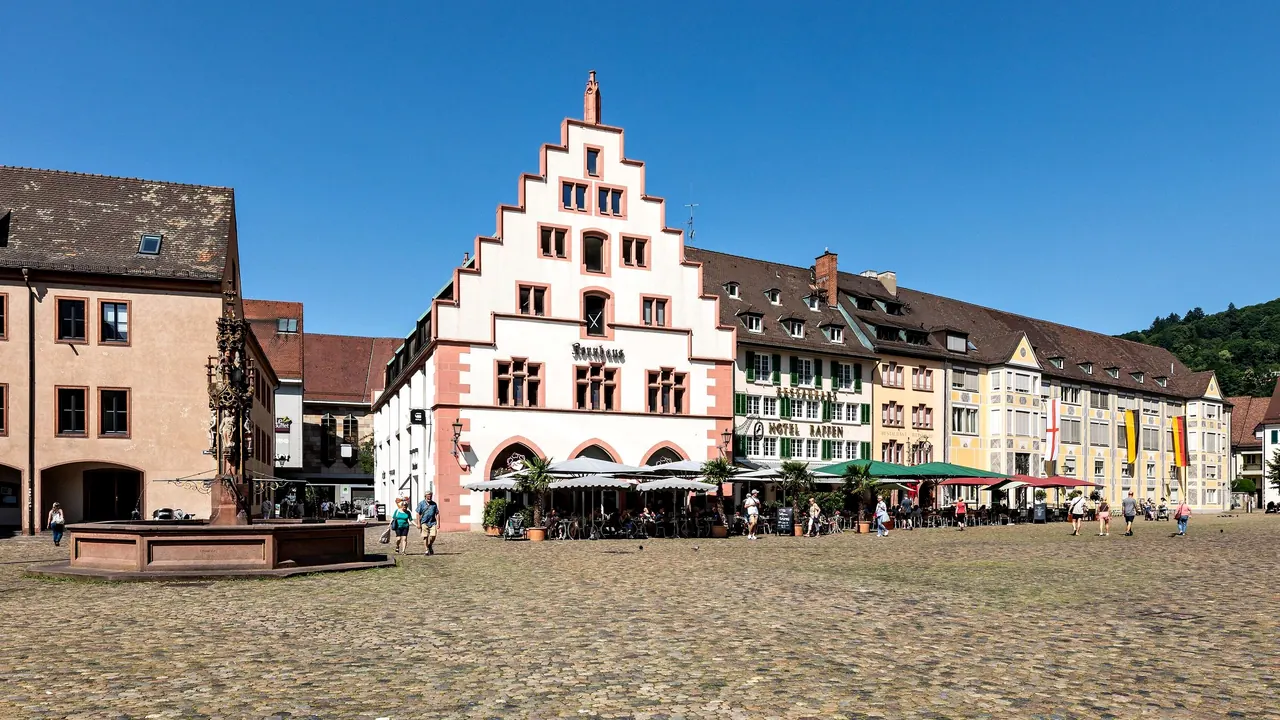
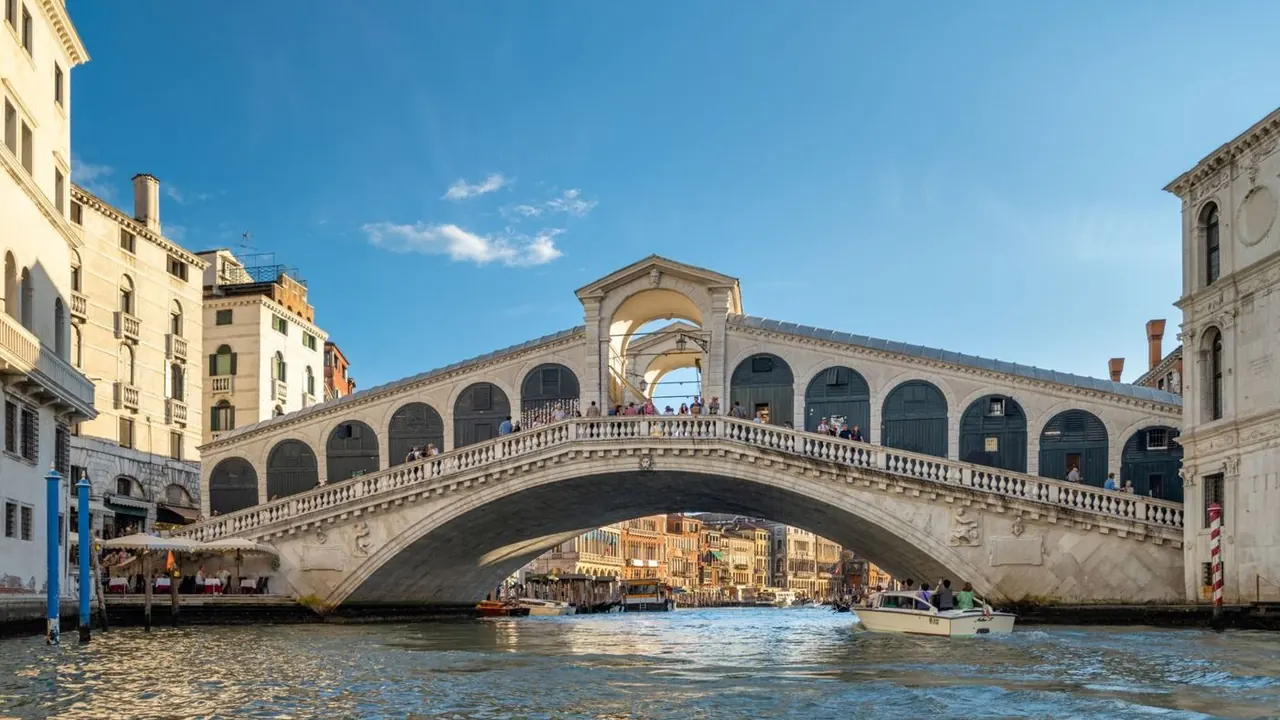
Photos: Freiburg by Dietmar Rabich, CC BY-SA 4.0, cropped; Venice by David Vives, Pexels License.
Freiburg or Venice?
Our verdict in twelve categories, each scored against the same fixed benchmark cities, and the climate month by month, so you can choose for your trip.
Choose Freiburg for
- nature and the outdoors
- families
- wellness
Freiburg suits travellers who want an easy, green base rather than a headline city. It works for walkers and cyclists heading into the Black Forest, for families with young children, and for anyone keen to see France and Switzerland from one hotel. The evenings are friendlier, the spas are close and the bills are gentler.
Choose Venice for
- culture and sights
- beaches
- shopping
For art, architecture and the sense of being somewhere unlike anywhere else, Venice is the one to choose. Couples and culture lovers who come for the palaces, the painters and a night at La Fenice will put up with the prices, the crowds and the early nights. It is best on a shorter stay, away from the heat of high summer.
Scoreboard
Twelve categories on one fixed scale from 0 to 100. The shaded stretch is the gap between the two.
Your match
Pick a travel style or drag the sliders, and both match scores follow your weighting.
Too close to call, 1 point apart
Wins on nature and the outdoors and families with your weighting.
Wins on culture and sights and beaches with your weighting.
What matters to you?
Category by category
What the scores mean for a trip.
Beaches & swimming
Neither city is a beach destination, but only Venice has the sea. The Lido is a short boat ride from San Marco, with fine Adriatic sand and shallow water warm enough for children in high summer, and Pellestrina is quieter and wilder.
In Freiburg you swim inland. There are gravel-pit lakes with grassy shores on the Rhine plain that warm up nicely, cooler mountain lakes such as Titisee about an hour away, and busy open-air pools. That is fine for a dip after a hot day on the bike, but not for a day on the sand.
Food & drink
The two eat about equally well, in very different ways. Freiburg's food is sit-down Baden cooking with a French touch: Schäufele, mountain trout and spring asparagus, with Pinot from the Kaiserstuhl just outside town. Some of Germany's best fine dining is a short drive away.
In Venice you graze: cicchetti and a spritz at a bacaro counter, then black cuttlefish risotto and lagoon shellfish from the Rialto market. The risk is the tourist restaurants on the main routes, while Freiburg's taverns are reliably honest. Neither city has much beyond its own regional cooking.
Culture & sights
This is where Venice pulls far ahead. The whole city is the monument, centuries of palaces and churches standing on water. The art inside ranges from Titian at the Frari and Tintoretto at San Rocco to the Accademia and the Guggenheim, with the Biennale on top. A week will not exhaust it.
Freiburg fills a satisfying day or two: the Münster tower you can climb, the red Kaufhaus on the market square, the old city gates, the Bächle running through the streets, and medieval sculpture in the Augustinermuseum. Much of the centre was rebuilt after the war, so it is charming rather than overwhelming.
Nightlife
Freiburg has the livelier evenings, thanks to its students. There are pubs and wine bars around the Martinstor, summer crowds along the Dreisam until late, and a few clubs for techno and indie nights, all at their best during term.
In Venice the peak is aperitivo hour in the bacari of Cannaregio and around the Rialto, and Campo Santa Margherita stays busy a little longer. After midnight the canals go silent. That makes for a beautiful late walk, but not a night out.
Nature & outdoors
Freiburg wins clearly if you want to get out of town. The Black Forest begins at the edge of the city, with the Schauinsland cable car, ridge trails with views to the Alps, the Feldberg for hiking or winter skiing, and the Kaiserstuhl vineyards for gentle cycling.
In Venice the outdoors means the lagoon: rowing or kayaking among the salt marshes around Torcello, watching herons and flamingos, and cycling the sea walls of Pellestrina. It is flat and peaceful, and the nearest real mountains, the Dolomites, are more than two hours away.
Day trips
Both are excellent bases, and Venice edges ahead with so many great towns on one fast rail line. Padua's Scrovegni Chapel is half an hour away, and Vicenza's Palladio and Verona's arena are not much further, with Bologna and Trieste also within reach. The lagoon islands of Murano, Burano and Torcello make a day out without any train at all.
Freiburg's strength is variety across borders: Basel by train, Colmar and the Alsace wine villages by car, Strasbourg a little further, and Staufen, Breisach and Baden-Baden on the German side. Venice cannot offer three countries, but its list has more first-rank cities.
Good for families
Freiburg is much easier with children. It is small, safe and flat in the centre, and kids can chase toy boats along the Bächle. The Mundenhof animal park is free, and Europa-Park, Germany's largest theme park, is about 40 minutes away. Rainy days are the weak spot.
Children love the boats and car-free alleys of Venice, and the Lido and the glass-blowing on Murano go down well. But stepped bridges defeat pushchairs, summers are hot and crowded, and there are few playgrounds. It suits a short stay with older children.
Getting around
Both centres are car-free and walkable, but Freiburg is simpler to manage. You can walk across its old town in twenty minutes, trams and bike lanes cover the rest, and regional trains run straight into the Black Forest and on to Basel, often covered by a guest card.
Venice takes more effort. The centre is a forty-minute walk across a maze of alleys that often end at a canal, the vaporetti are slow and crowded, and hundreds of stepped bridges make luggage and wheels hard work. In return, a boat trip along the Grand Canal is sightseeing in itself.
Shopping & style
Venice has more worth taking home. Workshops in Dorsoduro, Castello and on Murano sell Murano glass, Burano lace, papier-mâché masks, marbled paper and furlane slippers, and the big fashion names are near San Marco. The trick is to avoid the imported copies sold along the main routes.
Freiburg is modest by comparison. There are chain stores on Kaiser-Joseph-Strasse, independent shops in the Gerberau, and cuckoo clocks, wood carvings and local schnapps at the market. Locals go to Basel for any serious shopping.
Affordability
Neither is a bargain, but Freiburg costs noticeably less on almost every count. Its hotels charge more than a city of its size would suggest, and rooms run short on summer weekends and during trade fairs. Still, they rarely come near Venetian rates, and a Black Forest village makes a cheaper fallback. Once you are there, meals in the wine taverns and the student quarter are fairly priced, and the Münster and most sights cost little or nothing.
Venice adds to the bill at every step. A room in the historic centre costs far more than in Freiburg, above all near San Marco, in summer and at carnival. Freiburg's trams are moderately priced, but the Venetian water buses are priced for visitors, and most churches and sights charge for entry. To spend less, eat cicchetti at a bacaro counter, sleep in Mestre or a quieter sestiere, and come in late autumn or winter.
Live music & performing arts
Venice has the grander stage. La Fenice, where works by Verdi and Rossini had their premieres, runs full seasons of opera, ballet and concerts, and the Biennale adds festivals of contemporary music, theatre and dance. Vivaldi concerts in churches are everywhere, though the quality varies.
Freiburg is solid for its size. It has repertory opera and drama at the Theater Freiburg, the acclaimed Freiburger Barockorchester at the Konzerthaus, and the summer Zelt-Musik-Festival. Its small student jazz and live music scene actually does better than Venice, where jazz and rock venues are few.
Wellness & relaxation
Freiburg is in real spa country. There is a thermal bath on the city's edge, Bad Krozingen's warm outdoor pools twenty minutes south, Badenweiler's Roman ruins a little further on and Baden-Baden an hour away. The paths along the Dreisam are there for the rest of the day.
Venice has no bathing tradition of its own, only hotel spas, and the thermal pools of Abano Terme are about an hour away. Its calm comes from silence instead: no traffic, and quiet early mornings in Castello, Cannaregio or on Giudecca, as long as you stay away from the crowds at San Marco.
When should you go?
Pick your month. The climate figures are measured averages, not a forecast.
Freiburg in July
Venice in July
Daytime high, °C
Rainfall in the month, mm
Temperature and rainfall are climate normals, averaged over the years shown. Freiburg: 1991-2020 normals, Freiburg (0.6 km from centre). Venice: 1991-2020 (sunshine 1971-2000, rainfall 1981-2010) normals, Venezia / Tessera (6.7 km from centre).
Freiburg is at its best from May to September, when it is warm enough for walking and hiking and highs reach about 27°C in July. Summer is also its wettest stretch, with May the rainiest month at 103mm, so expect showers between the long sunny days. Spring and early autumn are the ideal seasons for the Black Forest trails. Winter is cold and dull in town, though the higher slopes get snow.
Venice runs a little warmer all year. The Adriatic at the Lido is warm enough for swimming from June to September and peaks at around 26°C in August. July is the sunniest month, but at about 29°C and humid it makes long walks hard work, so May, June and September are better for sightseeing. Rain peaks in June and again in October at 93mm. Winters are cold but fairly dry.
Which traveller are you?
On an outdoors trip, Freiburg is the clear choice. Hikers, mountain bikers and skiers can leave town within minutes and be back for dinner. Venice offers a gentle paddle or a morning's birdwatching, but nothing more strenuous.
On a family trip with young children, Freiburg is far easier. Parents can push a buggy anywhere, let children roam safely and fill a week with little planning. Venice enchants older children on a short visit but wears out toddlers.
For a culture and arts trip, choose Venice. Freiburg is good for a day of strolling. Venice is the whole point of the journey for anyone who travels to look at paintings and buildings, and a week there still leaves plenty unseen.
Before you go
| Measure | Freiburg | Venice |
|---|---|---|
| Official language | German | Italian |
| Currency | Euro (EUR) | Euro (EUR) |
| Sockets | CF230 V, 50 Hz | CFL230 V, 50 Hz |
| Driving side | Right | Right |
| Time zone | UTC+1, UTC+2 in summer | UTC+1, UTC+2 in summer |
| Emergency number | 112 | 112 |
| Elevation | 278 m | 2 m |
| Main airport | EuroAirport Basel–Mulhouse–Freiburg (BSL)50 km from centre112 non-stop destinations | Venice Marco Polo Airport (VCE)7 km from centre103 non-stop destinations |
| Public holidays this year | 12 days | 13 days |
By the numbers
| Measure | Freiburg | Venice |
|---|---|---|
| City population | 238,299 | 250,369 |
| People per km² | 1,558 | 602 |
| Museums within 10 km | 13 | 52 |
| UNESCO World Heritage sites within 50 km | 2 | 5 |
| Swim season, months above 21 °C | - | 4 months |
Where else could you go?
Every comparison below shares a destination with this one, so you can follow Freiburg or Venice somewhere new.
- Paduavs Venice
- Colmarvs Freiburg
- Baselvs Freiburg
- Strasbourgvs Freiburg
- Zurichvs Freiburg
- Baden-Badenvs Freiburg