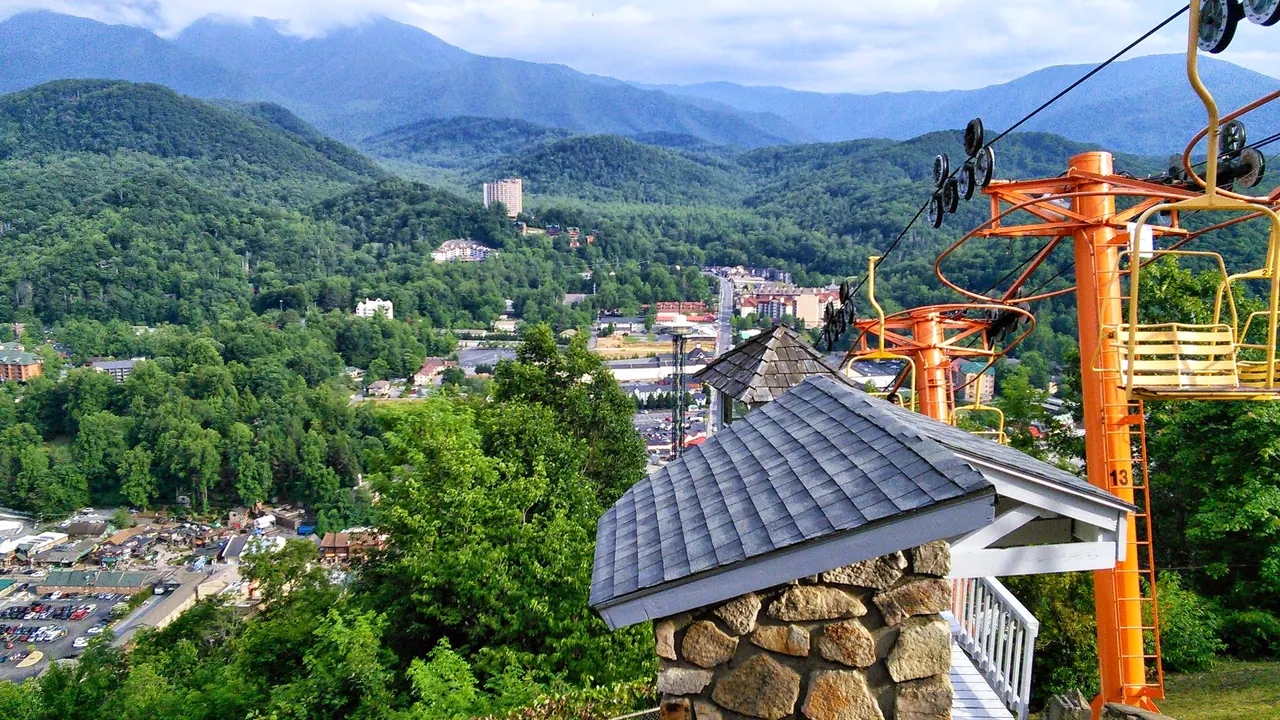

Photos: Gatlinburg by Evan Nichols, CC BY 3.0, cropped; St. Louis by Holly Cheng, CC BY 2.0, cropped.
Gatlinburg or St. Louis?
Our verdict in twelve categories, each scored against the same fixed benchmark cities, and the climate month by month, so you can choose for your trip.
Choose Gatlinburg for
- nature and the outdoors
- wellness
- families
Gatlinburg is for travellers who want their days in the mountains: waterfall trails, black bears seen from the car, creek wading and a cabin with a hot tub on the deck at night. It also suits families who want a long run of child-friendly attractions with Dollywood close by. Just accept that the town itself has little history, little cooking worth seeking out and not much to do after dark.
Choose St. Louis for
- culture and sights
- live music and the arts
- food and drink
St. Louis is the better choice for a city trip with some substance. The Gateway Arch, the free museums of Forest Park, a respected symphony, summer musicals at the Muny and blues bars in Soulard give it far more to see and hear. Its food, from toasted ravioli on the Hill to Bosnian grills on South Grand, has a character the Parkway's pancake houses lack. The outdoors here is gentle rather than grand.
Scoreboard
Twelve categories on one fixed scale from 0 to 100. The shaded stretch is the gap between the two.
Your match
Pick a travel style or drag the sliders, and both match scores follow your weighting.
Wins on nature and the outdoors and wellness with your weighting.
Wins on culture and sights and live music and the arts with your weighting.
What matters to you?
Category by category
What the scores mean for a trip.
Beaches & swimming
Neither city is a beach destination, and both lie hundreds of kilometres from any coast. What you get instead is different. In Gatlinburg you can tube and wade in the cold, clear rivers of the national park or swim at Douglas Lake. In St. Louis the Mississippi and Missouri are working rivers far too strong to swim in, so cooling off means a pool or a long drive to an Ozark reservoir.
Food & drink
St. Louis is the better place to eat. It has dishes of its own, such as toasted ravioli, Provel-topped thin-crust pizza and gooey butter cake, along with serious rib barbecue, Italian trattorias on the Hill and Bosnian, Vietnamese and Ethiopian cooking on South Grand. The brewing heritage in Soulard and the Saturday market add to it.
Gatlinburg feeds a resort crowd. Expect pancake breakfasts, barbecue, fudge and moonshine tastings on the Parkway. Proper Appalachian cooking, like trout, country ham and stack cake, turns up only in the odd restaurant.
Culture & sights
St. Louis has real sightseeing. There is the Gateway Arch with its museum of westward expansion, the Old Courthouse of the Dred Scott case, and free collections in Forest Park. The Wainwright Building and whole streets of red-brick housing in Soulard and Lafayette Square fill two or three days.
Gatlinburg's landmarks are an observation tower and mountaintop amusement parks. Its heritage lives in the working studios of the Arts and Crafts Community and in the old cabins, mills and churches of Cades Cove and the Roaring Fork, which you visit as outings into the park.
Nightlife
St. Louis gives you an evening out, though it is spread over separate areas. There are corner taverns and blues bars in Soulard, dance bars on Washington Avenue, the Grove's late LGBTQ+ strip and student haunts on the Delmar Loop, with a taxi often needed in between.
In Gatlinburg the evening means a stroll along the lit Parkway, a moonshine tasting and perhaps a brewery terrace. The strip empties by late night, and most people end up back in the cabin hot tub.
Nature & outdoors
Gatlinburg wins easily. The town is the gateway to the Great Smoky Mountains, and within minutes you are in deep hardwood forest. Trails range from Laurel Falls to the climb up Mount LeConte, and the road runs up to Clingmans Dome at close to 2,025m. Bears, deer and elk are part of the experience, alongside rafting on the Pigeon River. Weekend and leaf-season traffic is the price.
St. Louis has the big woods and lakes of Forest Park and, within an hour, the river bluffs and caves of Castlewood and Meramec. The landscape rolls rather than soars, though wintering bald eagles near Alton are a real draw.
Day trips
Both have a good handful of outings, but of a different kind, and both need a car. From Gatlinburg the best trips are scenic: over Newfound Gap to Cherokee and its museum of the Eastern Band, on to Bryson City's heritage railway, or to Asheville and the Biltmore Estate.
From St. Louis the outings lean towards history. Cahokia Mounds, the UNESCO-listed remains of a pre-Columbian city, is twenty minutes away. Further afield are the French colonial houses of Ste. Genevieve, the German wine towns of Hermann and Augusta, Mark Twain's Hannibal and Lincoln's Springfield.
Good for families
Gatlinburg is the more complete family vacation. The Parkway is a strip of aquarium, mirror mazes, alpine coasters and chairlift parks, with Dollywood a short drive away and junior ranger walks in the national park. Expect high-season queues and crawling traffic.
St. Louis comes close with fewer crowds. The climbable City Museum is a highlight, and the zoo and Science Center in Forest Park are free. There is also the Magic House, the tram pods up the Arch and an easy evening of baseball at Busch Stadium, though the attractions are spread out.
Getting around
You will want a car in both, but for different reasons. Gatlinburg's Parkway strip is walkable and a trolley loops out to Pigeon Forge. The hillside cabins, trailheads and park roads all need a car, though, and at busy times those roads can stall for long stretches.
St. Louis is spread out. The MetroLink light rail covers a few key routes, from the airport through the Central West End and Forest Park to downtown, with a branch to Clayton. Soulard, the Hill and South Grand need a car or taxi, but parking is easy and the roads are mostly clear.
Shopping & style
Shopping is a side pleasure in both, but the pleasures differ. In Gatlinburg the souvenir and candy shops of the Parkway matter less than the artisans' loop, where quilts, pottery, brooms and woodwork come straight from the studio. There are outlet malls nearby for brands.
St. Louis offers urban browsing instead: antiques, vintage and records on Cherokee Street, independent shops on the Loop and boutiques in the Central West End. Fashion labels are out in the suburban malls.
Affordability
Overall costs are similar, but the money goes in different places. In Gatlinburg, a shared cabin or an older motel can be good value and the national park costs little. The paid Parkway attractions and Dollywood add up quickly for a family, and rates jump in leaf season, at Thanksgiving and over Christmas and New Year.
In St. Louis, hotels cost less than in the coastal cities, and the zoo and the Forest Park museums are free. The extra cost is a hire car, or taxis between neighbourhoods.
Live music & performing arts
St. Louis is far stronger here. It has a symphony founded in 1880 playing in Powell Hall and touring Broadway at the Fabulous Fox. In summer there are open-air musicals at the Muny and the Opera Theatre's festival season. On top of that is a blues lineage running through Chuck Berry and W.C. Handy, still heard in Soulard's bars.
Gatlinburg's live entertainment is bluegrass in the tasting rooms, mountain music at Dollywood and dinner shows in Pigeon Forge. That is fun for families, but there is no orchestra or serious theatre.
Wellness & relaxation
Neither has a spa tradition, but Gatlinburg is easier to unwind in if you stay up the hillsides. A secluded cabin with a hot tub, quiet nights and mist on the ridges does the work that spas do elsewhere. Avoid the noisy Parkway.
St. Louis is unhurried and rarely crowded. A slow morning in Forest Park or the Japanese garden at the Missouri Botanical Garden is the most restful thing it offers.
When should you go?
Pick your month. The climate figures are measured averages, not a forecast.
Gatlinburg in July
St. Louis in July
Daytime high, °C
Rainfall in the month, mm
Where the figures come from
Gatlinburg's temperatures are measured 45 km from the centre, at McGhee Tyson Airport.
Gatlinburg has no rain gauge within 25 km of the centre, so its rainfall comes from a gridded climate dataset read at the city rather than from a gauge further away.
Temperature and rainfall are climate normals, averaged over the years shown. Gatlinburg: 1991-2020 (sunshine 1981-2010) normals, McGhee Tyson Airport (44.9 km from centre). St. Louis: 2006-2020 (sunshine 1981-2010, rainfall 1991-2020) normals, Cahokia / Maplewood Park (7.2 km from centre).
Both follow the same broad pattern, with hot, humid summers peaking in the low 30s in July and mild springs and autumns. Neither has a sea. In Gatlinburg, June to August is the time to cool off in the national park's cold rivers, and May to July is the sunniest stretch. For trails or city streets, April to May and September to October are the comfortable months in both places. Midsummer afternoons are heavy and sticky in each.
Where they differ is rain and winter cold. Gatlinburg is wetter for most of the year, especially in winter and in July, when it gets around 145mm. October is its driest month, with mild days and only about 69mm, so autumn is a good time for walking there, even though the sunniest weeks come earlier in the year. St. Louis has colder winters, with January highs near 5°C against 9°C in Gatlinburg, but those are also its driest months. Its rain peaks in April and May, when it is slightly wetter than Gatlinburg, so spring there can bring grey, damp days.
Which traveller are you?
On an outdoors trip, Gatlinburg is the clear pick. The Great Smoky Mountains start where the Parkway ends, with waterfall walks, the climb up Mount LeConte, elk and bears. St. Louis offers pleasant Ozark foothills and the Katy Trail, not true mountains.
For a culture and arts trip, St. Louis wins easily. You get the Gateway Arch, free art and history museums in Forest Park, the mosaics of the Cathedral Basilica, a historic symphony, Broadway shows at the Fox and a deep blues heritage. Gatlinburg has craft studios and little else.
On a relaxing and wellness trip, Gatlinburg suits better, as long as you stay above town in a secluded hillside cabin with a hot tub, rocking chair and ridge views. St. Louis offers restful mornings in its parks but nothing built around slowing down.
Before you go
| Measure | Gatlinburg | St. Louis |
|---|---|---|
| Currency | US Dollar (USD) | US Dollar (USD) |
| Sockets | AB120 V, 60 Hz | AB120 V, 60 Hz |
| Driving side | Right | Right |
| Time zone | UTC-5, UTC-4 in summer | UTC-6, UTC-5 in summer |
| Emergency number | 911 | 911 |
| Elevation | 393 m | 149 m |
| Main airport | McGhee Tyson Airport (TYS)46 km from centre34 non-stop destinations | St. Louis Lambert International Airport (STL)20 km from centre64 non-stop destinations |
| Public holidays this year | 13 days | 14 days |
By the numbers
| Measure | Gatlinburg | St. Louis |
|---|---|---|
| City population | 3,577 | 301,578 |
| People per km² | 133 | 1,764 |
| Museums within 10 km | 4 | 18 |
| UNESCO World Heritage sites within 50 km | 1 | 1 |
Where else could you go?
Every comparison below shares a destination with this one, so you can follow Gatlinburg or St. Louis somewhere new.
- Pigeon Forgevs Gatlinburg
- Ashevillevs Gatlinburg
- Chattanoogavs Gatlinburg
- Atlantavs Gatlinburg
- Nashvillevs Gatlinburg
- Louisvillevs Gatlinburg