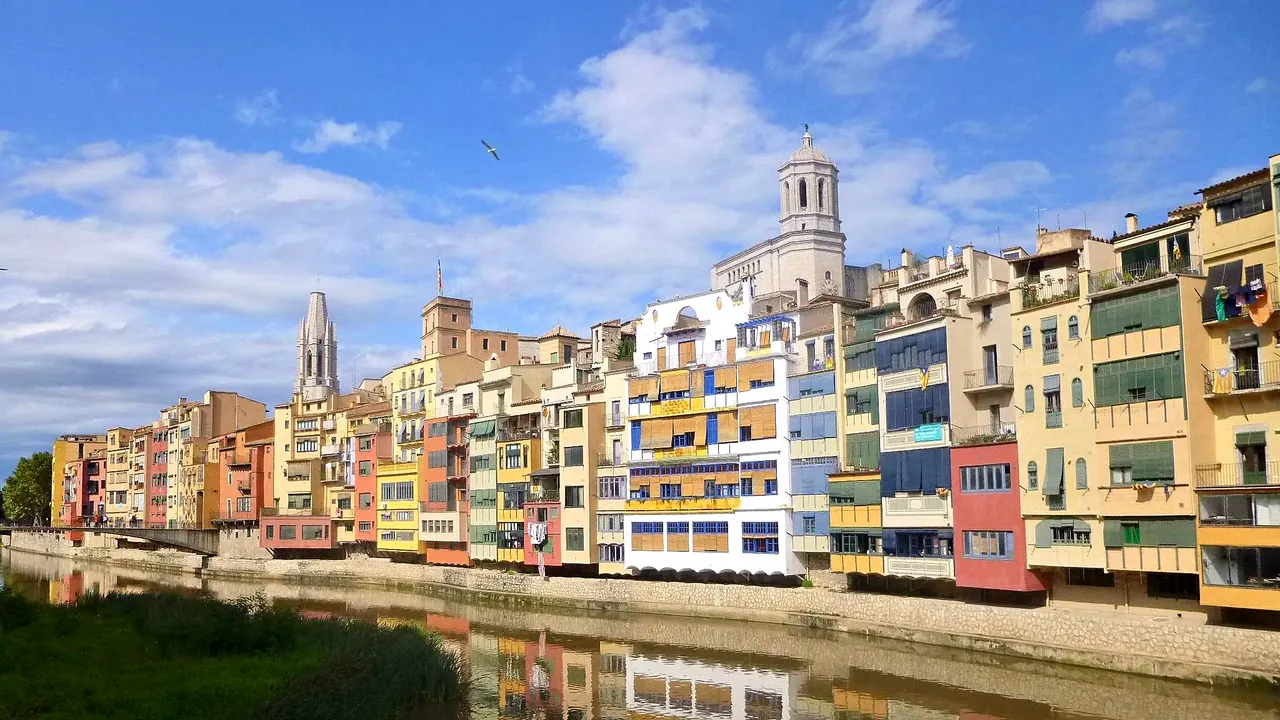
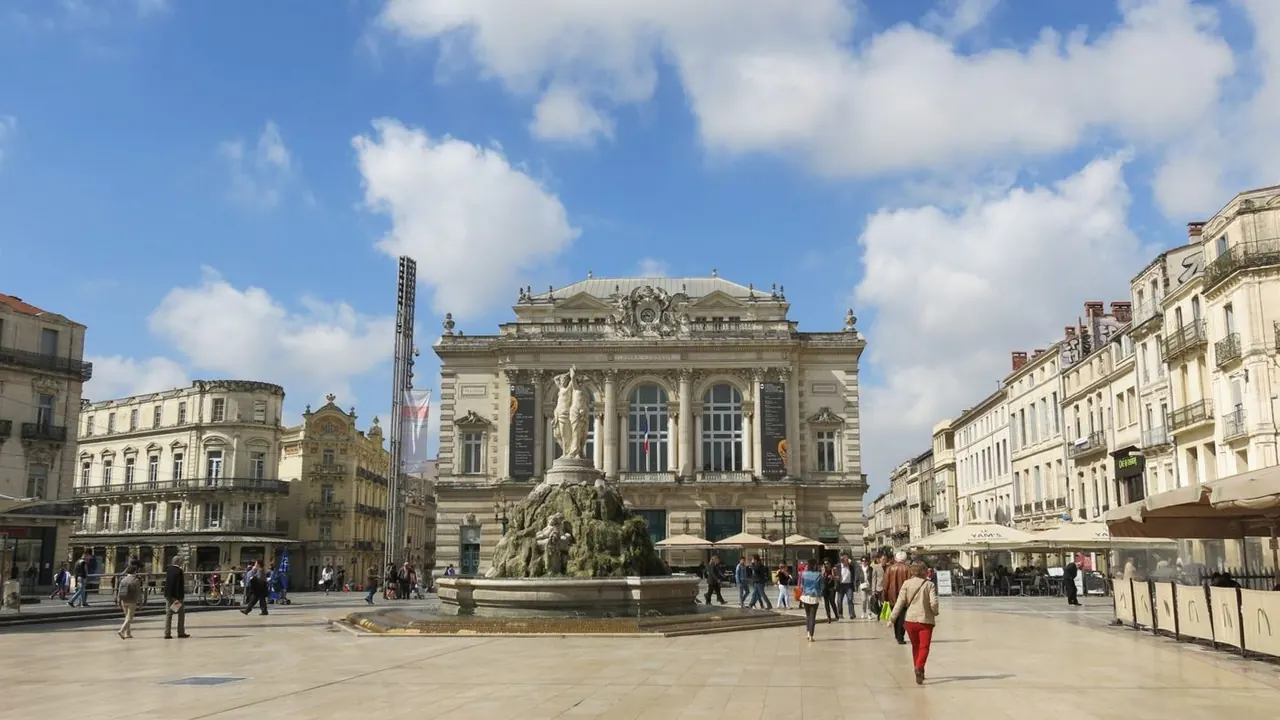
Photos: Girona by Zarateman, CC0; Montpellier by Peter, CC BY 2.0, cropped.
Girona or Montpellier?
Our verdict in twelve categories, each scored against the same fixed benchmark cities, and the climate month by month, so you can choose for your trip.
Choose Girona for
- nature and the outdoors
- culture and sights
- prices
Girona suits travellers who want a quiet, compact base with the countryside on its doorstep. Its walled medieval quarter takes a day or two at an easy pace, and the real draw is outside the walls: lanes and greenways for road cyclists, volcanic hills and Costa Brava coves within an hour, and Barcelona close enough for a day trip. Evenings mean a long dinner on a terrace and little else.
Choose Montpellier for
- nightlife
- live music and the arts
- families
Montpellier is the livelier and easier choice. A big student population keeps its bars and cheap places to eat busy, and its opera houses, national orchestra and summer dance festival give it a real stage season. Trams link the old town with the station and the districts beyond it, and gently shelving sandy beaches, a zoo and an aquarium make it the better fit for families and anyone without a car.
Scoreboard
Twelve categories on one fixed scale from 0 to 100. The shaded stretch is the gap between the two.
Your match
Pick a travel style or drag the sliders, and both match scores follow your weighting.
Wins on nature and the outdoors and culture and sights with your weighting.
Wins on nightlife and live music and the arts with your weighting.
What matters to you?
Category by category
What the scores mean for a trip.
Beaches & swimming
Neither city is on the sea. From Girona the Costa Brava is about 40 minutes away, and it is the prettier coast: pine-backed coves, with the clearest water around Begur and L'Escala. Without a car, though, sparse buses limit how much of it you see, and the best-known coves fill early in summer.
Montpellier is the better choice for regular beach days. Palavas and Carnon are only about 11km away by tram and bus, and a long strip of fine sand runs east to the dunes of l'Espiguette. The water is shallow and easy for swimming, though it has none of the rock and clarity of the Catalan coves.
Food & drink
The two eat about equally well, but in different ways. Girona has the higher peak: serious tasting-menu kitchens sit alongside Catalan taverns serving botifarra with beans and mar i muntanya dishes, with Empordà wine and xuixos from the pastry shops.
Montpellier is better for everyday eating than for big occasions. It has lagoon oysters and mussels from Thau, tielle from Sète, market halls with counters where you can eat, and plenty of cheap student places. Its wine, Pic Saint-Loup reds, comes from just beyond the city edge.
Culture & sights
These are close, but the sightseeing differs. Girona's appeal is one tightly packed medieval quarter: the cathedral with its huge single nave, the Call Jewish quarter, the Arab Baths and a walk along the walls. Its museums are modest.
Montpellier covers more centuries and has one major collection. The Musée Fabre is a gallery worth travelling for, and the formal Peyrou terrace, France's oldest botanical garden and Bofill's neoclassical Antigone add up to two or three days rather than one or two.
Nightlife
Montpellier is clearly the place for a night out. Its huge student population fills the wine bars and pubs around Place Jean-Jaurès on weeknights as well as weekends, and later the crowd moves on to clubs towards Lattes and the coast.
Girona's evenings are slow dinners and terrace drinks, with a few student bars and small late clubs. For anything bigger, people take the train to Barcelona.
Nature & outdoors
Girona is the stronger outdoor base, above all for cyclists. Quiet lanes lead straight out of town to the climbs of Rocacorba and Els Àngels, and traffic-free greenways run to Olot and the coast. Within reach are the beech woods and cinder cones of the Garrotxa, the coast-guard path above clear coves, and the Pyrenees for hiking or skiing.
Montpellier's countryside is gentler and wetter. Flamingos and herons feed in the lagoons behind the coast, and the Camargue marshes are about an hour away. Inland there is the climb up Pic Saint-Loup and canoeing in the Hérault gorges. Cycling here means flat coastal paths and the canal rather than mountain climbs, and the windy shore suits kitesurfing and windsurfing.
Day trips
Both are excellent bases, and the difference is in what you go out to see. From Girona, Barcelona is a quick high-speed train ride away, Dalí's Figueres, Púbol and Cadaqués form a trail of their own, and medieval villages such as Besalú and Peratallada sit close by, with Perpignan just over the border.
Montpellier opens up Roman and papal Provence. Nîmes, the Pont du Gard, Arles and Avignon are all an easy day out, and Carcassonne is within train range. As around Girona, the smaller villages are much easier with a car.
Good for families
Montpellier is the clear pick with children. It has the Lunaret zoo in its wooded park, an aquarium and a planetarium side by side at Odysseum, trams that are easy with a pushchair, and calm, shallow beaches.
Girona is safe and relaxed, and children enjoy the walls and the shade of the Devesa park. Beyond that it has no attractions aimed at them, and the stepped lanes of the Barri Vell are hard work with a pushchair, so families tend to spend their days on the coast.
Getting around
Both centres are walkable, but Montpellier goes further without a car. Its tram network links the station, the old town, Antigone, Odysseum and the edge of the city, from where buses run to the beach. Fast trains reach Nîmes and Avignon.
Girona is small enough to cross on foot in about twenty minutes, though it is steep and full of stairs. Trains serve Barcelona and Figueres well, but the coast and villages depend on infrequent buses, which is why many visitors rent a car.
Shopping & style
Montpellier offers more. Boutiques and wine shops fill the lanes of the Écusson, the Polygone mall stands next to the Comédie, and Odysseum adds the big brands, though there is no luxury street.
Girona is smaller still, with independent shops along the Rambla, cycling kit for visiting riders, and Barcelona for anything more serious. In both cities the best things to take home are edible: Empordà cheese and oil from the Mercat del Lleó, or Languedoc wine and honey from Montpellier's markets.
Affordability
Costs are much the same in both, sitting in the middle for Western Europe, but they build up in different places. In Girona it is the rooms: the old town has few, and they get expensive in summer and during the flower festival and the cycling season. A hire car adds more, though the set lunches are good value.
Montpellier's student economy keeps casual eating and drinking cheap, and the tram saves on taxis. Restaurant dinners with wine and summer rooms on the coast are where the money goes.
Live music & performing arts
Montpellier has far more on stage. Two opera houses share a year-round season of opera, ballet and concerts by the national orchestra. Contemporary dance is its speciality, with the Montpellier Danse festival each summer, and the Radio France festival brings many free concerts.
Girona has the Auditori for touring concerts and one standout event, the Temporada Alta theatre and dance festival in autumn. Outside that the programme is thin, and many plays are in Catalan.
Wellness & relaxation
Neither city has a bathing culture of its own, and each relies on a nearby spa town. For Girona it is Caldes de Malavella, about 20 minutes south, with its Roman past. For Montpellier it is Balaruc-les-Bains on the Thau lagoon, about half an hour away, which takes day visitors.
The real difference is the mood. Girona's quiet stone lanes and river walks make it the calmer place to slow down, while Montpellier's terraces are relaxing but rarely quiet.
When should you go?
Pick your month. The climate figures are measured averages, not a forecast.
Girona in July
Montpellier in July
Daytime high, °C
Rainfall in the month, mm
Temperature and rainfall are climate normals, averaged over the years shown. Girona: 1991-2020 normals, Gerona / Costa Brava (10.1 km from centre). Montpellier: 1991-2020 normals, Montpellier (7.8 km from centre).
Girona and Montpellier follow much the same pattern through the year. Spring and early autumn are the best times for walking in both: warm, but not tiring. Girona is inland and gets slightly hotter in high summer. July and August highs reach around 31°C, which makes the middle of the day hard going in its steep lanes. Montpellier is barely cooler but gets more sunshine, and July there is almost dry, with about 17mm of rain. For swimming, the Costa Brava is the warmer sea. It reaches about 24°C in August, against about 22°C off Montpellier's sandy shore. Both seas are pleasant from July to mid-September, and the water off Girona warms up a little earlier.
Autumn is when the two differ most. Rain increases in Girona in September and October, but Montpellier gets more, up to 93mm in October. Both winters are mild and fine for sightseeing, with Girona slightly milder by day, but neither is any use for the beach.
Which traveller are you?
On an outdoors trip, Girona has the edge. Road cyclists come from all over the world to ride its climbs and old railway greenways, and the Garrotxa volcanoes, the Cap de Creus cliff paths and the Pyrenees are all within reach.
For a food and nightlife trip, choose Montpellier. Both cities eat well, but Montpellier's student crowd fills the bars of the Écusson every night of the week and the night goes on to clubs, while Girona winds down after dinner.
On a family trip with children, Montpellier makes things easier. There is a zoo, an aquarium and a planetarium, the trams take pushchairs, and the sandy beaches shelve gently. Girona's stairs and cobbles are hard with a pushchair, and almost nothing there is built for children.
Before you go
| Measure | Girona | Montpellier |
|---|---|---|
| Official language | Spanish | French |
| Currency | Euro (EUR) | Euro (EUR) |
| Sockets | CF230 V, 50 Hz | CE230 V, 50 Hz |
| Driving side | Right | Right |
| Time zone | UTC+1, UTC+2 in summer | UTC+1, UTC+2 in summer |
| Emergency number | 112 | 112 |
| Elevation | 70 m | 7 m |
| Main airport | Girona-Costa Brava Airport (GRO)10 km from centre18 non-stop destinations | Montpellier-Méditerranée Airport (MPL)8 km from centre40 non-stop destinations |
| Public holidays this year | 14 days | 11 days |
By the numbers
| Measure | Girona | Montpellier |
|---|---|---|
| City population | 108,666 | 310,240 |
| People per km² | 2,779 | 5,452 |
| Museums within 10 km | 9 | 14 |
| UNESCO World Heritage sites within 50 km | 0 | 2 |
| Swim season, months above 21 °C | 3 months | 2 months |
Where else could you go?
Every comparison below shares a destination with this one, so you can follow Girona or Montpellier somewhere new.
- Avignonvs Montpellier
- Barcelonavs Girona
- Marseillevs Montpellier
- Aix-en-Provencevs Montpellier
- Carcassonnevs Montpellier
- Carcassonnevs Girona