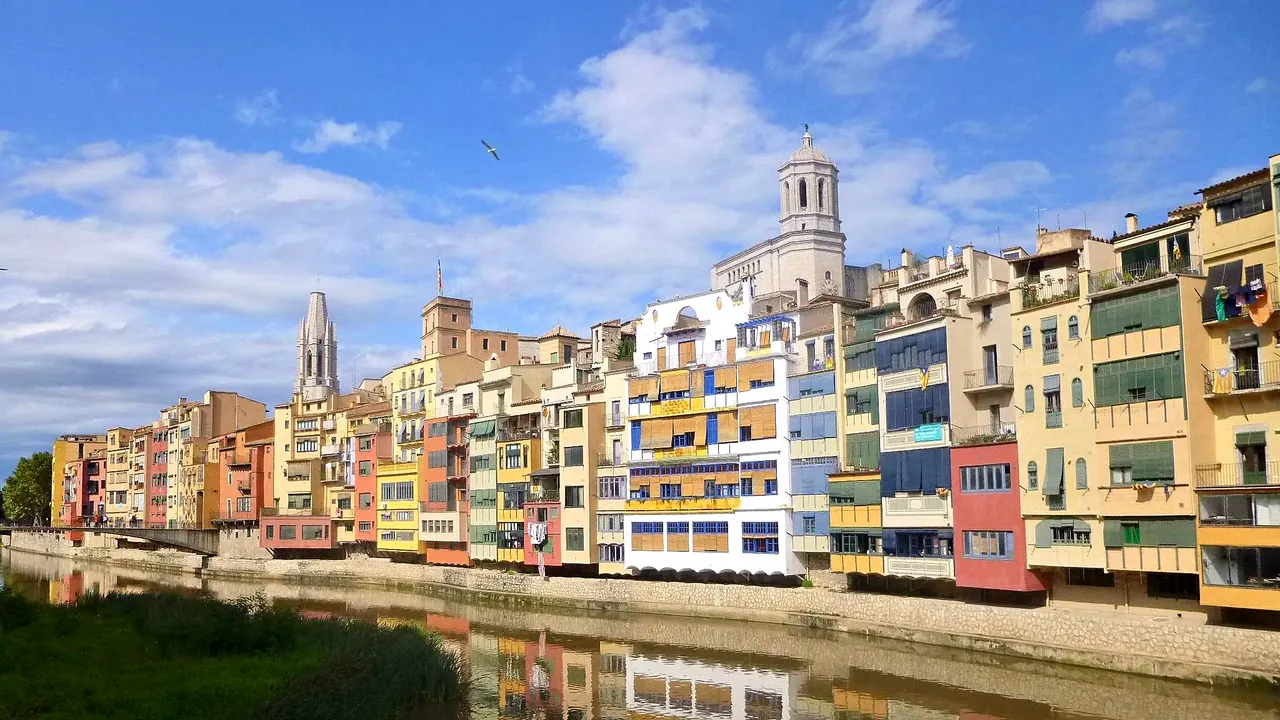
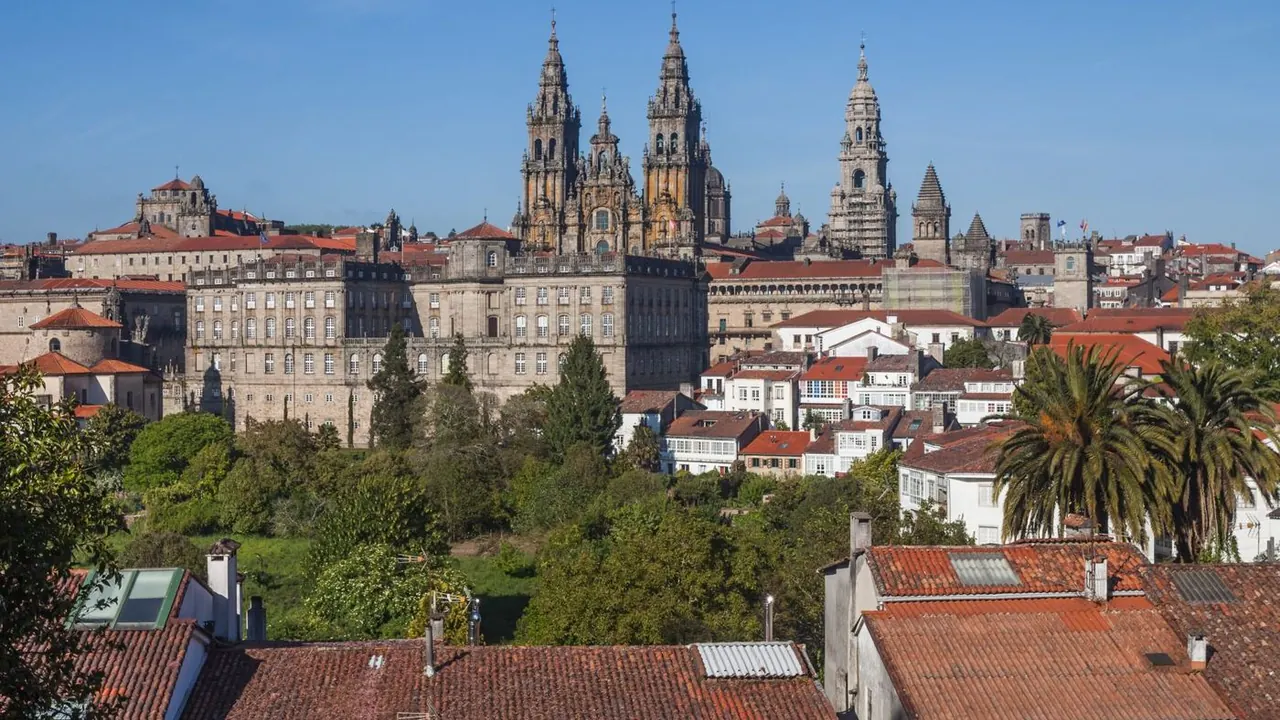
Photos: Girona by Zarateman, CC0; Santiago de Compostela by Luis Miguel Bugallo Sánchez (Lmbuga), CC BY-SA 3.0, cropped.
Girona or Santiago de Compostela?
Our verdict in twelve categories, each scored against the same fixed benchmark cities, and the climate month by month, so you can choose for your trip.
Choose Girona for
- beaches
- nature and the outdoors
- day trips
Girona is the better choice if the region matters as much as the city. Its medieval quarter is lovely but quick to see. The real pull is what lies around it: Costa Brava coves with warm summer water, road cycling and greenways from the edge of town, Dalí country, the Garrotxa volcanoes, and Barcelona close enough for a day. It suits active travellers and anyone happy to rent a car and use a quiet, well-fed city as a base.
Choose Santiago de Compostela for
- nightlife
- prices
- getting around
Santiago de Compostela is more of a destination in itself. The cathedral and its granite old town carry more historical weight than anything in Girona, the seafood is excellent and cheap, and a student population keeps the bars going late in term time. Choose it for a culture-led city break on a modest budget, or as the end of a pilgrimage, and come ready for rain rather than beach weather.
Scoreboard
Twelve categories on one fixed scale from 0 to 100. The shaded stretch is the gap between the two.
Your match
Pick a travel style or drag the sliders, and both match scores follow your weighting.
Too close to call, level with your weighting
Wins on beaches and nature and the outdoors with your weighting.
Wins on nightlife and prices with your weighting.
What matters to you?
Category by category
What the scores mean for a trip.
Beaches & swimming
Neither city is on the sea, but Girona's coast is a much stronger draw. The Costa Brava is about 40 minutes away, with sandy bays at Platja d'Aro and pine-backed coves around Begur and L'Escala, and in late summer the water is warm enough for a long swim.
Santiago's nearest beaches are the white sand inlets of the Ría de Muros e Noia and the Ría de Arousa. They are sheltered and attractive, but the Atlantic stays cold and summer is short. They make a pleasant afternoon out rather than a beach trip.
Food & drink
Girona's strength is depth and ambition. Catalan home cooking such as botifarra with white beans and mar i muntanya dishes sits beside tasting-menu kitchens with an international reputation. The Mercat del Lleó and the Empordà vineyards bring cheese, oil, wine and cava from the plain to the table, and xuixos are the pastry to try.
Santiago puts nearly everything into the sea. Octopus, scallops and percebes come from the granite hall of the Mercado de Abastos, where some counters will cook what you buy, and the taverns of Rúa do Franco pour Albariño with pimientos de Padrón. The cooking is more generous and less inventive than Girona's, and both cities have little international food.
Culture & sights
Santiago has more to see. The cathedral, with the Pórtico da Gloria and the shrine of Saint James, is one of Europe's great pilgrimage churches, and the Praza do Obradoiro and the UNESCO-listed granite old town around it are grander than anything in Girona. Museums like the Museo do Pobo Galego and the Cidade da Cultura give two or three days of material.
Girona's Barri Vell is very attractive in its own way: the wide Gothic nave of its cathedral, the Call's Jewish alleys, the Arab Baths and the walk along the walls. Its museums are smaller, though, and most visitors finish within a day or two.
Nightlife
Santiago has the livelier evenings, at least in term time. Tapas crawls along Rúa do Franco lead to pub-like bars with folk sessions around Praza de Cervantes, Thursday is the big student night, and a few clubs stay open until early morning. In summer the students leave and the early-to-bed pilgrims take over.
In Girona, a night out mostly means a terrace and a long dinner, plus student bars in term time and a few late music bars at weekends. For anything bigger, people take the train to Barcelona.
Nature & outdoors
Girona has more variety in its countryside, and it gets more use from active travellers. The cycling is world-class, from the climbs of Rocacorba and Els Àngels to flat greenways that run towards Olot and the sea. Within reach are the volcanic beech forests of the Garrotxa, the coast-guard path and Cap de Creus, and the Pyrenees for summer hiking or winter skiing.
Santiago's landscape is softer and wetter: oak woods and stone-walled fields, Camino paths leading out of town, and the ancient Fragas do Eume. The Costa da Morte cliffs are dramatic, but there are no high mountains, and rain gear matters more than sun cream.
Day trips
Girona has the stronger range of day trips. Barcelona is under 40 minutes by fast train, and Figueres and the Dalí Theatre-Museum are closer still. Add Besalú's fortified bridge, the stone villages of Pals and Peratallada, the ruins of Empúries and the chance to cross into France for Perpignan or Collioure.
Santiago is a good base for Galicia: A Coruña's Tower of Hercules, Lugo's complete Roman walls, Ourense's thermal springs and the Albariño villages of the Rías Baixas. It has no big city on the doorstep to match Barcelona, though, and Porto is a long way for a day.
Good for families
For families, the two are much alike: safe and relaxed, with children welcome late in the squares, but little built for them and old towns full of cobbles that are hard work with a pushchair. The difference is the weather. From Girona, children can spend their days on warm Costa Brava beaches, while in Santiago the backups are A Coruña's aquarium and science museums, useful on the many rainy days.
Getting around
Girona is easy on foot. The old town, the river and the modern centre are all within about twenty minutes of each other, though the Barri Vell is steep and full of stairs. Fast trains to Barcelona and Figueres are excellent, but buses to the coast and Olot are infrequent, so the villages, coves and wineries really need a hire car. Bikes are a handy extra for short local trips.
Santiago is the simpler of the two without a car. Nearly everything a visitor wants lies inside its pedestrian centre, which has only short climbs, though the granite gets slippery in the rain. City buses go to the station, the airport and the Cidade da Cultura, and trains connect A Coruña, Pontevedra, Vigo and Ourense. The beaches and the Costa da Morte are still easier with a car or a tour.
Shopping & style
Neither city is a shopping destination, and what you take home differs. In Girona it is Empordà cheese, oil and wine from the Mercat del Lleó, a few independent fashion shops on the Rambla and plenty of cycling kit, with Barcelona close by for anything more. Santiago's specialities are crafts: black jet set in silver around the Azabachería and blue-and-white Sargadelos ceramics. Away from those, a lot of the old town sells pilgrim souvenirs.
Affordability
Santiago is the cheaper stay. Tapas often come free with a drink, seafood and local wine cost less than in Girona, and pensiones and pilgrim hostels keep rooms affordable outside the July feast of Saint James.
Girona is more mid-priced. Weekday set lunches are good value, but the old town has few rooms and they get expensive in summer, during the flower festival and in cycling season. A hire car for exploring the region adds a further cost that Santiago visitors can often skip.
Live music & performing arts
Girona's stage year peaks in autumn with Temporada Alta, a long festival of international theatre and dance. The Auditori brings in touring orchestras and jazz, and in summer there is music in castle gardens and seaside towns along the coast. Outside those seasons there is little on, and many plays are in Catalan.
Santiago has its own resident orchestra, the Real Filharmonía de Galicia, which plays a season at the Auditorio de Galicia. Its most distinctive sound is traditional, though: bagpipes and folk sessions in old-town bars, and student tunas in black capes singing in the streets. In July the feast of Saint James brings concerts to the Obradoiro. Theatre is mostly in Galician and Spanish, and neither city has opera.
Wellness & relaxation
Both cities are easy places to slow down, and in both the thermal water lies just outside town. From Girona, the old spa town of Caldes de Malavella is about 20 minutes away and offers thermal pools in its hotels. Santiago has more choice: Caldas de Reis and Cuntis nearby, and Ourense's riverside pools, some of them free and open to everyone, a short train ride away.
When should you go?
Pick your month. The climate figures are measured averages, not a forecast.
Girona in July
Santiago de Compostela in July
Daytime high, °C
Rainfall in the month, mm
Temperature and rainfall are climate normals, averaged over the years shown. Girona: 1991-2020 normals, Gerona / Costa Brava (10.1 km from centre). Santiago de Compostela: 1991-2020 normals, Santiago / Labacolla (8.4 km from centre).
Girona has a proper Mediterranean summer. July and August reach about 31°C, which is good for the coast, where the sea gets to around 24°C, but tiring for climbing the old town's stairs at midday. May, June and September are the best months for walking and cycling, with plenty of sun. The wettest stretch is autumn, peaking in October, though it rarely lasts. Winters are mild and fairly bright.
Santiago is cooler and much wetter. Summer highs stay around 25°C, comfortable for walking, and July is its driest, sunniest month, but the sea rarely goes above 17°C. From October to January the city gets more than 200mm of rain in most months, under grey skies. For dry weather, aim for June to September. Girona is the better pick for spring and autumn sun, while Santiago is at its best only in high summer, when Girona is at its hottest.
Which traveller are you?
On a beach and sun trip, Girona is the clear choice. The Costa Brava coves are under an hour away, the water is warm by late summer and the skies are reliably sunny. Santiago's rías are pretty, but the Atlantic stays cold and summer weather is unreliable.
For an outdoors trip, Girona wins as well. Road cyclists come from all over the world for its quiet lanes and climbs, and greenways, volcanic forest, coastal paths and the Pyrenees are all close. Santiago has gentle Camino walks and wild cliffs, but more rain and no mountains.
On a trip with a tight budget, Santiago goes further. Free tapas with a drink, generous set lunches, cheap seafood, and pensiones and pilgrim hostels keep costs low. In Girona, scarce old-town rooms and car hire for reaching the coast and villages push the bill up.
Before you go
| Measure | Girona | Santiago de Compostela |
|---|---|---|
| Official language | Spanish | Spanish |
| Currency | Euro (EUR) | Euro (EUR) |
| Sockets | CF230 V, 50 Hz | CF230 V, 50 Hz |
| Driving side | Right | Right |
| Time zone | UTC+1, UTC+2 in summer | UTC+1, UTC+2 in summer |
| Emergency number | 112 | 112 |
| Elevation | 70 m | 260 m |
| Main airport | Girona-Costa Brava Airport (GRO)10 km from centre18 non-stop destinations | Santiago-Rosalía de Castro Airport (SCQ)10 km from centre29 non-stop destinations |
| Public holidays this year | 14 days | 13 days |
By the numbers
| Measure | Girona | Santiago de Compostela |
|---|---|---|
| City population | 108,666 | 100,965 |
| People per km² | 2,779 | 459 |
| Museums within 10 km | 9 | 6 |
| UNESCO World Heritage sites within 50 km | 0 | 2 |
| Swim season, months above 21 °C | 3 months | None |
Where else could you go?
Every comparison below shares a destination with this one, so you can follow Girona or Santiago de Compostela somewhere new.
- Barcelonavs Girona
- Carcassonnevs Girona
- Portovs Santiago de Compostela
- Montpelliervs Girona
- Toulousevs Girona
- Marseillevs Girona