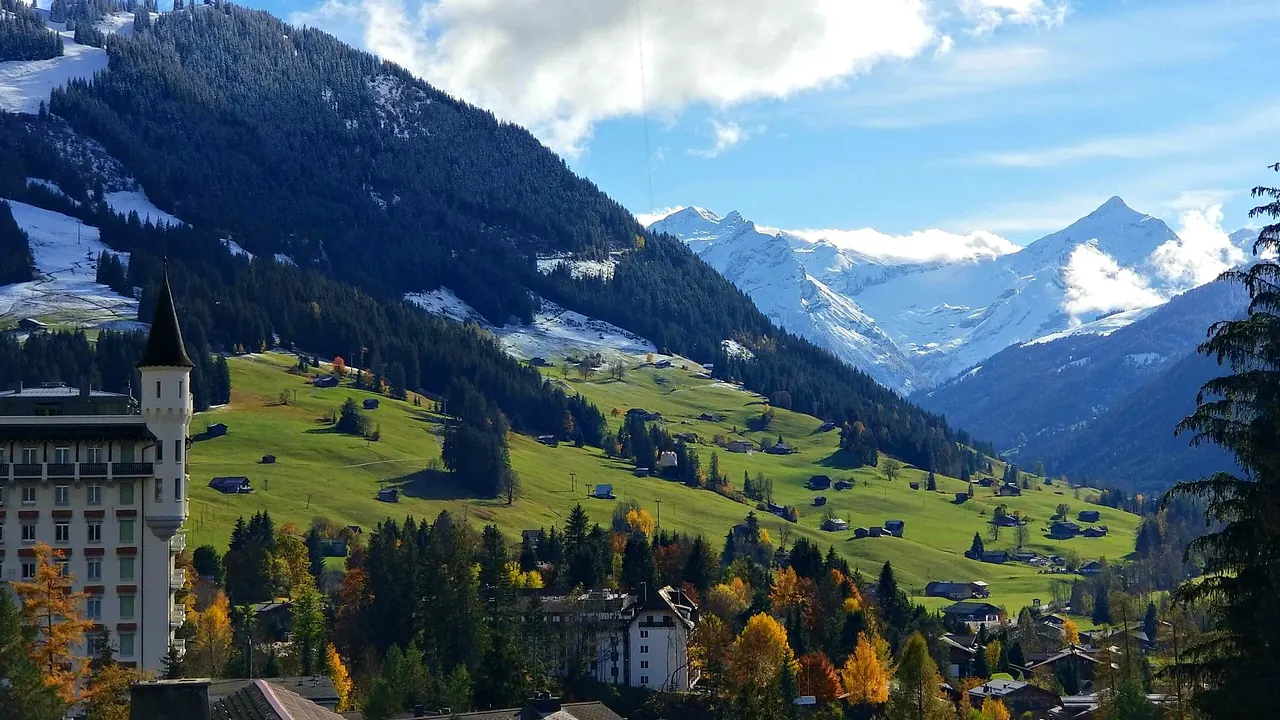
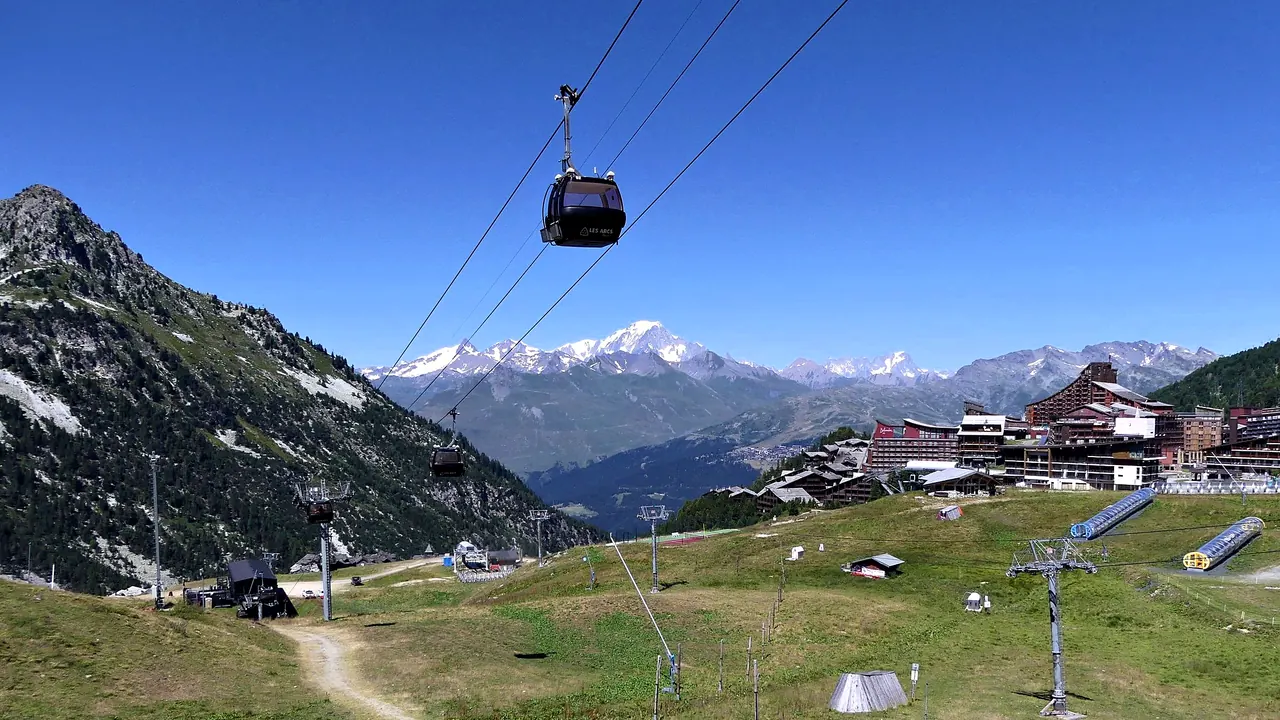
Photos: Gstaad by Samuel Barlow, CC BY-SA 4.0, cropped; Les Arcs by Florian Pépellin, CC BY-SA 4.0, cropped.
Gstaad or Les Arcs?
Our verdict in twelve categories, each scored against the same fixed benchmark cities, and the climate month by month, so you can choose for your trip.
Choose Gstaad for
- shopping
- day trips
- live music and the arts
Gstaad suits travellers who want the mountains as a setting for comfort rather than a test of stamina. Its draws are the lavish hotel spas, long lunches of fondue and shaved Hobelkäse, the Menuhin Festival concerts in village churches, the luxury Promenade and easy train rides down to Montreux or across to Gruyères. The slopes are gentle and the price is very high, so it rewards a calm, unhurried stay more than a hard week of skiing.
Choose Les Arcs for
- families
- prices
- nature and the outdoors
Les Arcs is the choice when the mountain itself is the point. The Paradiski ski area, descents from the Aiguille Rouge and summer trails into the Vanoise give active travellers far more terrain. Its car-free villages and ski schools were built for families on ski weeks. Self-catering apartments also keep it less ruinous than Gstaad, though there is little to do away from the snow and the trails.
Scoreboard
Twelve categories on one fixed scale from 0 to 100. The shaded stretch is the gap between the two.
Your match
Pick a travel style or drag the sliders, and both match scores follow your weighting.
Wins on shopping and day trips with your weighting.
Wins on families and prices with your weighting.
What matters to you?
Category by category
What the scores mean for a trip.
Beaches & swimming
Swimming is a minor extra in both, and Gstaad has slightly more of it. You can take a quick, cold summer dip from the grassy shores of Lauenensee or Arnensee, and the heated outdoor pool down in the valley is warmer.
Les Arcs offers only residence pools and small leisure lakes in the valley. A real lake swim means about two hours' drive to Annecy or Lac du Bourget.
Food & drink
Gstaad eats better, mainly because of its grand-hotel dining rooms, several of them serious gourmet kitchens. These sit alongside slope huts serving rösti and raclette. The cheese is a reason in itself: aged Hobelkäse from Saanen and fire-made L'Etivaz, sold by small valley dairies.
Les Arcs keeps to hearty Savoyard cooking such as tartiflette, croziflette and diots, all built around Beaufort. Away from a few more ambitious kitchens, most meals come from pizzerias, crêperies or a self-catering kitchen.
Culture & sights
Neither has much to see, but the two have different kinds of heritage. In Gstaad it is old: carved and painted Saanenland chalets, the medieval wall paintings in Saanen's late-Gothic church, and a stop at Rougemont's old church.
The interest in Les Arcs is modern design. Charlotte Perriand's stepped blocks at Arc 1600 and Arc 1800 draw architecture enthusiasts. Older baroque chapels lie down in the Tarentaise for anyone who seeks them out.
Nightlife
Both go quiet outside the winter peak, but the mood differs. Gstaad's nights are dressy and exclusive, with hotel bars, a couple of late cellar clubs in the grand hotels and much of the social life at private chalet parties.
Les Arcs is louder and more casual. Terrace bars fill as the lifts close, with DJs and table-dancing in Arc 1800 and Arc 2000, though the many families in apartments mean most evenings end early.
Nature & outdoors
Both are serious mountain bases, but Gstaad's is the gentler kind. Its valleys are pastoral and green, and its home slopes are low and easy, which suits unhurried skiers but leaves snow unreliable early in the season. For high-altitude snow you have to go to Glacier 3000. In summer, the walks to Lauenensee and across the alpine pastures are easier going than most routes around Les Arcs.
Les Arcs offers more mountain, and a wilder one. Linked to La Plagne as Paradiski, it gives a skier far more terrain. There are long descents from the Aiguille Rouge at over 3,200m and good off-piste, and the height keeps the snow more dependable. In summer, trails climb into the Vanoise National Park among ibex and marmots, and via ferrata and a bike park cater for those who want real effort.
Day trips
Gstaad is far better placed for outings. The GoldenPass railway runs down to Montreux, Chillon and the Lavaux vineyard terraces in about an hour and a half. Gruyères is under an hour by car, and Bern's arcaded old town can be reached by train.
From Les Arcs, most trips lead to other mountain places, such as Bourg-Saint-Maurice, the Beaufortain or Val d'Isère. Annecy is about two hours away, and Aosta becomes reachable only in summer, when the Little St Bernard Pass opens.
Good for families
Les Arcs was designed around family ski weeks, and it shows. Children can start ski school very young, there are kindergartens and themed fun slopes, and sledging, pools and ice skating fill the afternoons, all in largely car-free villages.
Gstaad is safe and peaceful, with beginner slopes, sleigh rides and walks past cows and goats. However, it has nothing built specifically for children, and nothing indoors for a wet day.
Getting around
Both can be reached without a car, and Gstaad is slightly simpler once you are there. Its centre is one short car-free promenade, and GoldenPass trains link the neighbouring villages where the lifts start. PostBuses climb to Lauenen and Glacier 3000.
In Les Arcs, a funicular runs up from the Bourg-Saint-Maurice station, but the four villages lie well apart along a winding road. That makes you depend on shuttles that slow down in snow.
Shopping & style
Gstaad has a real shopping street, however short. The Promenade packs fine watchmakers, jewellers, cashmere and fashion labels into a row of chalets, and there are a few shops selling carved wood and Pays-d'Enhaut papercuts.
Les Arcs is about ski rental, outdoor gear and supermarkets. Its best purchases are Beaufort and génépi from Bourg-Saint-Maurice.
Affordability
Les Arcs is the cheaper of the two by a clear margin, though neither is a bargain. In Gstaad the expense comes with the place itself. The grand hotels set the level for meals, lifts and even a short train ride, so a quiet summer stay still costs more than a comparable week in Les Arcs. The Christmas and February weeks cost the most of all.
In Les Arcs, most of the bill comes from the skiing: the Paradiski lift pass, rental and ski school. A summer visit, or a week with fewer days on the slopes, sheds much of that cost. General prices on the French side of the Alps are also lower than Swiss ones. The sharpest peaks fall in the French school vacation weeks, so those are the weeks to avoid.
Live music & performing arts
Music is a real reason to time a Gstaad trip. For several summer weeks, the Menuhin Festival puts leading soloists and orchestras in a large tent and in the intimate churches of Saanen, Rougemont and Lauenen. Winter adds a chamber-music festival and New Year concerts.
Les Arcs has a smaller July chamber festival with a music academy in its halls and chapels. For the rest of the year, live music means bands at the après-ski bars.
Wellness & relaxation
Gstaad is the more restful stay. Its grand hotels run large spas with outdoor pools, sauna landscapes and mountain views, and the quiet village sets a slow rhythm.
Les Arcs offers pools, saunas and hammams in many residences and a few spas aimed at tired skiers, but ski week keeps the pace brisk. It does have one thing Gstaad lacks: real thermal waters at Brides-les-Bains and Salins-les-Thermes, about an hour down the valley.
When should you go?
Pick your month. The climate figures are measured averages, not a forecast.
Gstaad in July
Les Arcs in July
Daytime high, °C
Rainfall in the month, mm
Where the figures come from
Gstaad's temperatures are measured 78 km from the centre, at Les Eplatures.
Gstaad has no rain gauge within 25 km of the centre, so its rainfall comes from a gridded climate dataset read at the destination rather than from a gauge further away.
Les Arcs's temperatures are measured 43 km from the centre, at Grand St. Bernard / Grand Saint Bernard.
Les Arcs's station stands 199 m above the city centre, so the centre is likely a little warmer than the figures say.
Les Arcs has no rain gauge within 25 km of the centre, so its rainfall comes from a gridded climate dataset read at the destination rather than from a gauge further away.
Temperature and rainfall are climate normals, averaged over the years shown. Gstaad: 2010-2020 (rainfall 1991-2020) normals, Les Eplatures (77.5 km from centre). Les Arcs: 1991-2020 normals, Grand St. Bernard / Grand Saint Bernard (43.4 km from centre).
Neither place has beach weather. Gstaad sits much lower, and its summer is genuinely mild, with highs of about 21°C in July and August. That is ideal for valley walks, concerts and lunch on a terrace, though the lakes stay cold. Winter days hover around 3°C, and rain or snow falls fairly evenly all year at roughly 100mm a month, a little heavier in December.
Les Arcs is a high-altitude resort, and it feels it. Daytime highs stay below freezing from November to March, around -4°C in January, which suits a ski week but makes it bitter for lingering outdoors. Even July only reaches about 12°C, so summer is for brisk hiking and biking rather than sunbathing. July has the most sunshine and the least rain. Late autumn is the wettest stretch, peaking at 193mm in November, and December is very dark.
Which traveller are you?
On a family trip with children, Les Arcs is easier. Apartments open straight onto the snow and the villages are mostly car-free. Kindergartens, fun slopes, pools and skating fill the days, while Gstaad offers calm and sleigh rides but nothing built for children.
For a culture and arts trip, Gstaad wins on music. In summer the Menuhin Festival brings leading soloists to a festival tent and to old village churches, and there are rail outings to Chillon and Gruyères. Les Arcs has its July chamber festival and modernist architecture, little else.
On a tight budget, Les Arcs is the more realistic of the two, though neither is cheap. Self-catering apartments, supermarket cheese and quieter weeks in January or late March cut costs. Gstaad sits at the top of Swiss prices and has few mid-range rooms.
Before you go
| Measure | Gstaad | Les Arcs |
|---|---|---|
| Official language | French, German, Italian, Romansh | French |
| Currency | Swiss Franc (CHF) | Euro (EUR) |
| Sockets | CJ230 V, 50 Hz | CE230 V, 50 Hz |
| Driving side | Right | Right |
| Time zone | UTC+1, UTC+2 in summer | UTC+1, UTC+2 in summer |
| Emergency number | 112 | 112 |
| Elevation | 1,050 m | 2,273 m |
| Main airport | Geneva International Airport (GVA)94 km from centre150 non-stop destinations | Geneva International Airport (GVA)92 km from centre150 non-stop destinations |
| Public holidays this year | 10 days | 11 days |
By the numbers
| Measure | Gstaad | Les Arcs |
|---|---|---|
| Population | 2,960 | - |
| Museums within 10 km | 0 | 0 |
| UNESCO World Heritage sites within 50 km | 4 | 0 |
Where else could you go?
Every comparison below shares a destination with this one, so you can follow Gstaad or Les Arcs somewhere new.
- La Rosièrevs Les Arcs
- La Plagnevs Les Arcs
- Tignesvs Les Arcs
- Val d'Isèrevs Les Arcs
- Adelbodenvs Gstaad
- Courchevelvs Les Arcs