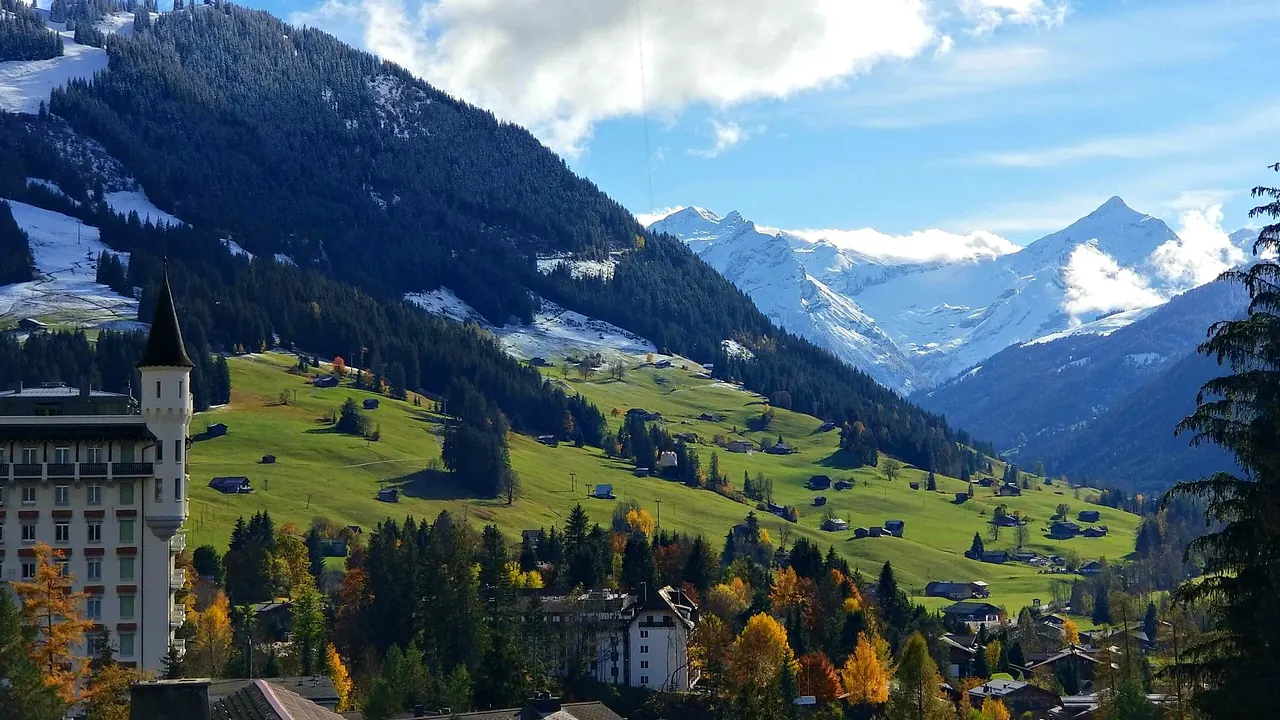
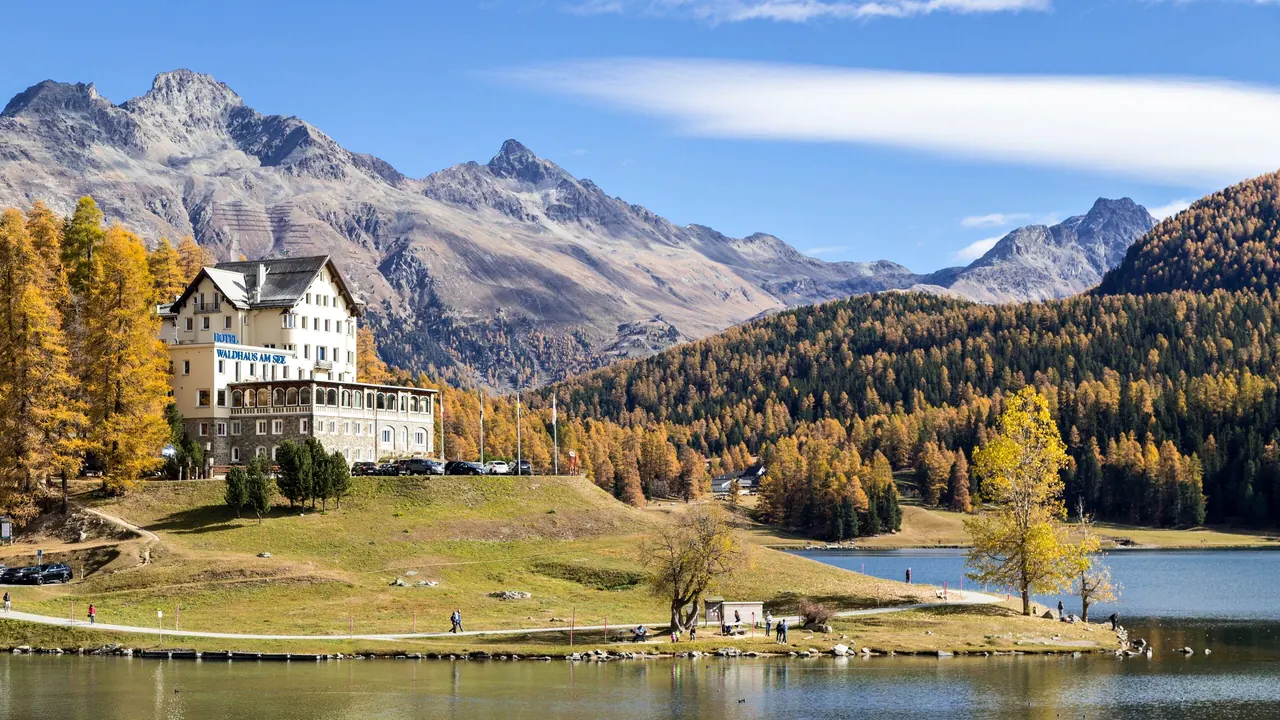
Photos: Gstaad by Samuel Barlow, CC BY-SA 4.0, cropped; St. Moritz by JoachimKohler-HB, CC BY-SA 4.0, cropped.
Gstaad or St. Moritz?
Our verdict in twelve categories, each scored against the same fixed benchmark cities, and the climate month by month, so you can choose for your trip.
Choose Gstaad for
- live music and the arts
- day trips
- shopping
Gstaad suits travellers who want a gentle, green Alpine stay with plenty to do away from the mountain. Summer is its strongest card. You get pastoral valley walks, the Menuhin Festival in the village churches, and a scenic railway down to Lake Geneva, with Gruyères and Bern also within reach for days out. Its homely, low-key village also makes an easy base for a calm family stay.
Choose St. Moritz for
- culture and sights
- nature and the outdoors
- getting around
For big skiing, high-altitude scenery and a stay without a car, St. Moritz is the stronger choice. The Upper Engadine has grander landscapes, more serious slopes and lakes for kitesurfing. Its old spring-water spa tradition makes the days between outings more restful, and the Segantini Museum is worth an afternoon. Its winter evenings are a little more glamorous too, though neither place is for a big night out.
Scoreboard
Twelve categories on one fixed scale from 0 to 100. The shaded stretch is the gap between the two.
Your match
Pick a travel style or drag the sliders, and both match scores follow your weighting.
Too close to call, level with your weighting
Wins on live music and the arts and day trips with your weighting.
Wins on culture and sights and nature and the outdoors with your weighting.
What matters to you?
Category by category
What the scores mean for a trip.
Beaches & swimming
Neither is a swimming destination. The only real difference is which cold lake you dip into. Around Gstaad it is the grassy shores of Lauenensee and Arnensee. Most people use the heated outdoor pool in the valley instead, and the nearest proper lakeside bathing is at Montreux on Lake Geneva.
St. Moritz sits some 750m higher, and its glacier-fed lakes are colder still. The small forest lake of Lej da Staz is the one that warms enough for a short summer swim, while Lake St. Moritz belongs to windsurfers in wetsuits. In both places, plan to swim in the hotel pool.
Food & drink
Both eat at the same two levels, grand-hotel dining rooms and huts on the slopes, with little in between, and many kitchens close out of season. St. Moritz has a slight edge at the top end. It has more serious kitchens, and long lunches on the terraces at Corviglia, Muottas Muragl and Diavolezza.
The bigger difference is the local food. Gstaad is cheese country, with fondue and raclette in the huts, curls of aged Saanen Hobelkäse, and L'Etivaz bought from the valley dairies. The Engadine looks towards Graubünden and Italy instead: capuns, pizzoccheri, air-dried beef, and the dense nut tart from the old village confectioners.
Culture & sights
Neither will fill a sightseeing day, but St. Moritz has a little more to see. The Segantini Museum and its great Alpine triptych are worth the trip on their own, and the Engadin Museum shows painted farmhouse rooms. The resort's own history adds a story you can walk through: it hosted the Winter Olympics in 1928 and 1948, and the Cresta Run is still in use.
Gstaad's heritage is mostly in its buildings. There are the carved, dark-timbered Saanenland chalets, the church at Saanen with its medieval wall paintings, and the old church at Rougemont. They are pleasant stops on a stroll, not a programme.
Nightlife
Both come alive only in the winter season, with après-ski in huts and hotel bars and a couple of exclusive late clubs, and both go quiet after dinner in summer. St. Moritz is the more openly glamorous, with hotel bars full of fur and champagne and a season that runs into early March. Gstaad is more discreet, and much of its social life happens in hotel cellars and at private chalet parties.
Nature & outdoors
This is where both resorts are at their best, and St. Moritz has the bigger landscape. Its high, sunny valley is strung with lakes below peaks over 3,000m. It has serious skiing on Corviglia, Corvatsch and Diavolezza and cross-country trails good enough for a marathon. In summer there are walks to the Morteratsch glacier, kitesurfing on Lake Silvaplana, and the Swiss National Park within the hour.
Gstaad is greener, lower and gentler. Its linked home ski areas are relaxed, though snow can be thin early in the season, and Glacier 3000 adds altitude. In summer it is lovely walking country, out to Lauenensee and the Geltental waterfalls or across pastures and ridges, with rafting on the Saane as well.
Day trips
Gstaad is the better base for day trips, because the GoldenPass line runs straight down to Lake Geneva. In about an hour and a half you are in Montreux, with the Castle of Chillon and the Lavaux terraces close by. Gruyères is under an hour by car, and Lake Thun and Bern's arcaded old town lie the other way.
From St. Moritz the outings are more about the train ride and small places. The Bernina line crosses the pass to Tirano in Italy, Sils Maria has Nietzsche's house, the Lower Engadine has its sgraffito villages, and Soglio lies over the Maloja Pass. They are charming, but there is no lake city or capital within reach.
Good for families
Both are equally safe and calm, and both have little built specifically for children, so the choice comes down to atmosphere. Gstaad feels the more homely. It has gentle home slopes, sleigh rides and summer walks past cows and goats, and the village suits young families as it is. St. Moritz has skating on natural ice and nursery slopes on Corviglia, but it is built around adult luxury, so families with small children often stay in the quieter villages nearby.
Getting around
St. Moritz is the easier place to manage without a car. Trains and buses connect the whole Upper Engadine from Maloja to Zuoz, along with the lifts and funiculars. The village itself climbs steeply from Bad up to Dorf, though escalators and a lift help, and icy winter pavements call for proper boots.
Gstaad's centre is a short car-free promenade where everything is a few minutes apart. GoldenPass trains and PostBuses reach the neighbouring villages, the side valleys and Glacier 3000. Because the resort is spread over several valleys and services thin out in the quiet months, many visitors end up using hotel shuttles or a car.
Shopping & style
Both pack a surprising amount of luxury into one short street: watches, jewellery, fashion labels and furs. Neither has anything for a modest budget. Gstaad's Promenade also has cashmere, interior design and local crafts such as the papercut art of the Pays-d'Enhaut. Via Serlas in St. Moritz leans towards high-end ski wear, its souvenirs are Engadine woodwork, linen and nut tart, and some of its boutiques close outside the season.
Affordability
There is nothing to choose between them on cost. Both are among the most expensive places in the Alps, for rooms, meals and lift passes alike, and both are gentler in summer and the shoulder seasons than at Christmas and in February.
The ways of saving differ a little. In Gstaad, the usual answer is to sleep down the valley in Saanen or Zweisimmen and come in for the day. In St. Moritz, many hotels include local lifts and public transport in the room, and simpler guesthouses elsewhere in the Engadine make a gentler base.
Live music & performing arts
For music, Gstaad is the clear choice. Each summer, the Gstaad Menuhin Festival, founded by Yehudi Menuhin, brings leading soloists and orchestras for several weeks. They play in a large tent and in the small village churches of Saanen, Rougemont and Lauenen. Winter adds chamber music and New Year concerts.
St. Moritz has good festivals on a smaller scale, a summer jazz festival in small rooms and the Engadin Festival's chamber concerts across the valley, but it has no hall of its own. Outside festival dates there is little to hear in either place.
Wellness & relaxation
St. Moritz has the deeper spa tradition. It was a spa town before it was a ski resort, and its iron-rich spring still supplies a medical bath in St. Moritz Bad. There is also a public indoor pool with saunas for visitors not staying in a grand hotel, and the thermal baths at Scuol are a train ride away. High winter there is more showy than restful.
Gstaad has no springs or bathing tradition, but it has an unusual number of lavish hotel spas for its size. With the village's slow rhythm of walk, lunch and sauna, it makes a truly calm stay, especially if you are a guest at one of those hotels.
When should you go?
Pick your month. The climate figures are measured averages, not a forecast.
Gstaad in July
St. Moritz in July
Daytime high, °C
Rainfall in the month, mm
Where the figures come from
Gstaad's temperatures are measured 78 km from the centre, at Les Eplatures.
Gstaad has no rain gauge within 25 km of the centre, so its rainfall comes from a gridded climate dataset read at the destination rather than from a gauge further away.
St. Moritz has no rain gauge within 25 km of the centre, so its rainfall comes from a gridded climate dataset read at the destination rather than from a gauge further away.
Temperature and rainfall are climate normals, averaged over the years shown. Gstaad: 2010-2020 (rainfall 1991-2020) normals, Les Eplatures (77.5 km from centre). St. Moritz: 2015-2025 (rainfall 1991-2020) normals, Samedan (5.5 km from centre).
Gstaad is the milder of the two in every month. Summer highs reach about 21°C in July and August, which is warm enough for long walks and a quick, cold dip in a mountain lake, and winter days stay just above freezing. St. Moritz is higher and a degree or two cooler in summer. Its winters are properly cold, with January highs around -1°C. That is good for skiing and the frozen lakes, but walking around the village is a bracing affair.
The rain falls in different patterns. Gstaad has no real dry season. Every month is fairly wet, and it is wettest in early winter, with about 125mm in December. St. Moritz splits the year in two. From December to April it is dry, with only about 42mm in February. From June through November it is much wetter, and autumn is barely drier than high summer. In both places, June to September is the time for walking and the lake shores, and January to March is the time for the slopes, when St. Moritz has the drier, steadier weather.
Which traveller are you?
On a culture and arts trip, Gstaad is the better pick if you go in summer. The Menuhin Festival brings leading classical musicians to its village churches, and the GoldenPass line takes you to Chillon, Lavaux, Gruyères and Bern. St. Moritz has Segantini but little more.
For an outdoors trip, choose St. Moritz. The high Upper Engadine has bigger skiing, top cross-country trails, glacier hikes to Morteratsch, kitesurfing on Lake Silvaplana and the Swiss National Park within an hour, and you can reach all of it without a car.
On a relaxing and wellness trip, St. Moritz is again slightly ahead. Its spring-water medical bath, its elaborate hotel spas and the thermal baths at Scuol give it a real tradition of taking the waters. Gstaad's lavish spas are mostly for hotel guests.
Before you go
| Measure | Gstaad | St. Moritz |
|---|---|---|
| Official language | French, German, Italian, Romansh | French, German, Italian, Romansh |
| Currency | Swiss Franc (CHF) | Swiss Franc (CHF) |
| Sockets | CJ230 V, 50 Hz | CJ230 V, 50 Hz |
| Driving side | Right | Right |
| Time zone | UTC+1, UTC+2 in summer | UTC+1, UTC+2 in summer |
| Emergency number | 112 | 112 |
| Elevation | 1,050 m | 1,822 m |
| Main airport | Geneva International Airport (GVA)94 km from centre150 non-stop destinations | Zürich Airport (ZRH)145 km from centre226 non-stop destinations |
| Public holidays this year | 10 days | 9 days |
By the numbers
| Measure | Gstaad | St. Moritz |
|---|---|---|
| Population | 2,960 | 5,027 |
| People per km² | - | 175 |
| Museums within 10 km | 0 | 7 |
| UNESCO World Heritage sites within 50 km | 4 | 2 |
Where else could you go?
Every comparison below shares a destination with this one, so you can follow Gstaad or St. Moritz somewhere new.
- Adelbodenvs Gstaad
- Crans-Montanavs Gstaad
- Leukerbadvs Gstaad
- Lenzerheidevs St. Moritz
- Arosavs St. Moritz
- Davosvs St. Moritz