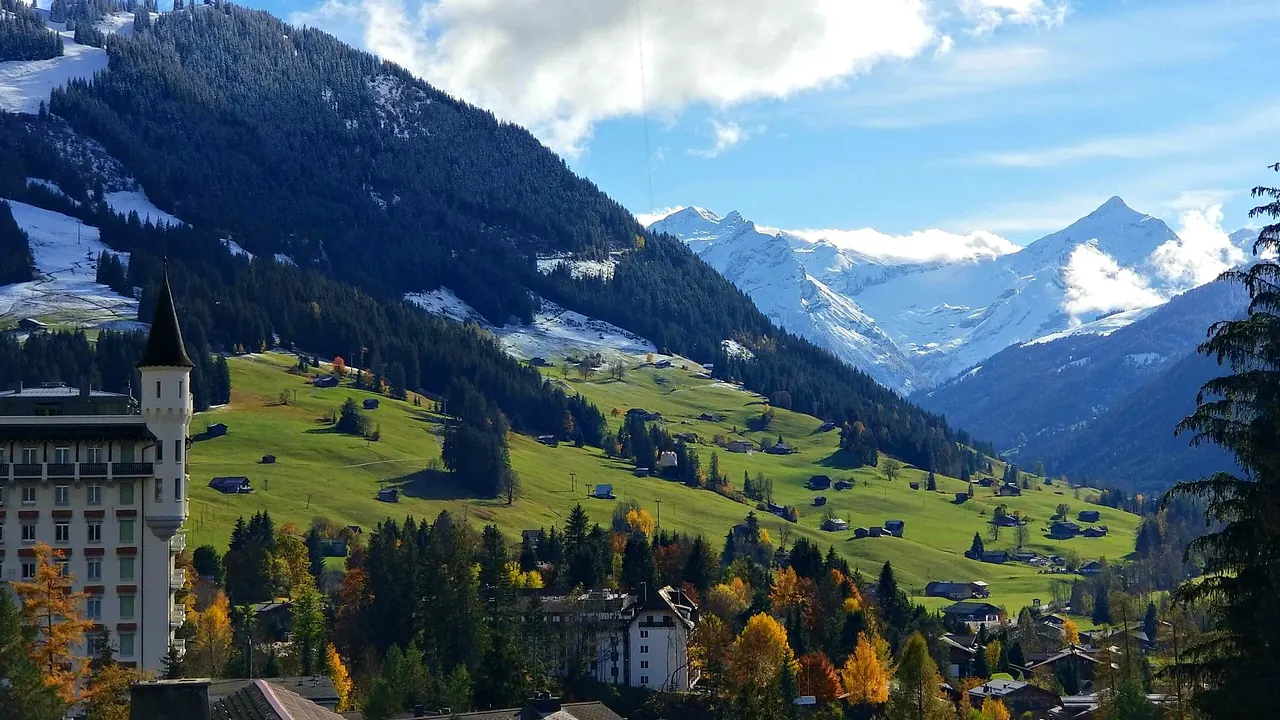
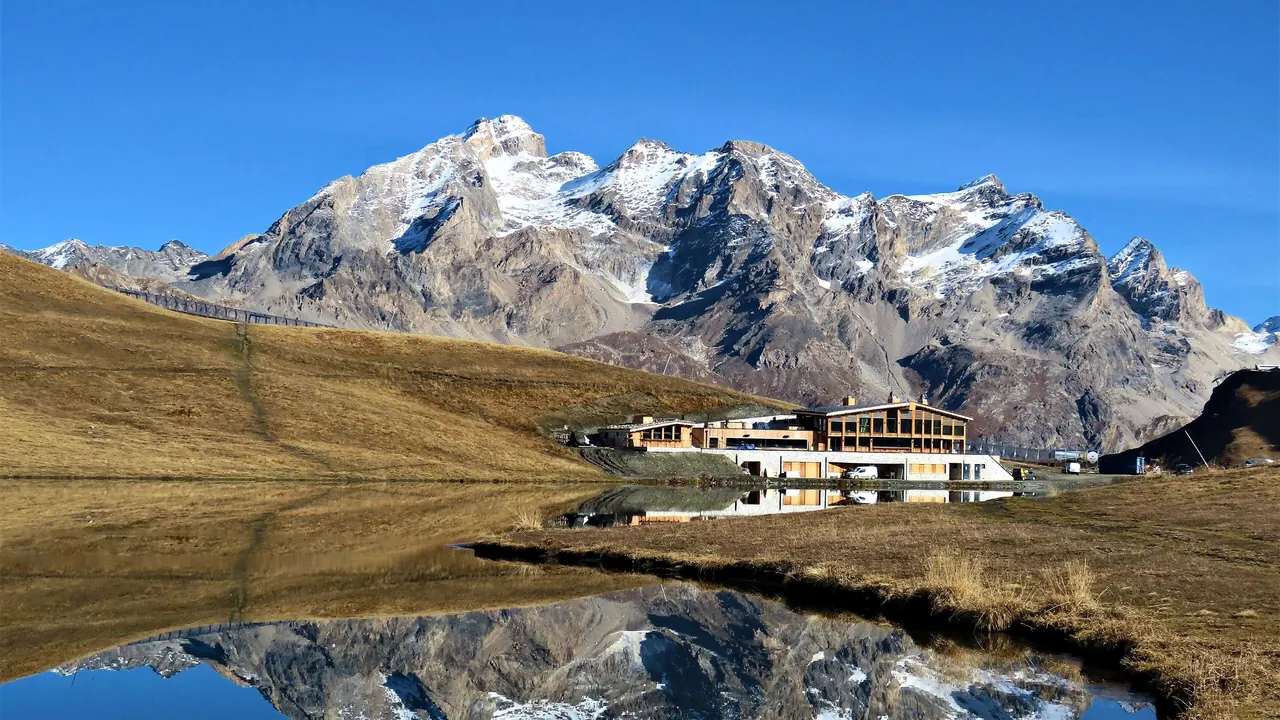
Photos: Gstaad by Samuel Barlow, CC BY-SA 4.0, cropped; Val d'Isère by Rémih, CC BY-SA 4.0, cropped.
Gstaad or Val d'Isère?
Our verdict in twelve categories, each scored against the same fixed benchmark cities, and the climate month by month, so you can choose for your trip.
Choose Gstaad for
- day trips
- live music and the arts
- shopping
Gstaad suits a slower, more comfortable mountain stay where the skiing is gentle and the rest of the day matters just as much: lavish grand-hotel spas, the luxury Promenade, summer concerts in old village churches, and a panoramic railway down to Lake Geneva or across to Bern. It is the better pick for groups where not everyone skis, and for summer walkers who like green, pastoral valleys.
Choose Val d'Isère for
- nightlife
- nature and the outdoors
- prices
Serious skiers should go to Val d'Isère. Linked with Tignes, it has high, snow-sure terrain, steep faces and big off-piste routes, which reach well beyond Gstaad's home slopes, and its après-ski is louder and goes on later. The cost is a village at the end of a long valley, with little to do off the snow and few outings beyond it. It rewards people who want to spend every day on the mountain.
Scoreboard
Twelve categories on one fixed scale from 0 to 100. The shaded stretch is the gap between the two.
Your match
Pick a travel style or drag the sliders, and both match scores follow your weighting.
Wins on day trips and live music and the arts with your weighting.
Wins on nightlife and nature and the outdoors with your weighting.
What matters to you?
Category by category
What the scores mean for a trip.
Beaches & swimming
Neither is a place to swim, and the gap between them is small. Gstaad's lakes at Lauenen and Arnensee have grassy shores for a cold summer dip, and there is a heated outdoor pool in the valley. Val d'Isère sits about 800m higher, so the choice is snowmelt in Lac de Tignes or the indoor pool at the sports centre. Gstaad's one real extra is Lake Geneva at Montreux, a long day out but at least within reach.
Food & drink
The food is on a par, and in both places it is built on cheese, though from two different traditions. Gstaad is Swiss: thin curls of long-aged Saanen Hobelkäse, L'Etivaz from the summer dairies, fondue in the huts, and serious gourmet cooking in the grand hotel dining rooms.
Val d'Isère is Savoyard: tartiflette, croziflette and charcuterie, Beaufort in nearly every dish, and Savoie whites in the wine bars, plus a few of the most celebrated kitchens in the French Alps. Neither offers much variety, and both largely close between seasons.
Culture & sights
Neither has enough sightseeing to fill a day, and what each has is modest and very local. Gstaad's heritage is in its carved and painted Saanenland chalets, the medieval wall paintings in Saanen's late-Gothic church and the old church at Rougemont. Val d'Isère has its Baroque altarpiece, the stone and larch hamlets of Le Fornet and Le Joseray, and the Bellevarde face where the 1992 Olympic downhill was raced, which matters more to skiers than to sightseers.
Nightlife
Val d'Isère is clearly the place to go out. Après-ski starts mid-afternoon with dancing on tables in ski boots, then moves down to crowded village bars and a couple of clubs that stay open late, with seasonal workers and groups of friends as well as chalet guests.
Gstaad's winter nights are smaller and dressier: hotel bars, a couple of exclusive cellar clubs, and a good deal of the social life behind closed doors at private chalet parties. In summer both villages go quiet, though Val d'Isère keeps a few terrace bars open.
Nature & outdoors
Both are excellent mountain bases, but Val d'Isère has the bigger, higher terrain. With Tignes it has steep pistes, serious off-piste and ski touring, and the Pissaillas glacier and Grande Motte keep the snow good from late November into May. Gstaad's linked areas across the Saanenland are gentler and lower, so snow can be thin early in the season unless you head to Glacier 3000.
The two summers feel different too. Gstaad has soft valley walks to Lauenensee and the Geltental waterfalls, plus rafting on the Saane. Val d'Isère opens onto the wilder Vanoise National Park, with ibex, chamois and one of the highest paved road passes in the Alps.
Day trips
This is one of Gstaad's biggest advantages. The GoldenPass railway runs down to Montreux, the Castle of Chillon and the Lavaux vineyard terraces, Gruyères and its castle are under an hour away by car, and Lake Thun and Bern can be reached by train.
Val d'Isère sits at a dead end in winter, when the passes close, so outings rarely go beyond Bourg-Saint-Maurice and the Tarentaise villages. Summer opens up Bonneval-sur-Arc and the road to Aosta in Italy, but the choice stays narrow.
Good for families
Both work about equally well for families, in slightly different ways. Gstaad is the calmer choice: gentle beginner slopes, sleigh rides, and summer walks past cows and goats, though there is nothing to do indoors on a wet day.
Val d'Isère is set up for families who ski, with ski schools from preschool age, fenced snow gardens and childcare in many chalets, and its sports centre adds a pool, climbing wall and ice rink. The cold and the altitude are harder going for very young children.
Getting around
Gstaad is easier to reach and to move around from. It sits on a main railway line with stations in the neighbouring villages, PostBuses run up the side valleys, and the centre is a short, mostly car-free promenade. The catch is that the resort spreads along several valleys, and many visitors end up using a car.
Val d'Isère is simple once you arrive, with free shuttles along the valley and lifts close to most beds. Getting there is the hard part: it is about an hour by road from the nearest station and several hours from the airports.
Shopping & style
Gstaad offers far more for shoppers, all of it on one street. The chalets along the Promenade house fine watchmakers, jewellers, cashmere and fashion houses, with local papercut art and carved wood as more personal souvenirs. Val d'Isère's main street is mostly ski kit, rental and boot-fitting. Its best buys are edible: Beaufort, charcuterie and Savoie wine from the delicatessens.
Affordability
Both are among the most expensive places in the Alps, but Val d'Isère is slightly easier on the wallet. Self-catered apartments, quiet January weeks and the late season bring a ski week down a little, although passes, hire and lessons still add up.
Gstaad is priced at the very top, with few mid-range rooms. Budget travellers there usually sleep down the valley in Saanen or Zweisimmen and come in for the day. In both resorts, summer costs noticeably less than Christmas or February.
Live music & performing arts
Gstaad wins this easily, thanks to the Menuhin Festival. Each summer, leading orchestras and soloists play in a large tent and in the intimate village churches of Saanen, Rougemont and Lauenen, and winter brings chamber music and New Year concerts. In Val d'Isère live music means cover bands and DJs in the après-ski bars, with no theatre or concert hall anywhere nearby.
Wellness & relaxation
Gstaad does wellness better, though neither has thermal springs. Its grand hotels have an unusual number of large spas with mountain views, and the quiet village makes it easy to settle into a rhythm of walks, long lunches and saunas.
In Val d'Isère the spas come with the hotels and chalets too, but for anyone staying elsewhere the public sauna and steam rooms at the sports centre are easier to use. A winter week there is busy and sociable, so it gets properly restful only in early summer and September.
When should you go?
Pick your month. The climate figures are measured averages, not a forecast.
Gstaad in July
Val d'Isère in July
Daytime high, °C
Rainfall in the month, mm
Where the figures come from
Gstaad's temperatures are measured 78 km from the centre, at Les Eplatures.
Gstaad has no rain gauge within 25 km of the centre, so its rainfall comes from a gridded climate dataset read at the destination rather than from a gauge further away.
Val d'Isère has no weather station within reach, so its figures come from a gridded climate model rather than a measured record, and read a broad area rather than one spot.
Temperature and rainfall are climate normals, averaged over the years shown. Gstaad: 2010-2020 (rainfall 1991-2020) normals, Les Eplatures (77.5 km from centre). Val d'Isère: 2001-2020 normals, NASA POWER reanalysis grid, no weather station within 90 km.
Both villages have two seasons, snow and summer, but winter feels very different in each. Val d'Isère is much colder, with daytime highs below freezing from December to February and around -4°C in January, against about 3°C in Gstaad. That cold is why its high slopes keep their snow well into spring, while Gstaad's lower home runs can be thin early on. Neither gets warm enough for a beach trip in any month.
For walking, June to September is the time to go in both. Gstaad reaches about 21°C in July and August, comfortable for long valley walks, while Val d'Isère peaks nearer 18°C. Gstaad is the wetter of the two in every month, with rain spread through the year and December the wettest at about 125mm. Val d'Isère is drier overall, and May brings it the most rain.
Which traveller are you?
On an outdoors trip, choose Val d'Isère. Its high, snow-sure ski area with Tignes, the glacier at the top and its off-piste suit strong skiers, and in summer it opens onto the Vanoise National Park and the climb to the Col de l'Iseran.
For a food and nightlife trip, Val d'Isère also comes out ahead. The Savoyard cooking is roughly as good as Gstaad's Swiss cheese kitchens, but the evenings are far livelier: table-dancing après-ski on the slopes, packed village bars and basement clubs open into the early hours.
On a culture and arts trip, Gstaad is the clear choice. The Menuhin Festival brings leading soloists to a festival tent and to small village churches every summer, and the railway reaches Chillon, Gruyères and Bern's arcaded old town as day trips.
Before you go
| Measure | Gstaad | Val d'Isère |
|---|---|---|
| Official language | French, German, Italian, Romansh | French |
| Currency | Swiss Franc (CHF) | Euro (EUR) |
| Sockets | CJ230 V, 50 Hz | CE230 V, 50 Hz |
| Driving side | Right | Right |
| Time zone | UTC+1, UTC+2 in summer | UTC+1, UTC+2 in summer |
| Emergency number | 112 | 112 |
| Elevation | 1,050 m | 1,785 m |
| Main airport | Geneva International Airport (GVA)94 km from centre150 non-stop destinations | Geneva International Airport (GVA)111 km from centre150 non-stop destinations |
| Public holidays this year | 10 days | 11 days |
By the numbers
| Measure | Gstaad | Val d'Isère |
|---|---|---|
| Population | 2,960 | 1,567 |
| People per km² | - | 17 |
| Museums within 10 km | 0 | 0 |
| UNESCO World Heritage sites within 50 km | 4 | 0 |
Where else could you go?
Every comparison below shares a destination with this one, so you can follow Gstaad or Val d'Isère somewhere new.
- Tignesvs Val d'Isère
- Les Arcsvs Val d'Isère
- Val Cenisvs Val d'Isère
- Adelbodenvs Gstaad
- La Rosièrevs Val d'Isère
- Crans-Montanavs Gstaad