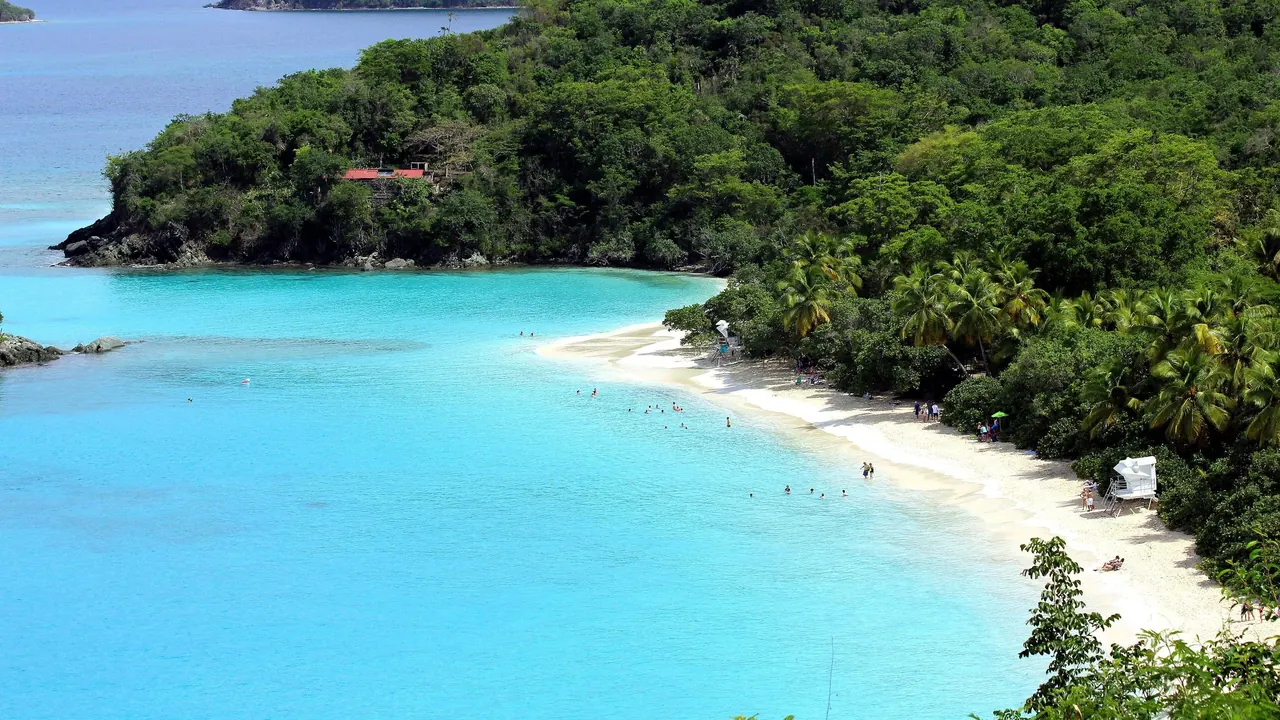
Photos: St John by Artix Kreiger 2, CC BY 2.0, cropped.
Guadeloupe or St John?
Our verdict in twelve categories, each scored against the same fixed benchmark cities, and the climate month by month, so you can choose for your trip.
Choose Guadeloupe for
- live music and the arts
- food and drink
- prices
Guadeloupe suits travellers who want more than one kind of day. Its two wings pair reef-sheltered white-sand lagoons on Grande-Terre with a volcanic rainforest on Basse-Terre. On top of that come Creole cooking, rum distilleries, gwoka drumming and ferries to Les Saintes and Marie-Galante. It is also the easier place to keep costs under control, with villas and guesthouses where you can cook and lolos where eating out stays reasonable.
Choose St John for
- beaches
St John is the choice when the beach is the whole point. Its north shore bays lie inside a national park with almost nothing built on them, the water is clear and calm, and turtles graze in water a child can stand in. It is costly, quiet after dinner and short on food and sights. If you can accept that, you get a small, protected island where the days run from early swim to snorkel to sundowner and very little else.
Scoreboard
Twelve categories on one fixed scale from 0 to 100. The shaded stretch is the gap between the two.
Your match
Pick a travel style or drag the sliders, and both match scores follow your weighting.
Wins on live music and the arts and food and drink with your weighting.
Wins on beaches with your weighting.
What matters to you?
Category by category
What the scores mean for a trip.
Beaches & swimming
Both have warm, swimmable sea all year, but St John's beaches are the more consistently superb. Its north shore runs bay after bay of white sand inside the national park, from Hawksnest and Trunk Bay with its snorkel trail to Maho and Francis. The water is clear and sheltered, and almost nothing is built behind the sand.
Guadeloupe has more variety and more ground to cover. There are calm lagoons along Grande-Terre's south coast from Le Gosier to Saint-François, wilder, darker sand on Basse-Terre, and the bays of Les Saintes and Marie-Galante. The catch is sargassum on some east- and south-facing shores in certain months, so it pays to be able to switch coasts.
Food & drink
Guadeloupe is much the better place to eat. Its Creole kitchen has a real identity, from accras and colombo curries to the bokit vans. The markets of Pointe-à-Pitre and the rum distilleries of Marie-Galante make food part of the sightseeing.
On St John, meals centre on Cruz Bay's open-air restaurants and beach bars, with a few West Indian kitchens for johnnycakes and stewed goat. Almost everything arrives by ship and there are no real markets, so many villa guests end up cooking for themselves.
Culture & sights
Neither is a culture trip, but Guadeloupe gives you more to see. The Mémorial ACTe in Pointe-à-Pitre treats the history of slavery with real weight. Forts, Hindu temples, Amerindian rock carvings and the sugar estates of Marie-Galante add a layer, though it is spread across the islands.
St John's history is told mainly through ruins along its trails: the Annaberg sugar mill, the Taíno petroglyphs on the Reef Bay Trail and the fort above Coral Bay where the 1733 revolt began. There is no museum of note, so a morning or two covers it.
Nightlife
Guadeloupe has the livelier evenings. Le Gosier has bars, a casino and weekend clubs playing zouk and dancehall, and the waterfronts in Sainte-Anne and Saint-François stay busy until around midnight. Carnival, from January to Ash Wednesday, keeps the whole island up late.
St John has no clubs at all. A few open-air bars on the Cruz Bay waterfront and in Coral Bay serve rum drinks into the late evening, and anyone after more takes the ferry to St Thomas.
Nature & outdoors
Guadeloupe has the bigger landscape. Basse-Terre's rainforest national park climbs to the steaming summit of La Soufrière at 1,467m, with the Carbet falls and the Route de la Traversée on the way. Offshore, the Cousteau Reserve and the mangroves of the Grand Cul-de-Sac Marin cover the water.
St John is smaller in scale and gentler: dry forest and headlands inside Virgin Islands National Park, short hikes such as Ram Head and the Reef Bay Trail, and reefs at Waterlemon Cay full of turtles and rays. It is excellent for snorkelling and paddling, less so for a demanding hike.
Day trips
On both islands the good days out involve a boat, and Guadeloupe has more of them. Ferries reach the painted village and bay of Terre-de-Haut in Les Saintes, the windmills and distilleries of Marie-Galante, quiet La Désirade and even Dominica. On the main island, towns such as Deshaies can fill an afternoon.
From St John, St Thomas is twenty minutes away, and charter boats run to the British Virgin Islands, with Jost Van Dyke and The Baths on Virgin Gorda the highlights. Ferries are infrequent, and crossing to the British side means a passport and customs.
Good for families
Guadeloupe is the easier family base. The knee-deep lagoons at Sainte-Anne suit small children. When they tire of the beach there is the aquarium at Le Gosier, the zoo at Parc des Mamelles and the botanical garden at Deshaies, with French healthcare behind it all.
St John works for children who are happy in the water, with turtles at Maho Bay and the gentle snorkel trail at Trunk Bay. Beyond that there is little for them, few lifeguards, and a flight, a taxi and a ferry just to arrive.
Getting around
Both need a car, and neither is easy without one. Guadeloupe is the simpler of the two: you fly straight in and drive on good French-style roads. Distances are longer, though, and traffic around Pointe-à-Pitre and the bridges between the two wings can be slow, so many visitors stay on one side.
St John is small but awkward. With no airport, you arrive by ferry from St Thomas, then drive steep switchbacks on the left, usually in a hired jeep. Safari taxis to the north shore beaches and a walkable Cruz Bay help those staying nearby.
Shopping & style
Neither is a shopping destination, but Guadeloupe offers a little more. Pointe-à-Pitre's covered spice market sells vanilla, punches and madras cloth, the distilleries sell rum at source, and French chains and malls cover practical needs. On St John, shopping means an hour among the galleries, jewellers and resortwear boutiques in the Cruz Bay courtyards, with the duty-free streets of Charlotte Amalie a ferry ride away.
Affordability
Neither is cheap, but St John is markedly the more expensive. Guadeloupe's prices track mainland France or a little above. Villas, apartments and guesthouses with kitchens, along with bokit vans and lolos, keep a stay in check, though a hire car is a fixed cost.
On St John, high villa and resort rates, restaurant prices driven up by shipping, jeep hire, ferries and taxis all add up fast. The free national park beaches and trails and the Cinnamon Bay campground are the main ways to soften the cost.
Live music & performing arts
Guadeloupe has a living music culture. Gwoka drumming, recognised by UNESCO, fills léwòz evenings, zouk plays everywhere, and carnival groups parade with drums and conch shells for weeks. L'Artchipel in Basse-Terre town and the Terre de Blues festival on Marie-Galante add formal stages.
St John has no theatre or concert hall. Live music means a singer-guitarist or a steel pan band at a Cruz Bay bar, and the St John Festival in early summer, with calypso and quelbe, is the one big occasion.
Wellness & relaxation
Guadeloupe has the edge, thanks to its volcano. Hot springs at the Bains Jaunes on the way up La Soufrière, shoreline pools near Bouillante and the small thermal spa at Ravine Chaude give it a real bathing tradition. Deshaies and Les Saintes are made for slowing down.
St John offers calm rather than treatments. It has no springs, little traffic, quiet nights broken only by tree frogs, and hillside villas looking over the water. Massage therapists who come to the villas and a few yoga studios make up the rest.
When should you go?
Pick your month. The climate figures are measured averages, not a forecast.
Guadeloupe in July
St John in July
Daytime high, °C
Rainfall in the month, mm
Temperature and rainfall are climate normals, averaged over the years shown. Guadeloupe: 1991-2020 normals, Le Raizet, Guadeloupe (7.3 km from centre). St John: 1991-2020 normals, C. Amalie / St. Thomas Airport (20 km from centre).
Both islands are hot all year, with daytime highs from about 29°C in winter to 32°C in late summer, and both seas are warm enough to swim in every month. The difference is rain. St John is the drier of the two all year round. Its wetter stretch from August to November is modest next to Guadeloupe's, where rain builds from May and peaks in October at about 211mm. Late summer and autumn are also the hurricane months on both.
For each island the best window is roughly January to April. Guadeloupe is driest in February, its sunshine holds fairly steady through the year, and the dry months suit the hiking on Basse-Terre. St John stays reliably dry from January right through June, with under 80mm in any of those months, so its beach season runs further into early summer.
Which traveller are you?
On a beach and sun trip, Guadeloupe gives you range, from Grande-Terre's calm lagoons to the bays of Les Saintes. St John still has the edge. Its north shore is one unbroken run of park-protected white sand, clear and sheltered, with turtles close in.
For a food and nightlife trip, Guadeloupe is the clear pick. Creole cooking, roadside bokit, market spices and rum tastings give meals real character, and Le Gosier has bars and weekend clubs. In Cruz Bay on St John, most evenings end soon after dinner.
On a tight budget, Guadeloupe is the cheaper of the two, though its prices still run at or above mainland France's. Bokit vans and market stalls keep meals cheap. St John costs far more, and its rates only ease in the summer and autumn hurricane months.
Before you go
| Measure | Guadeloupe | St John |
|---|---|---|
| Official language | - | English |
| Currency | Euro (EUR) | US Dollar (USD) |
| Sockets | CE230 V, 50 Hz | - |
| Driving side | Right | Left |
| Time zone | UTC-4 | UTC-4 |
| Emergency number | 112 | 911 |
| Main airport | Maryse Condé International Airport (PTP)21 non-stop destinations | Cyril E. King Airport (STT)26 non-stop destinations |
| Public holidays this year | 12 days | 18 days |
By the numbers
| Measure | Guadeloupe | St John |
|---|---|---|
| Population | 384,160 | 3,881 |
| People per km² | 236 | 76 |
| Swim season, months above 21 °C | 12 months | 12 months |
Where else could you go?
Every comparison below shares a destination with this one, so you can follow Guadeloupe or St John somewhere new.
- St Thomasvs St John
- British Virgin Islandsvs St John
- Culebravs St John
- St Croixvs St John
- Viequesvs St John
- Puerto Ricovs St John