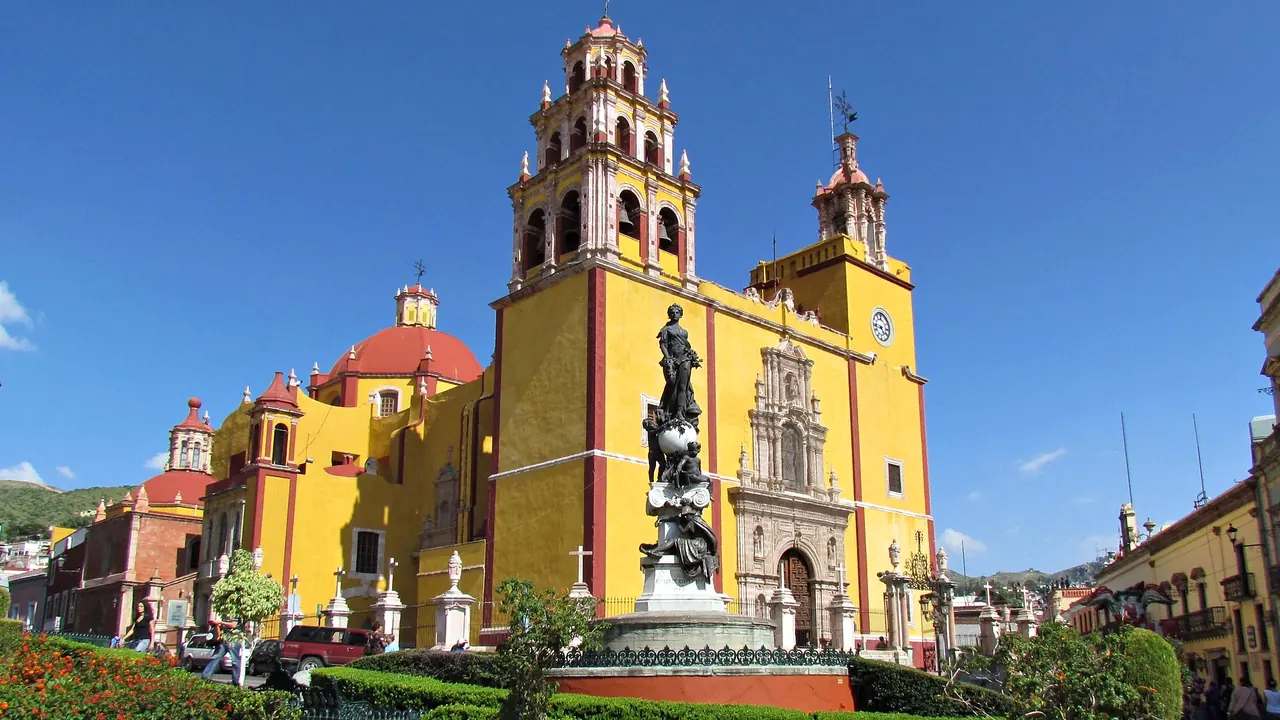
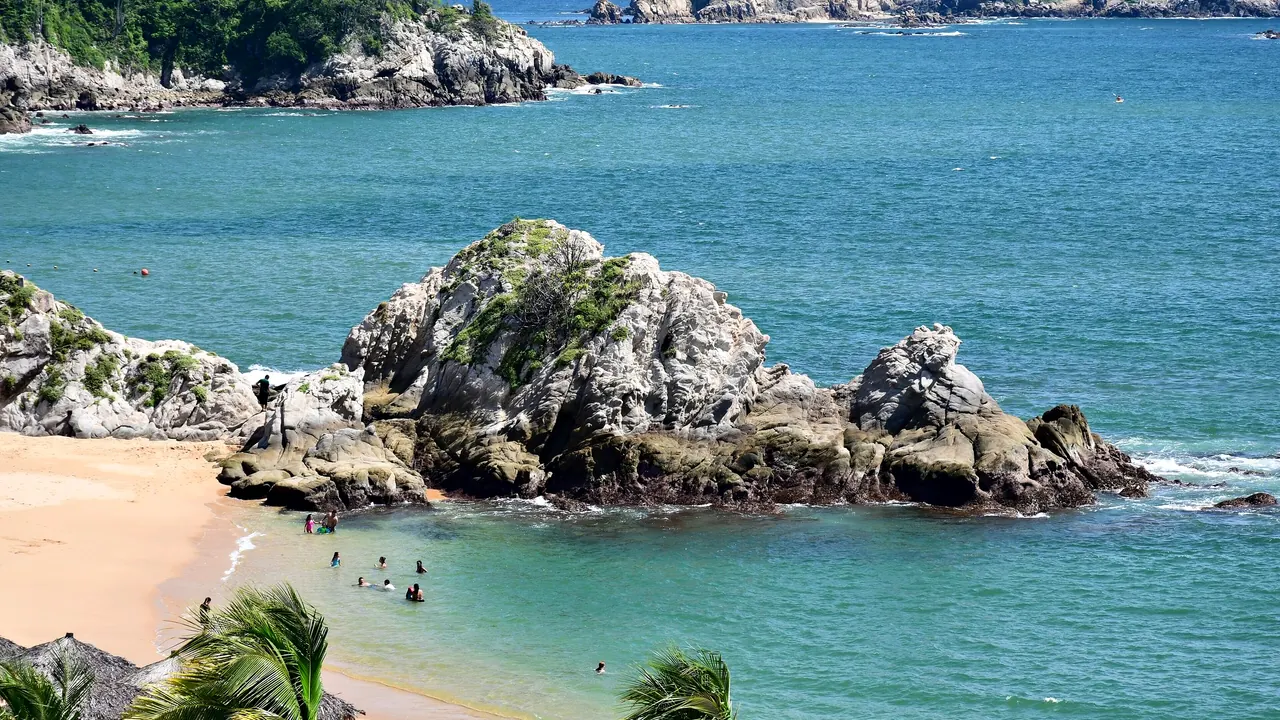
Photos: Guanajuato by Sandra Dominic Saldaña Garcia, CC BY-SA 3.0, cropped; Huatulco by Gzzz, CC BY-SA 4.0, cropped.
Guanajuato or Huatulco?
Our verdict in twelve categories, each scored against the same fixed benchmark cities, and the climate month by month, so you can choose for your trip.
Choose Guanajuato for
- culture and sights
- live music and the arts
- day trips
Guanajuato is the pick for travellers who want a historic town to wander and look at: a painted ravine of churches, plazas and alleys with real museums, the Cervantino festival in October, and the colonial towns of the Bajío within easy reach by bus. It is also the cheaper of the two. Two or three days in town and a couple of outings make a full trip, as long as you don't mind steep stairways and having no sea at all.
Choose Huatulco for
- beaches
- nature and the outdoors
- families
If you want warm water, Huatulco is the clear choice. Its sheltered bays, coral and national park coastline are made for swimming, snorkelling and slowing down, and families with young children will find it far easier than a hillside town. Don't expect much to see beyond a morning of sights, and the evenings are quiet. The sea, the forest and the slow pace are the reasons to come.
Scoreboard
Twelve categories on one fixed scale from 0 to 100. The shaded stretch is the gap between the two.
Your match
Pick a travel style or drag the sliders, and both match scores follow your weighting.
Wins on culture and sights and live music and the arts with your weighting.
Wins on beaches and nature and the outdoors with your weighting.
What matters to you?
Category by category
What the scores mean for a trip.
Beaches & swimming
Here the two cities are completely different. Guanajuato is a mountain town a long way from either coast, so swimming means a hotel pool or a trip out to one of the warm-water balnearios in the countryside.
Huatulco is built around the water. Its sheltered coves have golden sand and calm, clear sea, from Santa Cruz and Chahué beside the town to the wilder Cacaluta and El Órgano inside the national park, reached by boat or forest path. At La Entrega the coral is close enough to snorkel from the beach.
Food & drink
Both eat at much the same level: simple, cheap and good rather than ambitious, and in both the better meals are away from the showpiece terraces. The cooking is what differs. Guanajuato serves highland dishes such as enchiladas mineras, a miners' dish, and gorditas, with cajeta and candied fruit at the stalls of Mercado Hidalgo.
Huatulco brings Oaxacan cooking to the coast: mole, tlayudas and tamales wrapped in banana leaf, whole fish grilled at beach palapas, and mezcal and coffee from the hills. The best of it is around La Crucecita's square and market.
Culture & sights
The town of Guanajuato is the sight in itself: a UNESCO-listed ravine of painted houses, the baroque Valenciana church, the Teatro Juárez, and the Alhóndiga, stormed in the first battle of the War of Independence in 1810. The Quijote museum, Diego Rivera's birthplace and the mummies add more, and together they fill two or three days.
Huatulco is a planned resort and has very little by comparison: the great painted dome of La Crucecita's church, the small ceremonial site and forest walk at Copalita, and a quiet colonial church inland. You can see it all in a morning.
Nightlife
Neither is a party town, but Guanajuato's university gives it the livelier evenings. Terraces around the Jardín de la Unión and Plaza San Fernando fill first, and the night carries on in mezcal bars and a few small clubs in the old stone alleys, mostly from Thursday to Saturday.
Outside the winter high season and Mexican vacation periods, Huatulco is quiet by midnight. An evening there means dinner, a drink on La Crucecita's plaza or a beach bar by the Santa Cruz marina, and anyone who wants to dance late goes up the coast to Zipolite.
Nature & outdoors
Huatulco is much stronger for the outdoors. A large part of its coast is national park, where dry tropical forest runs down to cliffs and coral, whales pass offshore from December to March and turtles nest on nearby beaches. Inland there is rafting on the Copalita River, and the Sierra Sur foothills have waterfalls and coffee farms.
In Guanajuato, nature means climbing out of the ravine: up to the Pípila for the view, on a half-day hike up La Bufa, or further out to the oak forest and bike trails of the Sierra de Santa Rosa. It suits a walk with a view, but the land is semi-arid and there is nothing to do on the water.
Day trips
Guanajuato is the far better base for day trips. San Miguel de Allende is an easy outing by bus, and Dolores Hidalgo has independence history and Talavera pottery workshops. Querétaro's aqueduct, León's leather, the half-abandoned mining town of Mineral de Pozos and a few wineries add more choices.
From Huatulco the trips are mostly along the coast: Mazunte's turtle centre, Puerto Ángel and Zipolite about an hour west, the surf town of Puerto Escondido further on, or the coffee villages inland. Oaxaca city is too far for a day and needs a night away.
Good for families
Guanajuato welcomes children but has nothing built for them, with no zoo, aquarium or theme park, so a family visit depends on the town itself. Older children enjoy the funicular up to the Pípila, the tunnels beneath the streets and the costumed students singing through the alleys at night. The Museum of the Mummies thrills some teenagers but is too much for many younger ones, the steep lanes are no place for a pushchair, and two or three days usually holds their interest.
Huatulco is the better choice for families, because the beach keeps children busy day after day in a small, calm town that is easy to manage. It has no zoo or aquarium either, so older children can run out of things to do after a week. When you go matters more here than in Guanajuato: June to September is hot, humid and wet, which makes it harder going, and the dry winter is much easier with small children.
Getting around
In Guanajuato almost everything is a walk from the Jardín de la Unión, and the traffic runs underground through tunnels. The effort is in the climbing, on stairways at about 2000m, while cheap buses and taxis reach the outlying sights.
Huatulco is spread across several bays. La Crucecita is compact and the walk down to Santa Cruz is easy, but elsewhere you rely on taxis and colectivos, with boats or a hire car for the remoter coves and the coast villages. Distances are short, but you can't get around on foot.
Shopping & style
Neither is a place to shop for fashion, and both sell crafts rather than labels, but Guanajuato has a little more to browse. Mercado Hidalgo sells leather, cajeta and candied fruit under its iron roof, the centre adds majolica-style ceramics and silver jewellery, and León's shoe trade is close by.
Huatulco's stalls in La Crucecita and Santa Cruz carry Oaxacan textiles, black pottery, alebrijes and hammocks among the beach souvenirs, though serious craft buyers save their money for Oaxaca city.
Affordability
Guanajuato is the cheaper of the two. Market meals, buses, taxis and museums all cost little. Only the boutique hotels in restored mansions, the plaza restaurants and the October festival push the bill up.
Huatulco is fairly priced for a beach resort, and a guesthouse in La Crucecita with meals at the fondas keeps it modest. The all-inclusives in Tangolunda, boat tours and high-season rates add up much faster than anything in Guanajuato.
Live music & performing arts
Guanajuato has far more to see. In October the Festival Internacional Cervantino fills the Teatro Juárez, the plazas and the university courtyards with theatre, dance and orchestras from many countries. On most evenings estudiantinas lead callejoneadas through the alleys, though the formal programme outside the festival is modest.
Huatulco offers little beyond folk dance shows in the resorts, a few bands in bars, and music on La Crucecita's plaza at festival times.
Wellness & relaxation
Huatulco is the more restful place. It is low-rise and quiet once the boats are in, with full spas in the Tangolunda and Conejos resorts and the temazcal, a pre-Hispanic steam bath with herbs, taken with a guide.
Guanajuato is no retreat, as student music and weekend crowds keep it noisy late, and wellness in town means a hotel spa or a massage. What it has that the coast lacks is hot springs: thermal balnearios such as Comanjilla near León, about an hour away.
When should you go?
Pick your month. The climate figures are measured averages, not a forecast.
Guanajuato in July
Huatulco in July
Daytime high, °C
Rainfall in the month, mm
Where the figures come from
Huatulco's temperatures are measured 42 km from the centre, at Puerto Angel, Oax..
Huatulco's station stands 177 m below the city centre, so the centre is likely a little cooler than the figures say.
Huatulco has no rain gauge within 25 km of the centre, so its rainfall comes from a gridded climate dataset read at the city rather than from a gauge further away.
Temperature and rainfall are climate normals, averaged over the years shown. Guanajuato: 1991-2020 normals, Guanajuato, Gto. (0.7 km from centre). Huatulco: 1991-2020 normals, Puerto Angel, Oax. (42.2 km from centre).
Guanajuato sits high in the hills, so it never gets as hot as the coast. Spring is the warm, dry stretch, reaching about 32°C in April and May, which makes the steep alleys tiring by midday. The rains arrive in June and peak in July at around 186mm, turning the dry hills green. November to March is the most comfortable time to walk the town: dry, sunny and mild.
Huatulco is hot in every month, around 33°C, and the sea is warm enough to swim in all year, never below 27°C. Rain is what changes through the year. November to April is dry and very sunny, the best time for the beach and clear water. June to September is wet and humid, and June is the wettest month at about 270mm. Both cities are dry in winter, so a trip between December and March suits either.
Which traveller are you?
On a beach and sun trip, Huatulco is the only real choice. Guanajuato is far inland, and the only swimming is in hotel pools or countryside balnearios. Huatulco has nine sheltered bays of warm, calm water, boat trips to coves with no road, and snorkelling over coral.
For a culture and arts trip, Guanajuato is far richer. Its UNESCO-listed centre, the Alhóndiga murals, the Teatro Juárez and the evening callejoneadas fill several days, and October brings the Cervantino. Huatulco's sights, a painted church dome and the Copalita ruins, take a morning.
On a family trip with young children, Huatulco is the easier place. Gentle coves like La Entrega let children snorkel close to shore, and resort pools and kids' clubs fill the afternoons in a calm, small town. Guanajuato's stairways and crowded lanes suit older children who like walking.
Before you go
| Measure | Guanajuato | Huatulco |
|---|---|---|
| Official language | Spanish, Nahuatl, Yucatec Maya | Spanish, Nahuatl, Yucatec Maya |
| Currency | Mexican Peso (MXN) | Mexican Peso (MXN) |
| Sockets | AB127 V, 60 Hz | AB127 V, 60 Hz |
| Driving side | Right | Right |
| Time zone | UTC-6 | UTC-6 |
| Emergency number | 911 | 911 |
| Elevation | 2,045 m | 220 m |
| Main airport | Guanajuato International Airport (BJX)23 km from centre22 non-stop destinations | Bahías de Huatulco International Airport (HUX)15 km from centre13 non-stop destinations |
| Public holidays this year | 9 days | 9 days |
By the numbers
| Measure | Guanajuato | Huatulco |
|---|---|---|
| City population | 70,068 | 7,409 |
| Museums within 10 km | 8 | 0 |
| UNESCO World Heritage sites within 50 km | 3 | 0 |
| Swim season, months above 21 °C | - | 12 months |
Where else could you go?
Every comparison below shares a destination with this one, so you can follow Guanajuato or Huatulco somewhere new.
- San Miguel de Allendevs Guanajuato
- Puerto Escondidovs Huatulco
- Oaxacavs Huatulco
- Guadalajaravs Guanajuato
- Mexico Cityvs Guanajuato
- Zihuatanejovs Guanajuato