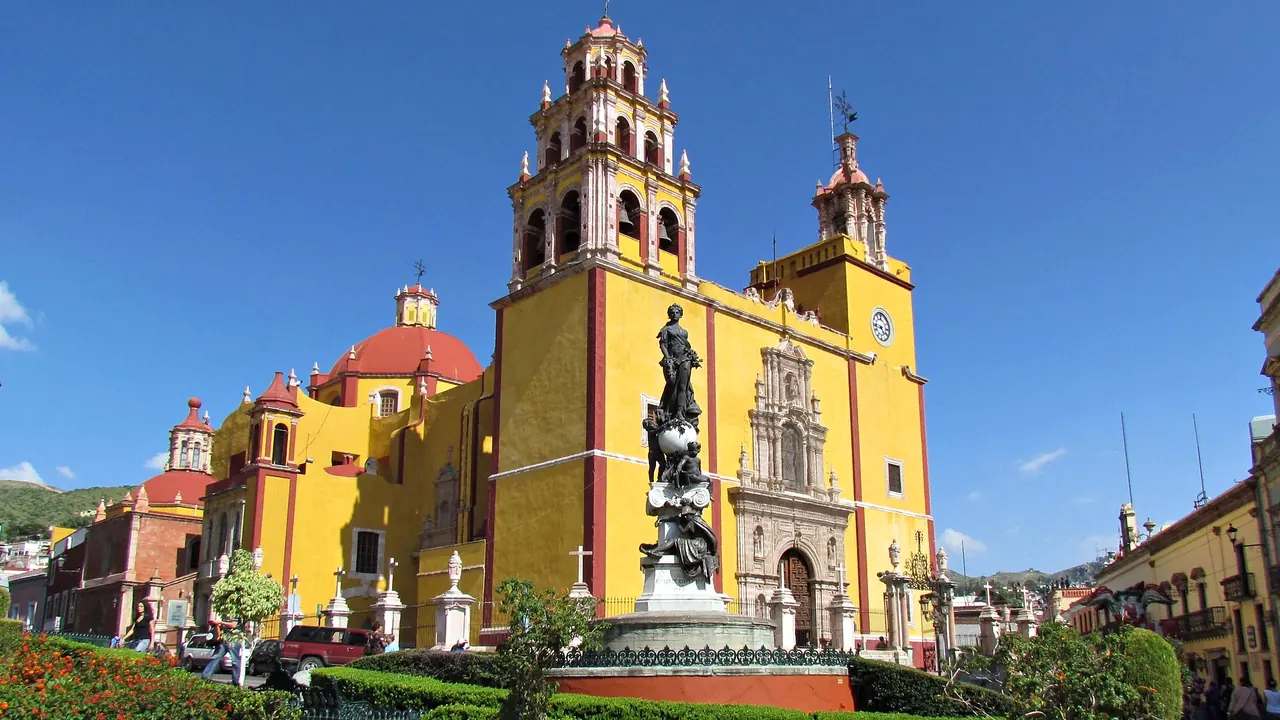
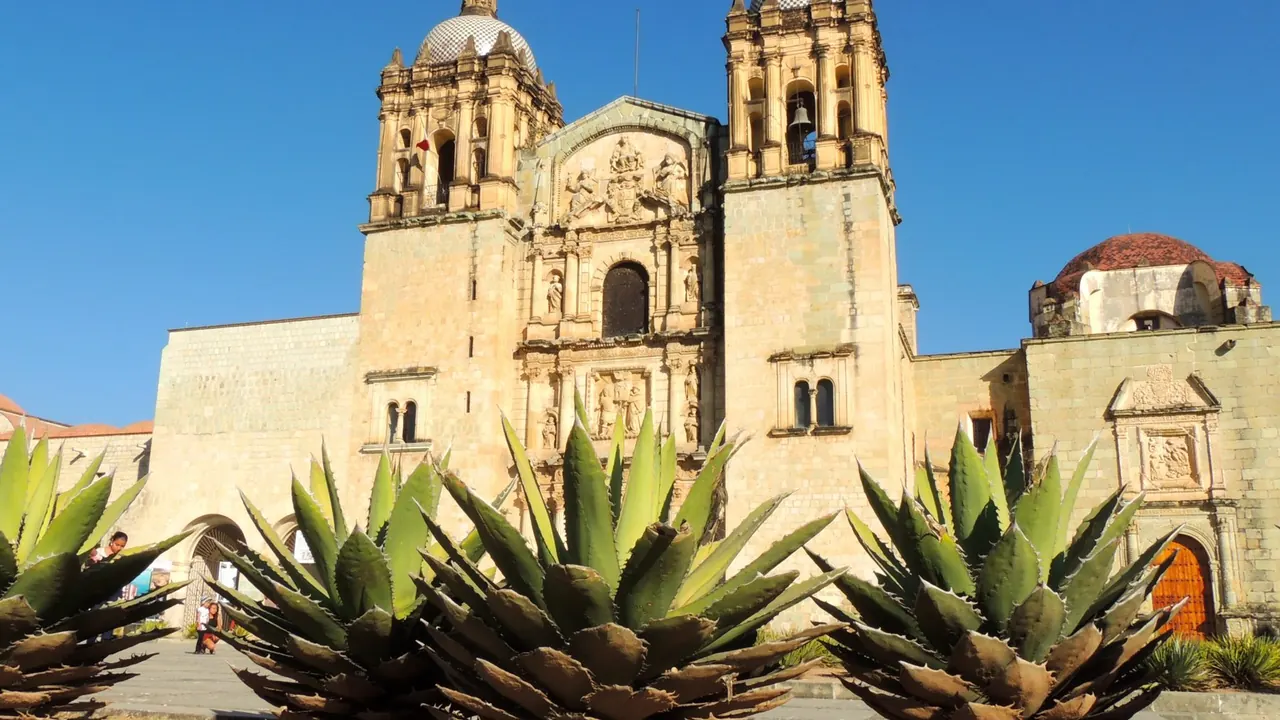
Photos: Guanajuato by Sandra Dominic Saldaña Garcia, CC BY-SA 3.0, cropped; Oaxaca by Öskr Rck, CC BY-SA 3.0, cropped.
Guanajuato or Oaxaca?
Our verdict in twelve categories, each scored against the same fixed benchmark cities, and the climate month by month, so you can choose for your trip.
Choose Guanajuato for
- live music and the arts
- getting around
- day trips
Guanajuato suits travellers who want a town to walk and climb, and a base for exploring the region. Its painted ravine, steep alleys and tunnels make a dramatic setting, and the Bajío's colonial towns, San Miguel de Allende and Querétaro among them, are all within easy reach. It is also the stronger choice for performance: student minstrels sing through the lanes most evenings, and in October the Cervantino festival fills the town.
Choose Oaxaca for
- food and drink
- shopping
- nature and the outdoors
Oaxaca is for people who plan their days around the next meal, the next mezcal and the next craft village. Its moles, markets and tasting rooms are in a different league, the weaving and pottery villages make it one of Mexico's best places to shop, and the Sierra Norte and the temazcal sweat lodges add a slower, more outdoor side that Guanajuato cannot match.
Scoreboard
Twelve categories on one fixed scale from 0 to 100. The shaded stretch is the gap between the two.
Your match
Pick a travel style or drag the sliders, and both match scores follow your weighting.
Wins on live music and the arts and getting around with your weighting.
Wins on food and drink and shopping with your weighting.
What matters to you?
Category by category
What the scores mean for a trip.
Beaches & swimming
Neither city has a beach. Both are inland highland cities where swimming means a hotel pool. What differs is how far the sea is. Guanajuato is a long day's drive from either coast, so the nearest you will get to bathing is the warm-water balnearios in the countryside. From Oaxaca, the Pacific beaches at Puerto Escondido, Mazunte and Huatulco are a short flight away, so many visitors end their trip with a few days on the coast.
Food & drink
Oaxaca is one of the great food regions of Mexico, and the gap here is wide. You can work your way through its family of moles, eat tlayudas crisped over charcoal and choose meat to be grilled in the smoke-filled aisle of the 20 de Noviembre market. Mezcal from valley distilleries, hot chocolate ground with cinnamon and a group of serious chefs cooking with heirloom maize all add depth.
Guanajuato eats well but simply. Enchiladas mineras, the upstairs counters at Mercado Hidalgo and street gorditas are worth seeking out, and the better meals are in family places away from the plaza terraces. A food-minded visitor will have seen most of it within a few days.
Culture & sights
Both are UNESCO-listed colonial cities that can be seen in two or three days. Oaxaca has a little more depth. Monte Albán, the Zapotec capital on its levelled mountaintop, is twenty minutes away, and the Tomb 7 gold in the Santo Domingo monastery adds an ancient layer. The Tamayo and Textile museums and the printmaking workshops show a living art scene.
In Guanajuato the town itself is the sight. Painted houses fill a ravine, the Valenciana church stands over old silver mines, and the Alhóndiga carries the story of 1810. The Mummies museum and Diego Rivera's birthplace give it a more quirky, story-led character.
Nightlife
The two are about even, and neither is a clubbing destination. Guanajuato's evenings are shaped by its university. Terraces fill around the Jardín de la Unión and Plaza San Fernando, and the night carries on in mezcal spots and a few dance clubs tucked into the alleys, mainly from Thursday to Saturday.
Oaxaca is a little older in mood. You might start with rooftop drinks over the domes of Santo Domingo and move on to tasting bars in Jalatlaco, with the odd salsa night at weekends. It suits people who like conversation over a glass more than a dance floor.
Nature & outdoors
Oaxaca offers much more for anyone who wants to get outdoors. In the Sierra Norte, Zapotec villages run trails and cabins through pine-oak and cloud forest, so you can walk from village to village for several days. Hierve el Agua's petrified-looking mineral cliffs make an easy half-day trip.
Guanajuato's outdoors is mostly about climbing out of the ravine, up to the Pípila or the rocks of La Bufa, for views over the rooftops. The oak woods of the Sierra de Santa Rosa and the Cristo Rey summit on the Cubilete go further, but the dry hills reward a good walk rather than a real trek.
Day trips
Guanajuato has the better day trips, because its outings lead to proper towns. San Miguel de Allende, Querétaro with its long aqueduct and Dolores Hidalgo, where independence began, each fill a day on their own. The ghostly mining town of Mineral de Pozos and a few wineries add variety.
Oaxaca's trips are rewarding but on a smaller scale. You can combine stops in the Central Valleys, such as the great Tule cypress, the rug looms of Teotitlán, the stone fretwork of Mitla and the mezcal pits of Matatlán, or drive out to the lonely Mixteca monasteries. What it lacks is a second historic city to visit.
Good for families
Neither city is built for young children. Both lack a zoo, aquarium or theme park, and both are hard work with a pushchair. Guanajuato's appeal is more of an adventure: the funicular, the tunnels under the town and the singing callejoneadas. The mummies tend to suit teenagers better than small children, and the steep stairways tire young legs.
Oaxaca's pedestrian streets and zócalo, with balloon sellers and evening music, are flatter and easier to spend time in. Painting an alebrije or making chocolate or tortillas gives children something hands-on to do, though the ruins have little shade.
Getting around
Guanajuato works better for getting around without a car. Nearly everything sits close to the Jardín de la Unión. Buses and cheap taxis reach the Valenciana church and the mummy museum through the tunnels, and a funicular takes you up to the viewpoint. The cost is in your legs, with steep stairways at about 2000m.
Oaxaca's centre is a flat, easy grid around the zócalo, but beyond it things get harder. City buses are confusing, so for the valley villages you need colectivos, second-class buses or a driver booked for the day.
Shopping & style
Oaxaca is far stronger for shopping, and its crafts are a reason to go in their own right. Along the Macedonio Alcalá, cooperatives and galleries sell huipiles, rugs, black pottery and alebrijes. Better still is buying in the villages that make them, such as Teotitlán, San Bartolo Coyotepec and San Martín Tilcajete, and at the weekly markets in Tlacolula and Ocotlán.
Guanajuato's shopping comes down to cajeta, candied fruit, majolica-style ceramics and Cervantes keepsakes. Anyone after leather goes to León.
Affordability
Both cities are cheap for market meals, taxis and museum or site entry, so there is little to choose between them on cost. The differences lie in when prices rise. In Guanajuato, rooms become scarce and expensive during the Cervantino in October. In Oaxaca, the Guelaguetza in July and the Day of the Dead have the same effect, and its chef-led tasting menus and colonial boutique hotels can push up the cost of a more comfortable trip.
Live music & performing arts
Guanajuato has more live performance through the year. The Cervantino brings theatre, dance and orchestras from many countries to the Teatro Juárez, the plazas and the university courtyards each October. In other months the estudiantinas still lead singing callejoneadas through the alleys most evenings.
Oaxaca's big moment is the Guelaguetza in July, with regional dances in the hillside auditorium. Outside the festivals it is mostly the state band and marimbas in the zócalo and the occasional concert at the Teatro Macedonio Alcalá.
Wellness & relaxation
Oaxaca is the better place to slow down. The temazcal, a domed sweat lodge with herbs and hot volcanic stones, is still a living Zapotec and Mixtec tradition, and healers lead sessions in the city and nearby villages. Yoga studios, shaded courtyards and quiet Jalatlaco gardens add to the easy pace.
Guanajuato has no bathing culture of its own. You are left with hotel spas or a half day at the Comanjilla hot springs near León, and the late student music means the centre is rarely quiet.
When should you go?
Pick your month. The climate figures are measured averages, not a forecast.
Guanajuato in July
Oaxaca in July
Daytime high, °C
Rainfall in the month, mm
Temperature and rainfall are climate normals, averaged over the years shown. Guanajuato: 1991-2020 normals, Guanajuato, Gto. (0.7 km from centre). Oaxaca: 1961-1990 (rainfall 1991-2020) normals, Oaxaca, Oax. (1.1 km from centre).
Guanajuato is at its best from October to March, when the rains are over and days are mild, around 23°C in December and January. That is the most comfortable weather for climbing its stairways. Oaxaca sits lower and stays warmer through the winter, near 28°C, and from November to February it is almost completely dry, with more sunshine than Guanajuato. That makes those months its strongest season for walking the centre and visiting the ruins.
Both cities heat up in April and May, with highs around 32°C, which is warm for steep alleys or shadeless archaeological sites. The summer rains come to both from June to September. Guanajuato's are slightly heavier, peaking at 186mm in July. The rain mostly falls as afternoon storms, and it turns the hills around both cities green.
Which traveller are you?
On a food and nightlife trip, Oaxaca is the clear pick. It has moles, charcoal tlayudas, smoky market grills and mezcal tasting rooms pouring village spirits, and the evenings lead naturally from a long dinner to drinks. Guanajuato's student bars are fun, but its food runs out after a few days.
For a shopping trip, choose Oaxaca. You can buy handwoven textiles, barro negro pottery and carved alebrijes in the galleries on the Macedonio Alcalá or straight from the villages that make them. Guanajuato offers little more than ceramics, sweets and souvenirs in Mercado Hidalgo.
For a short city break, Guanajuato packs more into a few days. Its sights sit within a short walk of the Jardín de la Unión, a funicular and the tunnels carry you to the rest, and the evening callejoneadas fill the nights without any planning.
Before you go
| Measure | Guanajuato | Oaxaca |
|---|---|---|
| Official language | Spanish, Nahuatl, Yucatec Maya | Spanish, Nahuatl, Yucatec Maya |
| Currency | Mexican Peso (MXN) | Mexican Peso (MXN) |
| Sockets | AB127 V, 60 Hz | AB127 V, 60 Hz |
| Driving side | Right | Right |
| Time zone | UTC-6 | UTC-6 |
| Emergency number | 911 | 911 |
| Elevation | 2,045 m | 1,555 m |
| Main airport | Guanajuato International Airport (BJX)23 km from centre22 non-stop destinations | Xoxocotlán International Airport (OAX)7 km from centre15 non-stop destinations |
| Public holidays this year | 9 days | 9 days |
By the numbers
| Measure | Guanajuato | Oaxaca |
|---|---|---|
| City population | 70,068 | 258,913 |
| People per km² | - | 3,028 |
| Museums within 10 km | 8 | 10 |
| UNESCO World Heritage sites within 50 km | 3 | 2 |
Where else could you go?
Every comparison below shares a destination with this one, so you can follow Guanajuato or Oaxaca somewhere new.
- San Miguel de Allendevs Guanajuato
- Puerto Escondidovs Oaxaca
- Huatulcovs Oaxaca
- Guadalajaravs Guanajuato
- Pueblavs Oaxaca
- Mexico Cityvs Guanajuato