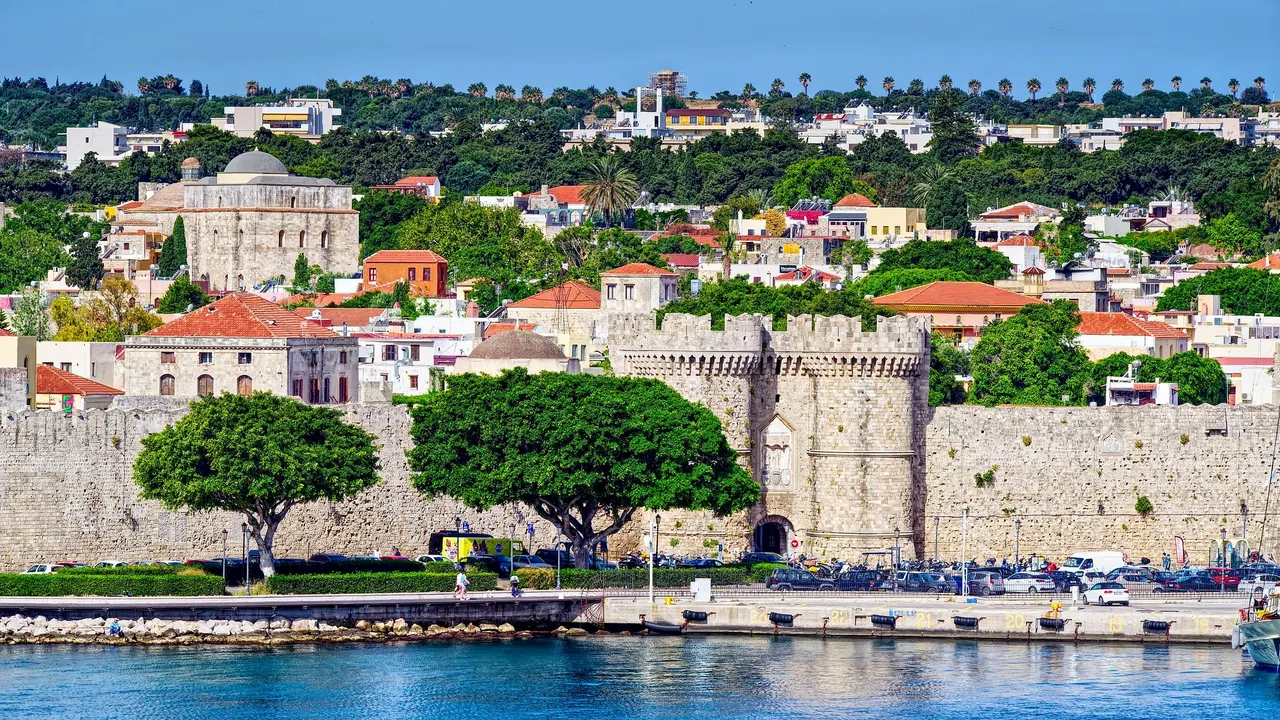
Photos: Rhodes by Mark Thomas, Pexels License.
Halkidiki or Rhodes?
Our verdict in twelve categories, each scored against the same fixed benchmark cities, and the climate month by month, so you can choose for your trip.
Choose Halkidiki for
- wellness
- live music and the arts
- beaches
Halkidiki suits travellers who want the sea and little else, and plenty of it. Its three peninsulas give very different shores, from the organised beaches of Kassandra to the granite coves of Sithonia, with pine forest almost down to the water. It is also the more restful of the two, with warm thermal pools at Agia Paraskevi and quiet waterfront evenings on Sithonia and around Ouranoupoli. Thessaloniki is close enough for a day of food and city life. The trade-off is a stay that depends on a car and has only modest sights.
Choose Rhodes for
- culture and sights
- getting around
- shopping
Rhodes is the better pick when you want history alongside your swimming. The walled Old Town and the acropolis at Lindos give you days of real sightseeing between beach days. The town is easy to manage on foot, and a bus runs down the east coast. Rhodes also has more going on after dark and more laid on for children. The price is a busier, more resort-like east coast, with rows of sunbeds on the popular bays in high summer.
Scoreboard
Twelve categories on one fixed scale from 0 to 100. The shaded stretch is the gap between the two.
Your match
Pick a travel style or drag the sliders, and both match scores follow your weighting.
Wins on wellness and live music and the arts with your weighting.
Wins on culture and sights and getting around with your weighting.
What matters to you?
Category by category
What the scores mean for a trip.
Beaches & swimming
Both are first-class swimming destinations, and the difference is in the kind of shore. Halkidiki has more of it: hundreds of kilometres of pale sand or small pebble across three peninsulas, often backed by pine. You can choose sunbeds and beach bars on Kassandra or rocky coves at Kavourotrypes and Karydi on Sithonia.
Rhodes concentrates its best water on the sheltered east coast, a chain of bays from Faliraki to Lindos where sand is often mixed with shingle. Tsambika is the soft-sand standout. The west coast is windier and stonier, and Prasonisi offers calm water and waves on either side of one sandbar.
Food & drink
Neither is a destination for serious eating. Both reward you for skipping the resort strips and heading to family tavernas. In Halkidiki the best meals are grilled fish and octopus in fishing villages such as Nikiti and Toroni, with the region's big green olives and Athos wines. Serious eaters drive to Thessaloniki for the day.
Rhodes has more distinctive island dishes to look out for, such as chickpea pitaroudia, matsi pasta and the anise spirit souma. Its meze places in the newer parts of Rhodes Town and a small upmarket tier around Lindos give a little more choice without leaving the island.
Culture & sights
This is where the two differ most. Rhodes has one of Europe's most complete medieval fortified towns, with the Palace of the Grand Master and an archaeological museum in the old Knights' Hospital. Mosques and Byzantine churches sit inside the walls, and Lindos, Kamiros and Monte Smith lie beyond them.
Halkidiki's great monument, Mount Athos, is closed to women and permit-only for men, so most visitors see the monasteries from a boat out of Ouranoupoli. The rest, such as Olynthos, ancient Stagira and the Petralona cave, are pleasant half-days rather than reasons to come.
Nightlife
Rhodes offers more choice after dark. Faliraki runs until dawn for a young crowd, a lane of bars in the Old Town and the area around Mandraki keep Rhodes Town busy, and the rooftop bars of Lindos attract an older crowd.
Halkidiki's scene is mostly on Kassandra, with open-air clubs at Kallithea and bar strips in Pefkohori and Hanioti, and it is liveliest at weekends when young people drive in from Thessaloniki. In both places it is a summer-only affair, and Sithonia is for quiet tavernas.
Nature & outdoors
Both are green, gentle landscapes rather than dramatic ones, and both are best for walking in spring and autumn. Halkidiki's draw is forest meeting sea, especially on Sithonia, with granite headlands, small islets and Mount Itamos. Sea kayaking, snorkelling and boat trips to the Diaporos lagoon are the main activities.
Rhodes is all about the wind. Prasonisi is one of the Mediterranean's best-known kitesurfing and windsurfing spots, and Mount Attavyros gives a real climb. The Valley of the Butterflies and Seven Springs are shady inland walks.
Day trips
The outings are about equally good, but one is by road and the other by sea. From Halkidiki you drive: Thessaloniki is about an hour away for Byzantine churches and good food, with Vergina and Pella further on, and Kavala lies beyond the Athos side.
From Rhodes you take a boat to pastel Symi and the monastery of Panormitis, to quiet Halki, or across to Marmaris in Turkey for a taste of another country. The catch is that these trips depend on ferry timetables and calm summer seas.
Good for families
Both have calm, shallow, sandy water and tavernas that welcome children late into the evening. Rhodes edges ahead because it offers more than the beach. A water park above Faliraki, the aquarium in Rhodes Town and the Old Town ramparts break up the week, though Lindos's stepped lanes are hard going with a pushchair.
Halkidiki's shallow sand at Gerakini, Psakoudia and on Kassandra is excellent for toddlers, and the big resorts have kids' clubs. Beyond a boat trip and the Petralona cave, though, there is little built for children, and the drives between peninsulas add effort.
Getting around
Rhodes is noticeably easier without a car. The car-free Old Town, the harbour and the new town are all walkable, and buses run down the east coast to Faliraki and Lindos. Many visitors hire a car for only a few days to reach the south.
In Halkidiki, a car is essential for the whole stay. Because the peninsulas are long fingers, getting from Kassandra to Athos means driving back up one and down the next. Buses are too sparse to rely on, and southern Sithonia is close to two hours from the airport.
Shopping & style
Neither is a shopping destination, but Rhodes gives you more to browse. Sokratous Street in the Old Town is lined with jewellery, leather and sponges, the new town has Greek high-street fashion, and Lindian-style ceramics from Archangelos make a good souvenir.
Halkidiki's resort strips sell little beyond beachwear. The best things to take home are honey, olive oil, wine, and the icons and incense sold in Ouranoupoli. For anything more, go to Thessaloniki.
Affordability
Costs are much the same, and both get pricier in July and August. Halkidiki's prices are kept down by Greek and Balkan families driving in, so there are plenty of simple apartments and village rooms. The bills rise at the big Kassandra resorts and with sunbed charges on organised beaches.
On Rhodes, package hotels and all-inclusive resorts keep prices moderate on the north and east coasts. Lindos and the Old Town's boutique hotels are where you pay a premium.
Live music & performing arts
Neither is a stage destination, though Halkidiki has slightly more planned. In July and August, the Kassandra Festival puts on concerts and theatre in the open-air amphitheatre at Siviri, and the Sani Festival brings jazz and classical evenings.
Rhodes's best offerings are its settings, with summer concerts in the medieval moat or the ancient stadium and a folk-dance company performing in the Old Town. Beyond that, both rely on taverna musicians.
Wellness & relaxation
Halkidiki is the better place to unwind. The thermal springs at Agia Paraskevi on Kassandra's southern tip offer warm mineral pools above the sea, and the coast of Sithonia and around Ouranoupoli is quiet all summer.
Rhodes has no bathing tradition, and the Kallithea rotunda is something to look at rather than bathe in. Rest there means the east-coast hotel spas or a stay in southern villages such as Lahania and Asklipio, away from the noise of the north.
When should you go?
Pick your month. The climate figures are measured averages, not a forecast.
Halkidiki in July
Rhodes in July
Daytime high, °C
Rainfall in the month, mm
Where the figures come from
Halkidiki's temperatures are measured 64 km from the centre, at Thessaloniki Airport.
Halkidiki has no rain gauge within 25 km of the centre, so its rainfall comes from a gridded climate dataset read at the destination rather than from a gauge further away.
Rhodes has no rain gauge within 25 km of the centre, so its rainfall comes from a gridded climate dataset read at the destination rather than from a gauge further away.
Temperature and rainfall are climate normals, averaged over the years shown. Halkidiki: 1991-2020 normals, Thessaloniki Airport (63.7 km from centre). Rhodes: 1991-2020 normals, Rhodes Airport (12.6 km from centre).
Halkidiki has a shorter, sharper summer. The sea is warm enough for swimming from June to September, and still bearable into early October. July and August bring long sunny days and highs of around 32°C, which is too hot for walking in the middle of the day. Rain is fairly light and spread through the year, and winter is cold for this part of the world at around 10°C, so the region effectively shuts down after October.
Rhodes stretches the season further at both ends. Its summer is almost completely dry from June to August, and the sea stays warm well into autumn, still around 24°C in October, so autumn beach trips work better here. Winter is milder than in Halkidiki but much wetter, with about 170mm of rain in December and January. For walking and sightseeing, spring and late autumn suit Rhodes best.
Which traveller are you?
On a culture and arts trip, choose Rhodes. The walled Old Town with the Street of the Knights, the acropolis at Lindos and ancient Kamiros fill several days. Halkidiki's Mount Athos can only be seen from a boat for most visitors.
For a relaxing and wellness trip, Halkidiki is the calmer choice. You can bathe in the thermal pools at Agia Paraskevi and stay in Sithonia or near Ouranoupoli, where evenings are quiet. On Rhodes, the old Kallithea spa is only a sight, and wellness means hotel spas.
On a family trip with children, Rhodes is a little ahead. It has the same calm, shallow bays, plus a water park and an aquarium for a day off the beach, and buses mean you don't always need a car. Halkidiki's days revolve almost entirely around the sea.
Before you go
| Measure | Halkidiki | Rhodes |
|---|---|---|
| Official language | Greek | Greek |
| Currency | Euro (EUR) | Euro (EUR) |
| Sockets | CF230 V, 50 Hz | CF230 V, 50 Hz |
| Driving side | Right | Right |
| Time zone | UTC+2, UTC+3 in summer | UTC+2, UTC+3 in summer |
| Emergency number | 112 | 112 |
| Main airport | Thessaloniki Macedonia International Airport (SKG)93 non-stop destinations | Rhodes International Airport "Diagoras" (RHO)136 non-stop destinations |
| Public holidays this year | 15 days | 15 days |
By the numbers
| Measure | Halkidiki | Rhodes |
|---|---|---|
| Population | 110,587 | 127,613 |
| People per km² | 38 | 91 |
| Swim season, months above 21 °C | 5 months | 6 months |
Where else could you go?
Every comparison below shares a destination with this one, so you can follow Halkidiki or Rhodes somewhere new.