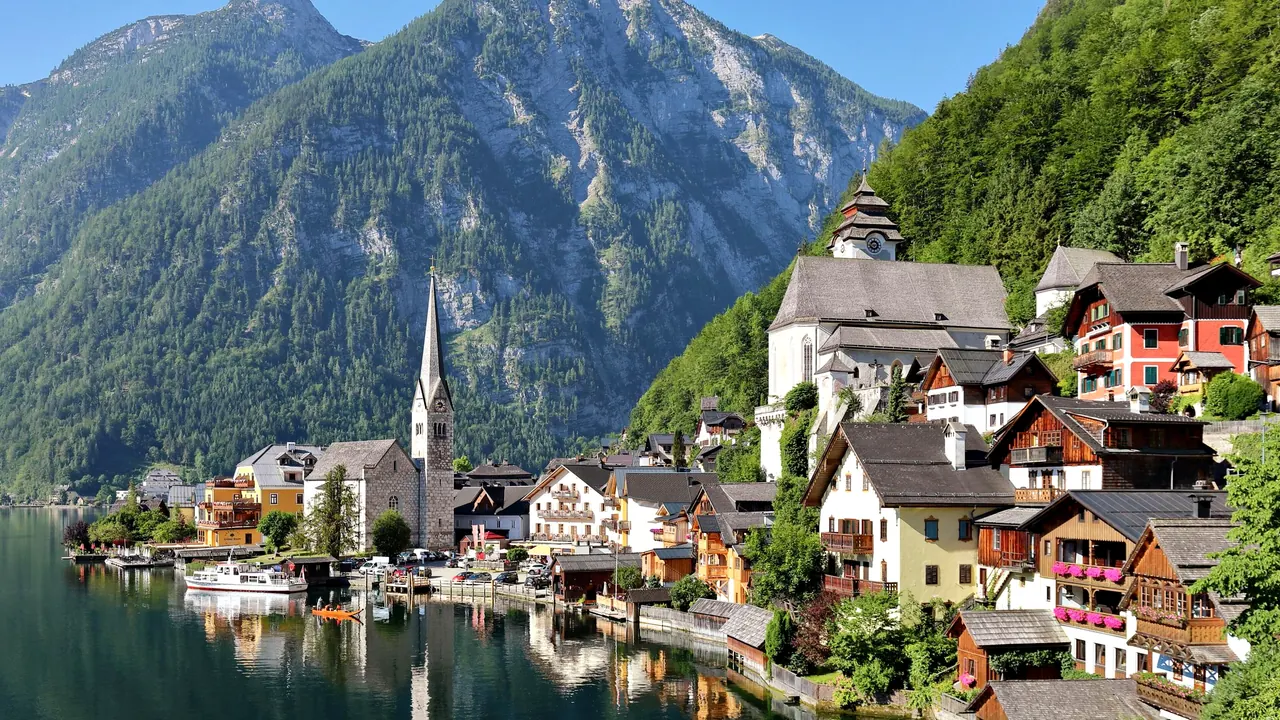
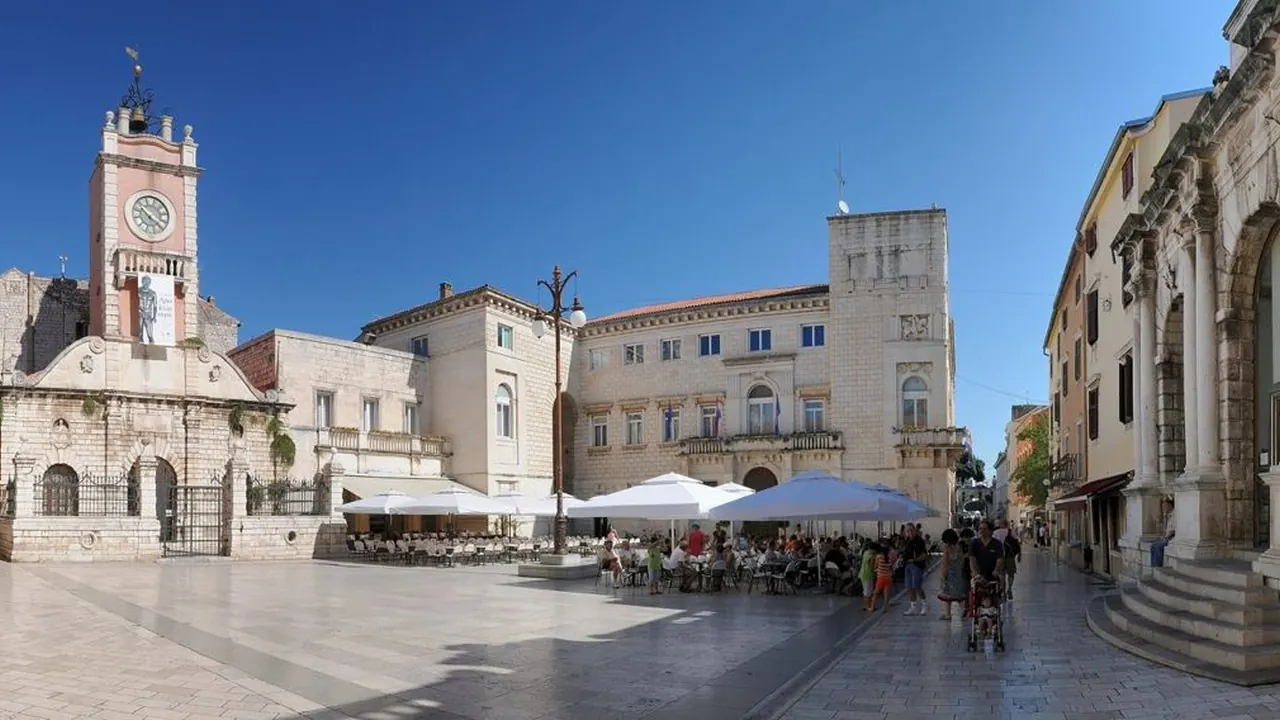
Photos: Hallstatt by C.Stadler/Bwag, CC BY-SA 4.0, cropped; Zadar by Böhringer Friedrich, CC BY-SA 2.5, cropped.
Hallstatt or Zadar?
Our verdict in twelve categories, each scored against the same fixed benchmark cities, and the climate month by month, so you can choose for your trip.
Choose Hallstatt for
- wellness
- nature and the outdoors
Hallstatt is for travellers who want mountains and quiet. Days go on the Dachstein: walking up the Echerntal, riding the Krippenstein cable car, going into the ice caves, rowing on a still lake early in the morning. It suits a short, slow stay for couples and walkers who are happy with simple dinners and early nights, and who accept paying more to sleep in a tiny village.
Choose Zadar for
- beaches
- nightlife
- prices
Choose Zadar for a summer trip built around the sea. You swim off the promenade, take ferries to the islands, see Roman and medieval stone in a flat, walkable old town and still have somewhere to go in the evening. It costs less, you eat better and it does more for families and night owls, while Paklenica and the Kornati islands keep wild country within reach.
Scoreboard
Twelve categories on one fixed scale from 0 to 100. The shaded stretch is the gap between the two.
Your match
Pick a travel style or drag the sliders, and both match scores follow your weighting.
Wins on wellness and nature and the outdoors with your weighting.
Wins on beaches and nightlife with your weighting.
What matters to you?
Category by category
What the scores mean for a trip.
Beaches & swimming
In Hallstatt a swim means a bracing dip in a deep, dark-green Alpine lake, from the lawn and jetty in the village or the lido at Obertraun. The season is short and the shores are steep. It is something to do after a hike, not a reason to come.
In Zadar, swimming is part of every summer day. Locals step off the stone promenade, and Kolovare and Borik are close by. Nin's shallow sand and the islands of Ugljan, Pašman and Dugi Otok offer quieter places to swim. Expect pebble and concrete platforms in town rather than sand.
Food & drink
Neither is a place to travel for food, but Zadar gives you more to eat. Hallstatt has a few guesthouse dining rooms serving schnitzel, goulash and char from the lake, and their kitchens close early.
Zadar's Dalmatian cooking has more range: grilled fish, black risotto, octopus or lamb cooked under the peka, and Pag cheese with pršut. The city also has Maraschino, the cherry liqueur it once distilled for European courts, and a morning market by the walls. Menus repeat across the peninsula, but there is enough to keep you interested through a week.
Culture & sights
Hallstatt's history goes deep but covers little ground. It has seven thousand years of salt mining, the Iron Age burial ground that gave the Hallstatt culture its name, the salt mine and its small museum, and the painted skulls of the Beinhaus. Together they fill about a day.
Zadar packs more onto its peninsula. There is the open Roman forum, the round church of St Donatus, the Venetian walls and the Museum of Ancient Glass, and the Sea Organ adds a modern sight on the waterfront. Allow two days rather than one.
Nightlife
In Hallstatt, an evening out means dinner, a glass of wine by the water and a walk along the dark lakeshore. There is nothing more.
Zadar has a real nightlife, if a modest one. It starts with sunset at the Sea Organ, then moves to café-bars on Kalelarga and terrace bars on the walls. Clubbers head to Zrće on Pag, about an hour away, in high summer. Out of season the town quietens to café-bars.
Nature & outdoors
Both are strong, but Hallstatt puts the high mountains on your doorstep. The Dachstein rises straight above the lake, with the Krippenstein cable car, the Five Fingers platform, the giant ice caves, the waterfalls of the Echerntal and the walk to the Gosausee, and ski touring in winter.
Zadar's outdoors covers more ground but takes travel to reach. There are the gorges and climbing walls of Paklenica, Kornati and Telašćica by boat, and the waterfalls of Krka and Plitvice further off. It leans towards sailing and sea kayaking, while Hallstatt is about hiking and Alpine views.
Day trips
Zadar has slightly more to choose from. Šibenik and its cathedral, tiny royal Nin, and Split and Trogir further south give a run of historic towns, and ferries reach Ugljan, Pašman and car-free Silba.
Hallstatt's outings are to the lake towns of the Salzkammergut: Bad Ischl with the Kaiservilla, St Wolfgang and its altarpiece, and Gmunden on the Traunsee. Salzburg makes a long day. From either base, a car makes things much easier.
Good for families
Zadar is easier with children. The old town is flat and car-free, the promenade suits scooters, the Greeting to the Sun lights up after dark and Nin has shallow sand. Simple days are easy, though there is no zoo or theme park.
Hallstatt gives you a few great hours: the wooden slides and underground lake of the salt mine, and the ice caves for older children. But a single steep lane crowded with tour groups is hard going with a pushchair, so families usually stay in Obertraun.
Getting around
You can walk across either centre in minutes, but the ground is very different. Hallstatt is one steep lane with steps, reached by a small boat across the lake from the station, and its buses thin out after summer.
Zadar's peninsula is flat and pedestrian, and the island ferries leave from its edge. For the national parks and Šibenik you will want a hire car or an excursion.
Shopping & style
Neither is a shopping trip, though Zadar offers a little more. Hallstatt's lane sells souvenirs, carved wood and salt from the mine above the village.
Zadar adds jewellers, chain stores and galleries along marble Kalelarga. The market by the walls is the place for Maraschino, Pag cheese, olive oil and Pag lace.
Affordability
Zadar is much easier on the budget. Private apartments are good value outside July and August, and ferries and buses are cheap, though national park entry and boat trips add up.
Hallstatt has few rooms and visitors from all over the world, so prices sit well above the Austrian norm, and the salt mine and cable car add to the bill. Staying in Bad Goisern or Obertraun saves a good deal.
Live music & performing arts
Zadar has one real highlight: the Musical Evenings in St Donatus, with early and chamber music inside the ninth-century church. In summer there are also concerts and klapa singing in the squares.
Hallstatt has its brass band on feast days and the odd concert in church. For a proper evening out you have to drive, to the operetta in Bad Ischl or the season in Salzburg.
Wellness & relaxation
Hallstatt is the better place to unwind, mostly thanks to the region around it. The salt-brine baths and thermal complex of Bad Ischl are half an hour away and Bad Aussee is close too, and the village has its misty mornings on the lake once the crowds have gone.
Zadar has hotel spas at Borik and the mud lagoon at Nin. Otherwise it relaxes you through its pace: long café mornings, a siesta and sunset from the steps of the Sea Organ.
When should you go?
Pick your month. The climate figures are measured averages, not a forecast.
Hallstatt in July
Zadar in July
Daytime high, °C
Rainfall in the month, mm
Where the figures come from
Hallstatt's temperatures are measured 56 km from the centre, at Salzburg.
Hallstatt has no rain gauge within 25 km of the centre, so its rainfall comes from a gridded climate dataset read at the city rather than from a gauge further away.
Zadar has no rain gauge within 25 km of the centre, so its rainfall comes from a gridded climate dataset read at the city rather than from a gauge further away.
Temperature and rainfall are climate normals, averaged over the years shown. Hallstatt: 1991-2020 normals, Salzburg (55.5 km from centre). Zadar: 1999-2020 (rainfall 1991-2020) normals, Zadar / Zemunik (9.9 km from centre).
Hallstatt is best in summer and early autumn. Days reach about 25°C in July and August, warm enough for hiking and a cold lake swim. These are also the wettest months, with up to 178mm of rain, so expect showers and mist even in the sunniest stretch. May, June and September are good for walking, and March and April bring milder days and longer spells of sun as spring arrives. From November to February, highs stay in single figures and the days are short and dull, which suits winter scenery and ski touring better than wandering the village.
Zadar's year runs almost the other way. Summers are hot and dry, around 31°C in July and August with the sea at 25°C. That is ideal for swimming but tiring for sightseeing in the middle of the day. June and September are the best balance, with a warm sea and gentler heat. The rain comes in autumn, at roughly 100mm or more a month from September to November, and winters are mild next to the Alps but too cool for the beach.
Which traveller are you?
On a beach and sun trip, Zadar is the clear choice. The sea is warm from June to September, you can swim straight off the stone promenade, and there are sandy shallows at Nin and island coves by ferry. That easily beats a short, chilly season on an Alpine lake.
For an outdoors trip, Hallstatt edges ahead. The Dachstein starts at the edge of the village, with the Krippenstein, the giant ice caves, the walk to the Gosausee and ski touring in winter. Zadar's Paklenica gorges and Kornati islands are excellent, but they are a drive or a boat ride away.
On a tight budget, Zadar goes further. Private apartments, cheap ferries and fair konoba meals compare well with Hallstatt. There, a handful of rooms in a world-famous village charge resort prices, and most budget travellers end up sleeping in Obertraun or Bad Ischl.
Before you go
| Measure | Hallstatt | Zadar |
|---|---|---|
| Official language | German, Austrian Sign Language | Croatian |
| Currency | Euro (EUR) | Euro (EUR) |
| Sockets | CF230 V, 50 Hz | CF230 V, 50 Hz |
| Driving side | Right | Right |
| Time zone | UTC+1, UTC+2 in summer | UTC+1, UTC+2 in summer |
| Emergency number | 112 | 112 |
| Elevation | 511 m | 5 m |
| Main airport | Salzburg Airport (SZG)55 km from centre64 non-stop destinations | Zadar Airport (ZAD)10 km from centre66 non-stop destinations |
| Public holidays this year | 16 days | 14 days |
By the numbers
| Measure | Hallstatt | Zadar |
|---|---|---|
| City population | 741 | 70,779 |
| People per km² | 12 | - |
| Museums within 10 km | 3 | 1 |
| UNESCO World Heritage sites within 50 km | 2 | 2 |
| Swim season, months above 21 °C | - | 4 months |
Where else could you go?
Every comparison below shares a destination with this one, so you can follow Hallstatt or Zadar somewhere new.
- Salzburgvs Hallstatt
- Splitvs Zadar
- Bledvs Hallstatt
- Grazvs Hallstatt
- Cortina d'Ampezzovs Hallstatt
- Rovinjvs Zadar