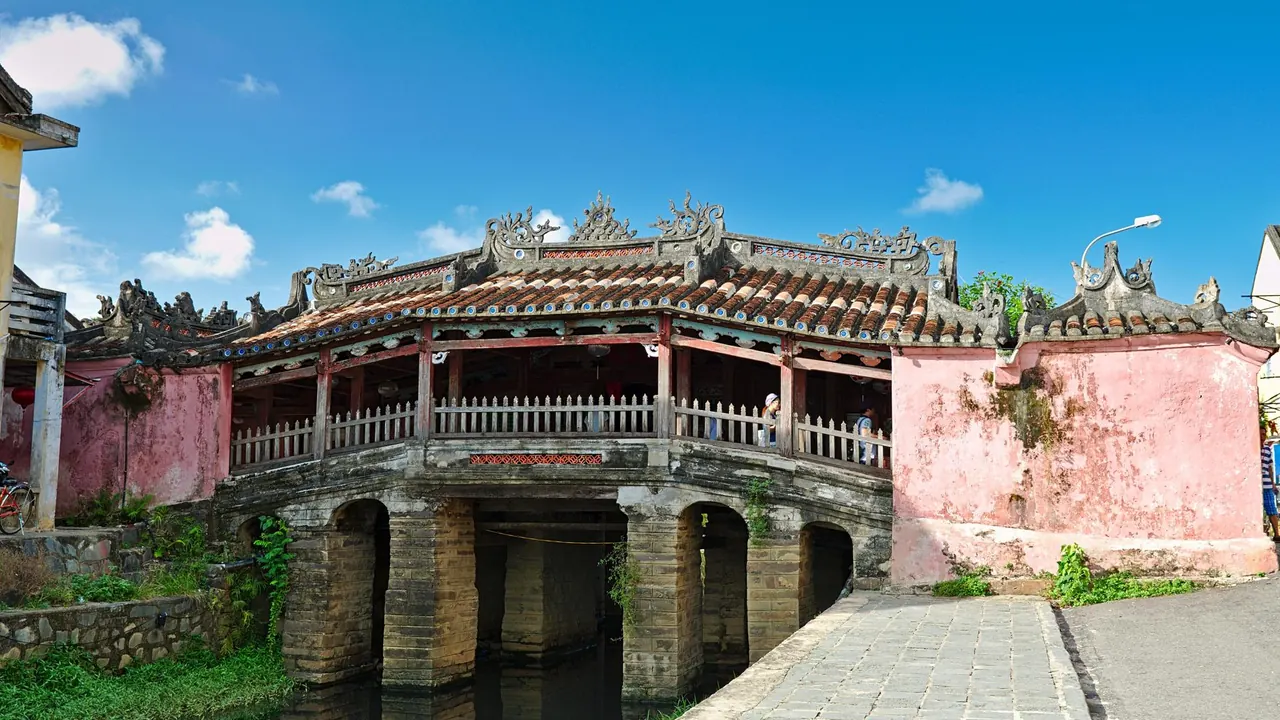

Photos: Hoi An by François Guerraz, CC BY-SA 3.0, cropped; Yangshuo by Rod Waddington from Kergunyah, Australia, CC BY-SA 2.0, cropped.
Hoi An or Yangshuo?
Our verdict in twelve categories, each scored against the same fixed benchmark cities, and the climate month by month, so you can choose for your trip.
Choose Hoi An for
- beaches
- culture and sights
- shopping
Hoi An is the better pick for a rounded vacation that mixes several things at an easy pace. You get a lantern-lit old town of merchant houses and assembly halls, a local cooking found nowhere else, a sandy beach a short bike ride away and a tailor who will make you a suit. Couples, families and first-time visitors to the region will find culture, food and sea in one small, inexpensive base, as long as they avoid the autumn storms.
Choose Yangshuo for
- nature and the outdoors
- nightlife
- live music and the arts
Choose Yangshuo when the landscape is the point of the trip. Karst peaks rise straight out of the rice fields, the Li and Yulong rivers wind between them, and rafting, cycling and some of Asia's best rock climbing start at your guesthouse door. In exchange you get plainer food, few sights and no sea. It suits active travellers, climbers and photographers, and anyone who wants a loud night out will find more on West Street than in quiet Hoi An.
Scoreboard
Twelve categories on one fixed scale from 0 to 100. The shaded stretch is the gap between the two.
Your match
Pick a travel style or drag the sliders, and both match scores follow your weighting.
Wins on beaches and culture and sights with your weighting.
Wins on nature and the outdoors and nightlife with your weighting.
What matters to you?
Category by category
What the scores mean for a trip.
Beaches & swimming
Hoi An has a proper coastline. An Bang is about 5km from the old town through the rice fields, and the pale sand runs almost unbroken north towards Da Nang. From spring to late summer the water is warm and calm, though autumn brings red flags and heavy surf.
Yangshuo is far inland and has no beach at all. A swim from the gravel banks of the Yulong or in a quiet bend of the Li is a nice way to end a hot day of rafting, but anyone who wants sand and sea should go to Hoi An.
Food & drink
Hoi An is worth eating your way through. Cao lau, white rose dumplings, chicken rice, mi Quang and its stuffed banh mi are a short but genuine local cooking, served cheaply at market counters and plastic stools, and cooking classes that start in the market or at Tra Que are a local speciality.
Yangshuo has fewer dishes worth seeking out: beer fish, pork-stuffed snails and vegetables, and Guilin rice noodles for breakfast. Both towns have a tourist strip with repetitive menus, the Hoi An riverfront and West Street, but Yangshuo has less to fall back on beyond it.
Culture & sights
Hoi An's old town is a heritage sight in its own right. It is a former trading port where Chinese, Japanese and Vietnamese influences show in the wooden shophouses, family chapels and the covered bridge, and it is especially beautiful after dark under the silk lanterns.
Yangshuo cannot compete on this. Its centre is largely rebuilt, there are no significant museums, and the interest lies in scattered pieces: brick villages along the Yulong, the Ming-era Dragon Bridge and an ancient banyan tree. People go there for the scenery, not the history.
Nightlife
Neither town is a nightlife destination, but Yangshuo is livelier after dark. West Street fills with domestic tourists, bars open onto the lane with loud music and dancers on stage, and it stays busy well past midnight.
Hoi An's evenings are gentler: a walk along the lantern-lit river, a paper candle floated on the water, a drink, and an old town that is quiet before midnight. The few late backpacker bars on An Hoi islet are about as wild as it gets. For a real night out, people take a taxi to Da Nang.
Nature & outdoors
Yangshuo's scenery is world-class, and it starts right at the edge of town. Limestone peaks crowd around the Li and Yulong rivers, and bamboo rafts, the walk from Yangdi to Xingping, the viewpoints on Moon Hill and Laozhai Hill, climbing, kayaking and caving are all close by.
Hoi An's countryside is flat and quieter: rice paddies seen by bicycle, and the nipa palm channels of Cam Thanh explored by basket boat. Its one real advantage is the sea. The Cham Islands offer snorkelling and diving over coral, which landlocked Yangshuo cannot offer, and the Hai Van Pass and Son Tra add drama further away.
Day trips
For day trips the two are fairly level, but the outings differ in kind. Hoi An has one major excursion, the Cham temple ruins of My Son in their jungle valley, plus Da Nang's museum of Cham sculpture and the Marble Mountains. After those the options thin out, and Hue is too far for a day.
Yangshuo's list is longer but lighter: the small old towns of Xingping, Fuli, Daxu and the better-preserved Huangyao, with Guilin and its Reed Flute Cave about an hour away. Choose Hoi An for one memorable ancient site, and Yangshuo for a string of pleasant villages.
Good for families
Hoi An is the easier choice with children, and it suits younger ones too. They can make a silk lantern, spin in a basket boat or cycle through the paddies, and resorts with pools, a gently shelving beach in the calm season and a large theme park with a safari park down the coast fill the other days.
Yangshuo suits families with older, outdoorsy children. Bamboo rafting and caves with mud pools go down well, but nothing is built for children, and summer storms, a noisy West Street and roads busy with coaches need managing.
Getting around
Hoi An is easier to get around. The old town is closed to motor traffic for long parts of the day, and the beach, the rice fields and the villages are all an easy, flat bike ride away, often on a bicycle lent by your hotel. Only Da Nang, the airport and My Son call for a taxi or a driver.
In Yangshuo the compact centre matters less, because almost everything worth seeing is out in the countryside. That means a hired bicycle or e-scooter, local minibuses or a driver, with signs mostly in Chinese beyond the centre and the high-speed rail station a drive out of town.
Shopping & style
Hoi An gives you a real reason to shop: made-to-measure tailoring, with suits, dresses, coats, shoes and bags cut in a day or two. It is worth allowing time for several fittings. Silk lanterns, ceramics and the An Hoi night market add to it, though there is no luxury shopping.
Yangshuo's shopping is mostly mass-produced souvenirs along West Street. The exceptions are the hand-painted fans from the workshops in Fuli and simple gifts of local tea and osmanthus.
Affordability
Both are cheap, and Hoi An is slightly cheaper. Its homestays with pools, almost-free street food and free hotel bicycles keep a stay inexpensive, and the main extra costs are the old town's heritage entry fee, the riverfront restaurants and the international-style beach resorts.
Yangshuo's guesthouses, noodle breakfasts and minibuses also cost little, but the money goes on tickets for river cruises, bamboo rafts, caves and the night show. Room rates also jump during Golden Week and the Spring Festival.
Live music & performing arts
Neither town has a theatre or a concert hall, and both rely on one large outdoor spectacle on a river. Yangshuo's is the better known: Zhang Yimou's show on the Li, with hundreds of performers lit against floodlit karst peaks.
Hoi An's island show retelling the town's history is smaller in reputation, but the town also has more intimate folk performances: bai choi, a sung card game visitors can join, and short music and dance shows at a traditional arts house. In Yangshuo, the rest is cover bands on West Street.
Wellness & relaxation
Hoi An makes rest easier. There are massage rooms and spas on almost every street, from foot-massage parlours to resort treatment centres, yoga classes are easy to find, and the resorts between the paddies and the sea are built for doing very little.
Yangshuo can be just as calm, but only in the right place: a guesthouse in the Yulong valley looking out over the peaks, with tai chi in the morning and a warm mud pool in one of the caves. It has few spas, and the town centre is loud late into the night, so where you stay matters more there.
When should you go?
Pick your month. The climate figures are measured averages, not a forecast.
Hoi An in July
Yangshuo in July
Daytime high, °C
Rainfall in the month, mm
Where the figures come from
Yangshuo's temperatures are measured 64 km from the centre, at Guilin.
Yangshuo has no rain gauge within 25 km of the centre, so its rainfall comes from a gridded climate dataset read at the city rather than from a gauge further away.
Temperature and rainfall are climate normals, averaged over the years shown. Hoi An: 1991-2020 normals, Da Nang (23.5 km from centre). Yangshuo: 1991-2020 normals, Guilin (64.4 km from centre).
The two climates almost mirror each other. Hoi An is at its most comfortable from February to April, when it is dry, warm and good for walking the old town. From May to August it gets hot, with highs near 35°C, but this is the sunniest stretch and the best for the beach, with the sea around 29°C and usually calm. From September to December the monsoon arrives, peaking at about 726mm of rain in October, with rough seas and flooding streets.
Yangshuo has a real winter, with January highs around 12°C: fine for walking but too cool for river swims. Spring brings mist and steadily more rain, which peaks in June at about 326mm, and July and August are hot and humid. Autumn, from September to November, is drier, mild and clear, the best time for hiking, cycling and climbing among the peaks. That is exactly when Hoi An is at its wettest.
Which traveller are you?
For a beach and sun trip, Hoi An is the only real option. An Bang and the long sand stretching towards Da Nang are a short cycle from town, the sea is warm and calm through spring and summer, and resorts with pools line the way.
On a culture and arts trip, Hoi An wins easily. The old town of merchant houses, Chinese assembly halls and the covered Japanese Bridge is the sight in itself, and My Son's Cham temples are an hour away. Yangshuo's mostly rebuilt centre offers little heritage.
For an outdoors trip, Yangshuo is the clear choice. Karst peaks begin at the edge of town, the Li and Yulong rivers are made for rafting and riverside walks, and hundreds of bolted limestone routes make it a climbing base Hoi An cannot match.
Before you go
| Measure | Hoi An | Yangshuo |
|---|---|---|
| Official language | Vietnamese | Putonghua |
| Currency | Dong (VND) | Yuan Renminbi (CNY) |
| Sockets | ACFG220 V, 50 Hz | ACI220 V, 50 Hz |
| Driving side | Right | Right |
| Time zone | UTC+7 | UTC+8 |
| Emergency number | Police 113, ambulance 115, fire 114 | Police 110, ambulance 120, fire 119 |
| Elevation | 13 m | 118 m |
| Main airport | Da Nang International Airport (DAD)23 km from centre47 non-stop destinations | Guilin Liangjiang International Airport (KWL)67 km from centre43 non-stop destinations |
| Public holidays this year | - | 6 days |
By the numbers
| Measure | Hoi An | Yangshuo |
|---|---|---|
| City population | 121,716 | 273,124 |
| People per km² | - | 190 |
| Museums within 10 km | 5 | 0 |
| UNESCO World Heritage sites within 50 km | 2 | 1 |
| Swim season, months above 21 °C | 12 months | - |
Where else could you go?
Every comparison below shares a destination with this one, so you can follow Hoi An or Yangshuo somewhere new.