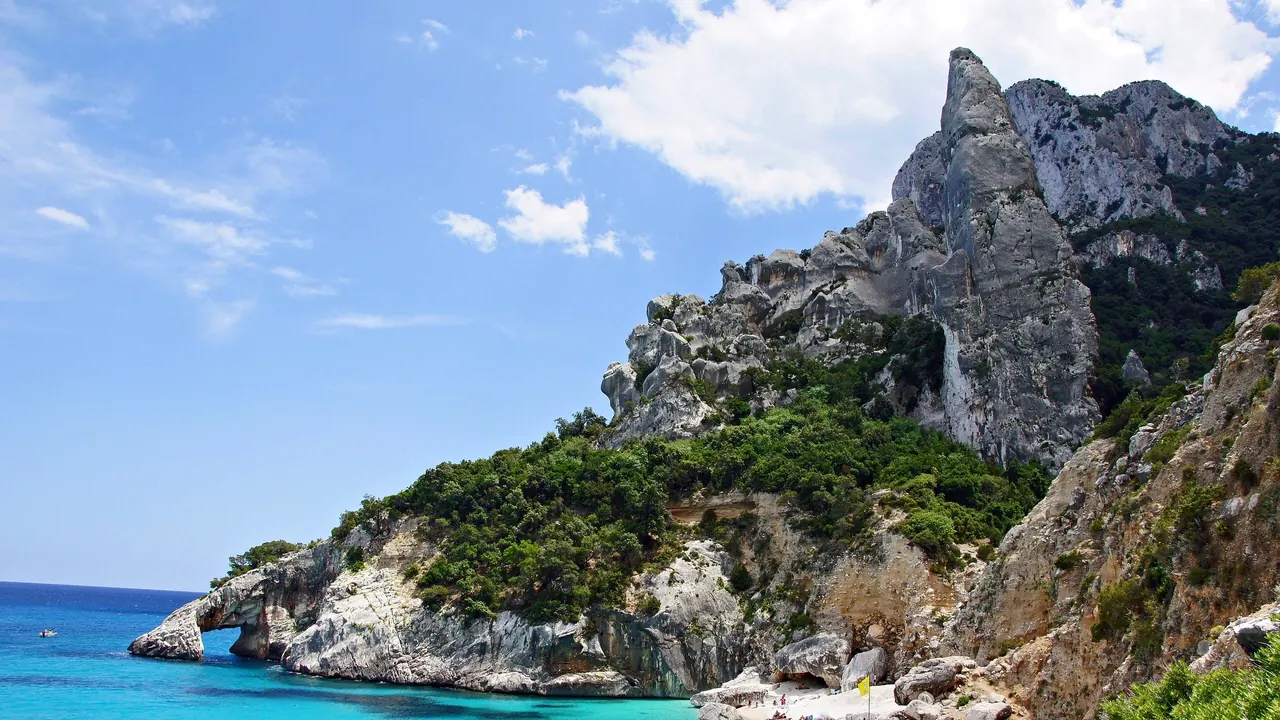
Photos: Sardinia by Yesuitus2001, CC BY-SA 2.5, cropped.
Ischia or Sardinia?
Our verdict in twelve categories, each scored against the same fixed benchmark cities, and the climate month by month, so you can choose for your trip.
Choose Ischia for
- wellness
- day trips
- prices
Ischia suits a slow, restorative trip built around warm water: thermal parks, a hot spring bubbling into the sea at Sorgeto, mud treatments and a small island where one base and no car are enough. It also has the stronger outings, with Procida, Naples and the Phlegraean Fields a ferry ride away, so a week can mix doing very little with a day of serious sightseeing across the bay.
Choose Sardinia for
- nightlife
- nature and the outdoors
- culture and sights
Choose Sardinia for a bigger, more varied vacation with a hire car. It has the finer beaches, from the granite coves of the northeast to the shallows at Chia, and wilder country in the Supramonte and along the Gulf of Orosei. It also has Bronze Age nuraghi found nowhere else and shepherd cooking at farm tables in the hills. It asks for more driving and planning, and repays them with a range of landscapes a small island cannot offer.
Scoreboard
Twelve categories on one fixed scale from 0 to 100. The shaded stretch is the gap between the two.
Your match
Pick a travel style or drag the sliders, and both match scores follow your weighting.
Wins on wellness and day trips with your weighting.
Wins on nightlife and nature and the outdoors with your weighting.
What matters to you?
Category by category
What the scores mean for a trip.
Beaches & swimming
Ischia has good swimming for the Bay of Naples. There is dark volcanic sand at Maronti, sunset bathing at Citara and calm water at San Montano, but much of its coast is rock and small coves, and the popular bays are crowded with sunbeds and day boats in high summer.
Sardinia has the better beaches, and more kinds of them: pale sand and turquoise water in the granite coves of the northeast, white pebble bays under the Orosei cliffs, and shallows at La Pelosa and Chia where you can wade far out. Because the island is so large, there is nearly always a sheltered side when the mistral blows.
Food & drink
Both islands cook more from the land than visitors expect. Ischia's signature is rabbit stewed in terracotta, with grilled fish in the harbours at Sant'Angelo and Forio and its own Biancolella whites. But the range is narrow, and many guests eat on half-board in their hotels.
Sardinia goes further and tastes more distinct: suckling pig roasted over myrtle wood, culurgiones, pecorino, bottarga and Cannonau. It is best eaten as long set menus at agriturismi in the hills, and Cagliari's San Benedetto market gives the island the market life Ischia lacks.
Culture & sights
Ischia has few sights, but good ones: the Aragonese Castle on its causeway, and Nestor's Cup from ancient Pithekoussai in the museum at Villa Arbusta. A couple of days covers them.
Sardinia has a whole ancient culture to explore. There are the Bronze Age nuraghi, with Su Nuraxi at Barumini as the greatest, sacred wells and giants' tombs, the Mont'e Prama stone figures in Cagliari, the Phoenician and Roman ruins of Nora and Tharros, and Catalan Alghero. The catch is distance, since the sites lie far apart across the countryside.
Nightlife
Neither island is made for regular late nights, but Sardinia gives you more choice. On Ischia most evenings end after dinner and a stroll, with a few wine bars and a couple of summer discos around Ischia Porto in July and August.
Sardinia has the glamorous and costly beach clubs of Porto Cervo in high summer and aperitivo crowds on Alghero's ramparts. Cagliari adds a modest scene of wine bars that keeps going all year.
Nature & outdoors
Ischia's nature is compact: chestnut woods and vineyards up Monte Epomeo, steam vents on the south coast and snorkelling in the Regno di Nettuno marine area. It is enough for a week of easy outings.
Sardinia is wilder and far larger. It has the limestone Supramonte and the Gorropu canyon, Gennargentu forests with mouflon, wild horses on the Giara plateau, kitesurfing at Porto Pollo and flamingos in the lagoons. Hikers, climbers and sailors will find much more to do there.
Day trips
Ischia wins here because the Bay of Naples is on its doorstep. Procida is a short hop away, Naples is about an hour by fast ferry, the Phlegraean Fields are reached through Pozzuoli, and summer boats run to Capri and Sorrento, all without a car.
Sardinia's outings are pleasant but smaller, slower to reach and tied to your base. You can cross to Bonifacio in Corsica from Santa Teresa Gallura, take the boat to Carloforte from the Cagliari side, or drive to the mountain villages of Barbagia from the east.
Good for families
With children, both islands work best as beach vacations, and Sardinia does it better. It has many more shallow, sandy beaches, such as Chia, the Costa Rei and La Pelosa, and resort villages with pools and children's clubs.
Ischia has gentle water at San Montano and Maronti, and its thermal parks make easy pool days. But villages full of steps and crowded summer buses can leave older children restless. In Sardinia, plan instead for long drives and the midday heat.
Getting around
Getting around is awkward on both islands, in opposite ways. Ischia is small enough to pick a base, walk within it and take the slow, crowded buses around the coastal loop, with water taxis to the coves. A car is more nuisance than help, and you arrive by ferry from Naples or Pozzuoli.
Sardinia needs a hire car and patience on winding roads. In return it has three airports, and flying into the one nearest your base saves hours.
Shopping & style
Neither island is a place to come for shopping, though Sardinia has more worth taking home. On Ischia it comes down to one evening walk between Ischia Porto and Ischia Ponte, past linen, sandals, ceramics and cosmetics made with the thermal waters. Sardinia has Alghero's red coral, filigree gold, woven rugs and Pattada shepherd's knives, plus the luxury boutiques of Porto Cervo in summer.
Affordability
Overall costs are much the same, but the spending works differently. Ischia is priced as an ordinary Italian resort, full of family-run spa hotels selling half-board, and the extras such as sunbeds, thermal parks and boat trips add up over a week.
Sardinia's prices vary far more. The Costa Smeralda in August is among the most expensive coasts in the Mediterranean, while rooms around Cagliari, Alghero and inland are moderate and agriturismo meals are generous. On both islands, June and September cost noticeably less than August.
Live music & performing arts
Ischia offers little beyond summer: chamber concerts in the Mortella gardens, film screenings at the castle during its summer festival and band music on village saints' days. For opera you have to cross the water to Naples.
Sardinia has more of its own. Cagliari's Teatro Lirico runs an opera and concert season, the deep shepherd singing of canto a tenore and the launeddas pipes turn up at village festivals, Berchidda hosts Time in Jazz and Cagliari holds the Sant'Efisio procession. Away from Cagliari, though, there is little most of the year.
Wellness & relaxation
Ischia is the place for this, and Sardinia cannot match it. On Ischia, hot springs feed most hotel pools and the terraced thermal parks at Citara, Lacco Ameno and Casamicciola, where a whole day goes by between warm pools and the sea. For wilder bathing there are the ancient steam caves of the Cavascura gorge near Maronti, and Sorgeto, where a spring heats rock pools in the sea that stay warm enough to use even on winter evenings.
Sardinia has some thermal water, beside the Roman baths at Fordongianus and at Sardara, but it plays a small part in most visits. A spa there usually means a beach resort's thalassotherapy centre. The island's calm comes instead from the slow pace of Ogliastra and the inland agriturismi.
When should you go?
Pick your month. The climate figures are measured averages, not a forecast.
Ischia in July
Sardinia in July
Daytime high, °C
Rainfall in the month, mm
Where the figures come from
Ischia's temperatures are measured 36 km from the centre, at Grazzanise.
Ischia has no rain gauge within 25 km of the centre, so its rainfall comes from a gridded climate dataset read at the destination rather than from a gauge further away.
Sardinia has no rain gauge within 25 km of the centre, so its rainfall comes from a gridded climate dataset read at the destination rather than from a gauge further away.
Temperature and rainfall are climate normals, averaged over the years shown. Ischia: 1991-2020 normals, Grazzanise (36 km from centre). Sardinia: 1991-2020 normals, Olbia / Costa Smeralda (3.1 km from centre).
The two islands follow the same Mediterranean pattern. The sea is warm enough for swimming from June to early October, and July and August bring daytime highs of about 31°C to 32°C, too hot for long walks at midday. Ischia's sea is slightly the warmer, reaching about 26°C in August, and its summers are very sunny. Autumn rain comes sooner and heavier there, building from September to a wet November of about 148mm. Spring and October are its best months for the thermal pools and for walking on Epomeo.
Sardinia, measured where most visitors stay, has the drier summer, with almost no rain in July, and its winters are less wet than Ischia's. June and September are the best months for the sea and for walking inland outside the heat. From October its water cools faster than Ischia's.
Which traveller are you?
On a relaxing and wellness trip, Ischia is the clear choice. The whole island is built around its hot springs: hotels pipe them into their own pools, there are terraced thermal parks and mud treatments, and the sea pools at Sorgeto stay warm. Sardinia's spas are mostly resort extras.
For an outdoors trip, Sardinia has far more ground to cover. The Gorropu gorge, the Selvaggio Blu cliff trek, climbing and kayaking from Cala Gonone and sailing around La Maddalena go well beyond Ischia's paths up Monte Epomeo, which a week will exhaust.
On a culture and arts trip, Sardinia gives more, provided you drive. It has nuraghi such as Su Nuraxi, the Mont'e Prama giants in Cagliari, the ruins of Nora and Tharros, canto a tenore and an opera season. Ischia's own sights fill a couple of days before Naples beckons.
Before you go
| Measure | Ischia | Sardinia |
|---|---|---|
| Official language | Italian | Italian |
| Currency | Euro (EUR) | Euro (EUR) |
| Sockets | CFL230 V, 50 Hz | CFL230 V, 50 Hz |
| Driving side | Right | Right |
| Time zone | UTC+1, UTC+2 in summer | UTC+1, UTC+2 in summer |
| Emergency number | 112 | 112 |
| Main airport | Naples International Airport (NAP)131 non-stop destinations | Olbia Costa Smeralda Airport (OLB)79 non-stop destinations |
| Public holidays this year | 13 days | 13 days |
By the numbers
| Measure | Ischia | Sardinia |
|---|---|---|
| Population | 62,027 | 1,628,384 |
| People per km² | 1,340 | - |
| Swim season, months above 21 °C | 5 months | 3 months |
Where else could you go?
Every comparison below shares a destination with this one, so you can follow Ischia or Sardinia somewhere new.