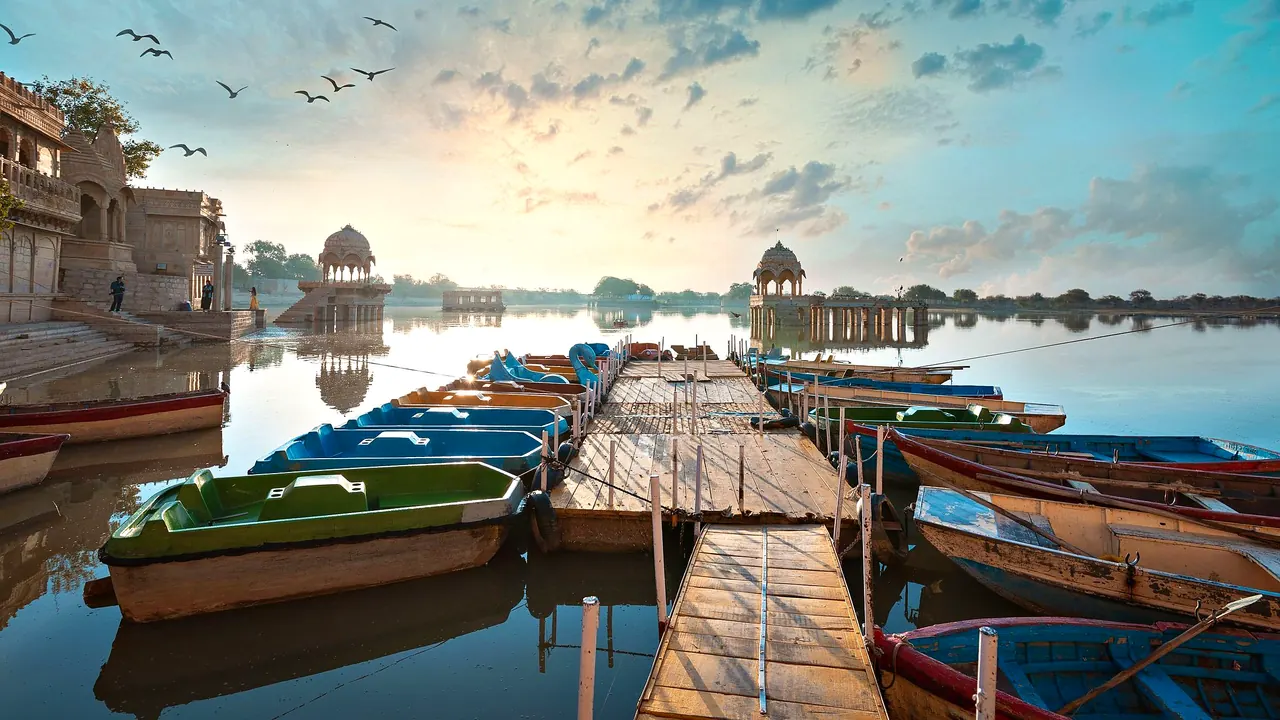
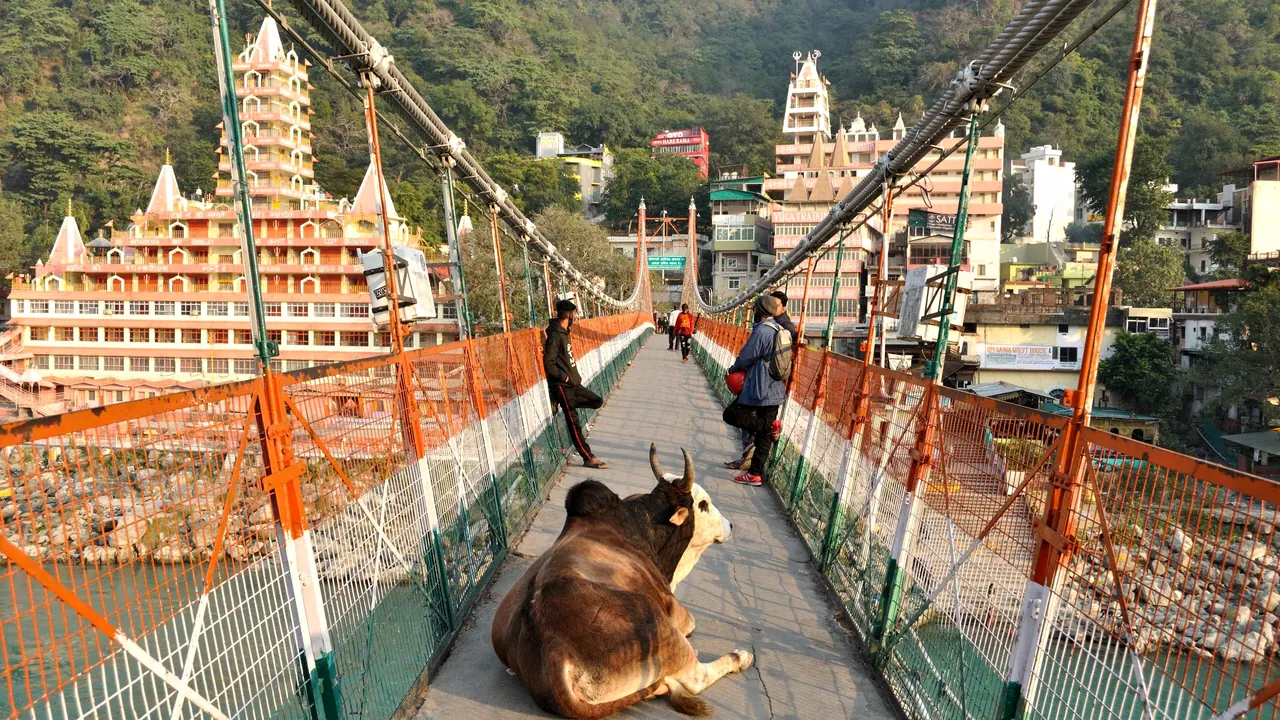
Photos: Jaisalmer by Prakash Yadav, Pexels License; Rishikesh by Dey.sandip, CC BY-SA 4.0, cropped.
Jaisalmer or Rishikesh?
Our verdict in twelve categories, each scored against the same fixed benchmark cities, and the climate month by month, so you can choose for your trip.
Choose Jaisalmer for
- culture and sights
- live music and the arts
- shopping
Jaisalmer is for the traveller who wants one unforgettable sight and a taste of the desert. The lived-in sandstone fort, the lace-carved havelis and an overnight camel trek into the Thar make a short, intense stop. You also get better craft shopping and evenings of Manganiyar music. Fold it into a wider Rajasthan route and come in the cool winter months.
Choose Rishikesh for
- wellness
- nature and the outdoors
- day trips
If you want to slow down and spend time outdoors, Rishikesh is the better choice. Its ashrams, daily yoga and Ayurvedic treatments are the real draw. The Ganges and the forested Shivalik ridges add rafting, waterfall walks and jeep safaris in Rajaji. It also makes a far better base, with Haridwar and Dehradun each about an hour away.
Scoreboard
Twelve categories on one fixed scale from 0 to 100. The shaded stretch is the gap between the two.
Your match
Pick a travel style or drag the sliders, and both match scores follow your weighting.
Wins on culture and sights and live music and the arts with your weighting.
Wins on wellness and nature and the outdoors with your weighting.
What matters to you?
Category by category
What the scores mean for a trip.
Beaches & swimming
Neither town has anywhere to swim in open water, but Rishikesh at least gives you a shoreline. You can sit on its white sand banks along the Ganges or at the rafting-camp beaches near Shivpuri and watch the river. The cold, fast current rules out a real swim, so the most you can do is a dip at the ghats, holding the chains.
Jaisalmer has even less. Gadisar Lake is for boats and sunsets, so a hotel pool is the only water you will get into, and in the hot months that pool matters.
Food & drink
The food is about as good in both towns, but very different. Jaisalmer cooks for the desert, with ker sangri, dal baati churma and, in meat-eating homes, slow mutton curries. You can also find a beer on the rooftops facing the fort.
Rishikesh is strictly vegetarian and sells no alcohol. Its strength is the riverside café: terraces over the Ganges in Tapovan, chai by the bridges, and puri and jalebi for breakfast. Its visitor menus lean towards smoothie bowls and Tibetan or Israeli plates for yoga students, while Jaisalmer's tourist rooftops drift into pizza and pancakes.
Culture & sights
Jaisalmer has the stronger sights by some way. Its twelfth-century fort is a UNESCO-listed citadel that people still live in, with the royal palace and finely carved Jain temples inside its walls. Below it, the merchant havelis, Patwon ki Haveli above all, add architecture of real distinction.
Rishikesh offers atmosphere rather than monuments. You cross Ram Jhula into Swarg Ashram, see the tiered Tera Manzil temple, watch the evening aarti at Triveni Ghat and wander the overgrown ashram where the Beatles stayed. It is moving to watch, but it has little historic building and nothing to match the fort.
Nightlife
Neither town is a place for going out, and the main difference is whether you can get a drink. In Jaisalmer you can have a beer over a rooftop dinner with the fort lit up opposite, or sit by a campfire out in the dunes. Rishikesh sells no alcohol at all, so evenings mean the aarti, a café terrace and perhaps a chant session, and most people go to bed early for dawn yoga.
Nature & outdoors
Rishikesh is far stronger outdoors. You can raft the Ganges from Shivpuri, hike to waterfalls such as Neer Garh, drive up to Kunjapuri for sunrise and take jeep safaris in Rajaji National Park, with bungee jumping and ziplining for adrenaline. That is enough variety for a week.
Jaisalmer has a single landscape, the Thar. An overnight camel trek beyond the crowded Sam dunes, or out to quieter Khuri, ends with a night under a very dark sky, and winter birders visit the Desert National Park. There are no hills, rivers or forests to add variety.
Day trips
Rishikesh makes much the better base. Haridwar and its huge aarti at Har Ki Pauri are under an hour down the river, and Dehradun is about as close. Mussoorie and Devprayag make longer days out into the hills.
Jaisalmer is remote, and its outings are short and local. The old Jain temples at Lodurva and the abandoned villages of Kuldhara and Khaba combine easily with the dunes. Beyond those, Pokaran and Tanot are long drives for a modest reward.
Good for families
Both towns suit older children far better than toddlers, and neither has anything built for children. Jaisalmer's sandcastle of a fort, camel rides and a night in a desert tent camp tend to delight school-age children in the cool months.
Rishikesh suits teenagers who are old enough to raft, zipline and ride through Rajaji on a jeep. The fast river, steep hills and food-snatching macaques make it hard going with small children.
Getting around
In both towns you get about mostly on foot, and neither has useful public transport, but they are laid out differently. Jaisalmer is compact. The fort, the havelis and Gadisar Lake sit close together, an auto-rickshaw covers short hops, and the dunes and Bada Bagh need a hired jeep or car.
Rishikesh stretches along both banks of the river. You link Tapovan, Lakshman Jhula and Ram Jhula by footbridge, riverside path, shared vikram or ferry, often walking uphill. Rafting put-ins and hilltop temples mean hiring a taxi.
Shopping & style
Jaisalmer has the richer craft shopping. The fort lanes are full of mirror-work and appliqué textiles, camel leather, silver and carved yellow sandstone, though much of the stock repeats and sellers push hard.
Rishikesh sells one theme: yoga cottons, malas, singing bowls, incense and philosophy books. That suits a yoga student but offers little to anyone else, and neither town has fashion streets or department stores.
Affordability
Both are very cheap places to stay well, and the difference lies in where the money goes. Rishikesh offers ashram rooms, shared autos that cost almost nothing and a free aarti. Jaisalmer has simple guesthouses with rooftop views of the fort and inexpensive thalis.
The bigger costs differ. In Jaisalmer they are the palace hotels, the luxury camps and the higher monument fees for foreigners. In Rishikesh they are rafting trips, teacher trainings and upmarket riverside retreats.
Live music & performing arts
Jaisalmer has more to hear. The hereditary Manganiyar and Langa musicians, with kamaicha fiddles and khartal clappers, play most evenings at desert camps, on rooftops and in small shows near the fort. The winter Desert Festival adds folk dance and camel contests.
In Rishikesh the music is devotional and you join in: drums and song at the aarti, kirtan in ashrams and cafés, and now and then a sitar or bansuri recital. Neither town has a theatre or concert hall.
Wellness & relaxation
Wellness is the reason Rishikesh exists as a destination. It has ashrams with daily classes, silent meditation, long teacher trainings and Ayurvedic detox treatments, and the International Yoga Festival each spring. The busy bridges and constant horns are the one catch.
Jaisalmer offers only hotel spas and simple massage places. Its calm comes from an unhurried afternoon in a haveli courtyard or a quiet night at a remote dune camp.
When should you go?
Pick your month. The climate figures are measured averages, not a forecast.
Jaisalmer in July
Rishikesh in July
Daytime high, °C
Rainfall in the month, mm
Where the figures come from
Jaisalmer has no rain gauge within 25 km of the centre, so its rainfall comes from a gridded climate dataset read at the city rather than from a gauge further away.
Rishikesh has no weather station within reach, so its figures come from a gridded climate model rather than a measured record, and read a broad area rather than the city itself.
Temperature and rainfall are climate normals, averaged over the years shown. Jaisalmer: 1993-2020 (rainfall 1991-2020) normals, Jaisalmer (1.9 km from centre). Rishikesh: 2001-2020 normals, NASA POWER reanalysis grid, no weather station within 90 km.
Jaisalmer is a winter destination. From November to February the days are warm and dry, around 24°C in January, though desert nights turn cold. Almost no rain falls outside the short monsoon in July and August, which is modest. By May afternoons reach 43°C, far too hot for the lanes or the dunes. October and March are warm but manageable early and late in the day.
Rishikesh is cooler all year, with January highs near 19°C, so its best walking months are October and November and again February and March. Its monsoon is much heavier, with July bringing 381mm and the river too swollen for rafting. May is hot at around 39°C. Neither town has a beach season, so in both the year is shaped by heat and rain.
Which traveller are you?
For a culture and arts trip, Jaisalmer is the clear pick. The lived-in golden fort with its Jain temples, the carved merchant havelis and evenings of Manganiyar music give you far more to see and hear than Rishikesh's riverside temples and aarti.
On a relaxing and wellness trip, choose Rishikesh. Ashrams, dawn yoga, meditation courses and Ayurvedic treatments are what the town is for, and the alcohol-free early nights fit that. Jaisalmer offers little beyond a hotel spa and hot, busy lanes.
For an outdoors trip, Rishikesh wins again. Rafting on the Ganges, forest waterfalls, the Kunjapuri sunrise and jeep safaris in Rajaji give real variety. Jaisalmer has only the Thar, which is wonderful on a camel trek but done in a night or two.
Before you go
| Measure | Jaisalmer | Rishikesh |
|---|---|---|
| Official language | Hindi, English | Hindi, English |
| Currency | Indian Rupee (INR) | Indian Rupee (INR) |
| Sockets | CM230 V, 50 Hz | CM230 V, 50 Hz |
| Driving side | Left | Left |
| Time zone | UTC+5:30 | UTC+5:30 |
| Emergency number | 108 or 112 | 108 or 112 |
| Elevation | 225 m | 372 m |
| Main airport | Jaisalmer Airport (JSA)6 km from centre5 non-stop destinations | Dehradun Jolly Grant Airport (DED)14 km from centre13 non-stop destinations |
By the numbers
| Measure | Jaisalmer | Rishikesh |
|---|---|---|
| City population | 65,471 | 70,499 |
| People per km² | 12,837 | 133 |
| Museums within 10 km | 2 | 0 |
| UNESCO World Heritage sites within 50 km | 1 | 0 |
Where else could you go?
Every comparison below shares a destination with this one, so you can follow Jaisalmer or Rishikesh somewhere new.
- Delhivs Rishikesh
- Jodhpurvs Jaisalmer
- Agravs Rishikesh
- Amritsarvs Rishikesh
- Udaipurvs Jaisalmer
- Jaipurvs Rishikesh