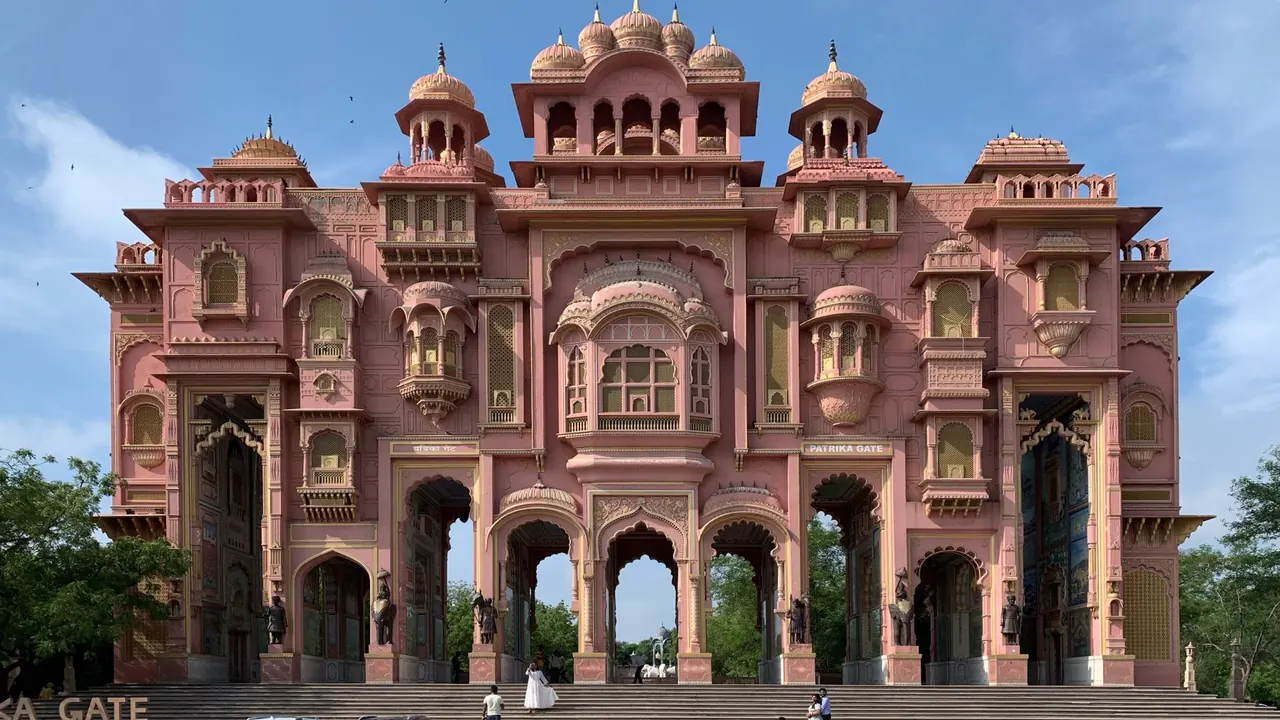
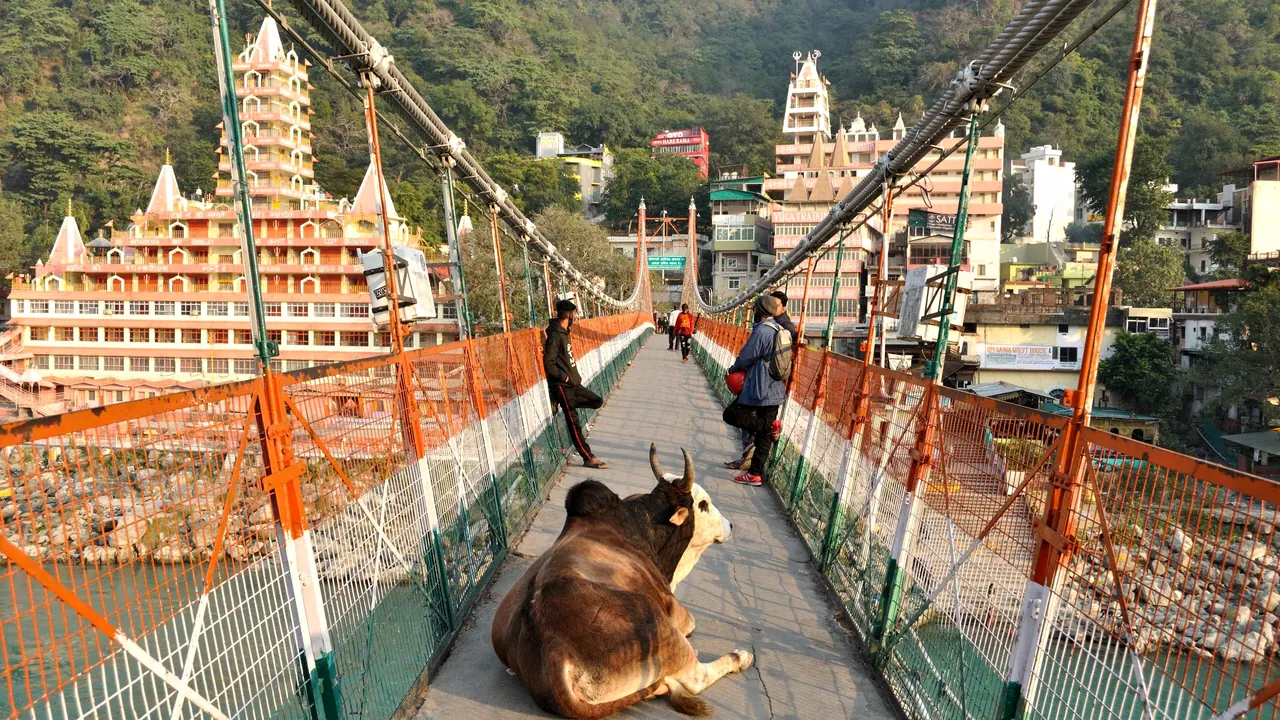
Photos: Jaipur by Chainwit., CC BY-SA 4.0, cropped; Rishikesh by Dey.sandip, CC BY-SA 4.0, cropped.
Jaipur or Rishikesh?
Our verdict in twelve categories, each scored against the same fixed benchmark cities, and the climate month by month, so you can choose for your trip.
Choose Jaipur for
- shopping
- culture and sights
- food and drink
Jaipur suits travellers who want a full programme of monuments and markets. The walled Pink City, the City Palace, Jantar Mantar and the Amber Fort on its ridge make up a dense run of sights. The bazaars are among the best in India for crafts, and Rajasthani cooking gives you something to look forward to at every meal. It is a place for long sightseeing days, and in the evening you can at least get a drink.
Choose Rishikesh for
- wellness
- nature and the outdoors
- beaches
Rishikesh is the better choice if you want to slow down or spend your time outside. Yoga ashrams, meditation courses and Ayurvedic treatment set the pace of the town, and the rafting stretch of the Ganges, the forested Shivalik hills and Rajaji National Park are all on its doorstep. Go knowing what it lacks: no meat, no alcohol, almost nothing after dark, and sights that are temples and the evening aarti rather than palaces.
Scoreboard
Twelve categories on one fixed scale from 0 to 100. The shaded stretch is the gap between the two.
Your match
Pick a travel style or drag the sliders, and both match scores follow your weighting.
Wins on shopping and culture and sights with your weighting.
Wins on wellness and nature and the outdoors with your weighting.
What matters to you?
Category by category
What the scores mean for a trip.
Beaches & swimming
Neither is a place to swim, but Rishikesh at least has a riverside. You can sit on the white sand banks along the Ganges or the camp beaches near Shivpuri and watch the cold green water, and a ritual dip at the ghats, holding the chains, is part of a visit. The current is too strong for a proper swim.
Jaipur, deep in inland Rajasthan, has no water to swim in at all, so the hotel pool is the only option. In the hot months that pool matters more there than it does in Rishikesh.
Food & drink
Jaipur has a regional cuisine worth travelling for. Dal baati churma, gatte ki sabzi and ker sangri made from desert beans lead the table, and street breakfasts of pyaaz kachori and lassi around Johari Bazaar and MI Road end with ghevar or milk sweets. The city leans vegetarian, but meat eaters can find laal maas, the fiery mutton curry of the old royal kitchens, and hotels and licensed bars will serve a drink with dinner.
Rishikesh is strictly vegetarian and alcohol-free, as befits a holy town, so there is no meat at all. Thalis at the dhabas and puri with jalebi at breakfast are good and cheap, and the café terraces in Tapovan are pleasant places to sit over the river. Their menus of smoothie bowls, pizza and Tibetan dishes repeat from café to café, though, and keen eaters run out of new things within a week.
Culture & sights
Jaipur is far ahead here. The Pink City, laid out on its grid in 1727, holds the City Palace, the Hawa Mahal and Jantar Mantar. Above it stand Amber, Jaigarh and Nahargarh on their ridges, and the Albert Hall Museum and the Galta temples add more, enough for three full days of major sights.
Rishikesh offers atmosphere rather than architecture. You get the painted ashrams of Swarg Ashram across Ram Jhula, the tiered Tera Manzil temple, the evening aarti at Triveni Ghat and the overgrown Beatles ashram in the forest. It is memorable, but there are no museums of note, and two or three days are enough.
Nightlife
Neither city is good for a night out, but Jaipur at least lets you have a drink. You can eat dinner on a rooftop facing the lit-up forts, then go on to a hotel bar or one of the few lounges and clubs in C-Scheme, which fill up at weekends. Rishikesh sells no alcohol and has no bars, so an evening there means the aarti, dinner on a café terrace and bed before dawn yoga.
Nature & outdoors
Of the two, Rishikesh is clearly the outdoor town. Upstream from Shivpuri the Ganges rapids give serious rafting outside the monsoon. Forest trails lead to waterfalls such as Neer Garh, the Kunjapuri hilltop looks across to snow peaks on clear winter dawns, and Rajaji National Park, with its elephants and deer, is right next to town.
Jaipur's outdoors are drier and more limited: the scrubby Aravalli hills, the view from Nahargarh and, best of all, leopard safaris in Jhalana on the southern edge of the city. Outside November to February the heat restricts most of this to early morning and evening.
Day trips
The two are evenly matched for day trips, but the outings are of different kinds. From Jaipur the nearby trips show rural Rajasthan: the Chand Baori stepwell, the painted palace at Samode, the ruins of Bhangarh and the block-printing villages. Pushkar and the Taj Mahal at Agra are long days rather than easy excursions.
From Rishikesh the drives are shorter and lead to holy places or into the hills. Haridwar and its huge aarti are under an hour away, Dehradun has the Forest Research Institute and a Tibetan monastery, and the hill station of Mussoorie is up a hairpin road. Devprayag, where two rivers meet to form the Ganges, makes a longer day.
Good for families
With young children both are hard work, and they come out about even, though for different reasons. Jaipur suits older children who enjoy ramparts, secret passages and puppet shows, as long as the family can cope with the traffic and sellers in the old city.
Rishikesh is better for teenagers ready for rafting, ziplines and jeep safaris in Rajaji. With toddlers it is tougher, because of the fast river, the steep lanes and macaques that snatch food.
Getting around
Rishikesh is the easier of the two to get around from day to day. Much of a stay is spent on foot, along the riverside paths and footbridges that link Tapovan, Lakshman Jhula and Ram Jhula, with shared vikrams on the main road and ferries across the river. The hills and the motorbikes slow you down, and trips out of town need a taxi.
Jaipur is more spread out and depends on auto-rickshaws, ride-hailing taxis or a car with driver, especially for Amber 11km to the north. The short metro line misses most of the sights, and inside the Pink City traffic, cows and missing pavements make walking slow.
Shopping & style
Jaipur is one of India's great craft markets, and shopping is a reason in itself to go. Johari Bazaar sells gems and silver, there are lanes of lac bangles, and you can buy block-printed cottons from Sanganer and Bagru, blue pottery, rugs and miniature paintings, with design boutiques in C-Scheme giving the crafts a modern cut. Buy stones with care, as gem scams there are long established.
Rishikesh sells to a single theme: yoga clothing, malas, singing bowls, incense, Ayurvedic oils and books on philosophy. It is fine for a few souvenirs, but there is no fashion or design worth seeking out.
Affordability
Both are very cheap, and Rishikesh is a little easier on the wallet. Ashram rooms are inexpensive, shared autos cost almost nothing and the aarti is free, so the bigger costs there are rafting and teacher trainings. In Jaipur the extra costs are a car and driver for the day, higher entry fees for foreigners at the monuments and the palace hotels, and alcohol is the one thing that feels expensive.
Live music & performing arts
Jaipur has more to watch, though no real season to plan around. There are Kathak, Kalbeliya dance, Rajasthani folk music and string puppetry at evening shows, and theatre and classical dance at Jawahar Kala Kendra and Ravindra Manch.
Music in Rishikesh is devotional: the singing and drums of the aarti and kirtan sessions in ashrams and cafés. There is the odd sitar or bansuri recital, and music lessons are easy to find.
Wellness & relaxation
For rest, Rishikesh is far ahead. Its ashrams offer daily yoga, silent meditation and residential teacher trainings, and Ayurvedic clinics run detox treatments. Dawn practice and early nights set the pace of the whole town, though the bridges and the main road are crowded and noisy.
In Jaipur, calm comes from your hotel: a shaded haveli courtyard, a pool and perhaps an Ayurvedic massage. The old city itself is loud, crowded and hot.
When should you go?
Pick your month. The climate figures are measured averages, not a forecast.
Jaipur in July
Rishikesh in July
Daytime high, °C
Rainfall in the month, mm
Where the figures come from
Jaipur has no rain gauge within 25 km of the centre, so its rainfall comes from a gridded climate dataset read at the city rather than from a gauge further away.
Rishikesh has no weather station within reach, so its figures come from a gridded climate model rather than a measured record, and read a broad area rather than the city itself.
Temperature and rainfall are climate normals, averaged over the years shown. Jaipur: 1993-2020 (rainfall 1991-2020) normals, Jaipur / Sanganer (11.1 km from centre). Rishikesh: 2001-2020 normals, NASA POWER reanalysis grid, no weather station within 90 km.
Jaipur is at its best from November to February, when it is dry and warm by day, with highs around 23°C in January. March is already hot. From April to June the heat is punishing, reaching 42°C in May, so sightseeing shrinks to the early morning. The monsoon brings most of the year's rain from July to September, peaking at about 226mm in August. October is dry again but still hot.
Rishikesh is a few degrees cooler all year, with January highs near 19°C and some light winter rain. October and November are its driest, mildest months, and February and March are also good. The pre-monsoon heat is a little gentler than Jaipur's, but the monsoon is far heavier, about 381mm in July, and the swollen river ends the rafting season. Neither city has a beach season at any time of year.
Which traveller are you?
On a culture and arts trip, Jaipur is the clear choice. The Pink City, City Palace, Jantar Mantar and Amber Fort fill three full days, with Kathak and folk shows in the evenings. Rishikesh's temples, ashrams and ghats take two or three days.
For a relaxing and wellness trip, Jaipur offers calm only inside a quiet hotel courtyard, away from the crowded old city. Rishikesh is built for it: ashram yoga, silent meditation and Ayurvedic treatment, with alcohol-free days and early nights to match.
On an outdoors trip, Jaipur has the Jhalana leopard safari and hilltop views, but for much of the year the heat limits you to dawn and dusk. Rishikesh wins easily, with Ganges rafting, waterfall hikes, sunrise at Kunjapuri and Rajaji safaris close by.
Before you go
| Measure | Jaipur | Rishikesh |
|---|---|---|
| Official language | Hindi, English | Hindi, English |
| Currency | Indian Rupee (INR) | Indian Rupee (INR) |
| Sockets | CM230 V, 50 Hz | CM230 V, 50 Hz |
| Driving side | Left | Left |
| Time zone | UTC+5:30 | UTC+5:30 |
| Emergency number | 108 or 112 | 108 or 112 |
| Elevation | 431 m | 372 m |
| Main airport | Jaipur International Airport (JAI)10 km from centre27 non-stop destinations | Dehradun Jolly Grant Airport (DED)14 km from centre13 non-stop destinations |
By the numbers
| Measure | Jaipur | Rishikesh |
|---|---|---|
| City population | 3,073,350 | 70,499 |
| People per km² | - | 133 |
| Museums within 10 km | 6 | 0 |
| UNESCO World Heritage sites within 50 km | 3 | 0 |
Where else could you go?
Every comparison below shares a destination with this one, so you can follow Jaipur or Rishikesh somewhere new.