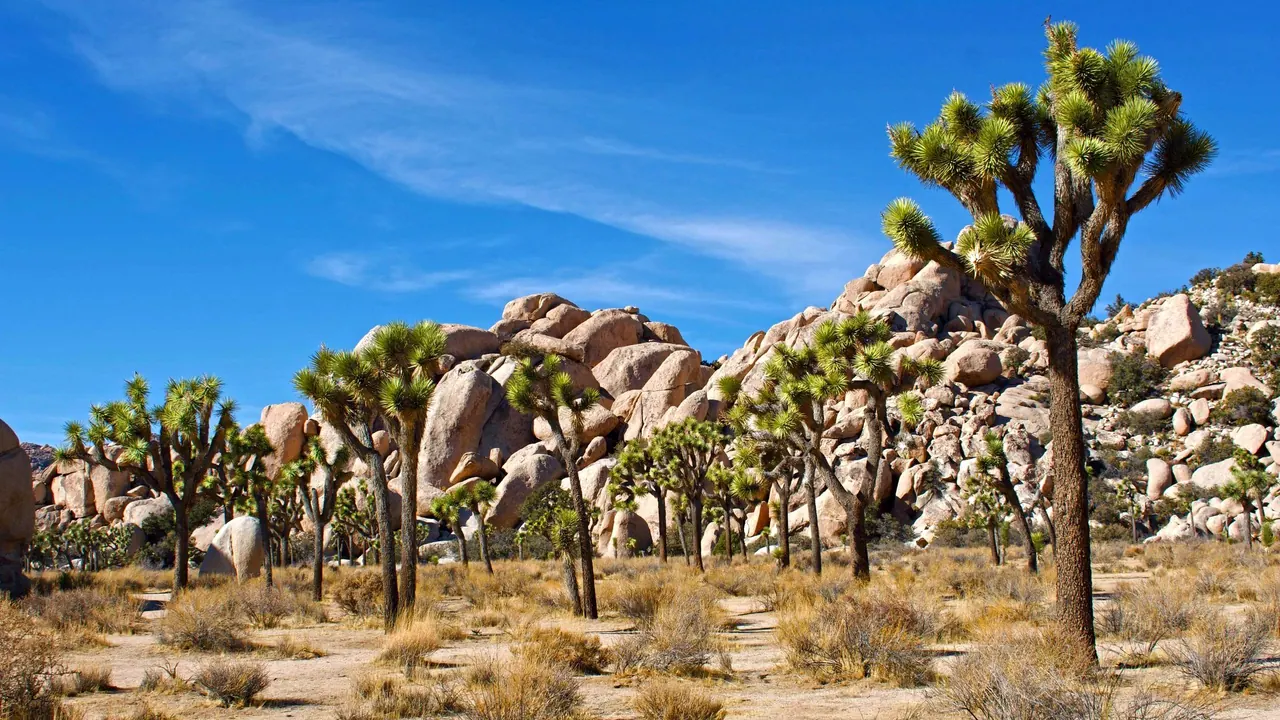
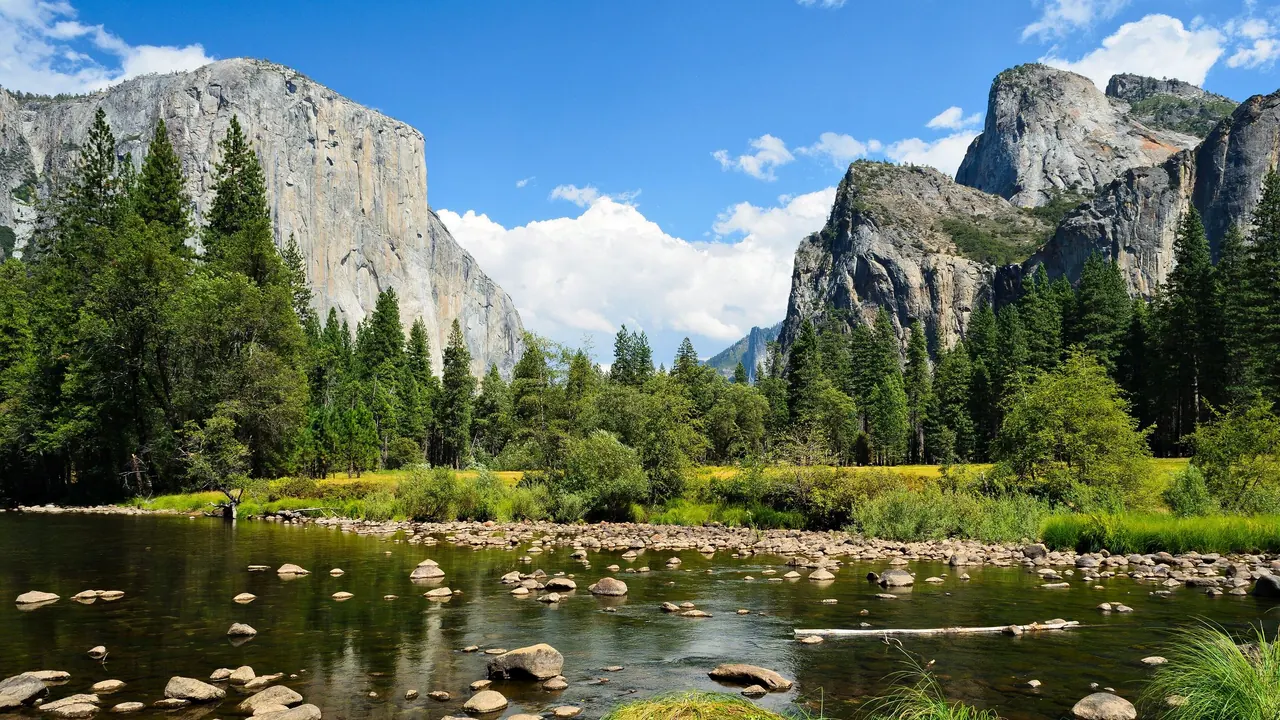
Photos: Joshua Tree by Mr. Location Scout, Pexels License; Yosemite by King of Hearts, CC BY-SA 3.0, cropped.
Joshua Tree or Yosemite?
Our verdict in twelve categories, each scored against the same fixed benchmark cities, and the climate month by month, so you can choose for your trip.
Choose Joshua Tree for
- wellness
- live music and the arts
- shopping
Joshua Tree suits travellers who want the desert as a slow retreat: a rental house with a pool or hot tub, climbing and bouldering among the granite piles by day, a sound bath or a soak at Desert Hot Springs, and a night at the Pioneertown roadhouse. Its odd sights and small-town cafés give you a little more to do off the trail. With a car, the driving between the towns and the trailheads is light and simple. Separately, the trip as a whole usually costs less, because older motels and campsites are always there as a cheaper option when the rental houses are expensive. It is at its best in the cooler half of the year.
Choose Yosemite for
- beaches
- nature and the outdoors
- families
For scenery on the grandest scale, pick Yosemite. The sheer walls of Yosemite Valley, the spring waterfalls, the sequoias of Mariposa Grove and the high country along Tioga Road make it the stronger choice for serious hikers and for families who like to camp. You give up almost everything else: evenings mean a campfire or a ranger talk, meals are lodge food, and rooms in season are expensive and book up early.
Scoreboard
Twelve categories on one fixed scale from 0 to 100. The shaded stretch is the gap between the two.
Your match
Pick a travel style or drag the sliders, and both match scores follow your weighting.
Wins on wellness and live music and the arts with your weighting.
Wins on beaches and nature and the outdoors with your weighting.
What matters to you?
Category by category
What the scores mean for a trip.
Beaches & swimming
Neither is a place to swim, but Yosemite at least has natural water. In late summer the Merced River slows into pools you can wade in the Valley, Tenaya Lake has a sandy shore and very cold water, and Bass Lake just south of the park feels like a proper summer lake resort.
Joshua Tree has nothing like this. In the high desert the only swim is the pool or plunge pool at your rental house or motel. Yosemite's advantage only holds once the snowmelt has slowed, because in spring and early summer its rivers are fast and dangerous.
Food & drink
Joshua Tree eats a little better, though nobody goes to either place for the food. Along Highway 62 there are diners, Mexican places, decent coffee shops and health-food cafés aimed at climbers, with barbecue up in Pioneertown. When you want a proper restaurant, Palm Springs is an hour away.
Inside Yosemite you eat in lodge dining rooms, cafeterias and pizza counters, and the historic Valley dining room is the one memorable setting. The gateway towns add diners and a few wine bars pouring Sierra foothill wines. In both places most visitors end up cooking for themselves or packing picnics.
Culture & sights
Joshua Tree's sights are odder and stay with you longer. There are Noah Purifoy's scrap-metal sculptures spread across the desert, the Integratron dome near Landers and Pioneertown's false-front film-set street, and inside the park you'll find Keys Ranch and petroglyphs along the trails.
Yosemite's heritage is quieter and tied to the park's own story. It includes the timber and stone grand hotel in the Valley, the Yosemite Museum's Ahwahneechee Miwok basketry, Ansel Adams's photographs and the stagecoach-era buildings at Wawona. Each takes an hour or two, and in neither place is culture the reason to go.
Nightlife
Evenings are short in both, but Joshua Tree has a little more going on. A couple of saloons in Joshua Tree and Twentynine Palms and the Pioneertown roadhouse, which fills up at weekends, give you somewhere to go after dinner. In Yosemite the evening means a lodge lounge, a ranger talk or a campfire, and the brewpubs in the gateway towns close early. Both are better for stargazing than for drinking.
Nature & outdoors
Joshua Tree is a superb landscape, but Yosemite is one of the world's great ones. The granite walls of Yosemite Valley rise about 1,000m above a meadow floor, with El Capitan, Half Dome and the waterfalls pouring off the cliffs. Beyond the Valley are the giant sequoias of Mariposa Grove and the alpine lakes of Tuolumne Meadows, and bears and deer are a common sight.
Joshua Tree's appeal is quieter: forests of Joshua trees among rounded boulders, cholla gardens lower down, palm oases and some of the finest climbing and bouldering anywhere. It also has a certified dark sky and a season that runs through winter, when Yosemite's high country is cut off by snow.
Day trips
In both places you spend most of your days inside the park, and the outings are equally modest. From Joshua Tree they lean towards design and desert oddities: the mid-century houses of Palm Springs an hour downhill, Route 66 across the Mojave past Amboy, and the decaying shoreline of the Salton Sea.
Yosemite's outings lean towards history. To the west are the gold-rush main street of Columbia, the old storefronts of Sonora and Jamestown, and the wineries around Murphys. Over Tioga Pass, in summer only, are the ghost town of Bodie and Mammoth Lakes.
Good for families
Yosemite is the easier family trip, mainly because of the Valley floor. It has flat paved cycle paths, meadows, a short walk to Lower Yosemite Fall and river edges to paddle in late summer, and the sequoias never fail to impress. It still calls for close supervision near cliffs, fast water and bears.
Joshua Tree thrills older children who like scrambling over the boulders at Hidden Valley and Skull Rock, and a rental house with a pool makes a comfortable base. But shade is scarce, the drives are long, and the heat makes much of the year a hazard for small children.
Getting around
Joshua Tree is simpler to get around, as long as you have a car. Highway 62 links the towns, traffic is light and most trailheads have parking a short walk from the rocks. Download your maps first, because there is no signal in much of the park.
Yosemite is the only one of the two you can reach without a car: regional buses run to the Valley from Merced and the gateway towns, and free shuttles loop around the Valley floor. Beyond the Valley it gets harder. Glacier Point, Mariposa Grove and Tuolumne Meadows are each an hour or more of winding road away, and Tioga Road is closed for much of the year.
Shopping & style
Joshua Tree's shopping is small but has character. Yucca Valley's old town sells vintage Western wear and mid-century furniture, Joshua Tree village has galleries, crystal shops and climbing stores, and local artists sell their work at weekend markets. Yosemite has little beyond the park stores, a long-standing landscape-print gallery in the Valley and a few antique shops in the gateway towns, so bring everything you need.
Affordability
Joshua Tree is easier on the budget, though neither is cheap. Rental houses cost a lot at weekends in winter and spring. Still, the older motels in Twentynine Palms and the park's campsites make a cheap trip possible, and petrol is the main ongoing cost.
In Yosemite the few rooms inside the park sell out early at high prices, the gateway motels charge peak rates all summer, and food in the park is poor value. The campsites are very cheap but hard to get. A winter visit or a base down in the foothills keeps costs down.
Live music & performing arts
Joshua Tree has one real draw, the old Pioneertown roadhouse, which books well-known indie, rock and country acts. The Joshua Tree Music Festival adds camping weekends of music in spring and autumn. Yosemite offers ranger campfire talks, the occasional one-person history show and a small repertory theatre in Sonora, which is too little to plan an evening around.
Wellness & relaxation
People come to Joshua Tree specifically to slow down. Yoga and meditation retreats and sound baths cluster around Joshua Tree village and in the Integratron's dome. Desert Hot Springs, half an hour away, has small spa motels with pools fed by hot mineral springs.
Yosemite is restful in the way wild country is, and you find that calm in winter or up in the high meadows rather than in the Valley in summer. Spa treatments are limited to a couple of resort hotels near the southern entrance. The open-air hot springs near Bridgeport and Mammoth Lakes are a long summer drive over Tioga Pass.
When should you go?
Pick your month. The climate figures are measured averages, not a forecast.
Joshua Tree in July
Yosemite in July
Daytime high, °C
Rainfall in the month, mm
Where the figures come from
Joshua Tree has no rain gauge within 25 km of the centre, so its rainfall comes from a gridded climate dataset read at the destination rather than from a gauge further away.
Yosemite has no weather station within reach, so its figures come from a gridded climate model rather than a measured record, and read a broad area rather than one spot.
Temperature and rainfall are climate normals, averaged over the years shown. Joshua Tree: 1992-2020 (rainfall 1991-2020) normals, Twentynine Palms / Sunfair Heights (20.4 km from centre). Yosemite: 1991-2020 normals, TerraClimate 4 km grid at the town, no weather station within 90 km.
The two are at their best at opposite ends of the year. Joshua Tree is a cool-season destination. From October to April the days are warm to mild and good for climbing and long hikes, winter is cool but bright, and there is very little rain in any month. From June to September highs reach 39°C, and hiking or climbing only makes sense at dawn and dusk.
Yosemite is the other way round. June to September is dry, with July highs around 28°C, which is ideal for the trails and the high country. From November to March it is cold and wet, with about 157mm of rain in January and highs near 8°C, and the snow closes the road east. April to June is the compromise many people choose, when the waterfalls are at full flow even though the air is still cool.
Which traveller are you?
For a relaxing and wellness trip, Joshua Tree is clearly better. Yoga retreats and sound baths gather around Joshua Tree village, the mineral pools of Desert Hot Springs are half an hour away, and a hot tub under dark skies ends the day.
On a family trip with children, Yosemite works better for families who camp. The flat Valley floor has cycle paths, meadows and short walks to the falls, and the sequoias impress every age. In Joshua Tree, heat, scarce shade and long drives limit younger children.
On an outdoors trip, Yosemite has the edge in sheer scale: the granite walls, the waterfalls, the Half Dome hike and the backcountry around Tuolumne Meadows. Joshua Tree answers with some of the world's best bouldering and a hiking season that runs through winter.
Before you go
| Measure | Joshua Tree | Yosemite |
|---|---|---|
| Currency | US Dollar (USD) | US Dollar (USD) |
| Sockets | AB120 V, 60 Hz | AB120 V, 60 Hz |
| Driving side | Right | Right |
| Time zone | UTC-8, UTC-7 in summer | UTC-8, UTC-7 in summer |
| Emergency number | 911 | 911 |
| Main airport | Palm Springs International Airport (PSP)29 non-stop destinations | Fresno Yosemite International Airport (FAT)15 non-stop destinations |
| Public holidays this year | 13 days | 13 days |
Where else could you go?
Every comparison below shares a destination with this one, so you can follow Joshua Tree or Yosemite somewhere new.
- Kings Canyonvs Yosemite
- Sequoiavs Yosemite
- Death Valleyvs Joshua Tree
- Death Valleyvs Yosemite
- Sequoiavs Joshua Tree
- Kings Canyonvs Joshua Tree