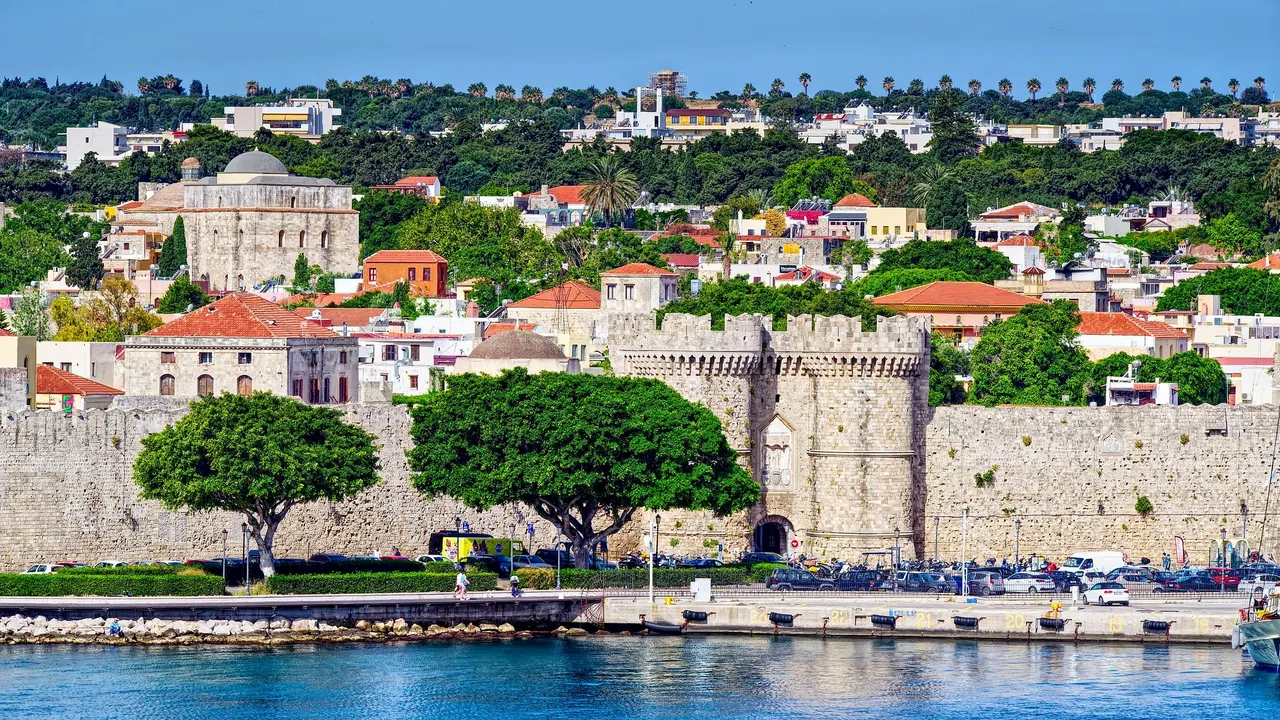
Photos: Rhodes by Mark Thomas, Pexels License.
Kefalonia or Rhodes?
Our verdict in twelve categories, each scored against the same fixed benchmark cities, and the climate month by month, so you can choose for your trip.
Choose Kefalonia for
- nature and the outdoors
- beaches
- wellness
Kefalonia suits travellers who come for landscape and sea: the white cliffs above Myrtos, the fir forest on Mount Ainos, the cave lake at Melissani, and days spent driving between coves on different coasts. Evenings are quiet, and most towns were rebuilt plainly after the 1953 earthquake, so it rewards people who are happy to make their own days outdoors rather than fill them with sights.
Choose Rhodes for
- culture and sights
- nightlife
- getting around
Choose Rhodes for a trip that mixes beach time with history and a bit of evening life. The walled Old Town and the acropolis at Lindos give it days of sightseeing that Kefalonia can't match. Its sheltered east-coast bays and resort hotels make life simple with children, and buses along that coast and boats to Symi mean a car matters less.
Scoreboard
Twelve categories on one fixed scale from 0 to 100. The shaded stretch is the gap between the two.
Your match
Pick a travel style or drag the sliders, and both match scores follow your weighting.
Wins on nature and the outdoors and beaches with your weighting.
Wins on culture and sights and nightlife with your weighting.
What matters to you?
Category by category
What the scores mean for a trip.
Beaches & swimming
Both islands have excellent swimming in very clear water, but the beaches look and work differently. Kefalonia's best beaches are its dramatic ones: Myrtos and Petani, white pebble below cliffs and green slopes, with sand at Skala, Lourdas and the reddish beach at Xi. They are spread across different coasts, so you end up driving between them.
On Rhodes, the beaches you'll actually use run in one continuous line down the sheltered east coast, from Faliraki through Tsambika to Lindos, where you can stay in one place and walk or bus to the next bay. The beaches are less spectacular than Myrtos and the busiest ones fill with sunbeds, but the water is calmer and there's more sand.
Food & drink
The two islands are about equal for food, and on both the best meals are long, simple ones in family tavernas. Kefalonia has a stronger local identity, with its meat pie, aliada with salt cod and red mandoles, and Robola wine you can taste at the wineries of the Omala valley.
Rhodes has its own dishes too, such as pitaroudia, slow-cooked goat and souma, but it takes more effort to find them because the resort strips mostly serve buffets and repeated menus. In practice, you eat better there in the inland villages and the local meze places of Rhodes Town.
Culture & sights
On culture the two islands are far apart. Rhodes has one of Europe's most complete medieval fortified towns, with the Street of the Knights, the Palace of the Grand Master, and mosques and a synagogue inside the walls. Beyond the town there's the cliff-top acropolis at Lindos and ancient Kamiros, together several days of real sightseeing.
Kefalonia lost most of its old buildings in the 1953 earthquake. Fiskardo's Venetian-era harbour, the fortress ruins at Assos, the tomb at Tzanata and abandoned Old Vlachata make good half-day outings, but none of them is a reason to choose the island.
Nightlife
Rhodes has the livelier evenings by a wide margin. Faliraki's strip of bars and clubs runs until dawn in high summer, a lane of bars in the Old Town stays open late, and Lindos has rooftop and courtyard bars for an older crowd.
On Kefalonia, a night out means a long dinner and then a drink on Argostoli's Lithostroto, at the beach bars of Lassi or by the harbour at Fiskardo. Clubs are few and small, and outside July and August most places are quiet before midnight.
Nature & outdoors
Kefalonia has the more striking scenery. Mount Ainos rises to about 1,628m, and its national park of Greek fir has semi-wild horses and wide views over Ithaca. Underground there's the Melissani lake cave and the Drogarati chamber, and loggerhead turtles feed in Argostoli harbour. Sea kayaking and sailing to Ithaca round it out.
Rhodes is gentler, with low pine-covered hills, the shaded Valley of the Butterflies and Seven Springs. Its outdoor strength is wind: Prasonisi, at the southern tip, is one of the Mediterranean's best-known windsurfing and kitesurfing spots, and nothing on Kefalonia compares.
Day trips
Rhodes has the better boat trips. Symi's pastel harbour, often combined with the monastery of Panormitis, is a classic day out. Quiet Halki is a short crossing from Kamiros Skala, and the ferry to Marmaris takes you to Turkey for the day.
Kefalonia's best outing is Ithaca, a short ferry ride from Sami, for Vathy, Kioni and the sites linked to Odysseus. Summer boats also go to Zakynthos and Lefkada. On both islands most crossings run only in the warmer months.
Good for families
Rhodes is the easier choice with children. The bays at Tsambika, Afandou and Kolymbia shelve gently into calm water, the big east-coast hotels are set up for families with pools and kids' clubs, and the water park above Faliraki and the aquarium in Rhodes Town fill a day when the beach gets dull.
Kefalonia works if you stay in the south near Skala or Lourdas, or on the Paliki peninsula near Xi, because the famous north-west pebble beaches drop off quickly. The boat through Melissani and spotting turtles go down well, but there are no attractions made for children, and the drives in summer heat are long and winding.
Getting around
Rhodes is much easier without a car. Rhodes Town's Old Town is compact and car-free, buses run steadily along the east coast to Faliraki and Lindos, and boats for Symi leave from Mandraki. Many visitors only hire a car for a few days.
On Kefalonia a car is close to essential. The mountainous island spreads its beaches and caves across different coasts, the drive from Argostoli to Fiskardo takes about an hour and a half on winding roads, and buses are too infrequent to plan around. The summer ferry from Argostoli to Lixouri saves one long drive.
Shopping & style
Neither island is worth visiting for shopping, though Rhodes has more to browse. Sokratous Street in the Old Town is lined with jewellery, leather and sponge stalls, and you can buy Lindian-style painted ceramics in Archangelos and lace in the villages.
Kefalonia has Argostoli's Lithostroto and a few boutiques around Fiskardo's harbour. Its best souvenirs are things to eat and drink: Robola wine, thyme honey and boxes of mandoles.
Affordability
Costs are similar on the two islands, and both are mid-priced for a Greek island in summer, with July and August the most expensive months. On Kefalonia, Skala, Lourdas and Lassi offer fair value while Fiskardo and Assos cost more, and almost everyone also pays for car hire.
On Rhodes, the large supply of package and all-inclusive hotels keeps the east coast moderate, and the buses save some of that car hire. Lindos is the island's expensive corner.
Live music & performing arts
Neither island has a theatre, opera or regular concert season, so plan around chance events. Kefalonia has a musical tradition of its own: kantades serenades with guitar and mandolin, and Argostoli's long-standing philharmonic band, both best heard at village festivals and summer concerts in the squares.
Rhodes is more about the setting than local music. There's a folk dance company in the Old Town and summer concerts in the medieval moat and the ancient stadium.
Wellness & relaxation
On both islands pampering means a resort hotel spa, and neither has a bathing tradition. On Rhodes, the Kallithea rotunda is a sight, not a place to bathe. The difference is in where to go to slow down. On Kefalonia, it's the Paliki peninsula, the north-east coast and harbour evenings in Assos.
On Rhodes, you need to head south, to villages such as Lahania, Asklipio and Gennadi, well away from the noisy resort strip in the north.
When should you go?
Pick your month. The climate figures are measured averages, not a forecast.
Kefalonia in July
Rhodes in July
Daytime high, °C
Rainfall in the month, mm
Where the figures come from
Kefalonia's temperatures are measured 59 km from the centre, at Zakinthos / Agrilia.
Kefalonia has no rain gauge within 25 km of the centre, so its rainfall comes from a gridded climate dataset read at the destination rather than from a gauge further away.
Rhodes has no rain gauge within 25 km of the centre, so its rainfall comes from a gridded climate dataset read at the destination rather than from a gauge further away.
Temperature and rainfall are climate normals, averaged over the years shown. Kefalonia: 1991-2020 normals, Zakinthos / Agrilia (58.6 km from centre). Rhodes: 1991-2020 normals, Rhodes Airport (12.6 km from centre).
Both islands are beach destinations from June to September, but their summers differ. Kefalonia gets hotter, with highs around 33°C in August and long, very sunny days, and the rain comes back early. Showers start in September, and by October the island gets about 100mm a month. Rhodes peaks slightly lower at about 31°C and stays almost completely dry well into September, with only 16mm that month. Its sea is also a degree or so warmer, reaching about 27°C in August, so swimming starts in late May and is still comfortable through October.
For walking, exploring villages and hiking, April, May and October are the best months on both islands, because high summer is too hot for anything strenuous after mid-morning. Winter on both is mild but wet, with Rhodes the wetter of the two in December and January.
Which traveller are you?
On a culture and arts trip, choose Rhodes. The Knights' walled Old Town, the acropolis at Lindos and ancient Kamiros fill several days. Kefalonia, rebuilt after its earthquake, has only a handful of pleasant outings, such as Fiskardo and the fortress at Assos.
For an outdoors trip, choose Kefalonia. It has fir forest and trails on Mount Ainos, sea kayaking along the north-east coast and the Melissani cave lake. Rhodes mostly offers wind, so it only wins if windsurfing or kitesurfing at Prasonisi is the plan.
On a family trip with young children, Rhodes is easier. Its east coast has shallow, sandy bays next to resort hotels with pools and kids' clubs, plus a water park and an aquarium. Kefalonia has gentle beaches in the south but little else built for children.
Before you go
| Measure | Kefalonia | Rhodes |
|---|---|---|
| Official language | Greek | Greek |
| Currency | Euro (EUR) | Euro (EUR) |
| Sockets | CF230 V, 50 Hz | CF230 V, 50 Hz |
| Driving side | Right | Right |
| Time zone | UTC+2, UTC+3 in summer | UTC+2, UTC+3 in summer |
| Emergency number | 112 | 112 |
| Main airport | Kefalonia International Airport "Anna Pollatou" (EFL)41 non-stop destinations | Rhodes International Airport "Diagoras" (RHO)136 non-stop destinations |
| Public holidays this year | 15 days | 15 days |
By the numbers
| Measure | Kefalonia | Rhodes |
|---|---|---|
| Population | 36,064 | 127,613 |
| People per km² | 49 | 91 |
| Swim season, months above 21 °C | 5 months | 6 months |
Where else could you go?
Every comparison below shares a destination with this one, so you can follow Kefalonia or Rhodes somewhere new.
- Zakynthosvs Kefalonia
- Lefkadavs Kefalonia
- Kosvs Rhodes
- Corfuvs Kefalonia
- Peloponnesevs Kefalonia
- Santorinivs Rhodes