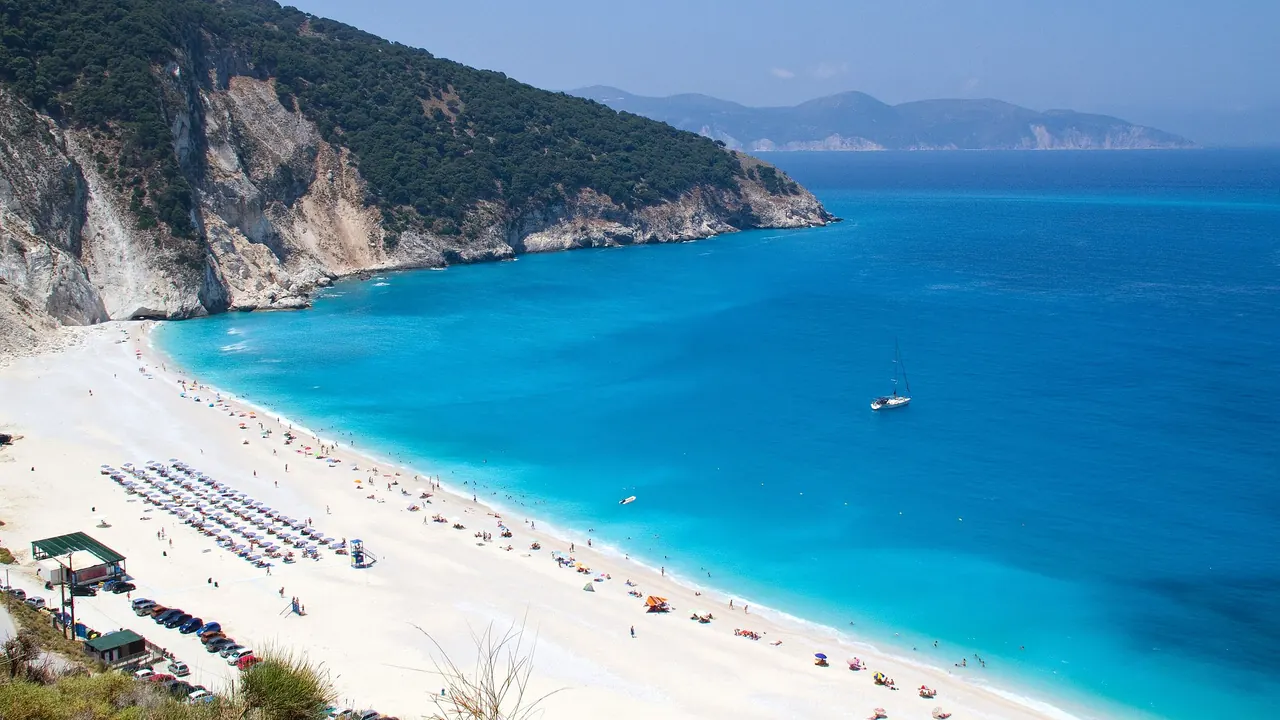
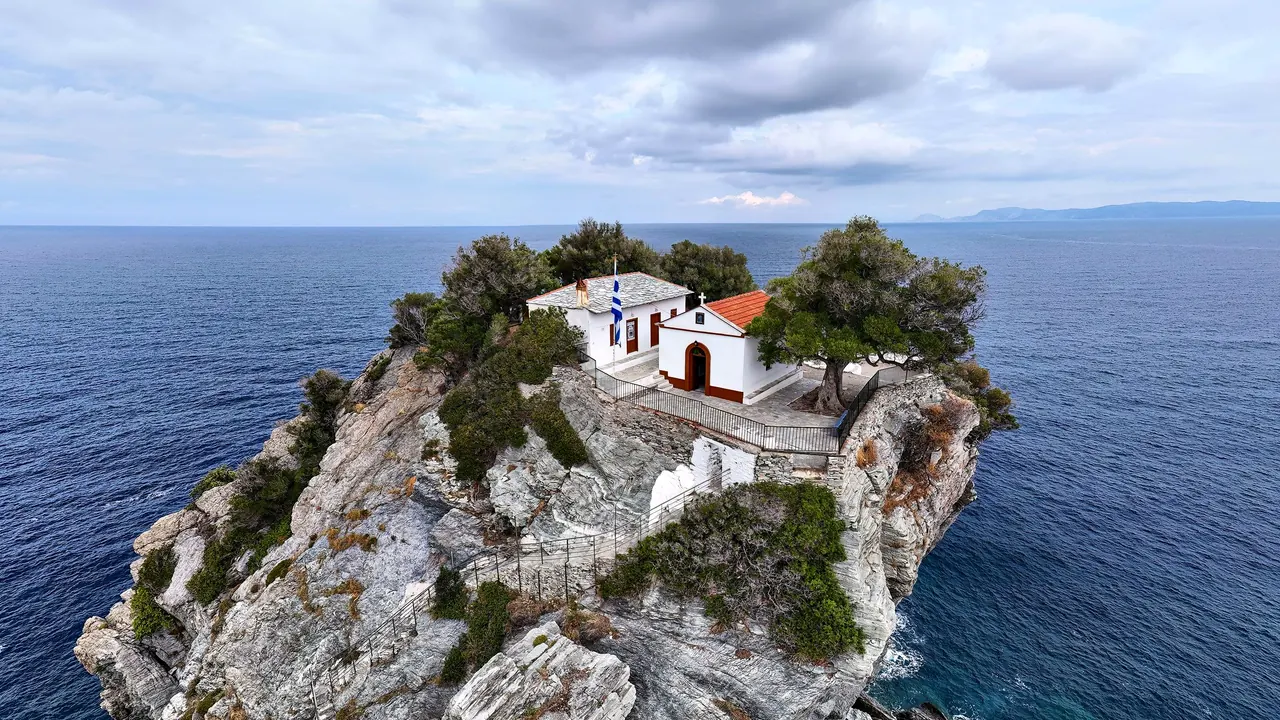
Photos: Kefalonia by Tony Hisgett from Birmingham, UK, CC BY 2.0, cropped; Skopelos by Giles Laurent, CC BY-SA 4.0, cropped.
Kefalonia or Skopelos?
Our verdict in twelve categories, each scored against the same fixed benchmark cities, and the climate month by month, so you can choose for your trip.
Choose Kefalonia for
- food and drink
- day trips
- nature and the outdoors
Kefalonia suits travellers who want a large, varied island to explore by car. It has cliff-backed beaches on one coast and sandy ones on another, a fir-covered mountain national park, caves you can take a boat through and a ferry to Ithaca. The food is more distinctive, and its southern resorts give families easy sand and a wider choice of things to do. The price is long, winding drives, and towns that were mostly rebuilt after the 1953 earthquake.
Choose Skopelos for
- culture and sights
- nightlife
- prices
Skopelos is the smaller, gentler choice for a slow beach vacation centred on one handsome town. Skopelos Town has kept its tiers of slate-roofed houses and stepped lanes, and the pine-fringed coves along the south and west lie close together on a single road. The trade-off is getting there, since there is no airport and every arrival ends with a boat. The food is narrower and there are fewer outings, but the island is easier to take in without driving all day.
Scoreboard
Twelve categories on one fixed scale from 0 to 100. The shaded stretch is the gap between the two.
Your match
Pick a travel style or drag the sliders, and both match scores follow your weighting.
Wins on food and drink and day trips with your weighting.
Wins on culture and sights and nightlife with your weighting.
What matters to you?
Category by category
What the scores mean for a trip.
Beaches & swimming
Both islands are superb for swimming in very clear water, so the choice comes down to the kind of beach you want. Kefalonia gives you drama and range. Myrtos lies beneath white cliffs, Petani and Xi are on the Paliki peninsula, and there is long sand at Skala and Lourdas, but these sit on different coasts and you will drive between them.
Skopelos is more uniform and more compact. Its beaches are pine-shaded coves of fine pebble or mixed sand along the sheltered south and west, from Stafylos and Velanio near town out to Panormos, Limnonari and Kastani, all on one road. When the meltemi blows, the south shore stays calm.
Food & drink
Kefalonia eats better and with more character. It has its own meat pie, bourbourelia bean soup and aliada with salt cod, Robola wine from Omala wineries you can visit, and a fish market in Argostoli.
Skopelos has its fried coiled cheese pie and dishes made with plums from its orchards, but beyond those it is a good standard Greek taverna island with a narrow range. Many places also close once summer ends.
Culture & sights
Neither island is a strong reason to travel for culture, but what each offers is different. On Skopelos the sight is the town itself: whitewashed houses with slate roofs rising to a Venetian castle, a folk museum, and the monasteries on Mount Palouki. Glossa is a smaller version of the same.
The 1953 earthquake left Kefalonia with few old streets outside Fiskardo. Instead it has scattered sites to drive to: the fortress at Assos, the Castle of Agios Georgios, the Mycenaean tomb at Tzanata and the abandoned village of Old Vlachata.
Nightlife
Evenings on both islands are about dinner and a drink by the water, and neither has proper clubs. Kefalonia's late nights happen in Argostoli's main square and in the beach and cocktail bars at Lassi. On Skopelos they happen in small bars in the town's lanes, where Greek music plays late in high summer.
Nature & outdoors
Kefalonia has the bigger landscape. Mount Ainos rises to about 1,628m under protected fir forest, the west coast drops in tall white cliffs, and underground lakes and caves lie beneath the karst. Loggerhead turtles feed in Argostoli harbour and nest on the southern beaches.
Skopelos is gentler country, with pine running from the shore up to Mount Delfi and mule tracks linking chapels and bays. Its standout is the neighbouring marine park, where boat trips go looking for dolphins and the rare monk seal.
Day trips
Kefalonia has more to choose from. Ithaca is a short ferry ride from Sami, summer boats reach Zakynthos and Lefkada, and Fiskardo and the Paliki peninsula make full days out on the island itself.
From Skopelos, the outings are limited to the Sporades: lively Skiathos, quieter Alonissos with its hilltop old village, and marine park cruises with swimming stops. The mainland is too far away for a day trip.
Good for families
Kefalonia works somewhat better for children, as long as you stay on the south coast or on Paliki, where Skala, Lourdas and Xi shelve gently. The Melissani boat ride and the turtles also make easy outings. The long drives in the heat are the drawback.
Skopelos has sheltered, shallow bays at Limnonari, Panormos and Agnontas, and a very relaxed pace. It has less to fill the days, though, the town's steps are hard work with a pushchair, and the ferry adds to the journey.
Getting around
On both islands, getting around takes some effort, but in different ways. Kefalonia has its own airport, but once you land it is a big, mountainous island, and you need a car for the winding drives between coasts, such as the long run from Argostoli up to Fiskardo.
Skopelos is harder to reach, since every trip ends with a boat, usually from Skiathos. Once there, it is easier to manage: a summer bus runs along the main road to the best-known beaches, and the car-free town is made for walking.
Shopping & style
Kefalonia's shopping is split between two places, Argostoli's pedestrian Lithostroto for everyday clothes and jewellery and the small boutiques around Fiskardo's harbour, and what is most worth taking home is edible: Robola, thyme honey and mandoles. Skopelos keeps everything in the lanes behind its harbour, where an evening's browsing turns up local ceramics and linen alongside prunes and herbal teas.
Affordability
Costs are much the same on both, and on each June and September are easier than high summer. On Kefalonia, the south around Skala and Lourdas is good value, Fiskardo and Assos cost noticeably more, and almost everyone pays for car hire. On Skopelos, family-run studios keep things moderate, but the ferry, a scooter and boat trips add up over a stay.
Live music & performing arts
Kefalonia's music comes from the Venetian side of its past, with kantades serenades sung in harmony to guitar and mandolin and Argostoli's philharmonic band playing open-air concerts in the town squares in summer. Skopelos is closer to the Greek taverna, with rebetiko and island songs on summer nights in Skopelos Town and music and dancing at village festivals on saints' days. On both, this is what you get in place of any theatre or concert season.
Wellness & relaxation
Kefalonia offers a little more for a restful stay, mainly because its larger resort hotels around Lassi, Skala and Fiskardo have proper spas. Its quiet Paliki peninsula and north-east coast are good places to slow down.
Skopelos relies almost entirely on its pace: late breakfasts, little traffic and shaded village tavernas. Treatments are limited to a few hotel spas and seasonal massage.
When should you go?
Pick your month. The climate figures are measured averages, not a forecast.
Kefalonia in July
Skopelos in July
Daytime high, °C
Rainfall in the month, mm
Where the figures come from
Kefalonia's temperatures are measured 59 km from the centre, at Zakinthos / Agrilia.
Kefalonia has no rain gauge within 25 km of the centre, so its rainfall comes from a gridded climate dataset read at the destination rather than from a gauge further away.
Skopelos's temperatures are measured 68 km from the centre, at Skyros Airport.
Skopelos has no rain gauge within 25 km of the centre, so its rainfall comes from a gridded climate dataset read at the destination rather than from a gauge further away.
Temperature and rainfall are climate normals, averaged over the years shown. Kefalonia: 1991-2020 normals, Zakinthos / Agrilia (58.6 km from centre). Skopelos: 1998-2025, 11 years observed (rainfall 1991-2020) normals, Skyros Airport (67.7 km from centre).
Both islands are beach destinations from June to September, and the sea warms at much the same pace on each, reaching about 26°C in August. The real difference is heat. Where most visitors stay on Kefalonia, high summer climbs to about 33°C under long hours of sunshine, so the middle of the day is for swimming, not sightseeing. Skopelos stays a few degrees cooler through July and August, which makes the town's steps and the monastery paths easier going.
The cooler months set them further apart. Kefalonia turns properly wet from October, with November bringing about 159mm, while Skopelos has a milder, steadier pattern of winter rain. May is a good walking month on both islands, though the sea is still too cool for most swimmers. For quieter swims, late September and early October are the time, when the water on Kefalonia holds a little more warmth than on Skopelos.
Which traveller are you?
On an outdoors trip, Kefalonia is the stronger island. Mount Ainos gives you real mountain walking among Greek fir and semi-wild horses, the Melissani and Drogarati caves add something Skopelos lacks, and you can sea kayak or sail across to Ithaca.
On a family trip with children, Kefalonia also comes out ahead, as long as you base yourselves in the south. Skala and Lourdas have shallow sandy water, and the cave boat ride and turtle-spotting fill the days. On Skopelos the town's steps and the ferry journey are harder work.
For a culture and arts trip, Skopelos is the more rewarding of the two, though neither is a major cultural destination. Its main town survives intact around the harbour, with a Venetian castle and monasteries close by, while Kefalonia's sights are scattered across a largely rebuilt island.
Before you go
| Measure | Kefalonia | Skopelos |
|---|---|---|
| Official language | Greek | Greek |
| Currency | Euro (EUR) | Euro (EUR) |
| Sockets | CF230 V, 50 Hz | CF230 V, 50 Hz |
| Driving side | Right | Right |
| Time zone | UTC+2, UTC+3 in summer | UTC+2, UTC+3 in summer |
| Emergency number | 112 | 112 |
| Main airport | Kefalonia International Airport "Anna Pollatou" (EFL)41 non-stop destinations | Skiathos Island National Airport (JSI)37 non-stop destinations |
| Public holidays this year | 15 days | 15 days |
By the numbers
| Measure | Kefalonia | Skopelos |
|---|---|---|
| Population | 36,064 | - |
| People per km² | 49 | - |
| Swim season, months above 21 °C | 5 months | 5 months |
Where else could you go?
Every comparison below shares a destination with this one, so you can follow Kefalonia or Skopelos somewhere new.
- Skiathosvs Skopelos
- Zakynthosvs Kefalonia
- Lefkadavs Kefalonia
- Halkidikivs Skopelos
- Paxosvs Kefalonia
- Aeginavs Skopelos