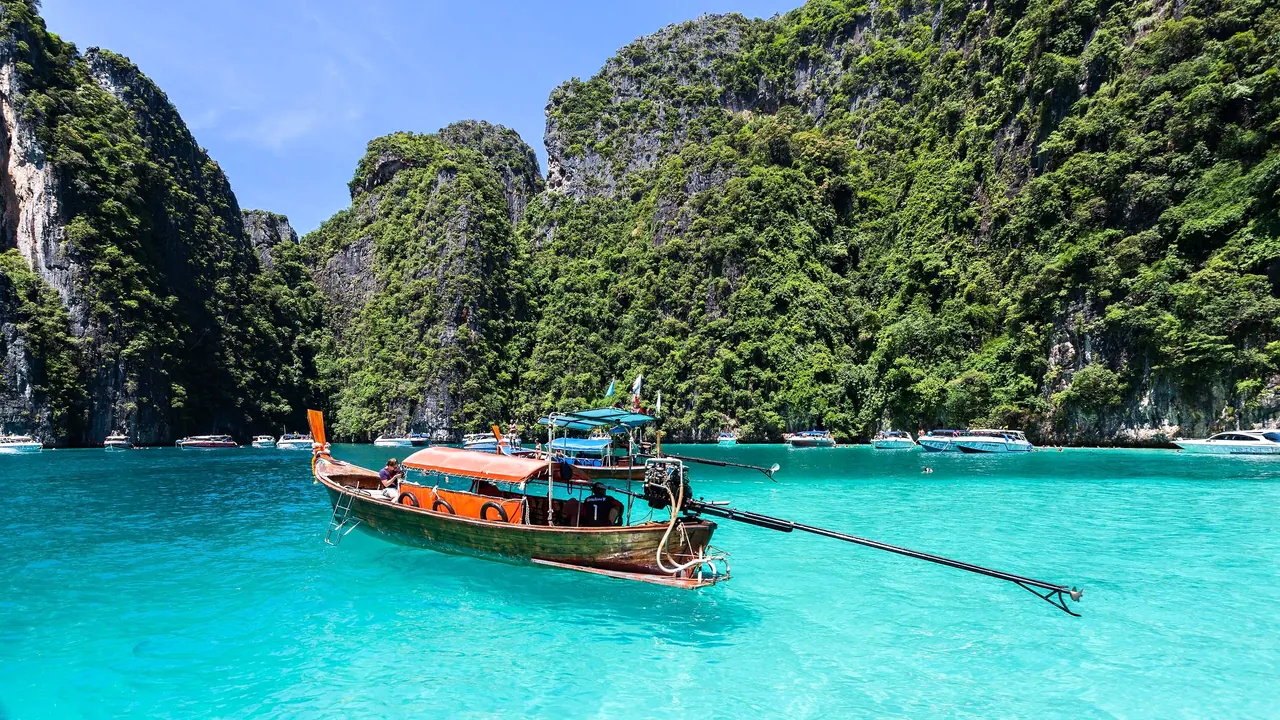
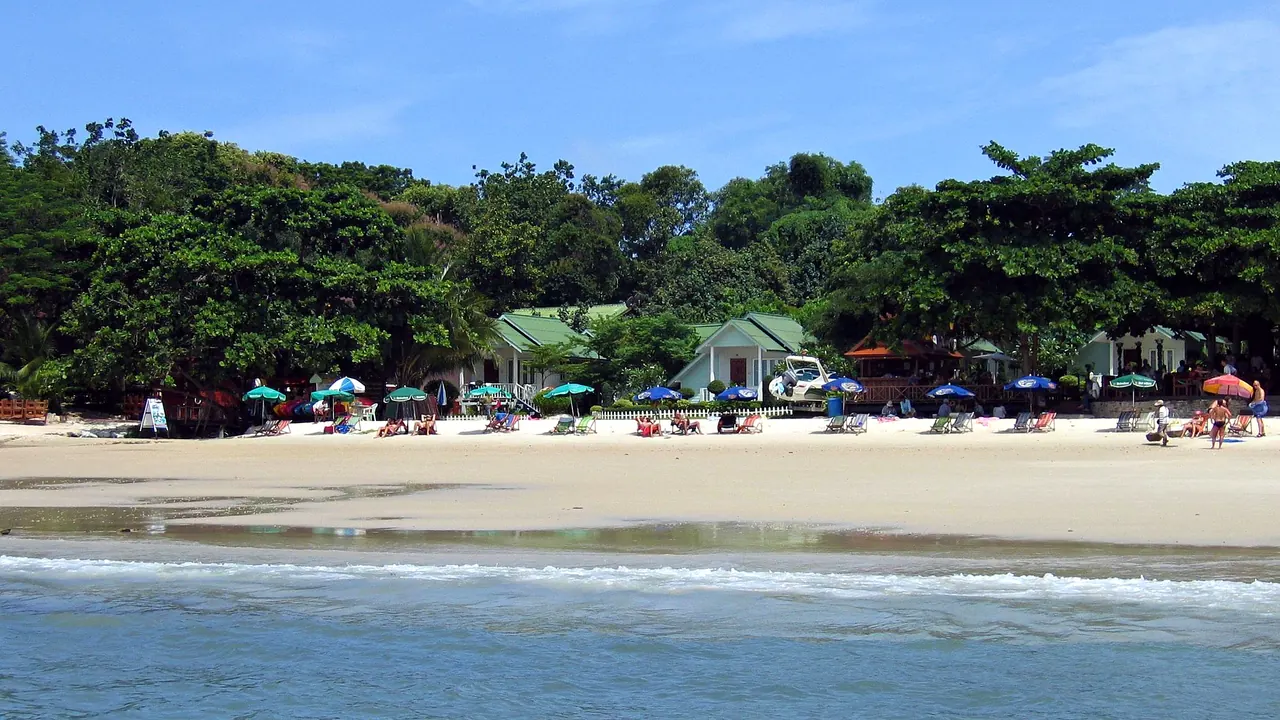
Photos: Koh Phi Phi by Diego Delso, CC BY-SA 3.0, cropped; Koh Samet by Bjørn Erik Pedersen, CC BY-SA 3.0, cropped.
Koh Phi Phi or Koh Samet?
Our verdict in twelve categories, each scored against the same fixed benchmark cities, and the climate month by month, so you can choose for your trip.
Choose Koh Phi Phi for
- nature and the outdoors
- nightlife
- day trips
Koh Phi Phi is the island for travellers who want scenery as much as sand. Its sheer limestone cliffs, the lagoons of Phi Phi Leh and the coral walls offshore make it the stronger choice for snorkellers, divers, kayakers and anyone who wants a day on the water every day. The beach parties on Loh Dalum give it a proper night out as well. You pay for all this with higher prices and a village that rarely sleeps.
Choose Koh Samet for
- prices
- families
- getting around
Koh Samet suits a simpler, cheaper beach stay, especially for families and for anyone coming from Bangkok. Its east coast is a string of soft white-sand bays you can walk between, the water is calm and shallow, and the quiet southern coves are easy with small children. The landscape is gentle rather than dramatic, and nights out are modest, but a week here costs noticeably less.
Scoreboard
Twelve categories on one fixed scale from 0 to 100. The shaded stretch is the gap between the two.
Your match
Pick a travel style or drag the sliders, and both match scores follow your weighting.
Wins on nature and the outdoors and nightlife with your weighting.
Wins on prices and families with your weighting.
What matters to you?
Category by category
What the scores mean for a trip.
Beaches & swimming
Both islands are built around their beaches, but Koh Phi Phi's water is the more striking. It is clear and turquoise under limestone cliffs, with soft, calm sand at Laem Tong and Long Beach, and boat trips to Bamboo Island and the coves of Phi Phi Leh. Loh Dalum, by the village, is shallow at low tide and crowded.
Koh Samet's strength is choice and ease. Its east coast runs from the fine, squeaky sand of Hat Sai Kaew down to the small quiet bays of Ao Thian and Ao Kiu, all within walking distance of each other, and Ao Prao faces the sunset. The water is calm but less glassy, and Bangkok crowds fill the northern beaches on Saturdays.
Food & drink
Neither island is a reason to travel for food, and both send serious eaters to the mainland. The difference is in the details. Phi Phi's Tonsai village mixes Thai dishes with pizza and burgers for a backpacker crowd, and its best food is street-cart roti and beach seafood. On Samet, the simple places in Na Dan village by the pier cook closer to how locals eat, and grilled fish is served at tables on the sand at dusk.
Culture & sights
There are almost no sights on either island. Phi Phi has a small tsunami memorial and the cliff entrance to Viking Cave, which you see from a boat. Samet has a literary link through Sunthorn Phu's poem Phra Aphai Mani, marked by statues of its characters on the rocks at Hat Sai Kaew, plus a modest temple in Na Dan.
Nightlife
Koh Phi Phi has the bigger party, and it happens every night. Bars along Loh Dalum put out mats, run fire shows, play dance music and serve drinks in buckets until the early hours, and reggae bars and Muay Thai bouts for visitors keep the village busy. It is young, loud and much the same from one bar to the next.
Koh Samet has the same ingredients on a smaller scale: cushions on the sand and fire dancers between Hat Sai Kaew and Ao Phai. It only really gets going on Friday and Saturday nights, when crowds arrive from Bangkok. Midweek it is quiet, which suits people who want one or two drinks rather than a big night.
Nature & outdoors
Here the islands are far apart. On Koh Phi Phi the landscape is itself an attraction: cliffs rising straight from the sea, a sandy isthmus joining the two halves of the island, the view over both bays from the hilltop, and the enclosed emerald water of Pileh Lagoon. Under water, soft coral covers the walls at Bida Nok and Bida Nai, though heavy boat traffic has worn the reefs.
Koh Samet is low and scrubby, with dry forest, monitor lizards and birds inside a marine national park. Its best outdoor day is the walk along the east coast over headlands from bay to bay. Snorkelling off Koh Kudee and Koh Talu is pleasant but modest, and calm-water kayaking is about as active as it gets.
Day trips
Neither island is a good base for excursions, but Phi Phi has better options within reach by boat. Koh Lanta's stilt-house old town is about an hour away, and Railay and Ao Nang are not much further, so a day away is easy to arrange. Phuket Town makes a long day out.
From Samet, everything on the mainland starts with the ferry to Ban Phe. Rayong is a short errand from the pier, and Chanthaburi, with its cathedral and riverside shophouses, is a long drive further on. Most visitors fit it into the journey in or out instead.
Good for families
Koh Samet is the easier island with small children because its gentle bays sit side by side. From a resort at Ao Wong Deuan or Ao Thian you can walk along the sand to the next cove, and the water stays shallow and calm through the dry season. The one real drawback is the rutted inland roads, which are hard going with a buggy.
On Phi Phi, the water that suits children is at Laem Tong and the other northern beaches, and you reach them by boat. Once there, families tend to stay inside the resort, because the way out is a steep, unlit path and the village beyond is loud until late. Neither island has anything built for children, and both have only basic medical care, though on Phi Phi there are no cars at all.
Getting around
Koh Samet is simpler to get around once you are there. The island is about 6km long, and sandy paths and coastal trails link the main bays, with green songthaew pickups and hired scooters for longer hops on rough inland roads. The catch is the journey in: about three hours by road from Bangkok, then a boat.
Phi Phi is closer to Phuket and Krabi, a ferry of under two hours, but has no roads at all. Tonsai and Loh Dalum are a short walk apart, and anywhere else means a longtail boat or a steep path over the hills, so a stay at a northern resort depends on boat transfers.
Shopping & style
There is no real shopping on either island, so bring what you need. Phi Phi's village lanes at least add dive and snorkel gear and a few tailor and jewellery stalls to the usual sarongs and sunscreen. Samet has little beyond beachwear, shell trinkets and convenience stores.
Affordability
Koh Samet is clearly the cheaper island. Both cost more than the Thai mainland for the same basic reason: food, drink and almost everything else arrives by boat, and visitors pay a park entry fee. On Phi Phi the pressure is greater. There is little space between the cliffs and dry-season rooms are in high demand. Much of the island can only be reached by water, so longtail rides and boat tours become a daily expense rather than an occasional one.
On Samet the extra costs are easier to avoid. They come from speedboat transfers, songthaew rides and the beachfront resorts on the best bays, and above all from weekends and Thai long weekends, when city crowds push prices up. If you come midweek and stay a little back from the beach, most of those costs disappear.
Live music & performing arts
Neither island has any stage or music scene. On both, the entertainment is fire dancers on the beach and the odd acoustic act in a bar, with Phi Phi's village bars more likely to have a cover band on any given night. For proper live music or theatre, Samet visitors at least have Bangkok close by.
Wellness & relaxation
The islands are equally good for a restful stay, and on both it depends on where you sleep. Phi Phi has massage mats in the shade along its beaches and spas among the trees at the northern resorts, and Laem Tong and the eastern bays are slow and calm, away from the village noise.
Samet's calm is easier to find, with massage pavilions open to the sea breeze and silent evenings in the southern coves of Ao Kiu, Ao Wai and Ao Thian. The bar strip is the only part to avoid, and only at weekends.
When should you go?
Pick your month. The climate figures are measured averages, not a forecast.
Koh Phi Phi in July
Koh Samet in July
Daytime high, °C
Rainfall in the month, mm
Where the figures come from
Koh Phi Phi's temperatures are measured 65 km from the centre, at Phuket Airport.
Koh Phi Phi has no rain gauge within 25 km of the centre, so its rainfall comes from a gridded climate dataset read at the destination rather than from a gauge further away.
Koh Samet has no rain gauge within 25 km of the centre, so its rainfall comes from a gridded climate dataset read at the destination rather than from a gauge further away.
Koh Samet's sunshine is measured 72 km from the centre, at Chanthaburi.
Temperature and rainfall are climate normals, averaged over the years shown. Koh Phi Phi: 1991-2020 (sunshine 1961-1990) normals, Phuket Airport (65.2 km from centre). Koh Samet: 2005-2020 (sunshine 1991-2020, rainfall 1991-2020) normals, Rayong (13.5 km from centre).
Both islands are hot all year, with daytime highs that hardly move from the low 30s, so the choice of month comes down mostly to rain. The hottest stretch, around 34°C, comes in March on Koh Phi Phi and in April and May on Koh Samet, when walking in the middle of the day is tiring. Phi Phi is at its best from December to March, when the sea is calm and the sun is out most days. Rain builds from April and peaks in October at 316mm, bringing rougher crossings and cancelled boat trips. Even through the wet season, though, Phi Phi gets more sunshine than Samet does in the same months.
Koh Samet, on the Gulf side, keeps a different calendar. Its dry season arrives earlier. November is already fairly dry while Phi Phi is still wet, and December is almost rainless at 8mm. From May to October Samet is wet and noticeably cloudy, with September the wettest month. The sea around both islands stays close to 29°C all year, so the water is always warm enough to swim.
Which traveller are you?
On an outdoors trip, Koh Phi Phi wins clearly. You can kayak into Pileh Lagoon, climb the bolted cliffs near Tonsai, snorkel among blacktip reef sharks at Shark Point and hike to the viewpoint. Samet offers little more than a coastal path and modest coral.
On a family trip with young children, Koh Samet is the easier choice. It is a short journey from Bangkok and the southern coves are quiet at night. Phi Phi's party village and rough wet-season crossings make it harder going with small children.
On a trip on a tight budget, Koh Samet stretches further, with cheap bungalows set back from the sand, plain Thai food and an inexpensive ride out from the capital. On Phi Phi, dormitories and cart roti keep costs down, but fees, boat tours and drinks soon add up.
Before you go
| Measure | Koh Phi Phi | Koh Samet |
|---|---|---|
| Official language | Thai | Thai |
| Currency | Baht (THB) | Baht (THB) |
| Sockets | ABCF220 V, 50 Hz | ABCF220 V, 50 Hz |
| Driving side | Left | Left |
| Time zone | UTC+7 | UTC+7 |
| Emergency number | Police 191, ambulance 1669, fire 199 | Police 191, ambulance 1669, fire 199 |
| Main airport | Krabi International Airport (KBV)14 non-stop destinations | U-Tapao–Rayong–Pattaya International Airport (UTP)2 non-stop destinations |
By the numbers
| Measure | Koh Phi Phi | Koh Samet |
|---|---|---|
| Swim season, months above 21 °C | 12 months | 12 months |
Where else could you go?
Every comparison below shares a destination with this one, so you can follow Koh Phi Phi or Koh Samet somewhere new.
- Koh Lantavs Koh Phi Phi
- Phuketvs Koh Phi Phi
- Pattayavs Koh Samet
- Koh Changvs Koh Samet
- Koh Lipevs Koh Phi Phi
- Langkawivs Koh Phi Phi