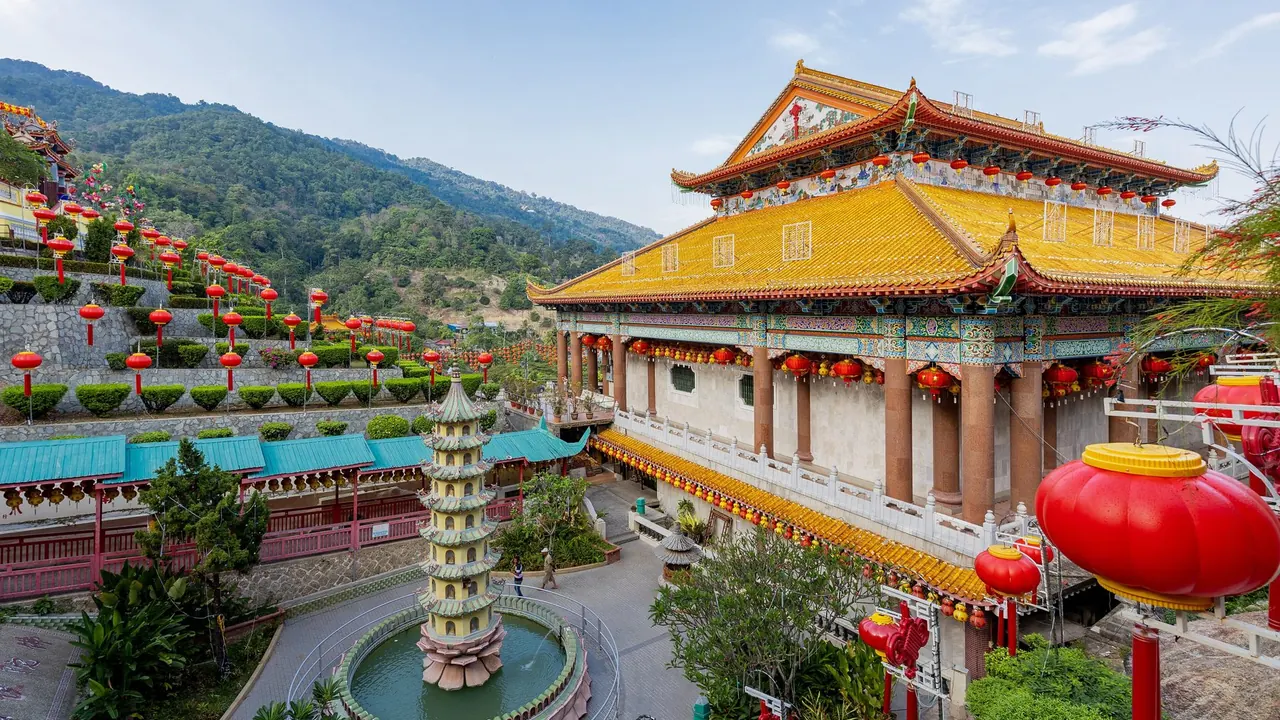
Photos: Penang by Supanut Arunoprayote, CC BY 4.0, cropped.
Koh Samui or Penang?
Our verdict in twelve categories, each scored against the same fixed benchmark cities, and the climate month by month, so you can choose for your trip.
Choose Koh Samui for
- wellness
- beaches
- nightlife
Koh Samui is the island for a vacation spent on the sand and in the water. It has the broad white curve of Chaweng, the sheltered bay at Choeng Mon, boat days out to the limestone islands of Ang Thong, and a long tradition of yoga, fasting and spa retreats on the slower north and west coasts. Chaweng also gives it the livelier nights. What it lacks is history and much reason to leave the beach, and it costs more to stay there.
Choose Penang for
- culture and sights
- food and drink
- prices
Travellers who would rather walk and eat should pick Penang. The shophouse streets, clan houses and temples of George Town fill two or three days on foot, and the hawker cooking, with its char kway teow, assam laksa and nasi kandar, is reason enough to go. Day to day it is the cheaper island, and Ipoh is within reach by train. The trade-off is the beach at Batu Ferringhi, which is something to fit in around the rest rather than a reason to come.
Scoreboard
Twelve categories on one fixed scale from 0 to 100. The shaded stretch is the gap between the two.
Your match
Pick a travel style or drag the sliders, and both match scores follow your weighting.
Too close to call, 1 point apart
Wins on wellness and beaches with your weighting.
Wins on culture and sights and food and drink with your weighting.
What matters to you?
Category by category
What the scores mean for a trip.
Beaches & swimming
On Koh Samui the beach is the whole point. Chaweng is a long sweep of fine white sand with clear water, Lamai is a slightly rougher version just to the south, and Choeng Mon and the north coast bays offer gentler swimming. Rocky coves such as Silver Beach are lovely for a swim among the boulders.
Penang treats the beach as a side trip. Batu Ferringhi is a resort strip of jet skis and parasailing, but the sea there is often murky. The better sand at Monkey Beach and Kerachut in the national park is a hike or a boat ride away and has few facilities.
Food & drink
Penang is the island you plan your meals around. Its hawker centres and old coffee shops serve Hokkien, Teochew, Malay, Tamil and Nyonya dishes side by side, and there are banana-leaf meals in Little India and night stalls on Gurney Drive.
Samui eats well in a narrower way, with southern Thai curries, beach-grilled seafood and the night markets at Lamai, Maenam and Fisherman's Village. Beyond Thai cooking and grilled fish there is little variety, and the menus on the Chaweng strip are uneven.
Culture & sights
George Town is a true heritage destination: two centuries of trading-port shophouses, clan temples, stilt villages on the water, and churches, mosques and Hindu and Chinese temples sharing Harmony Street. Kek Lok Si on the hill outside town adds one of the largest Buddhist temples in Southeast Asia.
Samui's sights fit into a single morning loop: the Big Buddha on its causeway islet, the many-armed Guanyin at Wat Plai Laem, the mummified monk at Wat Khunaram and the old wooden shophouses of Bophut. Anyone who comes for heritage will run out of things to see quickly.
Nightlife
Samui is where you go to party. Chaweng's beach clubs, roadside bars and the clubs in the lanes behind the sand run late through the high season, with DJs and fire shows. The full moon parties on Koh Phangan are a short boat ride away, although parts of the scene are generic and seedy.
Evenings in Penang are gentler: backpacker bars around Love Lane and Chulia Street, cocktail bars in restored shophouses and a few clubs on Upper Penang Road. Many nights end over a late plate at a hawker centre instead.
Nature & outdoors
Both islands offer plenty of green and blue, but in different ways. Samui's best scenery lies at sea. Boat trips go to the forty-odd limestone islands of Ang Thong for kayaking, snorkelling and the emerald lake, and divers go north to Sail Rock and Koh Tao. On the island itself there are only modest hills and the Na Muang waterfalls.
Penang's strengths are on land. You can take the funicular or walk the jungle trails up Penang Hill to a cooler summit and a canopy walk. There are also forest paths to a lighthouse and turtle beaches in the national park, and quiet cycling country among the orchards of Balik Pulau.
Day trips
From Penang, a day out can take you into mainland Malaysian history. Ipoh, about two hours south by train, has a colonial old town and cave temples in limestone hills, and Taiping, royal Kuala Kangsar and the early temple ruins of the Bujang Valley are all within reach.
Samui's outings are island-hopping instead: Koh Phangan's quieter beaches and port town, or a full day out to Koh Tao and the sandbar islets of Koh Nang Yuan. The nearby mainland is only a transport hub, so there are no historic towns to visit.
Good for families
For a family beach stay, Samui is at least as good a base and usually the easier one. Choeng Mon, Bophut and Maenam have shallow, calm water, and many resorts are built around children, with large pools and kids' clubs. Older children can take a boat trip to Ang Thong. Otherwise there are only a few animal parks and a water park, and you should keep away from Chaweng's late nights.
Penang has the weaker sea but a wider spread of outings. Families tend to stay at Batu Ferringhi and use the resort pool, then go to the water theme park and butterfly park at Teluk Bahang, ride the funicular up Penang Hill and watch the macaques in the Botanic Gardens. The hawker food is easy to share, but George Town's stepped walkways are hard going with a pushchair.
Getting around
Penang is the easier island to get around without your own wheels. The heritage core of George Town can be walked or covered by trishaw and bicycle, buses run out to Batu Ferringhi, and ride-hailing is cheap for anything farther away. The mainland railway is a short ferry ride away at Butterworth.
On Samui, everything hangs off a 51km ring road. Songthaews run along it with no timetable, taxi fares are haggled and expensive, and many visitors end up on scooters on hilly roads where accidents are common. Each beach area is walkable, but walking between them is not practical.
Shopping & style
Neither island is a shopping destination, but Penang has more worth taking home. George Town's antique and curio shops, its studios of Peranakan beadwork and batik, the fabrics and gold of Little India and the nutmeg at Chowrasta market are more interesting than anything you can buy on Samui.
Samui's best browse is the Friday walking street in Fisherman's Village, with crafts and coconut-wood homeware. Otherwise it is beachwear, tailored suits, the Chaweng mall and stalls selling copies.
Affordability
Penang is easier on the wallet. Hawker meals and rides across town cost very little, guesthouses and mid-range hotels in George Town are modestly priced, and most temples and clan houses are free or cheap to enter. Alcohol is the exception, as tax makes drinks cost far more than food.
Samui is among Thailand's dearest destinations. Its resorts are priced for international visitors, taxis are expensive and flights to the small airport are limited. Bungalows away from the beach, night-market food and massages keep a careful trip affordable, especially on the north and west coasts.
Live music & performing arts
Neither island is a place to travel for the stage, but Samui offers less. Its shows are put on for visitors: Muay Thai fight nights around Chaweng and Lamai, ladyboy cabaret, fire dancers on the beach and cover bands in the bars. There is no theatre or concert hall behind them.
Penang is the better choice for anyone who wants to see something performed, and much of what it offers grows out of its own traditions. For a few weeks each year the George Town Festival fills the heritage streets with theatre, dance and music. Temple festivals bring Chinese street opera and puppet shows on temporary stages, and a performing-arts centre on the north coast puts on local plays and concerts. Plan your visit around these occasions, because between them there is little to attend.
Wellness & relaxation
Samui is one of Asia's best-known places for a retreat. Lamai and the hills above it are known for detox and fasting programmes, and there are yoga and meditation centres and hillside spas looking over the Gulf. The quiet afternoons at Maenam, Bang Po and Lipa Noi suit a slow stay.
Penang's version of wellness is a daily foot reflexology session or a Chinese or Malay massage, a few resort spas at Batu Ferringhi and the cool air at the top of Penang Hill. These are pleasant breaks rather than a reason to choose the island.
When should you go?
Pick your month. The climate figures are measured averages, not a forecast.
Koh Samui in July
Penang in July
Daytime high, °C
Rainfall in the month, mm
Where the figures come from
Koh Samui has no rain gauge within 25 km of the centre, so its rainfall comes from a gridded climate dataset read at the destination rather than from a gauge further away.
Temperature and rainfall are climate normals, averaged over the years shown. Koh Samui: 1991-2020 normals, Ko Samui (7.4 km from centre). Penang: 1991-2020 (sunshine 1981-2010) normals, Penang / Bayan Lepas (14.5 km from centre).
Koh Samui has the longer good season. From January to September the east coast beaches are mostly dry and the sea calm, and February is the lightest month at 48mm. The northeast monsoon arrives in October and lasts until December. November is the wettest month at 372mm, and the east coast sea turns choppy. The heat peaks at 33°C in May and June, so explore in the morning and spend the afternoons in the water.
Penang's weather, measured around George Town and the north coast, follows a different calendar. It is at its best from December to March, and January and February have the least rain and the most sunshine. After that the rain builds through the year. September has the greyest skies and October is the wettest month at 335mm. Daytime heat hardly changes, so walking the old town is hot work in every month. The sea is warm enough to swim around both islands all year, and January to March is the time when both are at their best.
Which traveller are you?
On a beach and sun trip, choose Koh Samui. The whole island is organised around the sand, and you can pick a lively stretch or a quiet one. In Penang the beach is an add-on to a stay in George Town, and the sea there seldom tempts.
For a culture and arts trip, choose Penang. Its whole UNESCO-listed old town, shaped by Chinese, Indian, Malay and British trade, rewards several days on foot. Samui's temples fill half a day, which is not a reason to go.
On a relaxing and wellness trip, Koh Samui is the better choice. Rest is part of what the island is known for, so you can build a whole stay around a retreat. In Penang a massage is a pause between busy days of eating and walking.
Before you go
| Measure | Koh Samui | Penang |
|---|---|---|
| Official language | Thai | Malay |
| Currency | Baht (THB) | Malaysian Ringgit (MYR) |
| Sockets | ABCF220 V, 50 Hz | G240 V, 50 Hz |
| Driving side | Left | Left |
| Time zone | UTC+7 | UTC+8 |
| Emergency number | Police 191, ambulance 1669, fire 199 | 999 |
| Main airport | Samui International Airport (USM)10 non-stop destinations | Penang International Airport (PEN)32 non-stop destinations |
By the numbers
| Measure | Koh Samui | Penang |
|---|---|---|
| Population | 62,500 | 794,313 |
| People per km² | 273 | - |
| Swim season, months above 21 °C | 12 months | 12 months |
Where else could you go?
Every comparison below shares a destination with this one, so you can follow Koh Samui or Penang somewhere new.
- Langkawivs Penang
- Phuketvs Koh Samui
- Kuala Lumpurvs Penang
- Krabivs Penang
- Phuketvs Penang
- Langkawivs Koh Samui