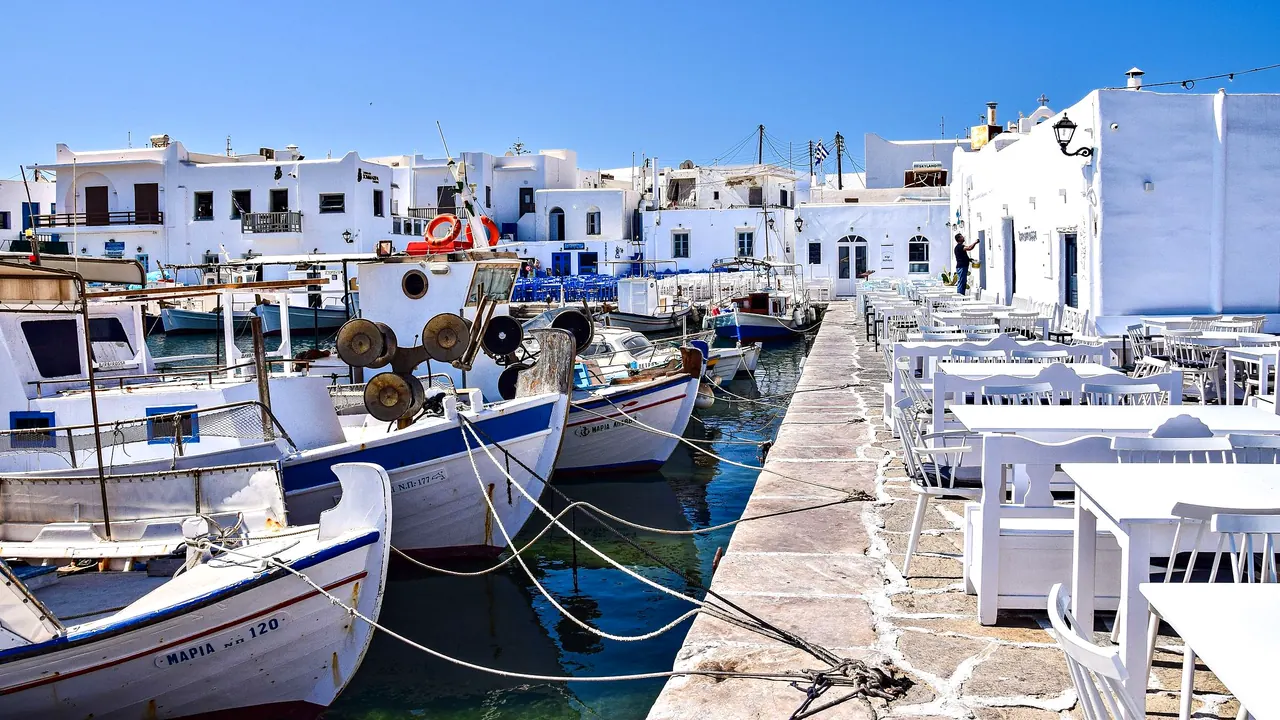
Photos: Paros by AXP Photography, Pexels License.
Kos or Paros?
Our verdict in twelve categories, each scored against the same fixed benchmark cities, and the climate month by month, so you can choose for your trip.
Choose Kos for
- prices
- families
- getting around
Kos is the easier and cheaper choice, especially for families. Its long north coast of shallow sandy beaches, resorts built around pools and kids' clubs, the water park near Marmari and plenty of mid-range rooms make a week here simple to plan and gentle on the budget. Kos Town adds Roman ruins, a knights' castle and the Asklepieion, all within cycling distance or a short ride.
Choose Paros for
- food and drink
- shopping
- day trips
Paros costs more, and in return it gives you better food and a better base for island-hopping. The tavernas on Naoussa's harbour, the island's own wines and the boutiques in its whitewashed lanes make the evenings more rewarding. Ferries put Antiparos, Naxos and the rest of the Cyclades within reach. Couples and food-minded travellers will get more from it than families with small children.
Scoreboard
Twelve categories on one fixed scale from 0 to 100. The shaded stretch is the gap between the two.
Your match
Pick a travel style or drag the sliders, and both match scores follow your weighting.
Too close to call, level with your weighting
Wins on prices and families with your weighting.
Wins on food and drink and shopping with your weighting.
What matters to you?
Category by category
What the scores mean for a trip.
Beaches & swimming
Both islands are serious beach destinations with sand rather than pebble, so the choice comes down to the kind of beach you want. Kos has long, open strands along the north coast from Tigaki to Mastichari, with shallow water and plenty of room. Its most beautiful bays are on the Kefalos peninsula, at Paradise Beach and Agios Stefanos.
Paros has a more indented coast of coves, such as Kolymbithres with its smooth granite boulders, plus wider bays at Golden Beach and Santa Maria and quieter sand across the water on Antiparos. Both islands get the summer meltemi wind. When it blows, head to the south coast on Kos, or to the south and west coasts on Paros.
Food & drink
Paros eats noticeably better. Naoussa's fishing harbour, with octopus drying in the sun, is one of the classic Greek island places to sit down to dinner. The island makes its own wines from Monemvasia and Mandilaria grapes, and you will also find chickpeas slow-baked in clay pots, local cheeses, souma and a few polished modern restaurants.
You can eat well on Kos too, especially in the hill villages of Zia and Pyli and at the fishing harbours of Mastichari and Kamari, where you can try chickpea fritters and cheese matured in red wine. Much of the resort food, though, is aimed at package and all-inclusive guests.
Culture & sights
The history of Kos is classical and Roman, and most of it sits in the middle of Kos Town. On the way to the knights' castle at the harbour you pass the Ancient Agora, the restored Odeon and the mosaics of the western excavations. The Asklepieion, the old healing sanctuary, stands on the hillside a short ride above the town.
Paros has a more Christian history, and it is spread out across the island. Its centrepiece is the Ekatontapiliani in Parikia, one of the oldest surviving churches in Greece. Beyond that, you find it in the village lanes of Lefkes and Naoussa, and in the ancient quarries at Marathi that supplied marble for classical sculpture. On either island the sights fill a few days, not a whole week.
Nightlife
Kardamena, on the south coast of Kos, is a true party resort, with late clubs, cheap drinks and a young crowd, mostly from Northern Europe. In Kos Town, the bars in the lanes of the old quarter stay loud into the small hours. Elsewhere on the island the evenings end with a quiet drink by the sea.
On Paros, nights out centre on the cocktail bars around Naoussa's harbour, where the crowd dresses up and stays out past midnight without the night turning into a binge. Parikia's seafront is looser and younger. On both islands the scene closes almost completely once the summer season ends.
Nature & outdoors
Kos has hills and woodland that Paros lacks. The Dikeos range rises to over 800m, with trails through the pine woods up to Mount Christos for the sunset. Peacocks wander the Plaka forest, and flamingos gather on the salt lake at Alikes in spring and winter.
Paros is dry Cycladic hill country, with no mountains or forests. Its best walks are the old marble path from Lefkes and the headland at Agios Ioannis Detis. Wind is its real outdoor draw. Golden Beach and Pounta are among the best windsurfing and kitesurfing spots in the Aegean, although Marmari and Tigaki on Kos are also good for the sport.
Day trips
Paros has the better choice of trips, because it sits in the middle of the Cyclades. Antiparos and its cave are a short crossing away, Naxos's Chora is under an hour by fast boat, and in summer you can also reach Mykonos, Sifnos and Delos.
Kos has fewer choices, but one of them takes you to another country. Bodrum on the Turkish coast is a short ferry ride away if you bring a passport. You can also walk the rim of the volcanic crater on Nisyros, visit the sponge-diving harbour on Kalymnos, or take a quiet taverna lunch on Pserimos.
Good for families
Kos works better with young children. Its resorts are built around pools, kids' clubs and all-inclusive dining, there is a large water park near Marmari, and the flat land and cycle paths around Kos Town make family bike rides easy. Just avoid Kardamena if you want quiet nights.
Paros has good shallow bays at Livadia, Golden Beach and Logaras, and children are welcome in its tavernas. Beyond the sea, though, there is little laid on for them, and on windy days you will need to pick the sheltered side of the island.
Getting around
Getting around is similar on both, and both reward hiring a car or scooter for a day or two. Kos is long and narrow, so some trips take up to an hour by road. Buses run along the main road, and cycle lanes around Kos Town make bikes a practical way to reach the nearby beaches.
Paros is compact, under half an hour from coast to coast. Its summer buses fan out from Parikia, and small boats cross the bay from Naoussa to Kolymbithres. Outside the summer, though, the buses become sparse, and in August parking around car-free Naoussa is tight.
Shopping & style
Neither is a shopping island, but Paros gives you more to browse. Naoussa's lanes have small boutiques selling linen, resort wear and Greek designer jewellery, and Lefkes has craft workshops. Expect high prices and shops that close when the season ends.
Kos Town's old quarter sells mostly souvenirs, leather and sponges. The real find is the Italian-era market hall on Eleftherias Square, good for herbs, spices and local produce.
Affordability
Kos is clearly the cheaper island. Because it is built for package and all-inclusive travel, mid-range apartments are plentiful, and away from the seafront the tavernas, buses and archaeological sites all cost little.
Paros is expensive in July and August, above all in Naoussa, where the harbour restaurants and cocktail bars charge resort prices. Car hire and ferry hops add up over a week too. You can bring the cost down by staying in Parikia or the inland villages, or by coming in June or September.
Live music & performing arts
Kos stages its performances in ancient settings. In summer, the Hippokrateia festival puts on concerts, theatre and dance at the Asklepieion, in the Roman Odeon and at the castle. The rest is village saints' days, resort shows and Greek nights.
Paros has folk music at village feasts, with island violin and lute while people eat and dance. The biggest of these is the mid-August feast of the Virgin at the Ekatontapiliani, and Naoussa re-enacts a pirate raid with fireworks. Neither island has any theatre or concerts outside the summer.
Wellness & relaxation
Both islands relax you mainly through their slow pace, but Kos has one natural extra. At Therma, a hot sulphur spring runs onto a pebble beach, and bathers build stone pools where it mixes with the sea.
Paros has no bathing tradition. It makes up for it with yoga and retreat centres and very quiet evenings in villages such as Lefkes and Prodromos, or across the water on Antiparos.
When should you go?
Pick your month. The climate figures are measured averages, not a forecast.
Kos in July
Paros in July
Daytime high, °C
Rainfall in the month, mm
Where the figures come from
Kos has no rain gauge within 25 km of the centre, so its rainfall comes from a gridded climate dataset read at the destination rather than from a gauge further away.
Paros's temperatures are measured 82 km from the centre, at Santorini Island / Monólithos.
Paros has no rain gauge within 25 km of the centre, so its rainfall comes from a gridded climate dataset read at the destination rather than from a gauge further away.
Temperature and rainfall are climate normals, averaged over the years shown. Kos: 1993-2020 (rainfall 1991-2020) normals, Kos Airport (23.2 km from centre). Paros: 2000-2025, 12 years observed (rainfall 1991-2020) normals, Santorini Island / Monólithos (81.8 km from centre).
The two islands follow almost the same summer curve. Both are warm enough for the beach from June to September, and you can still swim into early October. July and August reach about 31°C on Kos and a degree less on Paros, which is hot for walking ruins or village lanes at midday. The sea is a touch warmer off Kos, about 25°C in August. For sightseeing and walking, May and late September to October are more comfortable on both.
The real difference is winter. Kos gets much more rain, about 170mm in January against 78mm on Paros, and its rains also start earlier in the autumn. That makes Paros the drier choice from October to March, although neither is a winter beach island.
Which traveller are you?
On a trip on a tight budget, Kos makes more sense. It was built for package travel, so mid-range rooms in Tigaki, Marmari and Kardamena are plentiful, and buses and bike hire are inexpensive. On Paros, rooms in Naoussa and at the best-known beaches cost a lot in summer.
For a food and nightlife trip, choose Paros. Naoussa's harbour tavernas, local wines and modern Greek kitchens lead into cocktail bars that stay open past midnight. Kos's evenings are just as late, but resort menus and Kardamena's cheap-drinks crowd make them less rewarding.
On a family trip with young children, Kos is the stronger choice. Its flat north coast has gently shelving beaches, many resorts have pools and kids' clubs, and there is a water park near Marmari. Paros has good shallow bays but offers little else made for children.
Before you go
| Measure | Kos | Paros |
|---|---|---|
| Official language | Greek | Greek |
| Currency | Euro (EUR) | Euro (EUR) |
| Sockets | CF230 V, 50 Hz | CF230 V, 50 Hz |
| Driving side | Right | Right |
| Time zone | UTC+2, UTC+3 in summer | UTC+2, UTC+3 in summer |
| Emergency number | 112 | 112 |
| Main airport | Kos International Airport "Ippokratis" (KGS)75 non-stop destinations | Paros National Airport (PAS)5 non-stop destinations |
| Public holidays this year | 15 days | 15 days |
By the numbers
| Measure | Kos | Paros |
|---|---|---|
| Population | 33,387 | 13,715 |
| People per km² | 115 | 71 |
| Swim season, months above 21 °C | 5 months | 5 months |
Where else could you go?
Every comparison below shares a destination with this one, so you can follow Kos or Paros somewhere new.