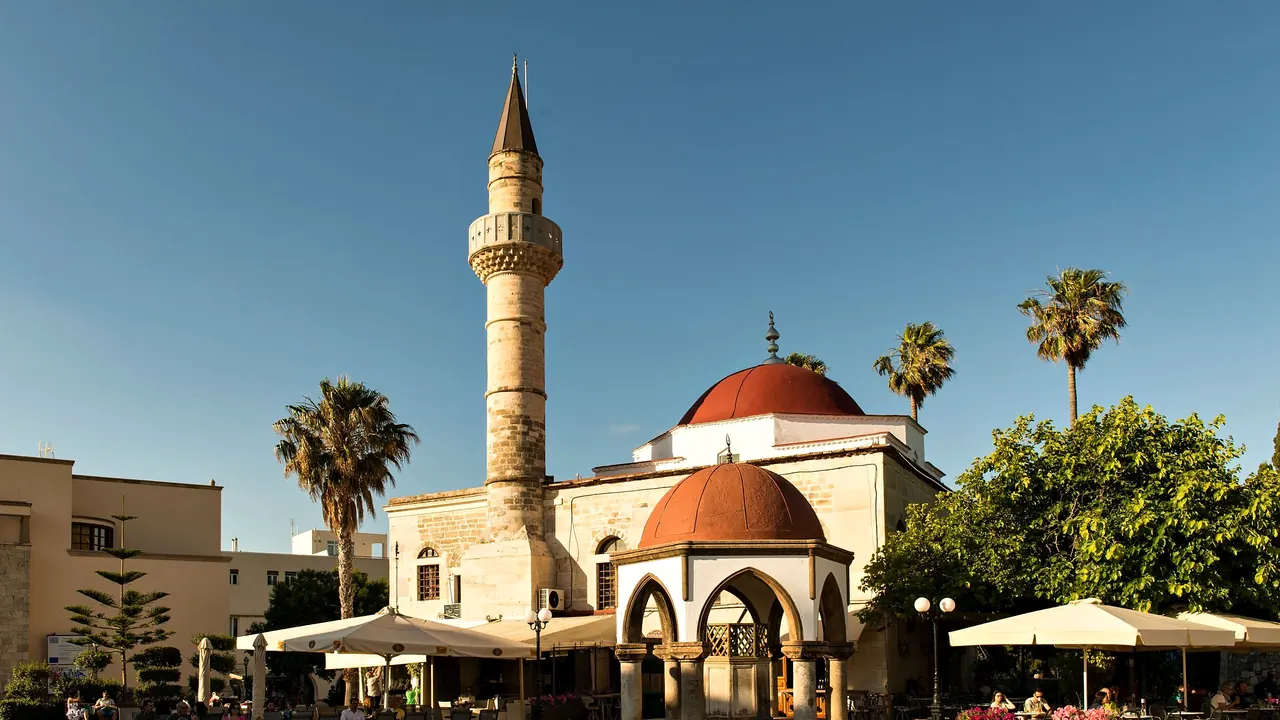
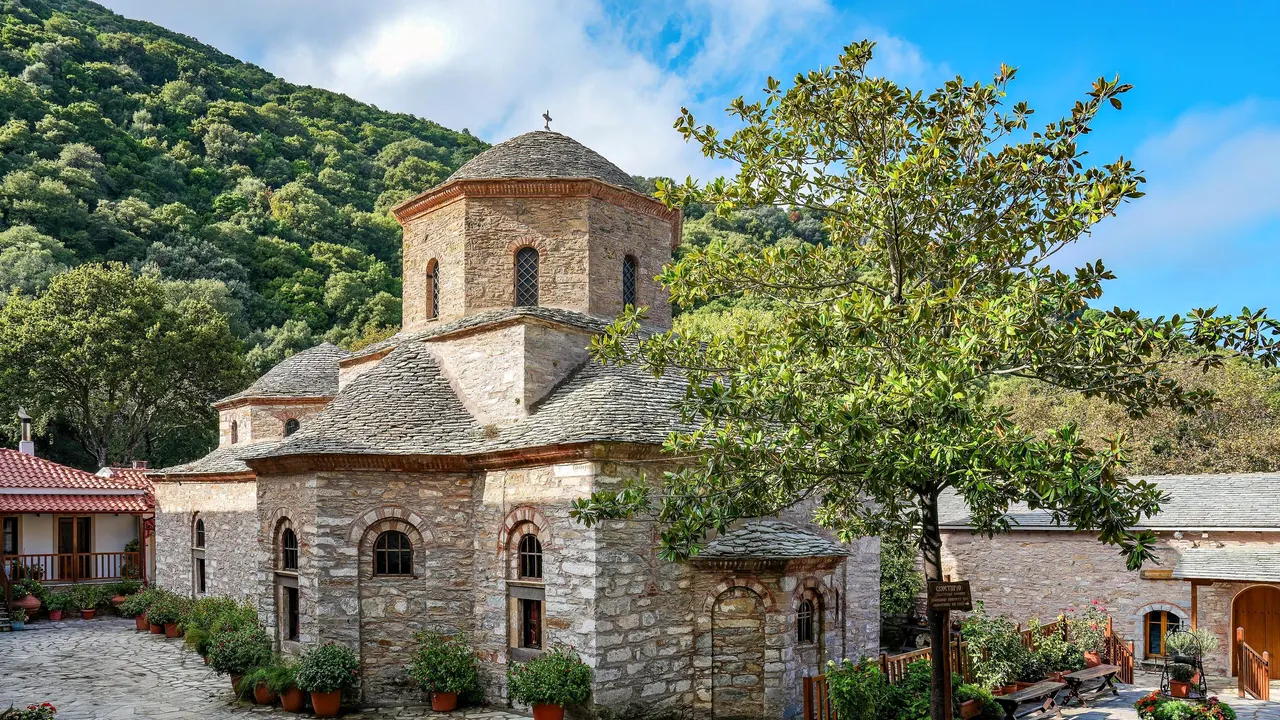
Photos: Kos by Wolfgang Weiser, Pexels License; Skiathos by Giles Laurent, CC BY-SA 4.0, cropped.
Kos or Skiathos?
Our verdict in twelve categories, each scored against the same fixed benchmark cities, and the climate month by month, so you can choose for your trip.
Choose Kos for
- culture and sights
- day trips
- families
Kos suits travellers who want a beach vacation with more going on around it. You get Roman streets and the Asklepieion in Kos Town, a hot spring to soak in at Therma, and boats to Bodrum and the volcano on Nisyros. It is also the easier island with young children, thanks to its shallow north-coast beaches, resort pools and a water park, and it usually costs a little less.
Choose Skiathos for
- nature and the outdoors
- beaches
If the beach and the pine woods are the whole point, pick Skiathos. Its sandy coves sit under trees that grow almost to the water, the green interior is good for walking in spring and autumn, and Skopelos is an easy hop by ferry. The trade-off is very little sightseeing, one crowded coast road in August and higher prices in peak season.
Scoreboard
Twelve categories on one fixed scale from 0 to 100. The shaded stretch is the gap between the two.
Your match
Pick a travel style or drag the sliders, and both match scores follow your weighting.
Wins on culture and sights and day trips with your weighting.
Wins on nature and the outdoors and beaches with your weighting.
What matters to you?
Category by category
What the scores mean for a trip.
Beaches & swimming
Both islands are made for beach days, and the difference is in the setting. Kos has long, open stretches of sand along the north coast from Tigaki to Mastichari, with plenty of room but choppy water when the meltemi blows. Its calmer and more beautiful bays are a drive away on the Kefalos peninsula: Paradise Beach, and Agios Stefanos, which faces a tiny chapel on the islet of Kastri.
Skiathos has a mix of long beaches and small coves, and on most of them the pines grow almost down to the sand. Koukounaries is the classic, a long pale curve in front of a pine forest and lagoon. The north coast has wilder beaches such as Elia and Asselinos, and you reach the white pebbles and rock arch of Lalaria by boat. The sheltered south coast is close to wherever you stay, and when its sunbed beaches fill up in high summer, a quieter spot is only a short ride away.
Food & drink
The cooking is much the same simple island fare on both, with grilled octopus and fish, and plenty of menus pitched at package visitors. Kos gives a curious eater a little more to look for: pitaroudia chickpea fritters, krasotyri cheese matured in red wine, a few small wineries near Kefalos, and good tavernas up in Zia and Pyli.
Skiathos keeps its better meals in the old quarter above the harbour and in pies made the Sporades way. Its beach tavernas serve lunch in the shade of the pines, which is half the pleasure.
Culture & sights
Kos has far more to see. Kos Town is a layered place, with the Ancient Agora, the restored Odeon and the mosaics of Casa Romana among its streets, Neratzia Castle at the harbour and the Italian-era buildings around the archaeological museum. On the hill behind town, the Asklepieion looks across the water to Turkey, and Old Pyli and the castle at Antimachia add another day.
Skiathos offers a pleasant town walk, the small Papadiamantis house museum and the Evangelistria Monastery in the woods. The cliff-top ruins of the Kastro are the real highlight, more for the setting than for what survives.
Nightlife
Both have a lively, young summer scene that dies down from October, so the difference is in layout. On Kos the nights split between the bar-packed lanes of Kos Town's old quarter and Kardamena, a resort given over to late clubs, so where you stay largely decides how loud your evenings are.
On Skiathos almost everything happens on the one bar street climbing from the harbour, plus a few waterfront clubs. Afternoon and sunset parties at the beach bars around Banana Beach are a draw of their own.
Nature & outdoors
Skiathos is the more rewarding island to explore on foot or by boat. Pine and oak forest covers its hills, with old paths running between chapels and the north coast. There is the protected Strofilia wetland by Koukounaries, and boat trips take in sea caves and the marine park off Alonissos, where dolphins are sometimes seen.
Kos is drier and flatter, though its Dikeos range climbs higher than anything on Skiathos, and sunset from Mount Christos is a fine end to a hike. Peacocks in the Plaka forest, flamingos on the Alikes salt lake and steady wind for kitesurfing at Marmari add variety.
Day trips
Kos has more variety on the water. A short ferry reaches Bodrum on the Turkish coast, with its castle and bazaar, so bring your passport. Excursion boats run to Nisyros, where you can look into a volcanic crater, and there are also the sponge-diving harbour of Kalymnos and the quiet tavernas of Pserimos.
From Skiathos the obvious outing is Skopelos, with its steep white harbour town and the clifftop chapel of Agios Ioannis, which often comes paired with Alonissos. Pelion on the mainland is better saved for an overnight stay.
Good for families
Kos is better set up for children. Beyond the shallow north-coast beaches, it has resorts with kids' clubs, a large water park near Marmari and flat cycle paths that families can ride together. Older children can spend a day among the ruins and castle in Kos Town.
Skiathos is good for a simple sea-based week, with calm water at Koukounaries, an airport transfer of minutes, and planes landing very low over the road for children to watch. It has nothing built for children, and the busy coast road with few pavements calls for care.
Getting around
Getting around is about equally easy, but the islands differ in size. Kos is long, so you rely on buses along the main road and the cycle lanes around a flat Kos Town. Most people hire a car for a day to reach the hill villages and the bays of Kefalos, and the roads are good.
Skiathos is compact, with one 12km coast road, a beach bus with numbered stops and water taxis from the old harbour. The catch is the steep stepped lanes of the old town, rough hill roads to the north coast and a crowded road in August.
Shopping & style
Neither island is worth a trip for shopping. On both it means souvenirs, sandals, jewellery, honey and olive oil. Kos Town's old quarter is slightly better for browsing, and its Italian-era market hall on Eleftherias Square sells herbs, spices and produce. Skiathos has only an evening stroll along its main street, and most of its shops close for winter.
Affordability
Kos is the cheaper island, mainly because it is built for package and all-inclusive travel. There are plenty of mid-range rooms in Kardamena, Tigaki and Marmari, buses and bike hire cost little, and the archaeological sites are inexpensive to enter.
On Skiathos in July and August, rooms near the popular beaches and boat trips quickly add up, though family-run studios help. Going in June or September makes the biggest difference there, while the sea is still warm.
Live music & performing arts
Neither has a performing arts life outside summer, and the difference is mostly in the setting. Kos's Hippokrateia festival puts concerts and theatre on ancient stages such as the Asklepieion and the Roman Odeon. Skiathos uses the open-air theatre on the pine-covered Bourtzi peninsula. Both have saints' day village festivals with traditional music.
Wellness & relaxation
Kos has the one natural spa between the two. At Therma, beyond Agios Fokas, a hot sulphur spring runs onto the beach, and bathers sit in pools of stones where it mixes with the sea, best early or late in the day. Slow days in Zia, Pyli or around Kefalos add to it.
Skiathos has no bathing tradition, only hotel spas along the south coast. Its restful side is shaded mornings under the pines on the quieter north coast, well away from the noise of the town at night.
When should you go?
Pick your month. The climate figures are measured averages, not a forecast.
Kos in July
Skiathos in July
Daytime high, °C
Rainfall in the month, mm
Where the figures come from
Kos has no rain gauge within 25 km of the centre, so its rainfall comes from a gridded climate dataset read at the destination rather than from a gauge further away.
Skiathos's temperatures are measured 60 km from the centre, at Anchialos Airport.
Skiathos has no rain gauge within 25 km of the centre, so its rainfall comes from a gridded climate dataset read at the destination rather than from a gauge further away.
Temperature and rainfall are climate normals, averaged over the years shown. Kos: 1993-2020 (rainfall 1991-2020) normals, Kos Airport (23.2 km from centre). Skiathos: 1998-2020 (rainfall 1991-2020) normals, Anchialos Airport (59.8 km from centre).
Both islands are beach destinations from June to early October, and both are almost rainless in July and August. Skiathos runs slightly hotter in high summer, reaching about 32°C, and its sea is a touch warmer in August at around 26°C. On Kos the water holds its warmth a little better into autumn, still about 23°C in October, so it is the slightly better bet for a late-season swim. For walking, April, May and late September are comfortable on both before and after the strongest heat.
Winter is where they part. Kos stays milder but turns very wet, with around 170mm of rain in January, while Skiathos is cooler but much drier. Neither is a winter beach island. A spring or autumn walking trip works better on Skiathos, where the footpaths through the woods are at their best.
Which traveller are you?
On a culture and arts trip, Kos is the clear choice. Kos Town is threaded with Roman and Hellenistic ruins and guarded by a crusader castle, and the Asklepieion sanctuary sits just outside. Skiathos has a few modest sights that take a couple of days.
On a family trip with young children, Kos makes life easier. It has gently shelving sand at Tigaki and Marmari, resorts built around pools and kids' clubs, a water park and flat cycle paths. On Skiathos the days revolve around the sea, along a coast road without pavements.
On an outdoors trip, Skiathos has the gentler and greener ground. Old footpaths cross pine and oak forest between monasteries and the north coast, and boat trips head for the marine park off Alonissos. Kos is mostly dry farmland and scrub below its one range of hills.
Before you go
| Measure | Kos | Skiathos |
|---|---|---|
| Official language | Greek | Greek |
| Currency | Euro (EUR) | Euro (EUR) |
| Sockets | CF230 V, 50 Hz | CF230 V, 50 Hz |
| Driving side | Right | Right |
| Time zone | UTC+2, UTC+3 in summer | UTC+2, UTC+3 in summer |
| Emergency number | 112 | 112 |
| Main airport | Kos International Airport "Ippokratis" (KGS)75 non-stop destinations | Skiathos Island National Airport (JSI)37 non-stop destinations |
| Public holidays this year | 15 days | 15 days |
By the numbers
| Measure | Kos | Skiathos |
|---|---|---|
| Population | 33,387 | - |
| People per km² | 115 | - |
| Swim season, months above 21 °C | 5 months | 5 months |
Where else could you go?
Every comparison below shares a destination with this one, so you can follow Kos or Skiathos somewhere new.