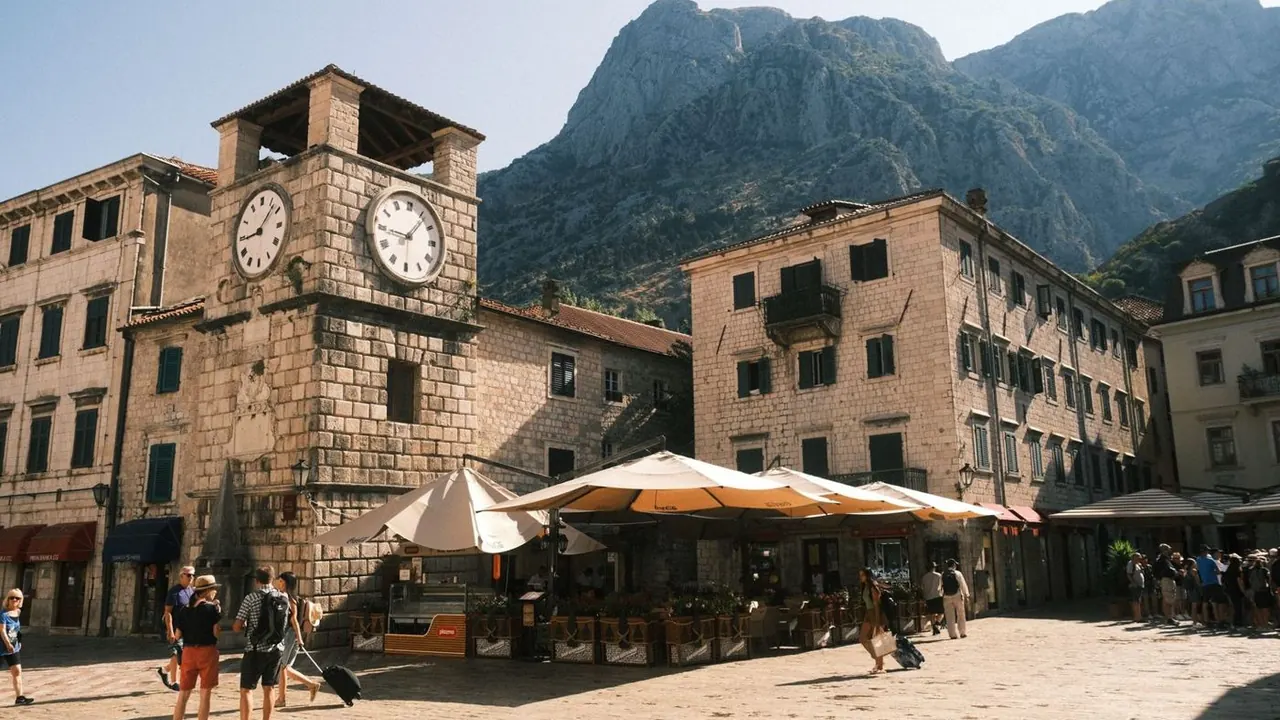
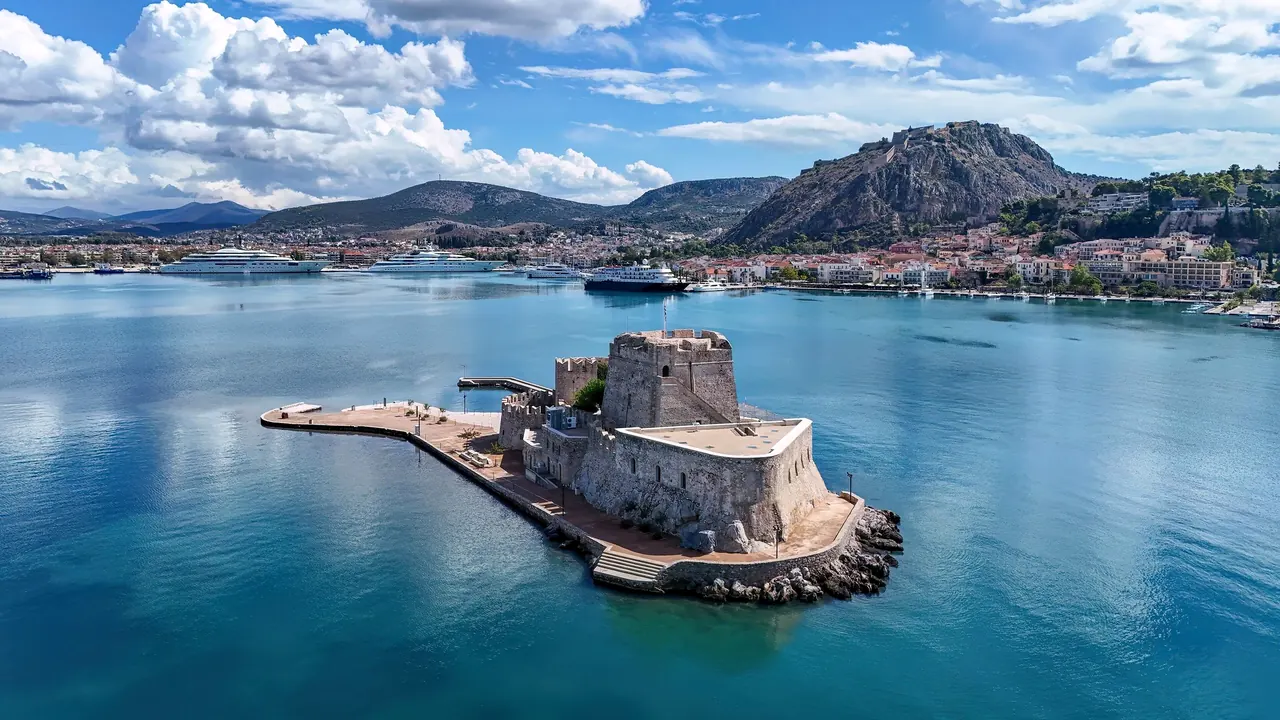
Photos: Kotor by Muhammed Fatih Beki, Pexels License; Nafplio by Giles Laurent, CC BY-SA 4.0, cropped.
Kotor or Nafplio?
Our verdict in twelve categories, each scored against the same fixed benchmark cities, and the climate month by month, so you can choose for your trip.
Choose Kotor for
- nature and the outdoors
- nightlife
- getting around
Kotor is the choice for travellers who come for scenery and want to walk it. The town sits at the deepest point of a fjord-like bay, with limestone walls rising almost straight from the water. Trails start at the town gates, and the shoreline villages are best seen by kayak or small boat. It suits active couples and walkers who are happy to make a separate trip for a beach and to accept a wetter autumn.
Choose Nafplio for
- day trips
- families
- live music and the arts
Nafplio rewards anyone who wants ancient Greece and the sea from one easy base. Mycenae, Tiryns and Epidaurus are all a short drive from its handsome old town, and you can swim within walking distance of the harbour. With calm, shallow beaches, a gentle pace, summer drama in an ancient theatre and a drier climate, it is the better fit for families, history lovers and anyone after a slower beach-and-sightseeing vacation.
Scoreboard
Twelve categories on one fixed scale from 0 to 100. The shaded stretch is the gap between the two.
Your match
Pick a travel style or drag the sliders, and both match scores follow your weighting.
Wins on nature and the outdoors and nightlife with your weighting.
Wins on day trips and families with your weighting.
What matters to you?
Category by category
What the scores mean for a trip.
Beaches & swimming
Kotor itself has no real beach. Swimming means stepping off jetties, concrete platforms or narrow pebble strips towards Dobrota and Muo, and the calm water of the inner bay is less clear than the open sea. For sand, you go over the hill to Jaz or the pink pebbles near Sveti Stefan on the Budva riviera.
Nafplio has its swimming closer to hand. Arvanitia's pebbles are a short walk from the old town, below the Palamidi cliffs, and sandy Karathona lies about 3km away in a bay backed by pines. Tolo's longer strip, with tavernas and sunbeds, is further east. The beaches are modest and busy on summer weekends, but a swim fits easily into an ordinary day of sightseeing.
Food & drink
The two are about equally good, and both have the same weakness: repetitive menus on the busiest squares, with better cooking found away from the centre. In Kotor that means konobas in Dobrota, Prcanj and Perast cooking bay mussels, black cuttlefish risotto and the day's catch, with Njegusi ham and dark Vranac wine from the mountains.
Nafplio's cooking is Peloponnesian taverna food, such as slow-cooked lamb, pies and gulf octopus, with agiorgitiko from nearby Nemea and citrus from the Argolid plain. Its best fish meals are at Tolo or in the villages of the plain. It also has more of a sweet tooth, with gelato and loukoumades by the harbour.
Culture & sights
Both are compact towns that take a few days to know, but they offer different kinds of history. Kotor is a single UNESCO-listed Venetian townscape packed under a cliff. Its marble lanes lead to the Romanesque Cathedral of St Tryphon and the Maritime Museum's seafaring history, and its walls climb to the fortress of St John.
Nafplio tells the story of modern Greece. It was the country's first capital, and its streets mix Venetian, Ottoman and neoclassical houses. The Archaeological Museum holds Mycenaean bronze armour, and Agios Spyridon is where Kapodistrias was assassinated. Palamidi, Akronafplia and the Bourtzi make three fortresses where Kotor has one great wall.
Nightlife
Neither town is built for a big night out, and evenings in both mean a long dinner followed by a drink outside. In Kotor that drink is on an old-town square under the floodlit walls. A few bars and a small club scene stay open late in summer, and Budva's seafront clubs are about half an hour away.
Nafplio has harbour-front and lane bars that fill with Athenians on summer weekends, but it has no clubs at all and no livelier town nearby to compare with Budva.
Nature & outdoors
Kotor's landscape is in another league. Limestone walls rise more than 1,000m almost from the water, and you can start up the old Ladder of Kotor mule track straight from the town gates. Above the hairpin road, Lovcen National Park opens into beech woods and karst meadows with views to the open Adriatic, and Lake Skadar's wetlands make a day out.
Nafplio's outdoors is gentler: the paved path around the Akronafplia headland, the coastal trail to Karathona, rock climbing on the local limestone and kayaking off Tolo. Real mountain walking means driving about an hour and a half to the fir forests of Mainalo.
Day trips
Kotor's outings are scenic. There is baroque Perast with its island church, the old royal capital of Cetinje over Lovcen, Njegos's mausoleum on the summit and the cliff monastery of Ostrog. Dubrovnik is possible but means about two hours and a border crossing.
Nafplio has more on its doorstep. Tiryns is ten minutes away, Mycenae under half an hour and Epidaurus about forty minutes. Ancient Corinth, the canal and the Nemea wine villages are each about an hour away. The islands of Hydra and Spetses and the Byzantine ruins of Mystras extend the list, making it one of the best bases in Greece for ancient sites.
Good for families
Kotor's car-free old town is safe and its street cats win children over, but very little is made for them. The fortress climb is steep and hot, the lanes are crowded at midday, and swimming means jetties in the bay or a drive to Budva's sand.
Nafplio makes family days simpler. Karathona and Tolo have calm, shallow water, the boat out to the Bourtzi feels like an adventure, and the harbour front suits evening strolls. Like Kotor it has no zoos or theme parks, and the ancient sites are hard going at midday.
Getting around
Both have small, flat, walkable cores and thin bus services beyond them, so a car does most of the work in either place. Kotor's advantage is the water: boats and water taxis link some bay villages, and Tivat airport is close, although the single road around the bay jams in summer.
Nafplio has a direct bus to Athens taking about two hours. The ancient sites and beaches, however, really need a car, and parking near the old town fills up in summer.
Shopping & style
Neither town is a shopping destination. Nafplio has a little more to browse: small jewellers, ceramics and textile shops and art galleries between the souvenir stalls on Vasileos Konstantinou and Staikopoulou, plus komboloi worry beads as a local buy.
Kotor's lanes stick mostly to souvenirs and cat trinkets, with silver filigree, lace and coral jewellery. Its best buys are Vranac and Njegusi ham from the green market. For brands, people go to Tivat's marina from Kotor and save it for Athens from Nafplio.
Affordability
Costs are much the same, with moderately priced taverna or konoba meals and local wine in both. They differ in when prices rise. Kotor charges resort rates inside the walls in July and August, so an apartment in Dobrota or Muo in May, June or September saves noticeably.
Nafplio's restored-mansion guesthouses cost most on Friday and Saturday nights, when Athenians come for the weekend. Weekday stays or a room in Tolo keep the bill down.
Live music & performing arts
Nafplio has one of the great summer experiences of the Mediterranean. The Athens and Epidaurus Festival stages ancient Greek drama in the theatre at Epidaurus, famous for its acoustics, and a classical festival in town uses buildings such as the old Parliament.
Kotor's summer festival of recitals and choirs in its squares and churches is smaller. Its distinctive moments are the carnival and Boka Night, when decorated boats fill the bay. Outside summer, both towns fall quiet.
Wellness & relaxation
Neither has a bathing tradition, but Nafplio is easier to unwind in. An evening walk around the headland and coffee by the harbour set a calm pace, and the thermal waters of Loutraki and the Methana springs are within about an hour's drive.
In Kotor, wellness means a resort hotel spa along the bay or at Tivat. Rest comes from quiet early mornings on the water and village lunches, staying away from the walls when day visitors crowd in at midday.
When should you go?
Pick your month. The climate figures are measured averages, not a forecast.
Kotor in July
Nafplio in July
Daytime high, °C
Rainfall in the month, mm
Where the figures come from
Kotor has no rain gauge within 25 km of the centre, so its rainfall comes from a gridded climate dataset read at the city rather than from a gauge further away.
Kotor's sunshine is measured 42 km from the centre, at Podgorica-Grad.
Nafplio's temperatures are measured 89 km from the centre, at Kalamata Airport.
Nafplio has no rain gauge within 25 km of the centre, so its rainfall comes from a gridded climate dataset read at the city rather than from a gauge further away.
Temperature and rainfall are climate normals, averaged over the years shown. Kotor: 1991-2020 normals, Tivat (4.2 km from centre). Nafplio: 1991-2020 normals, Kalamata Airport (88.8 km from centre).
In Kotor, July and August are hot, with highs of 31-32°C, so the fortress steps and the bare limestone above town are best tackled early or late in the day. June is three or four degrees cooler and still pleasant for walking. The sea is warm enough for easy swimming from June to September and is warmest in August. The catch is rain. Kotor turns wet in September and is wettest in November, with about 200mm, so April to June is the safest time for walking, and late September is more of a gamble.
Nafplio follows a similar summer pattern. Highs reach about 32°C in July and August, and June is three or four degrees cooler. The difference is that Nafplio stays almost dry from May to September and gets more sun than Kotor in every month. Its sea stays warm a little longer into October, and its winters are slightly milder with only moderate rain. That makes April, May and October dependable months for the old town and the ancient sites.
Which traveller are you?
For an outdoors trip, Kotor is the stronger choice. Serious mountain walking starts on foot from where you are staying rather than after a long drive, and the bay works as a place to paddle as well as to look at. Go in spring or autumn.
On a family trip with young children, Nafplio is easier. Swimming fits into every day without needing a car, and the town's unhurried pace suits small legs. In Kotor, the main sights are hard work for children and swimming takes more planning.
On a culture and arts trip, Nafplio goes deeper. The town itself is about as rewarding as Kotor, but it opens onto the heart of Bronze Age and classical Greece, and a summer evening of ancient drama is hard to match anywhere.
Before you go
| Measure | Kotor | Nafplio |
|---|---|---|
| Official language | Montenegrin | Greek |
| Currency | Euro (EUR) | Euro (EUR) |
| Sockets | CF230 V, 50 Hz | CF230 V, 50 Hz |
| Driving side | Right | Right |
| Time zone | UTC+1, UTC+2 in summer | UTC+2, UTC+3 in summer |
| Emergency number | 112 | 112 |
| Elevation | 10 m | 6 m |
| Main airport | Tivat Airport (TIV)5 km from centre42 non-stop destinations | Athens Eleftherios Venizelos International Airport (ATH)109 km from centre173 non-stop destinations |
| Public holidays this year | - | 15 days |
By the numbers
| Measure | Kotor | Nafplio |
|---|---|---|
| City population | 562 | 14,532 |
| People per km² | - | 433 |
| Museums within 10 km | 3 | 5 |
| UNESCO World Heritage sites within 50 km | 3 | 2 |
| Swim season, months above 21 °C | 5 months | 5 months |
Where else could you go?
Every comparison below shares a destination with this one, so you can follow Kotor or Nafplio somewhere new.