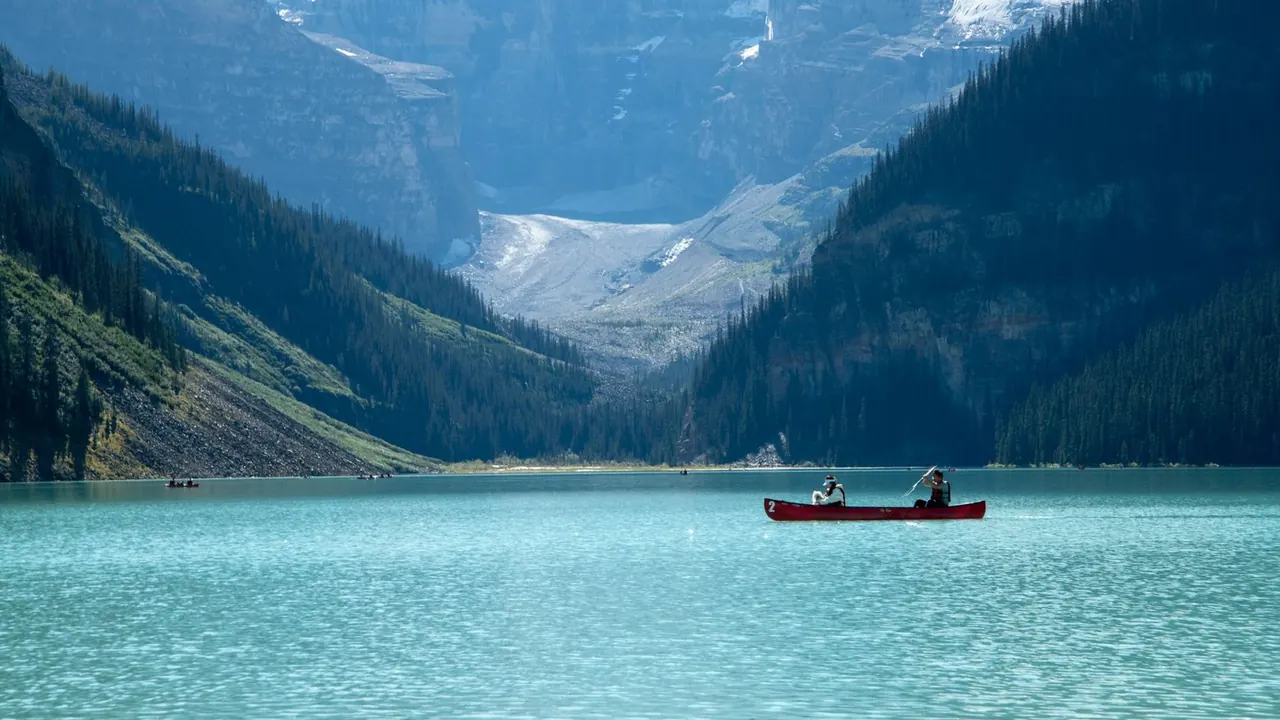
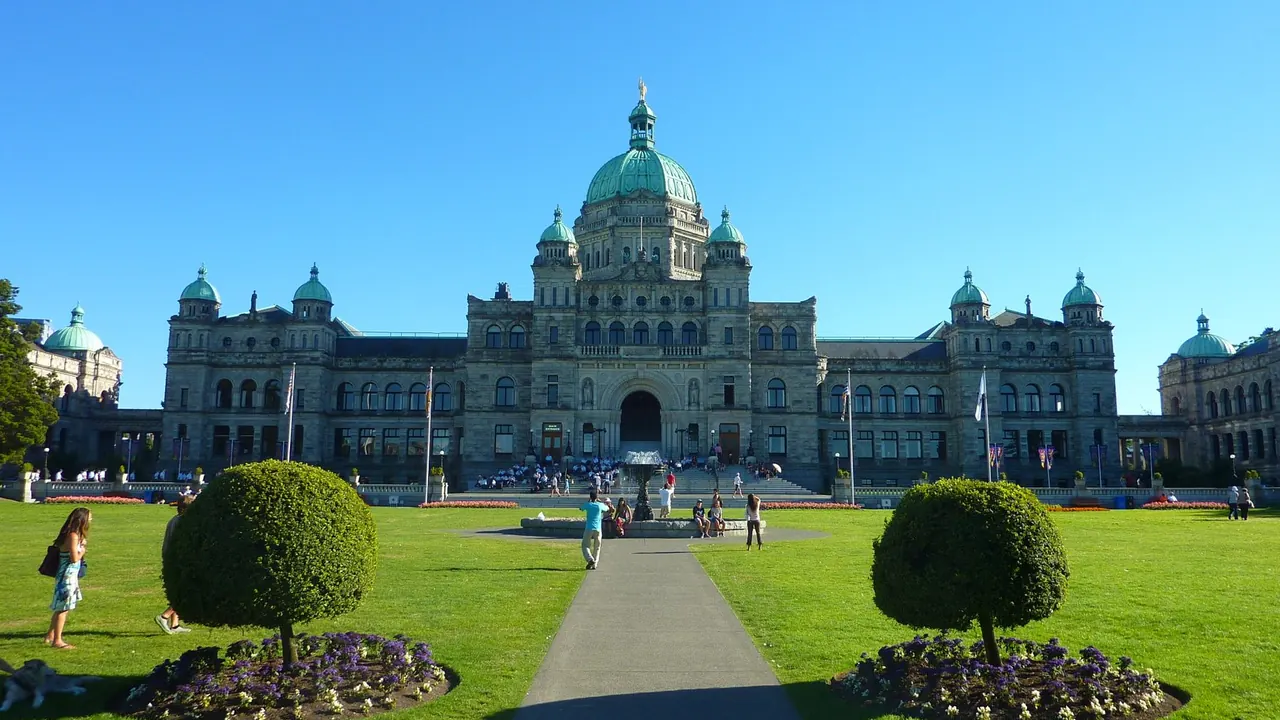
Photos: Lake Louise by Andrew Patrick Photo, Pexels License; Victoria by Guilice, CC BY-SA 3.0, cropped.
Lake Louise or Victoria?
Our verdict in twelve categories, each scored against the same fixed benchmark cities, and the climate month by month, so you can choose for your trip.
Choose Lake Louise for
- nature and the outdoors
Lake Louise is for travellers who come for the mountains and very little else. You get glacier-fed lakes, high trails up to the old teahouses, canoeing in summer and one of Canada's largest ski areas in winter. In return you accept early nights, resort-priced meals and almost nothing to do indoors. It suits hikers, skiers and photographers far better than anyone who wants a town around them.
Choose Victoria for
- live music and the arts
- culture and sights
- shopping
Choose Victoria if you want a small, easy city with the outdoors close at hand. The Inner Harbour, the Royal BC Museum, pubs, seafood and a steady arts calendar fill the evenings, while whale watching, sea kayaking and coastal trails fill the days. The scenery is gentler than in the Rockies, but you can walk almost everywhere and the mild climate makes it a place to visit all year.
Scoreboard
Twelve categories on one fixed scale from 0 to 100. The shaded stretch is the gap between the two.
Your match
Pick a travel style or drag the sliders, and both match scores follow your weighting.
Wins on nature and the outdoors with your weighting.
Wins on live music and the arts and culture and sights with your weighting.
What matters to you?
Category by category
What the scores mean for a trip.
Beaches & swimming
Neither is a beach destination, but Victoria at least gives you a shoreline to use. You can walk on the sheltered sand at Willows Beach and Gonzales or along the driftwood at Dallas Road, and in summer lakes such as Thetis warm up enough for a proper swim. At Lake Louise the glacial water stays close to freezing even in August, so the turquoise lakes are for canoeing and photographs, and swimming means a hotel pool or a drive towards Banff.
Food & drink
Eating at Lake Louise means hotel dining rooms, a bakery and deli in the village, and the trail teahouses at Lake Agnes and the Plain of Six Glaciers, which you remember more for the walk than for the menu. Anyone who cares about dinner ends up driving to Banff.
Victoria offers far more choice. There is wild salmon, Dungeness crab and spot prawns, produce and wine from the Saanich Peninsula and the Cowichan Valley, serious brunch and a long-established craft beer scene, plus afternoon tea at the Empress and fish and chips at Fisherman's Wharf. It is not a gourmet capital, but you can eat well for a week without repeating yourself.
Culture & sights
At Lake Louise the sightseeing amounts to the Chateau and the old log railway station, and the real attraction is the peaks. Victoria fills two or three days properly. The Parliament Buildings and the Empress face each other across the Inner Harbour, and nearby are the Royal BC Museum with its First Nations collections, the totem poles of Thunderbird Park, Craigdarroch Castle and Emily Carr's house. Neither is a great museum city, but only Victoria gives you a good day indoors.
Nightlife
Lake Louise winds down early. There is a hotel lounge, a lodge pub with a fireplace and après-ski in winter, and most people go to bed early so they can be at Moraine Lake for sunrise. Victoria is no late-night city either, but it has a real pub culture. Brewery taprooms and cocktail bars fill the old brick buildings around Wharf Street and Lower Johnson, and students keep a small club scene going at weekends. In Victoria an evening means a pint by the harbour, while at Lake Louise it is usually over before it starts.
Nature & outdoors
Both are outdoor destinations, but Lake Louise is on another scale. From the shore you walk straight into high alpine country, up to Lake Agnes, the Plain of Six Glaciers and Larch Valley, with grizzlies on the slopes above the gondola. The Icefields Parkway and Yoho are close by, and winter brings a major ski area and skating on the frozen lake.
Victoria's outdoors is coastal and gentler. There is whale watching from the Inner Harbour, sea kayaking for beginners around Discovery Island, the car-free Galloping Goose trail and old-growth cedar at Goldstream. You can enjoy it in any month, but there are no high mountains nearby.
Day trips
From Lake Louise, most outings are drives further into the scenery. Banff is the one real town, Canmore and Field are quieter stops, and Calgary is about two hours away. Victoria has more variety: Butchart Gardens, the bookshops of Sidney, the wineries and cideries of the Cowichan Valley, the murals of Chemainus, the ferry to Salt Spring Island and a floatplane hop to Vancouver. The catch is that many of these trips involve a ferry and take longer than the map suggests.
Good for families
Lake Louise works for active families. Children can canoe, ride the gondola to look for wildlife, walk to the Lake Agnes teahouse and take ski lessons, and toddlers can manage the flat lakeshore path. On a wet day, or with children who won't walk, there is very little else to do.
Victoria is easier with children of all ages. Beacon Hill Park's petting farm and playgrounds, the replica old town in the Royal BC Museum, seaplanes and harbour ferries, whale-watching trips and the small aquarium in Sidney are all a short trip apart. It has no zoo or theme park, though.
Getting around
The village at Lake Louise is tiny, but the sights are spread out. The lake is 4km uphill, Moraine Lake is further along a winding road and the ski area is across the valley. That means park shuttles, coaches or a car, very early starts for parking in summer and proper tyres in winter.
Victoria is the opposite. The harbour, the museum, Chinatown and Beacon Hill Park are all within walking distance of each other, harbour ferries and protected bike lanes add to that, and you only need a car for Sooke or the Cowichan Valley.
Shopping & style
At Lake Louise, shopping covers the basics: outdoor gear, maps, groceries and souvenirs in the village mall, plus a few boutiques in the Chateau. Victoria is a place to browse. You can try the restored storefronts and local labels on Lower Johnson Street, the courtyard of Market Square, Chinatown's tea shops, second-hand bookshops and galleries selling Northwest Coast First Nations prints and carvings. Neither has luxury brands, but only Victoria makes shopping part of the trip.
Affordability
Both are expensive, and Lake Louise more so. A handful of hotels charge some of the highest summer rates in Canada, meals are resort-priced, and park, gondola and lift passes come on top. Many visitors save by staying in Banff, Canmore, the hostel or the campground, or by coming in late spring or autumn.
Victoria is easier on the budget, though it is not cheap. Rooms cost more in summer, and whale watching and Butchart Gardens add up. Even so, the walkable centre, the free parks and waterfront, pub meals and Chinatown's cheaper restaurants keep daily costs down, and room rates fall a long way in winter.
Live music & performing arts
At Lake Louise the only live music is the odd pianist or folk singer in a hotel lounge, and concerts happen down in Banff. Victoria has a modest but regular calendar. The symphony, Pacific Opera Victoria and ballet play the historic Royal Theatre and McPherson Playhouse, the Belfry stages contemporary Canadian theatre, and summer brings the jazz and Fringe festivals. Lake Louise has nothing like the symphony's free summer concert on a barge in the Inner Harbour.
Wellness & relaxation
The two are fairly level here. Neither has thermal baths of its own and both rely on hotel spas, so the difference is in the kind of calm. Lake Louise offers mountain silence, best in winter and the shoulder seasons, but the lakeshores fill with coaches in July and August and the nearest hot springs are in Banff.
Victoria's calm is slower and more urban, with gardens, seafront walks, long afternoon teas and unhurried days in Oak Bay, and the mild climate keeps it pleasant out of season.
When should you go?
Pick your month. The climate figures are measured averages, not a forecast.
Lake Louise in July
Victoria in July
Daytime high, °C
Rainfall in the month, mm
Where the figures come from
Lake Louise has no rain gauge within 25 km of the centre, so its rainfall comes from a gridded climate dataset read at the city rather than from a gauge further away.
Victoria's sunshine is measured 87 km from the centre, at Vancouver International Airport.
Temperature and rainfall are climate normals, averaged over the years shown. Lake Louise: 1991-2020 normals, Yoho Park (11.2 km from centre). Victoria: 1991-2020 normals, Victoria Gonzales CS (3.6 km from centre).
Lake Louise really has two seasons. July and August reach about 20°C by day, which is ideal for walking, and only then are the high trails clear of snow. In late September the larches turn gold. From November to February the days stay below freezing, down to about -8°C in December, and March is only just above it, so winter is for skiing and skating on the lake, not hiking. April, May and October are cool and in between, with snow still on the higher ground.
Victoria is mild all year, and rain sets its seasons more than cold does. May to September is dry and sunny, with nearly 300 hours of sunshine in July and warmth much like Lake Louise's summer, so it is good for walking, cycling and kayaking. Even then the sea only reaches about 12°C, so it is never beach weather. The rain returns in October and peaks at about 116mm in November. Winter is grey and wet but still mild enough for walks along the seafront.
Which traveller are you?
On an outdoors trip, Lake Louise is the clear choice. Trails lead from the lakeshore to glaciers, teahouses and larch meadows, and you can canoe both lakes, drive the Icefields Parkway and ski in winter. Victoria's coastal walks and kayaking are gentler and have no high mountains.
For a culture and arts trip, Victoria wins easily. The Royal BC Museum, the totem poles in Thunderbird Park, Craigdarroch Castle, Emily Carr's house and evenings at the Royal Theatre or the Belfry fill several days. Lake Louise has the Chateau and little more.
On a family trip with young children, Victoria is the easier base. Short walks link Beacon Hill Park's petting farm, the museum and the seaplanes in the harbour, and there are things to do on rainy days. Lake Louise only works for children who enjoy walking outdoors.
Before you go
| Measure | Lake Louise | Victoria |
|---|---|---|
| Official language | French, English | French, English |
| Currency | Canadian Dollar (CAD) | Canadian Dollar (CAD) |
| Sockets | AB120 V, 60 Hz | AB120 V, 60 Hz |
| Driving side | Right | Right |
| Time zone | UTC-7, UTC-6 in summer | UTC-8, UTC-7 in summer |
| Emergency number | 911 | 911 |
| Elevation | 1,600 m | 23 m |
| Main airport | Calgary International Airport (YYC)155 km from centre102 non-stop destinations | Victoria International Airport (YYJ)25 km from centre16 non-stop destinations |
| Public holidays this year | 13 days | 11 days |
By the numbers
| Measure | Lake Louise | Victoria |
|---|---|---|
| City population | - | 91,867 |
| People per km² | - | 4,711 |
| Museums within 10 km | 0 | 6 |
| UNESCO World Heritage sites within 50 km | 2 | 0 |
| Swim season, months above 21 °C | - | None |
Where else could you go?
Every comparison below shares a destination with this one, so you can follow Lake Louise or Victoria somewhere new.