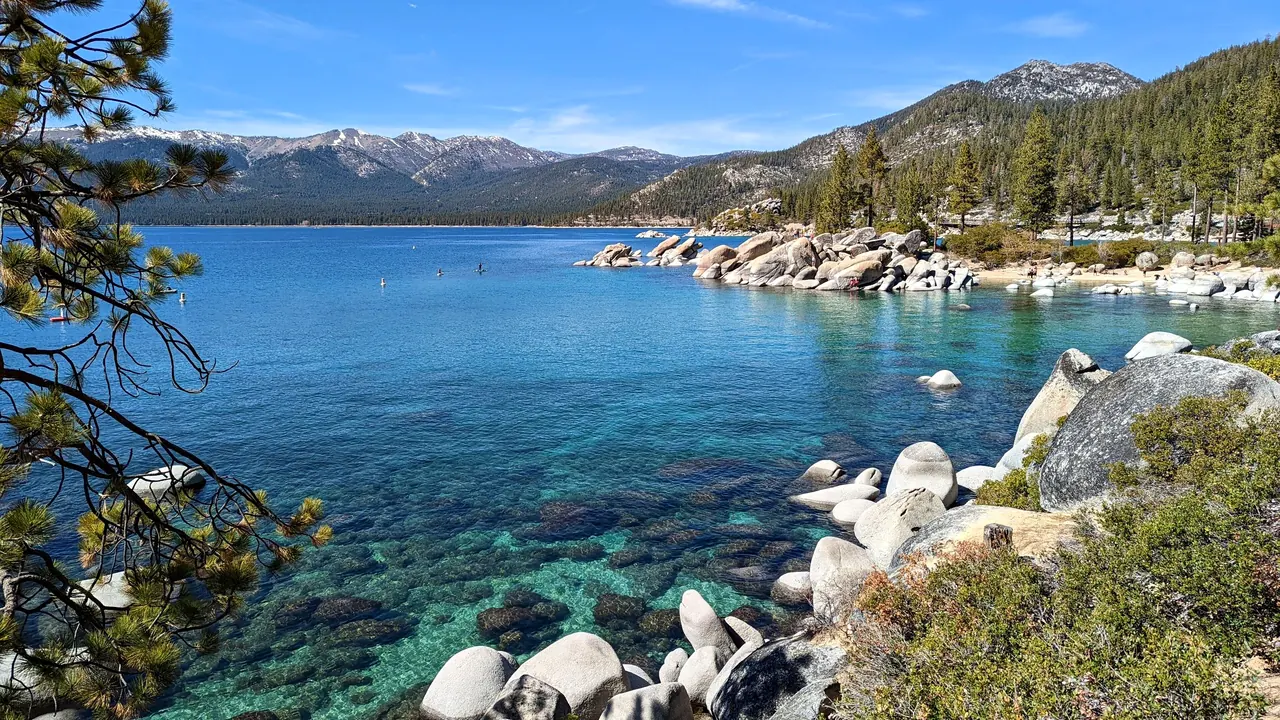
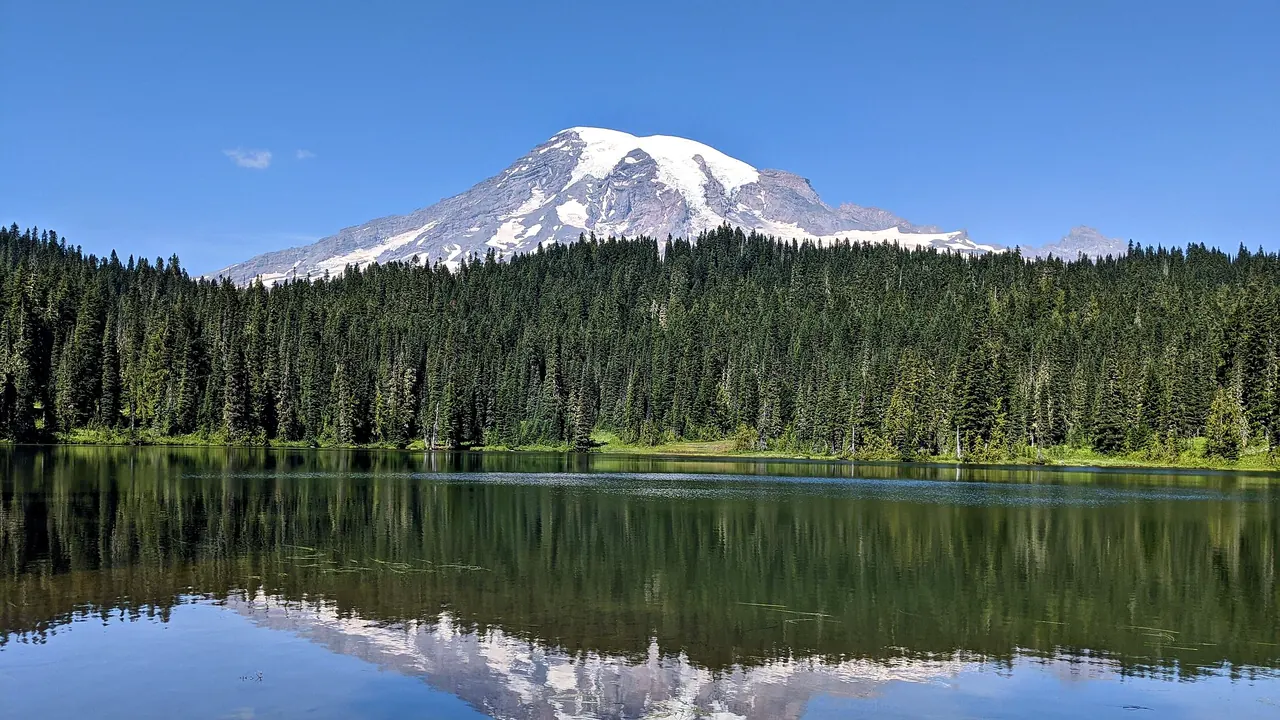
Photos: Lake Tahoe by Blake Everett Carroll, CC BY-SA 4.0, cropped; Mount Rainier by Angelina Suzuki, CC BY-SA 4.0, cropped.
Lake Tahoe or Mount Rainier?
Our verdict in twelve categories, each scored against the same fixed benchmark cities, and the climate month by month, so you can choose for your trip.
Choose Lake Tahoe for
- beaches
- nightlife
- live music and the arts
Lake Tahoe suits travellers who want the mountains with some comforts attached. There is a clear alpine lake to swim in through high summer, sandy beaches on the south and north shores, drinks on a lakeside deck at sunset and the casino lounges of Stateline for a late night. It is the easier choice for families and mixed groups where not everyone wants to hike every day, and its ring of ski areas makes it just as strong in winter.
Choose Mount Rainier for
- prices
Choose Mount Rainier when the mountain itself is the whole point. Walkers get as much here as in the Tahoe basin: a glaciated volcano, wildflower meadows at Paradise and Sunrise, old-growth forest and the Wonderland Trail. Almost nothing else competes for your time, though. There are no beaches, no nightlife and only basic food. In return it is the cheaper of the two if you are willing to camp, and the quieter, built for early starts and nights in a cabin under the firs.
Scoreboard
Twelve categories on one fixed scale from 0 to 100. The shaded stretch is the gap between the two.
Your match
Pick a travel style or drag the sliders, and both match scores follow your weighting.
Wins on beaches and nightlife with your weighting.
Wins on prices with your weighting.
What matters to you?
Category by category
What the scores mean for a trip.
Beaches & swimming
Lake Tahoe is the only one of the two with a beach life. The water is cold, around 18-21°C near the shore even in August, but Sand Harbor's granite coves and the long sand at Pope, Baldwin and Zephyr Cove make a real summer swimming trip possible from July to early September.
At Mount Rainier swimming barely comes into it. Reflection Lakes and the high tarns are snowmelt you wade in. The nearest proper dip is at a lowland reservoir such as Alder Lake, which has no sand.
Food & drink
Neither is a place to travel for food, but Tahoe gives you more choice. Truckee's old railroad downtown, Tahoe City and Incline Village have kitchens working with Californian produce and wine, and a drink on a lakeside deck at sunset stays in the memory.
Around Rainier, the gateway towns of Ashford, Packwood and Elbe have diners, pizza and the odd brewpub, and the old park lodges have their dining rooms. A trailhead picnic is often the best meal of the day, and a serious restaurant means driving back towards Tacoma.
Culture & sights
Both have modest heritage, best taken as a break from the outdoors, but the stories differ. Tahoe's history is about the people who came for the summer: Vikingsholm at Emerald Bay, the Tallac estates of San Francisco's wealthy families, Thunderbird Lodge, and the Donner Party story at Truckee. Rainier's history is about the national park itself, with the original headquarters at Longmire and the beamed lobby of Paradise Inn showing where the American style of park architecture began.
Nightlife
Tahoe has an evening scene and Rainier has none. At Stateline, the Nevada casino hotels keep their gaming floors and lounges open very late. Truckee and Tahoe City have a few lively bars, though the north and west shores go quiet early.
At Rainier, a tavern beer in Ashford or Packwood is the limit. Most visitors are in bed early for a dawn start on the high trails.
Nature & outdoors
These are two of the great mountain landscapes of the American West, and what differs is what sits at the centre. At Tahoe it is water: a huge, clear lake ringed by granite, with Emerald Bay and the Desolation Wilderness behind it. The Tahoe Rim Trail and the Flume Trail run along the ridges, there is kayaking and sailing on the lake, and a dozen ski areas open in winter.
At Rainier it is ice: a 4,392m volcano whose glaciers you see up close from Sunrise, meadows in flower at Paradise in late summer, and moss-hung rainforest in the Carbon River valley. The Wonderland Trail and guided summit climbs give it a more serious mountaineering side, while its lift skiing at Crystal Mountain and White Pass is a smaller offer than Tahoe's.
Day trips
Tahoe has the better spread of outings, in two directions. To the east are Virginia City's silver-mining streets, little Genoa and Reno. To the west are the Gold Rush towns of Coloma and Placerville, with the foothill vineyards nearby.
From Rainier, worthwhile day trips mean dropping down to the lowlands: Tacoma's museum district with its glass hot shop, or Olympia's domed capitol, both well over an hour away. Seattle is just about possible as a day trip but works better as a stop of its own.
Good for families
Tahoe works better for children, and over a longer stay. Shallow sandy beaches at Kings Beach and Commons Beach, bike paths along the shore, glass-bottom boats and ski schools at every resort give each day something different, and condos with kitchens are easy to find.
Rainier suits a few days rather than a week. Short trails at Longmire and Paradise, the Box Canyon footbridge, junior ranger badges, marmots and early-summer snow all delight children, and the steam railway from Elbe adds a treat. Against that, the food is basic and the higher trails have drop-offs.
Getting around
You need a car for both, but Tahoe is a little more forgiving. Its one road round the lake is slow and jammed on summer weekends, yet buses and ski shuttles link the main towns, and the centres of Truckee, Tahoe City and Stateline are walkable.
Rainier has no useful public transport. Paradise and Sunrise are about two hours apart by road, and the east-side roads open only from early summer to autumn. Choosing your base matters more here: Ashford for the south side, Packwood or Enumclaw for the east and north.
Shopping & style
Neither is a shopping destination, but Tahoe has one good street in downtown Truckee, where independent clothing shops and galleries fill the railroad-era buildings, and Reno's malls are down the hill. Rainier has only park gift shops and general stores, so buy your gear in Seattle or Tacoma before driving up.
Affordability
Lake Tahoe is expensive in both its seasons. Winter brings costly lift tickets, and summer brings high prices for north-shore cabins, often with minimum stays at weekends. The savings are in the Stateline casino hotels and the older South Lake Tahoe motels, especially midweek.
Mount Rainier is easier on the budget, mainly because it rewards camping. The park campgrounds and national forest sites make a very cheap stay possible, and June and late September bring room rates down. Lodging in the gateway towns in July and August still fills early at full rates.
Live music & performing arts
Tahoe has a summer season and Rainier has essentially nothing. The Shakespeare festival on the outdoor stage among the boulders at Sand Harbor, with the lake behind the actors at sunset, is worth planning an evening around. There is also a classical series on the north shore and touring acts at Stateline.
At Rainier, the evening programme is a ranger talk at a campground amphitheatre. For concerts or theatre you have to go to Tacoma or Seattle.
Wellness & relaxation
Both offer the same basic kind of rest, quiet days outdoors and evenings in a cabin, but Tahoe adds more to it. There are resort spas at Incline Village and in the ski areas, yoga studios in the ski towns, and real hot-spring soaks within reach at Grover Hot Springs and Genoa.
At Rainier, the Ohanapecosh springs are for looking at rather than bathing in, and pampering stops at a cabin hot tub. What it gives you instead is deeper seclusion: a cabin near Ashford or Packwood with no phone signal and only the sound of the river at night.
When should you go?
Pick your month. The climate figures are measured averages, not a forecast.
Lake Tahoe in July
Mount Rainier in July
Daytime high, °C
Rainfall in the month, mm
Where the figures come from
Lake Tahoe has no rain gauge within 25 km of the centre, so its rainfall comes from a gridded climate dataset read at the destination rather than from a gauge further away.
Mount Rainier has no weather station within reach, so its figures come from a gridded climate model rather than a measured record, and read a broad area rather than one spot.
Temperature and rainfall are climate normals, averaged over the years shown. Lake Tahoe: 2000-2020 (rainfall 1991-2020) normals, South Lake Tahoe / Tahoe Valley (5.3 km from centre). Mount Rainier: 1991-2020 normals, TerraClimate 4 km grid at the town, no weather station within 90 km.
At lake level Tahoe has a dry, warm summer, with highs around 27°C in July and barely 7mm of rain that month. June to September is reliably settled, and July to early September is the only stretch when the lake is warm enough to swim. From November to March the weather turns wet and cold, with more than 100mm a month in midwinter and days too chilly to spend long outdoors unless you are on skis. That moisture is what feeds the ski season. May and October are cool and good for walking, but not for the beach.
Around Mount Rainier the summer is cooler and shorter. August peaks near 23°C, and only July and August are properly dry. That is also when the high meadows are open and in flower. From October the heavy rain returns, passing 300mm a month from November to January, and the high roads close. Tahoe gives you a longer, drier summer and a real winter sports season, while Rainier is at its best only in late summer.
Which traveller are you?
For a beach and sun trip, Lake Tahoe is the only real option. Its summers are dry and warm, and from July to early September you can swim off the granite coves at Sand Harbor or the long south-shore beaches, while Rainier's snowmelt lakes are for wading.
On a food and nightlife trip, Tahoe is the clear pick, though you should keep expectations modest. Truckee and Tahoe City have the better kitchens, lakeside decks fill at sunset and Stateline's casino lounges run late. Rainier's evenings end with one beer in Ashford.
On a tight budget, Mount Rainier goes further. Entry is cheap, the trails and viewpoints cost nothing, and the park campgrounds and national forest sites make a very economical stay, especially in June or late September. Tahoe stays expensive in both its seasons.
Before you go
| Measure | Lake Tahoe | Mount Rainier |
|---|---|---|
| Currency | US Dollar (USD) | US Dollar (USD) |
| Sockets | AB120 V, 60 Hz | AB120 V, 60 Hz |
| Driving side | Right | Right |
| Time zone | UTC-8, UTC-7 in summer | UTC-8, UTC-7 in summer |
| Emergency number | 911 | 911 |
| Main airport | Reno Tahoe International Airport (RNO)25 non-stop destinations | Seattle–Tacoma International Airport (SEA)136 non-stop destinations |
| Public holidays this year | 13 days | 11 days |
By the numbers
| Measure | Lake Tahoe | Mount Rainier |
|---|---|---|
| Population | - | 875 |
Where else could you go?
Every comparison below shares a destination with this one, so you can follow Lake Tahoe or Mount Rainier somewhere new.
- Yosemitevs Lake Tahoe
- Olympic National Parkvs Mount Rainier
- Vancouver Islandvs Mount Rainier
- Kings Canyonvs Lake Tahoe
- Sequoiavs Lake Tahoe
- Death Valleyvs Lake Tahoe