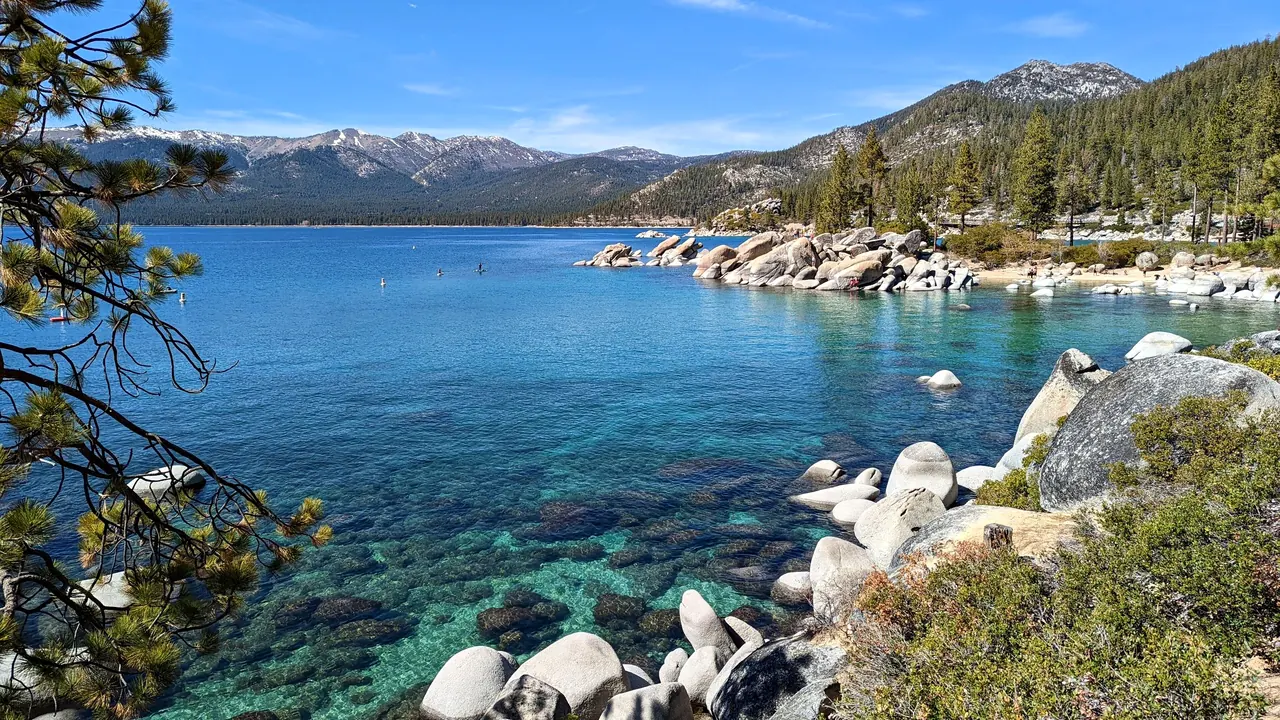
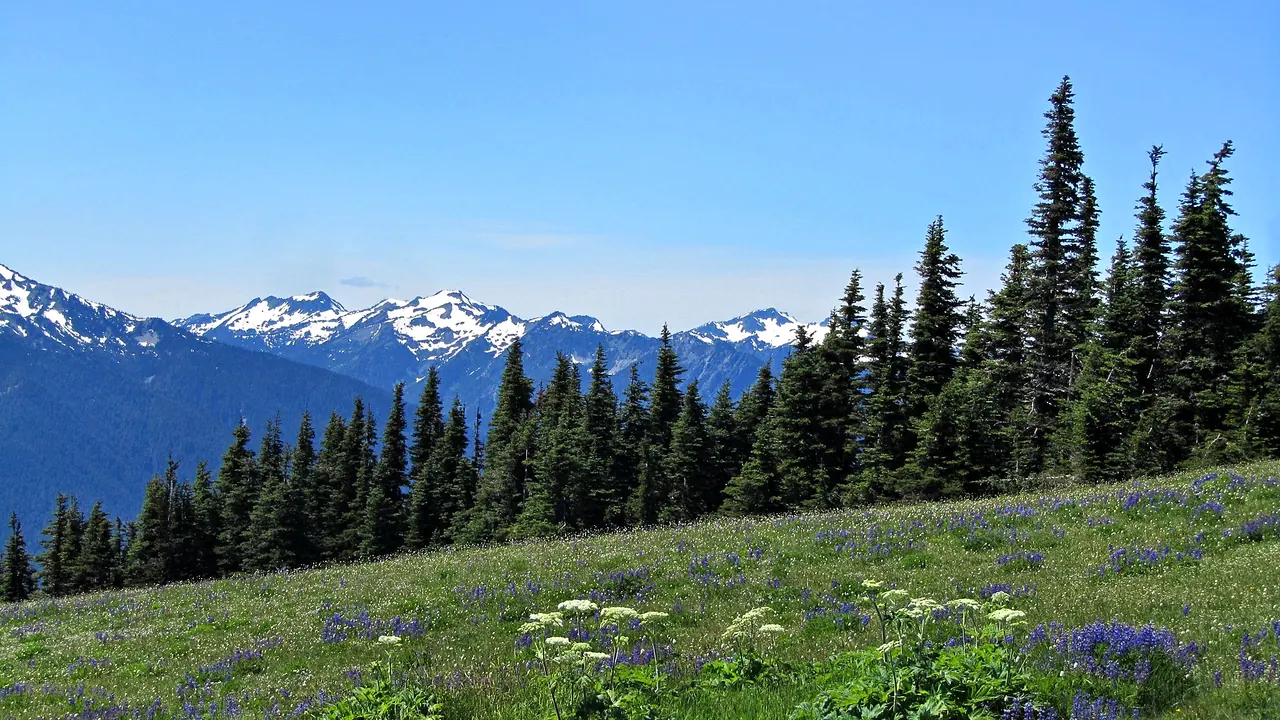
Photos: Lake Tahoe by Blake Everett Carroll, CC BY-SA 4.0, cropped; Olympic National Park by Jeffhollett, CC BY-SA 4.0, cropped.
Lake Tahoe or Olympic National Park?
Our verdict in twelve categories, each scored against the same fixed benchmark cities, and the climate month by month, so you can choose for your trip.
Choose Lake Tahoe for
- beaches
- nightlife
- families
Lake Tahoe suits travellers who want an outdoor vacation with some comfort around it. In summer the lake doubles as a place to swim off sandy beaches, in winter a dozen ski areas ring the basin, and families get gentle shallows, ski schools and lakeside towns that feel safe and easy. Stateline's casinos add evenings that run late if you want them, though all of it comes at mountain-resort prices.
Choose Olympic National Park for
- prices
- culture and sights
- wellness
Olympic National Park is for people who want wilder country and more variety in a single trip: glaciated peaks, mossy rainforest and a roadless Pacific coast of sea stacks and tide pools. It is quieter at night and harder to swim in, but camping and plain motels keep the cost down. Port Townsend and the Makah Museum also give it a little more history to see between hikes.
Scoreboard
Twelve categories on one fixed scale from 0 to 100. The shaded stretch is the gap between the two.
Your match
Pick a travel style or drag the sliders, and both match scores follow your weighting.
Wins on beaches and nightlife with your weighting.
Wins on prices and culture and sights with your weighting.
What matters to you?
Category by category
What the scores mean for a trip.
Beaches & swimming
Lake Tahoe has real swimming beaches, from the granite-strewn coves of Sand Harbor to the long sand at Pope and Baldwin. The clear alpine water is cool even in August, at roughly 18-21°C near shore, but on a hot day from July to early September it is very swimmable, and the beaches fill up on summer weekends.
Olympic's coast is more dramatic and almost useless for swimming. Rialto, Ruby and Second Beach are places for walking among sea stacks, driftwood and tide pools, and the surf is cold and dangerous. The only dips are quick ones in Lake Crescent or Lake Quinault.
Food & drink
Neither is a place to travel for the food, but they fall short in different ways. Tahoe offers resort dining: grills, diners and pizza, with the more ambitious kitchens in Truckee, Tahoe City and Incline Village, and its best moments are drinks on a lakeside deck at sunset.
Olympic has more local character in its ingredients, with Dungeness crab, Hood Canal oysters, smoked salmon and late-summer berries, best eaten in Port Townsend. Once you head to the west side around Forks, it drops to lodge dining rooms and picnics.
Culture & sights
Olympic has somewhat more to see. Port Townsend is a Victorian seaport that survives almost intact, with Fort Worden on its edge, and the Makah Museum at Neah Bay offers a serious look at the coast's Native whaling culture through the Ozette finds.
Tahoe's history comes as a handful of sights rather than a town: Vikingsholm at Emerald Bay, the Tallac estates, Thunderbird Lodge and the Donner story near Truckee. Either way, a day or two covers it.
Nightlife
Tahoe has nightlife where Olympic has almost none. The Stateline casinos keep gaming floors and lounges going very late, South Lake Tahoe adds sports bars, and après-ski and summer beer decks liven the rest of the lake.
On the peninsula, a pint in a Port Townsend or Port Angeles taproom is about as far as it goes, and in the park the evening entertainment is a campfire and the stars.
Nature & outdoors
Both are outstanding, but the landscapes differ completely. Tahoe is one vast, clear lake ringed by Sierra granite, with Emerald Bay, the bare high country of the Desolation Wilderness, the Tahoe Rim Trail and the Flume Trail for mountain bikers. It also stays strong in winter, when the ski areas, touring and cross-country trails take over.
Olympic packs three worlds into one park: glaciated peaks around Mount Olympus and the wildflower meadows of Hurricane Ridge, the dripping Hoh and Quinault rainforests, and a wild coast walked by the tides. Its wildlife is richer, with Roosevelt elk, marmots and passing grey whales, but its season is essentially summer.
Day trips
The two are about even on outings, which lead in different directions. From Tahoe you head down into mining history: the wooden sidewalks of Virginia City on the Nevada side, and Coloma, Placerville and the foothill vineyards on the California side, along slow mountain roads.
Olympic's best outings go by water. A ferry from Port Angeles reaches Victoria in British Columbia, so bring a passport, and another crosses from Port Townsend to Whidbey Island. Closer to the park are Sequim's lavender farms and the drive out to Cape Flattery.
Good for families
Tahoe is the easier family vacation. The shallows at Kings Beach and Commons Beach warm enough for paddling, there are flat bike paths along the north and west shores, and in winter every ski area runs beginner slopes and ski schools. Everything sits around one lake, with cabins that have kitchens.
Olympic delights children who like tide pools, elk and short trails such as the Hall of Mosses. However, its main areas are one to three hours apart, the ocean is no place to play, and the rain gear rarely stays in the bag.
Getting around
Both need a car, and in neither is it simple. At Tahoe the problem is congestion: one two-lane loop of about 115km jams around Emerald Bay and South Lake Tahoe on summer weekends, and winter storms bring chain controls. At least Truckee, Tahoe City and Stateline can be explored on foot.
On the peninsula the roads are quiet but the distances are long, because no road crosses the mountains. Port Angeles to the Hoh takes about two hours, which is why most visitors split their stay between a north and a west base.
Shopping & style
Tahoe has a little more to browse. Downtown Truckee has independent clothing shops, galleries and homeware stores in its railroad-era buildings, and Reno's malls are down the hill for anything bigger.
Olympic's shopping is mostly Port Townsend's antique and book shops, Sequim lavender and the occasional Native carving or print. Neither place is worth planning a trip around for its shops.
Affordability
Olympic is the cheaper trip, chiefly because it is so easy to camp there, and the motels in Port Angeles, Sequim and Forks are modest. The park lodges are pricey, though, and need booking well ahead.
Tahoe is expensive in both seasons, with steep lift tickets in winter and costly lakefront rentals and minimum stays in summer. The way to save is a midweek stay in a Stateline casino hotel or an older South Lake Tahoe motel.
Live music & performing arts
The two are much alike here: summer brings most of the performances and the rest of the year is quiet. What differs is the style. Tahoe's set pieces are Shakespeare on an outdoor stage among the boulders of Sand Harbor and touring bands and comedians in the Stateline casino showrooms.
Olympic's scene is smaller and more homespun, centred on Fort Worden's long-running jazz, blues and fiddle festivals and a small theatre in Port Townsend.
Wellness & relaxation
Both rely mainly on their slow pace, and they are roughly level. Olympic has the better soak inside its borders: the Sol Duc hot spring pools at the end of a forest road. It also has lodges at Lake Crescent and Quinault, where the lack of phone signal makes switching off easy.
Tahoe offers more pampering, with proper resort spas at Incline Village and yoga in the ski towns, but its hot springs, such as Grover, are a drive away. Avoid the south shore on peak weekends if calm is the point.
When should you go?
Pick your month. The climate figures are measured averages, not a forecast.
Lake Tahoe in July
Olympic National Park in July
Daytime high, °C
Rainfall in the month, mm
Where the figures come from
Lake Tahoe has no rain gauge within 25 km of the centre, so its rainfall comes from a gridded climate dataset read at the destination rather than from a gauge further away.
Olympic National Park has no rain gauge within 25 km of the centre, so its rainfall comes from a gridded climate dataset read at the destination rather than from a gauge further away.
Olympic National Park's sunshine is measured 87 km from the centre, at Quillayute State Airport.
Temperature and rainfall are climate normals, averaged over the years shown. Lake Tahoe: 2000-2020 (rainfall 1991-2020) normals, South Lake Tahoe / Tahoe Valley (5.3 km from centre). Olympic National Park: 2006-2020 (sunshine 1981-2010, rainfall 1991-2020) normals, Port Angeles / Firwest Mobile Home Park (5.1 km from centre).
Around the lake shore at Tahoe, the year splits cleanly in two. June to September is dry, and July is the warmest month at about 27°C. The lake itself is only warm enough for swimming from July to early September, though. June is better for hiking and biking, with snow still on the peaks. From November to March heavy rain and snow arrive, with around 119mm in January, and that is the ski season. April, May and October are cool and changeable, fine for walking but too chilly for the beach.
Olympic's figures are measured on the drier north side, where many visitors base themselves. The west-side rainforest valleys are far wetter all year. On the north side, July and August are mild at about 21°C and are also the sunniest and driest months, the clearest time for the coast and the high trails. The sea stays near 12°C even then, so the ocean is for looking at. From October the rain returns hard, with around 150mm in November there and much more in the Hoh and Quinault valleys, and the high country is snowbound until early summer. Tahoe has the hotter summer and a real winter season, while Olympic is best kept to the summer months.
Which traveller are you?
For a beach and sun trip, Lake Tahoe is the clear choice. Its summer is warmer and its sandy coves at Sand Harbor and Pope Beach allow real swimming in July and August, while Olympic's cold, rough Pacific is only for walking beside.
On a trip on a tight budget, Olympic National Park goes further. Campgrounds are plentiful and simple, the motels in Forks and Port Angeles are modest, and once you are in, the hiking is free. Tahoe stays expensive in both its seasons.
For skiers and snowboarders, only Lake Tahoe makes sense. A dozen ski areas circle the lake, including the 1960 Olympic valley, with deep Sierra snow, ski schools and backcountry touring. Olympic's winter brings heavy rain and closed high trails rather than lifts.
Before you go
| Measure | Lake Tahoe | Olympic National Park |
|---|---|---|
| Currency | US Dollar (USD) | US Dollar (USD) |
| Sockets | AB120 V, 60 Hz | AB120 V, 60 Hz |
| Driving side | Right | Right |
| Time zone | UTC-8, UTC-7 in summer | UTC-8, UTC-7 in summer |
| Emergency number | 911 | 911 |
| Main airport | Reno Tahoe International Airport (RNO)25 non-stop destinations | Seattle–Tacoma International Airport (SEA)136 non-stop destinations |
| Public holidays this year | 13 days | 11 days |
By the numbers
| Measure | Lake Tahoe | Olympic National Park |
|---|---|---|
| Swim season, months above 21 °C | - | None |
Where else could you go?
Every comparison below shares a destination with this one, so you can follow Lake Tahoe or Olympic National Park somewhere new.
- Vancouver Islandvs Olympic National Park
- Yosemitevs Lake Tahoe
- Mount Rainiervs Olympic National Park
- Kings Canyonvs Lake Tahoe
- Sequoiavs Lake Tahoe
- Death Valleyvs Lake Tahoe