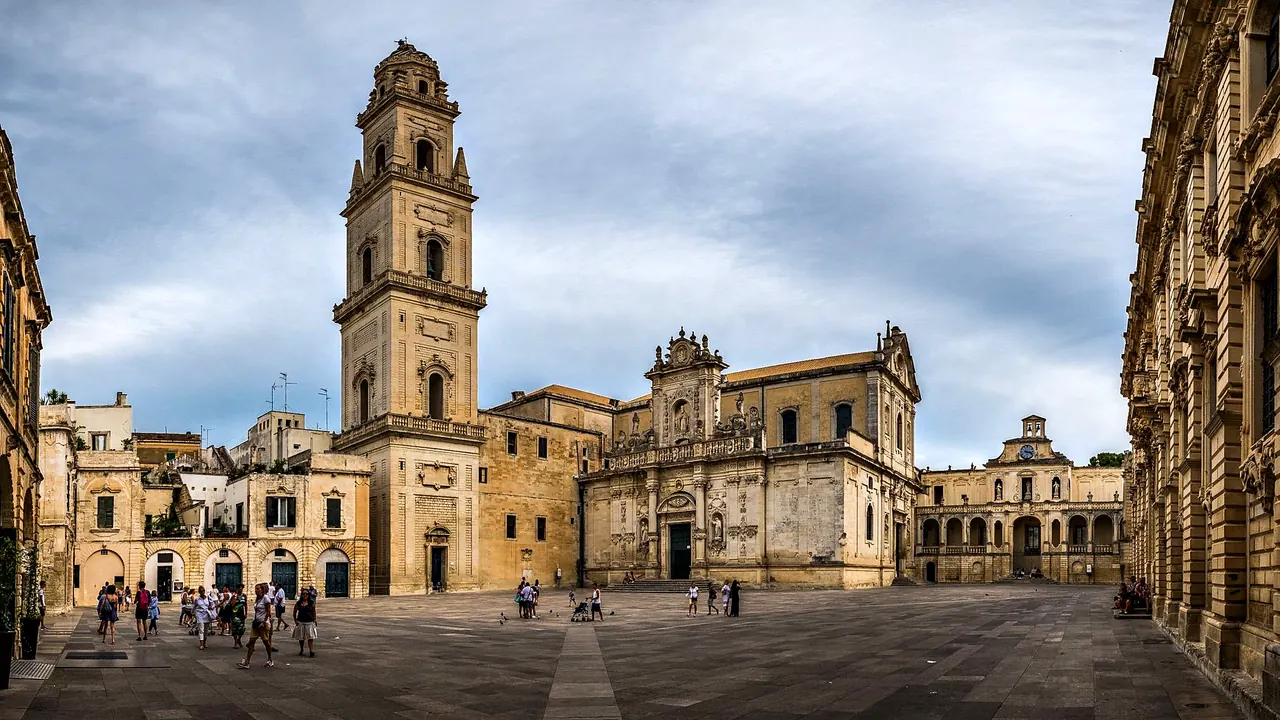
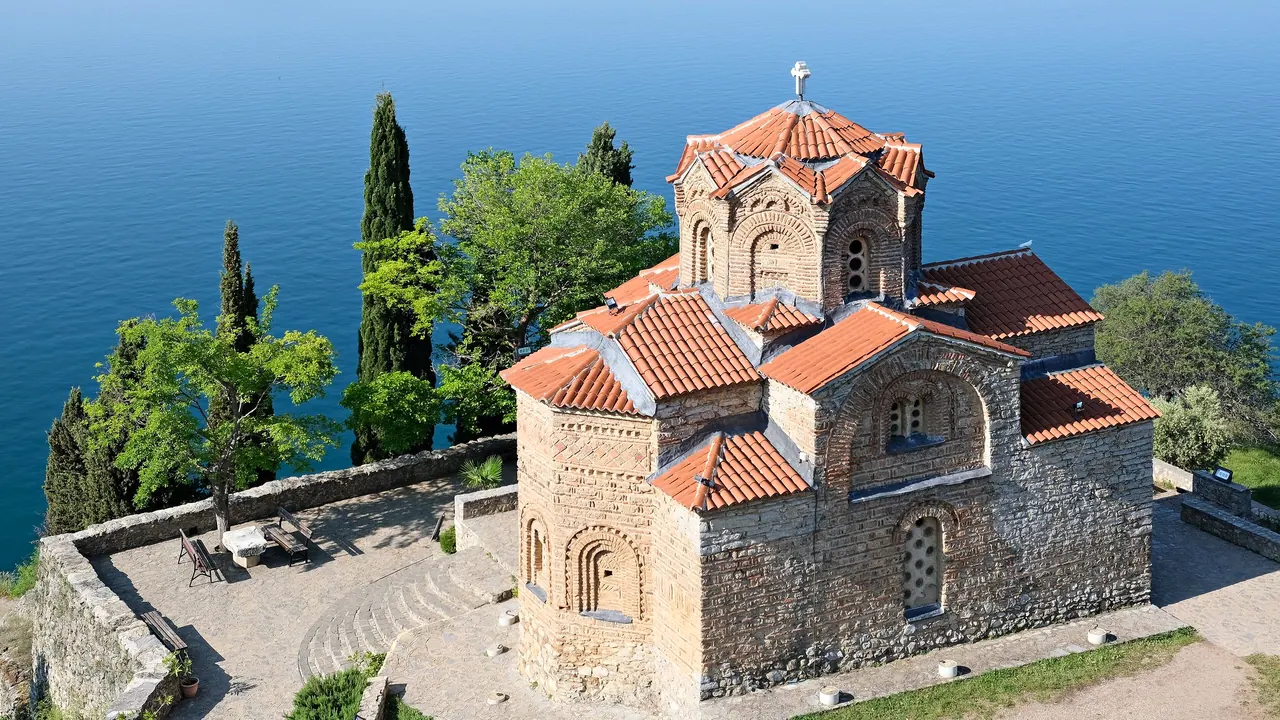
Photos: Lecce by Giuseppe Milo, CC BY 3.0, cropped; Ohrid by kallerna, CC BY-SA 4.0, cropped.
Lecce or Ohrid?
Our verdict in twelve categories, each scored against the same fixed benchmark cities, and the climate month by month, so you can choose for your trip.
Choose Lecce for
- food and drink
- beaches
- day trips
Lecce is the better pick for a summer by the sea with a handsome town to come back to in the evening. The Salento coast gives it sandy coves and clear Adriatic and Ionian water, and the Baroque old town makes a fine base. It also has more distinctive cooking and a longer list of towns to tour by car. It suits travellers who will hire a car and want each day to mix beach, food and stone towns.
Choose Ohrid for
- prices
- nature and the outdoors
- getting around
Ohrid is for travellers whose money has to go further and who would rather look at mountains than sea cliffs. Here you swim in a clear freshwater lake, walk or drive up into Galičica, and spend a day or two among some of the finest medieval churches in the Balkans, all in a small town you can mostly cover on foot. It is a slower, simpler trip, and it is at its best outside the August rush.
Scoreboard
Twelve categories on one fixed scale from 0 to 100. The shaded stretch is the gap between the two.
Your match
Pick a travel style or drag the sliders, and both match scores follow your weighting.
Wins on food and drink and beaches with your weighting.
Wins on prices and nature and the outdoors with your weighting.
What matters to you?
Category by category
What the scores mean for a trip.
Beaches & swimming
Lecce has the stronger beaches, though none of them are in town. Within about forty minutes by car you reach the pale coves and sea stacks of Torre dell'Orso on the Adriatic, or the long, shallow sands of Porto Cesareo on the Ionian. Both have proper sea swimming from early summer into autumn.
At Ohrid you swim in fresh water, from concrete platforms, jetties and short pebble strips rather than sand. The advantage is closeness: the coves below Kaneo and the town beach at Potpeš are a walk from the old town, and the lake is calm and very clear.
Food & drink
Lecce eats better, and more distinctively. A day there runs from pasticciotto and almond-milk iced coffee at breakfast to ciceri e tria and fava purée with chicory at dinner, with dark Negroamaro from the surrounding plain. Simple old-town osterie do this well.
Ohrid's Macedonian home cooking is honest and filling: tavče gravče, grilled meats, ajvar and lake fish such as belvica. The waterfront menus repeat one another, though, so the good meals take some seeking out in the upper old town or the shore villages. Neither city offers much beyond its own region's food.
Culture & sights
The two are closely matched, but their history comes from different worlds. Lecce is a flat Baroque townscape in honey-coloured limestone, with carved facades such as Santa Croce, the enclosed Piazza del Duomo and half a Roman amphitheatre sunk below the main square. You enjoy it by wandering, and the museums are minor.
Ohrid's heritage is medieval and Orthodox. The frescoes in St Sophia, St John at Kaneo above the water and the Cyrillic-era site at Plaošnik are spread over a hillside topped by Samuel's Fortress, so seeing them means climbing as well as looking.
Nightlife
Neither is a place to come for nightlife, but Lecce keeps going for more of the year. Students fill the wine bars and small cocktail bars in the old-town lanes at weekends outside summer. In August the dancing moves to beach clubs around Gallipoli, which means a drive.
Ohrid only comes alive in high summer, when café-bars line the promenade and beach clubs on the southern shore play late. From autumn to spring most evenings end at the dinner table.
Nature & outdoors
Ohrid wins on landscape. The deep, ancient lake is ringed by mountains, and Galičica National Park climbs steeply behind it to summits and paragliding launches, with a view of Lake Prespa on the other side. Kayaks and the lakeshore path give easier options.
Lecce sits on a flat plain of olive groves, so its outdoors is the coast. Cliffs and sea caves run from Roca Vecchia towards Santa Maria di Leuca, Le Cesine draws birdwatchers, and the snorkelling and diving are better than anything a lake can offer.
Day trips
Lecce is the better base for touring. Otranto's cathedral mosaic, Gallipoli's island old town and the frescoes at Galatina are all close, and white Ostuni and the trulli of Alberobello are within reach for a longer day. Trains run to Brindisi and Bari, though a car makes most trips far easier.
From Ohrid the obvious outing is St Naum, which in summer you can reach by boat along the shore. Bitola and the mosaics at Heraclea, Lake Prespa and a crossing into Albania for Korçë add variety, but the roads are slow.
Good for families
Both work for relaxed family time, and neither has a zoo or theme park. Lecce's old town is flat and largely free of cars, which is easy with a pushchair, and the shallow sand around Porto Cesareo suits toddlers. The summer heat means building the day around a long midday rest.
Ohrid offers unsalted, calm lake water within reach of town, boat rides and the prehistoric pile village at the Bay of Bones. Its steep, cobbled lanes are harder with small children, so a lakeside apartment is the easy option.
Getting around
Ohrid is easier to manage without a car. The promenade, bazaar and old town lie close together, cheap taxis cover short hops, and summer boats run along the shore, though the old town's stairs are tiring.
Lecce's centre is flatter and just as walkable, and fast trains leave from the edge of the old town. Beyond the walls, though, the Salento's slow local railways and summer-only beach buses push most visitors into a hire car, which then has to be parked outside the restricted centre.
Shopping & style
Neither is a shopping destination, and each has one craft worth looking for. In Lecce it is cartapesta, papier-mâché saints made in old-town workshops, along with limestone carvings, Grottaglie ceramics and food shops selling olive oil and wine. In Ohrid it is the lustre-coated Ohrid pearl, best bought from a long-established family workshop, plus filigree silver and icons.
Affordability
Ohrid is markedly cheaper. Guesthouse rooms, meals with Macedonian wine, taxis and church entry all cost little, and late spring or early autumn bring prices down further.
Lecce is reasonable by Italian standards, with cheap pastries and trattorias and fairly priced palazzo bed and breakfasts. A hire car and paid beach loungers add up, though. Both towns get pricier in August.
Live music & performing arts
Lecce has more to see. The Politeama Greco and Teatro Paisiello run a modest season of opera and theatre, and through the summer the Salento's villages dance to pizzica, which peaks at the huge open-air Notte della Taranta in Melpignano.
Ohrid's live culture is almost entirely its Summer Festival. Its concerts, opera and plays in St Sophia and the ancient theatre make memorable evenings, but there is little outside that window.
Wellness & relaxation
Lecce has more for a restful stay. The sulphur grottoes and cliff-top pools of Santa Cesarea Terme are under an hour away, several old masserie on the plain have become quiet spa retreats, and the long afternoon closing slows everyone down.
Ohrid offers hotel spas and little else formal, as its nearest thermal springs are far off near Debar. Its real draw for unwinding is a still lake in May, June or September, before August brings the crowds.
When should you go?
Pick your month. The climate figures are measured averages, not a forecast.
Lecce in July
Ohrid in July
Daytime high, °C
Rainfall in the month, mm
Where the figures come from
Lecce's temperatures are measured 38 km from the centre, at Brindisi.
Lecce has no rain gauge within 25 km of the centre, so its rainfall comes from a gridded climate dataset read at the city rather than from a gauge further away.
Ohrid has no rain gauge within 25 km of the centre, so its rainfall comes from a gridded climate dataset read at the city rather than from a gauge further away.
Temperature and rainfall are climate normals, averaged over the years shown. Lecce: 1991-2020 (sunshine 1981-2010) normals, Brindisi (38 km from centre). Ohrid: 1999-2017 (rainfall 1991-2020) normals, Ohrid (0.2 km from centre).
Lecce has the longer warm season. The sea is warm enough for swimming from June, reaches about 26°C in August and stays pleasant well into September and early October. July and August are almost rainless and very sunny, but highs of 30°C make midday walking in the stone streets hard work, so May, June and September are kinder for the old town. Rain comes with autumn and peaks in November at around 102mm, while winters stay mild enough for sightseeing.
Ohrid is more continental. Summer highs are close to Lecce's, and July and August are its driest months, but the lake is only really warm from late June to mid-September. Spring warms later, and winter is properly cold, with January highs of about 6°C and the wettest weather from October to December. Late May, June and September are best for walking the town and the hills.
Which traveller are you?
On a beach and sun trip, Lecce is the clear choice. You get two seas to pick between, sand rather than concrete underfoot, and swimming that lasts well beyond the summer. Ohrid's freshwater lake is lovely on a hot day, but only briefly.
On a tight budget, Ohrid stretches your money much further, and its small centre means you spend little just getting about. Lecce is fair value for Italy, but renting a car to explore the Salento soon adds to the cost.
For an outdoors trip, choose Ohrid. Mountains rise straight from the shore, so you can swim in the morning and be on a high ridge by the afternoon. Lecce's flat farmland suits gentle cycling, and beyond that its outdoors is mostly the sea.
Before you go
| Measure | Lecce | Ohrid |
|---|---|---|
| Official language | Italian | Albanian, Macedonian |
| Currency | Euro (EUR) | Denar (MKD) |
| Sockets | CFL230 V, 50 Hz | CF230 V, 50 Hz |
| Driving side | Right | Right |
| Time zone | UTC+1, UTC+2 in summer | UTC+1, UTC+2 in summer |
| Emergency number | 112 | 112 |
| Elevation | 49 m | 695 m |
| Main airport | Brindisi Airport (BDS)39 km from centre49 non-stop destinations | Ohrid St. Paul the Apostle Airport (OHD)9 km from centre14 non-stop destinations |
| Public holidays this year | 13 days | 12 days |
By the numbers
| Measure | Lecce | Ohrid |
|---|---|---|
| City population | 94,783 | 38,818 |
| People per km² | 393 | 100 |
| Museums within 10 km | 11 | 11 |
| UNESCO World Heritage sites within 50 km | 0 | 2 |
| Swim season, months above 21 °C | 4 months | - |
Where else could you go?
Every comparison below shares a destination with this one, so you can follow Lecce or Ohrid somewhere new.