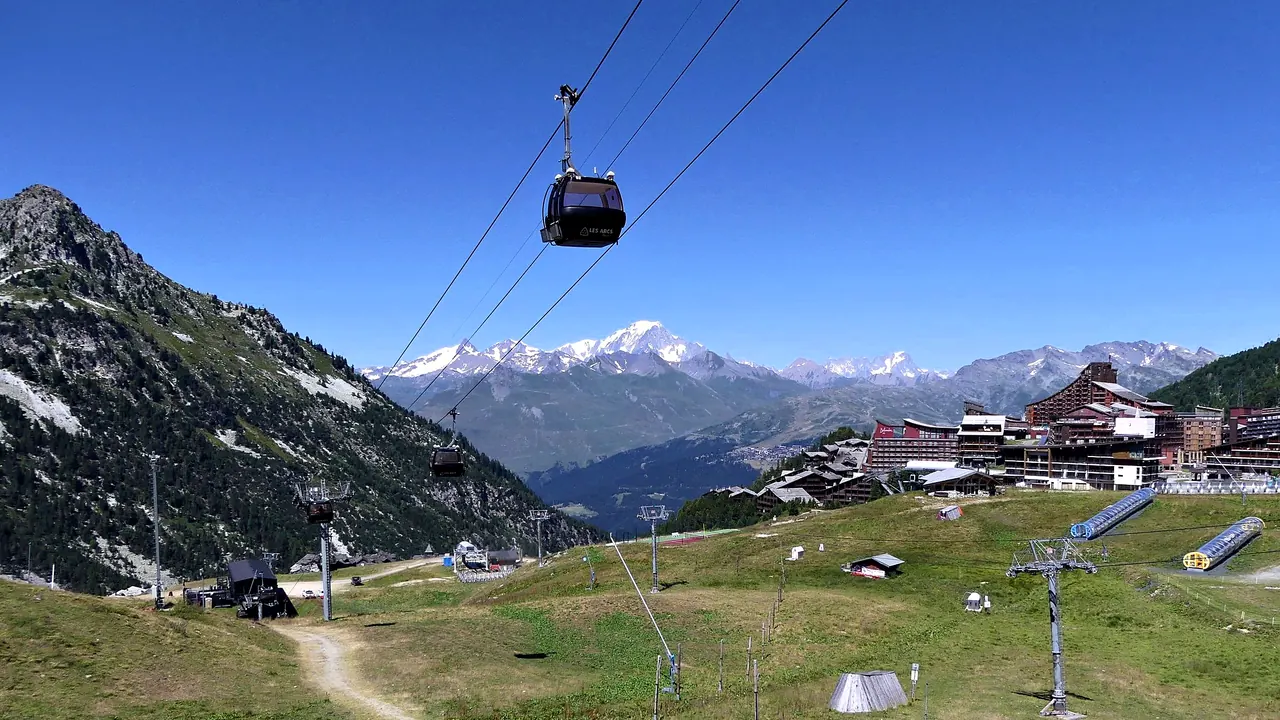
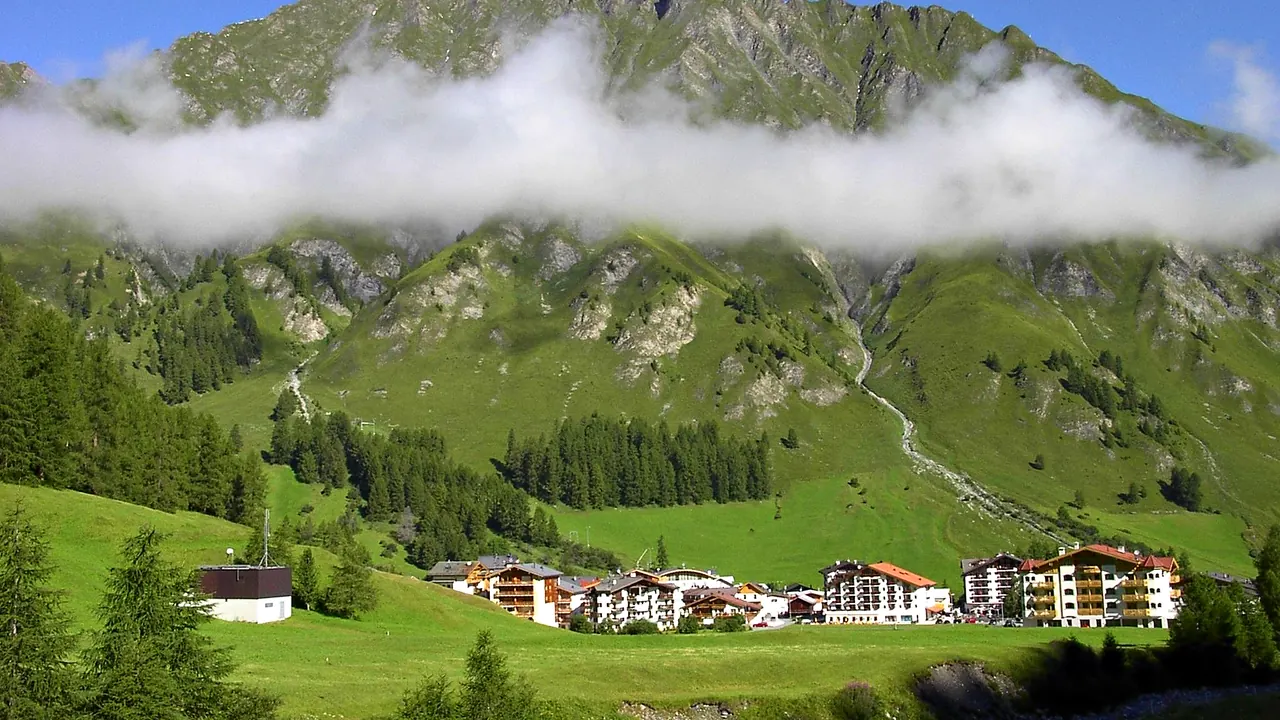
Photos: Les Arcs by Florian Pépellin, CC BY-SA 4.0, cropped; Samnaun by Rene Nueesch, CC BY 3.0, cropped.
Les Arcs or Samnaun?
Our verdict in twelve categories, each scored against the same fixed benchmark cities, and the climate month by month, so you can choose for your trip.
Choose Les Arcs for
- families
- getting around
- live music and the arts
Les Arcs is the better pick for a family ski week and for anyone who wants as much mountain as possible. Its villages were designed around children and ski-in apartments, the linked Paradiski area is bigger and more varied, and you can arrive by train and ride the funicular up from Bourg-Saint-Maurice. Summer adds rafting, via ferrata and a July chamber music festival, and the Charlotte Perriand architecture gives design lovers something to look at between runs.
Choose Samnaun for
- shopping
- wellness
- day trips
Samnaun suits travellers who want a remote, quiet valley with very good skiing on the doorstep and calm evenings afterwards. It works best for couples or groups with a car who will drive out to the painted villages of the Lower Engadine and the abbeys across the Reschen Pass. It is also one of the few mountain resorts where the duty-free shopping street is a real part of the stay.
Scoreboard
Twelve categories on one fixed scale from 0 to 100. The shaded stretch is the gap between the two.
Your match
Pick a travel style or drag the sliders, and both match scores follow your weighting.
Wins on families and getting around with your weighting.
Wins on shopping and wellness with your weighting.
What matters to you?
Category by category
What the scores mean for a trip.
Beaches & swimming
Neither place has a beach, so swimming comes down to pools. In Les Arcs that means heated outdoor pools at residences in summer and small leisure lakes in the valley. For a real lake swim you have to drive about two hours to Annecy or Lac du Bourget.
Samnaun's version is indoors: the village leisure pool and hotel pools. Its alpine lakes are only warm enough for a brave dip in August.
Food & drink
Les Arcs eats better, mainly because it has a proper regional cuisine. Fondue, tartiflette and diots come with Beaufort from the surrounding valleys, there are long lunches on terraces at converted farm huts, and a few kitchens cook refined alpine food. The markets and Beaufort cooperative in Bourg-Saint-Maurice are good for picnic supplies.
In Samnaun most meals are eaten on half board in hotel dining rooms, with capuns, pizokel and Tyrolean dishes from across the border. What stands out there is the drink in its duty-free shops, not the cooking.
Culture & sights
Neither resort is a sightseeing trip, but Les Arcs gives you more to look at. Charlotte Perriand's stepped apartment blocks at Arc 1600 and Arc 1800 are recognised twentieth-century architecture, and the baroque chapels of the Tarentaise are a short drive down the valley.
Samnaun's culture comes down to modest parish churches, a few old timber farmhouses and an interesting story: the valley was so isolated that it was left outside the Swiss customs area in 1892.
Nightlife
Both resorts go quiet early, and après-ski is the main event in each. Les Arcs is louder at teatime, with terrace bars at the foot of the slopes in Arc 1800 and Arc 2000 putting on DJs and table-dancing as the lifts close. Arc 1800 also has a late bar or two and a small club.
Samnaun relies more on hotel bars, with a club or two open on peak weekends. Its famous party neighbour across the ski area can only be reached on skis during the day. Once the lifts close, it is a long drive round through Austria.
Nature & outdoors
Both are serious ski destinations, but Les Arcs offers more in both seasons. Paradiski, linked to La Plagne by a double-decker cable car, has runs from the Aiguille Rouge at over 3,200m all the way down to the valley floor. In summer there are trails into the Vanoise with its ibex and marmots, plus a bike park, rafting on the Isère, paragliding and via ferrata.
Samnaun's cross-border area with the Paznaun is also huge, with high, snow-sure runs above the treeline. Its summers are quieter and focused on hiking and biking, with border ridges, the Tyrol and the Swiss National Park about an hour away. Its real advantage is how few people you will meet.
Day trips
The two are about level for day trips but head in different directions. From Les Arcs, most outings go to other mountain places: Bourg-Saint-Maurice, the Beaufortain cheese villages, and Val d'Isère and Tignes. Chambéry and Annecy are about two hours away, and in summer the Little St Bernard Pass opens a route to Aosta.
Samnaun's trips are more about historic villages. Scuol, Guarda and Sent have sgraffito houses, Tarasp Castle stands on its rock, and across the Reschen Pass are walled Glurns and the UNESCO-listed convent at Müstair. You really need a car for these.
Good for families
Les Arcs is clearly the more family-minded resort. It was planned for ski weeks with children, so the villages are largely car-free, apartments open onto the snow, and ski schools, kindergartens and themed fun slopes are all close by. Skating and sledging fill the afternoons.
Samnaun handles a family ski week well, with nursery slopes near the village, simple half board and a leisure pool with slides. Beyond that, little is built for children, and the winding approach road can be hard on young travellers.
Getting around
Les Arcs is far easier to reach. Long-distance trains arrive at Bourg-Saint-Maurice, and a funicular takes you up to Arc 1600 in a few minutes, with shuttle buses linking the villages from there. The villages are spread out along a winding road, though, so walking between them is not realistic.
Samnaun is a dead-end valley with no railway, and the postbus from Scuol takes over an hour. Once you are there, its hamlets sit along one road served by local buses, but day trips work much better with a car.
Shopping & style
In Les Arcs, shopping fits around the skiing. You hire or buy what the mountain requires and stock the apartment kitchen, and that is about it. The one purchase with a real sense of place is cheese, so a trip down to Bourg-Saint-Maurice for Beaufort and a bottle of génépi is worth more than browsing in the resort villages.
Samnaun gives a shopper a reason to keep an afternoon free. Because the valley lies outside the Swiss customs area, its main street is lined with shops selling Swiss watches, jewellery and perfume, and day-trippers come over from the Tyrol just for them. The downside is that it all looks the same: these are the brands you would find in any airport, and almost nothing on the shelves comes from the valley itself.
Affordability
Both are expensive, but Les Arcs gives you more ways to cut costs. Most lodging is self-catering apartments, so you can cook for yourself, and quieter weeks in January or late March, or a summer stay, bring the price down noticeably.
Samnaun follows Swiss mountain prices for hotels, passes and meals. Half board helps, and duty-free fuel and alcohol take some edge off the total.
Live music & performing arts
Les Arcs has the one real cultural event in this comparison. Its summer classical music festival, held since the 1970s, fills halls and chapels with chamber music and a music academy for a few weeks in July.
Samnaun's live music comes down to the occasional brass band, après-ski performers, and the big open-air concerts on the slopes at the start and end of the winter season.
Wellness & relaxation
Samnaun is the more restful of the two. Outside the main ski weeks the valley is calm, most bigger hotels have their own saunas and small spas, and the public pool has a sauna area. The mineral springs of Scuol, under an hour away, offer proper spa bathing.
Les Arcs has saunas and hammams in many residences, plus spas aimed at tired skiers, and Brides-les-Bains is about an hour down the valley. During ski week, though, the lifts set a busier pace, and the calm only arrives in summer and the shoulder weeks.
When should you go?
Pick your month. The climate figures are measured averages, not a forecast.
Les Arcs in July
Samnaun in July
Daytime high, °C
Rainfall in the month, mm
Where the figures come from
Les Arcs's temperatures are measured 43 km from the centre, at Grand St. Bernard / Grand Saint Bernard.
Les Arcs's station stands 199 m above the city centre, so the centre is likely a little warmer than the figures say.
Les Arcs has no rain gauge within 25 km of the centre, so its rainfall comes from a gridded climate dataset read at the destination rather than from a gauge further away.
Samnaun has no rain gauge within 25 km of the centre, so its rainfall comes from a gridded climate dataset read at the destination rather than from a gauge further away.
Temperature and rainfall are climate normals, averaged over the years shown. Les Arcs: 1991-2020 normals, Grand St. Bernard / Grand Saint Bernard (43.4 km from centre). Samnaun: 1991-2020 normals, Passo Resia / Resia Pass (16.3 km from centre).
Les Arcs is high mountain country all year. Daytime highs stay below freezing from November to March and reach only about 12°C in July and August. Rain or snow is heavy in every month and heaviest in early winter, with about 193mm in November. Sunshine is very short in December, picks up sharply from March and is longest in July. That makes winter reliable for a ski week, while summer means walking in cool, fresh air rather than warmth.
Samnaun's figures are noticeably milder. Winter highs sit around freezing, and July reaches about 21°C, which is comfortable for hiking and biking the high pastures. Its rainfall pattern is the other way round: winter is the drier season, with about 58mm in February, and early summer is the wettest, peaking around 118mm in July. Samnaun's summer is therefore wetter than summer in Les Arcs, but even its wettest months are well short of the early-winter totals in Les Arcs.
Which traveller are you?
On a family trip with young children, Les Arcs asks much less of the parents. The whole resort was planned around children on ski weeks, so each day takes less organising. You can also arrive by train, which spares a carsick child Samnaun's long, winding road in.
For a shopping trip, Samnaun is the only one of the two worth considering. Its duty-free status turns a ski week into a chance to buy well-known brands for less. Les Arcs sells what you need on the slopes, some local cheese and little else.
On a relaxing and wellness trip, Samnaun is the easier place to switch off. Because the valley is so remote, it stays quiet outside the peak weeks, and rest comes naturally after a day outdoors. For much of the winter, Les Arcs runs to the timetable of lifts and ski school.
Before you go
| Measure | Les Arcs | Samnaun |
|---|---|---|
| Official language | French | French, German, Italian, Romansh |
| Currency | Euro (EUR) | Swiss Franc (CHF) |
| Sockets | CE230 V, 50 Hz | CJ230 V, 50 Hz |
| Driving side | Right | Right |
| Time zone | UTC+1, UTC+2 in summer | UTC+1, UTC+2 in summer |
| Emergency number | 112 | 112 |
| Elevation | 2,273 m | 1,846 m |
| Main airport | Geneva International Airport (GVA)92 km from centre150 non-stop destinations | Innsbruck Airport (INN)82 km from centre40 non-stop destinations |
| Public holidays this year | 11 days | 9 days |
By the numbers
| Measure | Les Arcs | Samnaun |
|---|---|---|
| Population | - | 773 |
| People per km² | - | 14 |
| Museums within 10 km | 0 | 1 |
| UNESCO World Heritage sites within 50 km | 0 | 1 |
Where else could you go?
Every comparison below shares a destination with this one, so you can follow Les Arcs or Samnaun somewhere new.
- La Rosièrevs Les Arcs
- La Plagnevs Les Arcs
- Tignesvs Les Arcs
- Val d'Isèrevs Les Arcs
- Courchevelvs Les Arcs
- Méribelvs Les Arcs