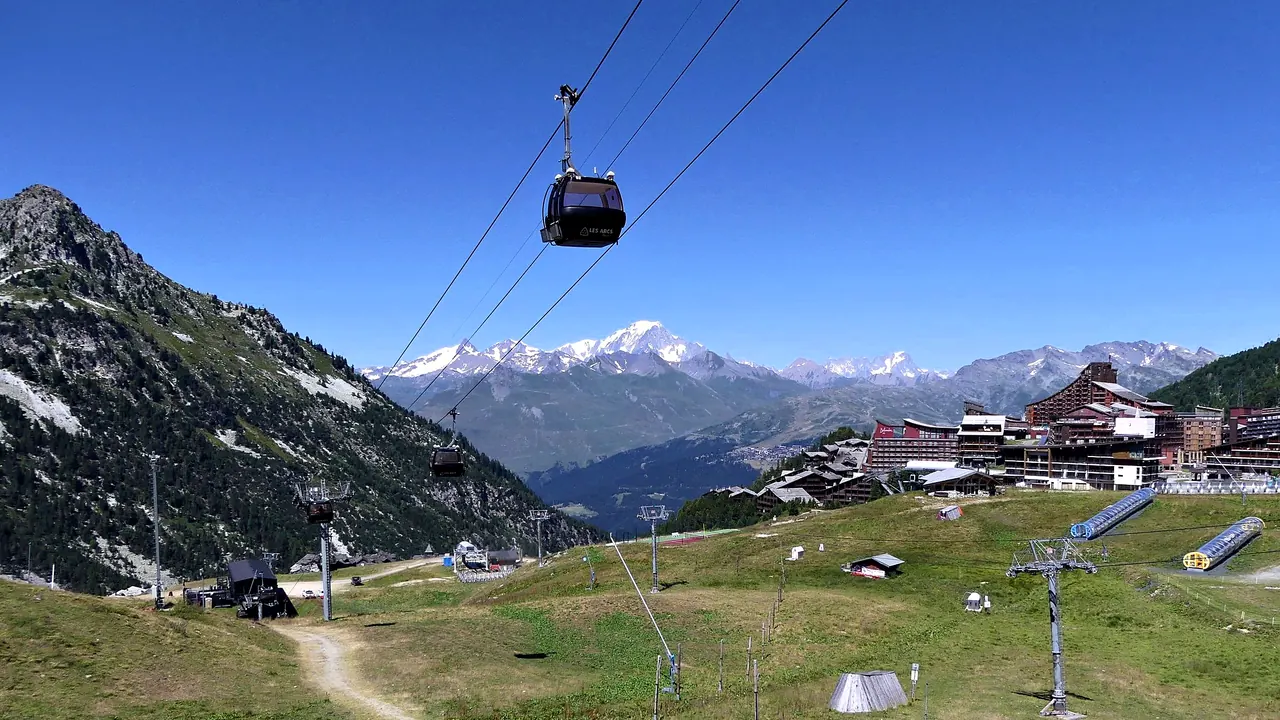
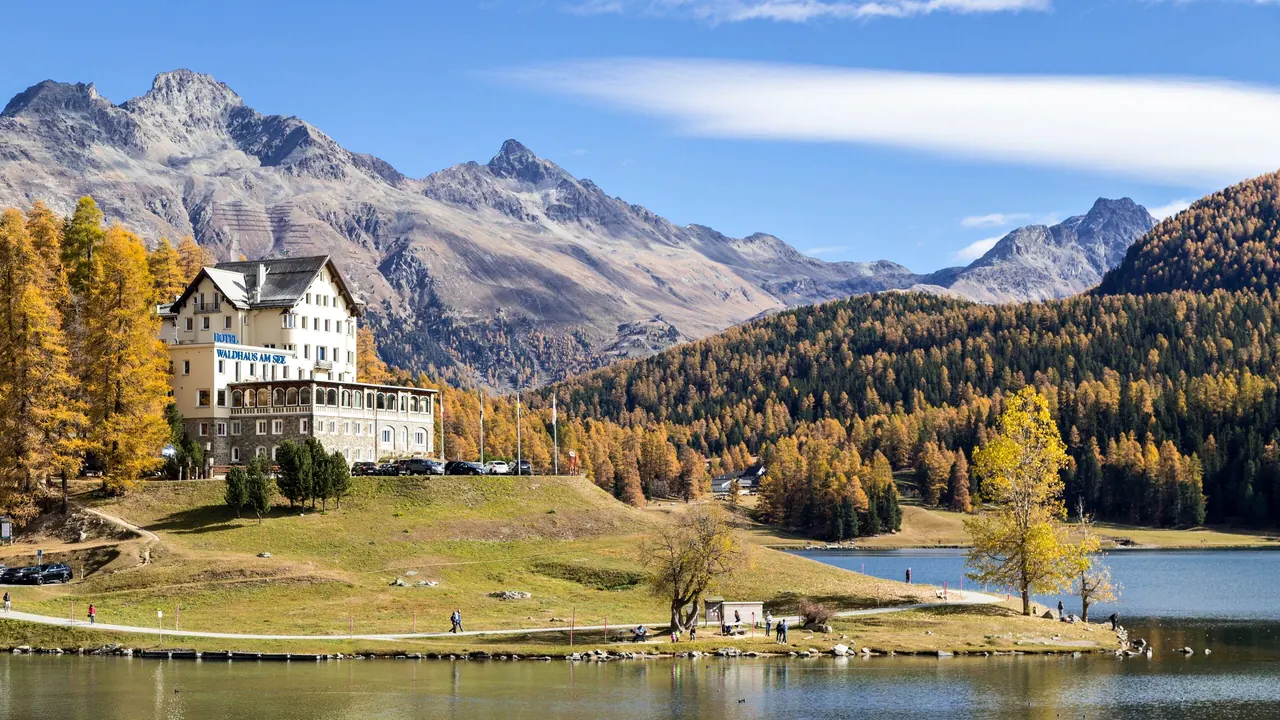
Photos: Les Arcs by Florian Pépellin, CC BY-SA 4.0, cropped; St. Moritz by JoachimKohler-HB, CC BY-SA 4.0, cropped.
Les Arcs or St. Moritz?
Our verdict in twelve categories, each scored against the same fixed benchmark cities, and the climate month by month, so you can choose for your trip.
Choose Les Arcs for
- families
- prices
Les Arcs is the better pick for families on a ski week and for anyone who wants the most skiing for the money. Its car-free villages put apartments straight onto the snow, ski schools take the smallest children, and the self-catering layout keeps a stay from becoming ruinous. Design-minded visitors also get Charlotte Perriand's stepped 1960s blocks, which are more interesting than any museum the resort lacks.
Choose St. Moritz for
- shopping
- wellness
- food and drink
St. Moritz suits couples and adults who see the mountains as a setting for comfort as well as sport. The grand hotels bring serious dining, elaborate spas and luxury boutiques, while the Engadine lakes, cross-country trails and the Bernina railway give the days variety. It is warmer in summer and easier to tour without a car, but you pay heavily for all of it.
Scoreboard
Twelve categories on one fixed scale from 0 to 100. The shaded stretch is the gap between the two.
Your match
Pick a travel style or drag the sliders, and both match scores follow your weighting.
Wins on families and prices with your weighting.
Wins on shopping and wellness with your weighting.
What matters to you?
Category by category
What the scores mean for a trip.
Beaches & swimming
Neither place is for swimming, and both are a long way from any sea. The difference is in what replaces it. Les Arcs has heated outdoor pools at the residences and small leisure lakes in the valley, and Lake Annecy for a real lake swim is about two hours' drive away. St. Moritz has a real natural option in Lej da Staz, a forest lake with a lawn, but even in July the water stays around 20°C at best.
Food & drink
St. Moritz eats better, mainly at the top end. Its grand hotels and mountain restaurants hold a surprising number of serious kitchens. The Engadine dishes, such as capuns, pizzoccheri and the nut tart from the old confectioners, give the town a cooking of its own with an Italian accent.
Les Arcs keeps to Savoyard comfort food: fondue, raclette, tartiflette and Beaufort cheese, eaten on terraces or in converted farm huts. A few more ambitious kitchens do refined alpine dishes, but most visitors self-cater and shop for cheese down in Bourg-Saint-Maurice.
Culture & sights
Neither is a culture destination, and the interest lies in different things. In Les Arcs the resort itself is the sight: Charlotte Perriand's stepped apartment blocks at Arc 1600 and Arc 1800 attract design enthusiasts. The baroque Tarentaise chapels sit below for anyone who goes looking.
St. Moritz has actual museums, if small ones. The Segantini Museum and its great Alpine triptych are the highlight, and the Engadin Museum shows painted farmhouse rooms. Add the leaning tower and the town's history as a two-time Winter Olympic host.
Nightlife
Les Arcs does après-ski the loud, casual way. As the lifts close, the terrace bars at the foot of the slopes in Arc 1800 and Arc 2000 fill up, with DJs and dancing on the tables, and Arc 1800 adds a late bar or two and a small club. With so many families in apartments, though, most nights finish early.
St. Moritz gives you more of an evening, in a dressier style. From Christmas to early March the grand hotel bars run on champagne, and a couple of exclusive clubs stay open late for guests with the right introduction. Out of season both places go quiet after dinner, and St. Moritz is usually asleep by eleven.
Nature & outdoors
Both are first-rate mountain destinations, and the difference is in character. Les Arcs is about scale of skiing: the Paradiski link with La Plagne, long runs from the Aiguille Rouge to the valley floor, and summer trails into the Vanoise National Park.
St. Moritz offers more variety. The wide, lake-filled Upper Engadine has some of the Alps' best cross-country trails, horse racing on the frozen lakes and the Morteratsch glacier walk, and in summer Lake Silvaplana is known for kitesurfing.
Day trips
St. Moritz has a little more to offer, largely thanks to the Bernina line. This UNESCO-listed railway crosses the pass to Poschiavo and Tirano in Italy. Sils Maria and the sgraffito villages of the Lower Engadine are close by.
From Les Arcs, outings are mostly to the market town below, Beaufortain cheese villages and neighbouring resorts. Annecy and Chambéry are around two hours away. The summer-only Little St Bernard Pass opens up Aosta, but in winter the options narrow.
Good for families
Les Arcs is far better for children. It was designed for family ski weeks, with car-free villages, slope-side apartments, kindergartens, gentle beginner areas and themed fun runs, plus sledging, pools and skating for the afternoons.
St. Moritz is safe and has nursery slopes on Corviglia and natural ice for skating. Its luxury tone leaves little made for children, though, and many families with toddlers base themselves in the quieter villages further along the valley.
Getting around
Both work without a car, but St. Moritz does it more smoothly. The Rhaetian Railway arrives in town, and buses and trains then link the whole Upper Engadine from Maloja to Zuoz. The steep climb from Bad up to Dorf is eased by escalators and a lift.
Les Arcs is reached by funicular from the station in Bourg-Saint-Maurice. Its four villages are spread far apart along a winding road, though, so you depend on shuttles that slow down in snow. Excursions down the valley are easier with a car.
Shopping & style
St. Moritz is the place for shopping, but only luxury shopping. Via Serlas and the streets nearby are lined with fashion, watch and jewellery boutiques, and there are furriers too. Les Arcs offers ski rental, outdoor gear and small supermarkets. Its best buys are Beaufort cheese, charcuterie and génépi, and you will find them in the valley town rather than up the mountain.
Affordability
Les Arcs is much the cheaper of the two, though a winter week there is still costly once you add a lift pass for the whole Paradiski area, rental and ski school. The savings come from the way the resort is built. An apartment with its own kitchen lets a family or group of friends share the rent, eat breakfast and dinner in, and save the slope-side restaurants for an occasional lunch. Rates climb steeply during the French school vacation weeks and fall a long way in summer.
St. Moritz gives you few of those options. The town is built around grand hotels, so the room, the dinner and the bar bill are all at luxury level, and the mountain lunches cost the same. Even out of season it stays dear. The main saving comes in summer, when many hotels include the local lifts, buses and trains in the stay, which helps a walking trip along the valley.
Live music & performing arts
Les Arcs puts its music into a few weeks of July. That is when its chamber music festival and academy, held since the 1970s, fill the resort's halls and chapels. In winter, live music means bands in the après-ski bars.
St. Moritz spreads its music across both seasons. There is a summer jazz festival in intimate rooms, the Engadin Festival's chamber and classical concerts in churches across the valley, and a winter classical series in hotel ballrooms. Neither place has a theatre or a year-round concert hall, so if music matters to you, plan your trip around the festival dates.
Wellness & relaxation
St. Moritz is far stronger here. It was a spa before it was a ski resort, and the medical bath in St. Moritz Bad still uses the iron-rich spring and peat. Its hotel spas, with indoor-outdoor pools facing the peaks, are among the most elaborate in the Alps, and the thermal baths at Scuol are a train ride away.
In Les Arcs, wellness usually means the sauna or hammam in your residence and a few hotel spas for tired skiers. Taking the waters means driving about an hour down to Brides-les-Bains.
When should you go?
Pick your month. The climate figures are measured averages, not a forecast.
Les Arcs in July
St. Moritz in July
Daytime high, °C
Rainfall in the month, mm
Where the figures come from
Les Arcs's temperatures are measured 43 km from the centre, at Grand St. Bernard / Grand Saint Bernard.
Les Arcs's station stands 199 m above the city centre, so the centre is likely a little warmer than the figures say.
Les Arcs has no rain gauge within 25 km of the centre, so its rainfall comes from a gridded climate dataset read at the destination rather than from a gauge further away.
St. Moritz has no rain gauge within 25 km of the centre, so its rainfall comes from a gridded climate dataset read at the destination rather than from a gauge further away.
Temperature and rainfall are climate normals, averaged over the years shown. Les Arcs: 1991-2020 normals, Grand St. Bernard / Grand Saint Bernard (43.4 km from centre). St. Moritz: 2015-2025 (rainfall 1991-2020) normals, Samedan (5.5 km from centre).
Les Arcs is cold and snowy for most of the year. Daytime highs stay below freezing from November to March and only reach about 12°C in July and August. That makes high summer the season for hiking and biking, and the sunniest weeks too. Snow or rain falls heavily all year, and early winter is the wettest stretch, at around 193mm in November, while December is very dark.
St. Moritz is milder and drier in winter, with highs close to freezing and only about 42mm in February, so January to March gives crisp, settled skiing weather. Summer is clearly warmer than at Les Arcs, at around 20°C in July, which is comfortable for walking. More of the year's rain falls from June to November, though. For snow, choose midwinter in either place. For a summer mountain stay, St. Moritz is the more comfortable of the two.
Which traveller are you?
On a family trip with young children, Les Arcs is the clear choice. It was planned around ski weeks, with car-free villages, kindergartens, beginner zones and apartments on the snow. St. Moritz is safe but built for adults, with little made for children.
For a relaxing and wellness trip, St. Moritz wins. It began as a spa town, the medical bath still uses its mineral spring, and the hotel spas have pools facing the peaks. Les Arcs offers residence saunas and little more.
On a tight budget, Les Arcs is the less painful option. You can self-cater in apartments, quieter January weeks cost less, and you avoid luxury pricing. In St. Moritz even a coffee is priced for wealthy guests, and budget visitors often stay elsewhere in the valley.
Before you go
| Measure | Les Arcs | St. Moritz |
|---|---|---|
| Official language | French | French, German, Italian, Romansh |
| Currency | Euro (EUR) | Swiss Franc (CHF) |
| Sockets | CE230 V, 50 Hz | CJ230 V, 50 Hz |
| Driving side | Right | Right |
| Time zone | UTC+1, UTC+2 in summer | UTC+1, UTC+2 in summer |
| Emergency number | 112 | 112 |
| Elevation | 2,273 m | 1,822 m |
| Main airport | Geneva International Airport (GVA)92 km from centre150 non-stop destinations | Zürich Airport (ZRH)145 km from centre226 non-stop destinations |
| Public holidays this year | 11 days | 9 days |
By the numbers
| Measure | Les Arcs | St. Moritz |
|---|---|---|
| Population | - | 5,027 |
| People per km² | - | 175 |
| Museums within 10 km | 0 | 7 |
| UNESCO World Heritage sites within 50 km | 0 | 2 |
Where else could you go?
Every comparison below shares a destination with this one, so you can follow Les Arcs or St. Moritz somewhere new.
- La Rosièrevs Les Arcs
- La Plagnevs Les Arcs
- Tignesvs Les Arcs
- Val d'Isèrevs Les Arcs
- Courchevelvs Les Arcs
- Méribelvs Les Arcs