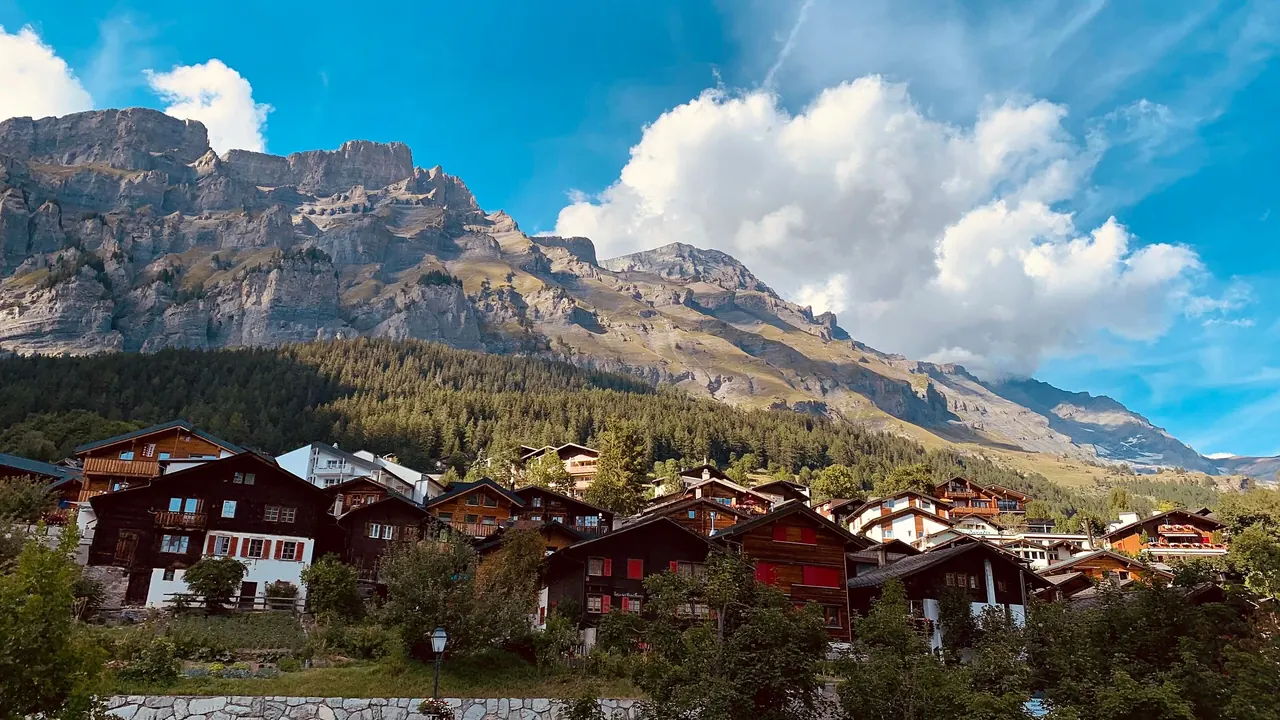
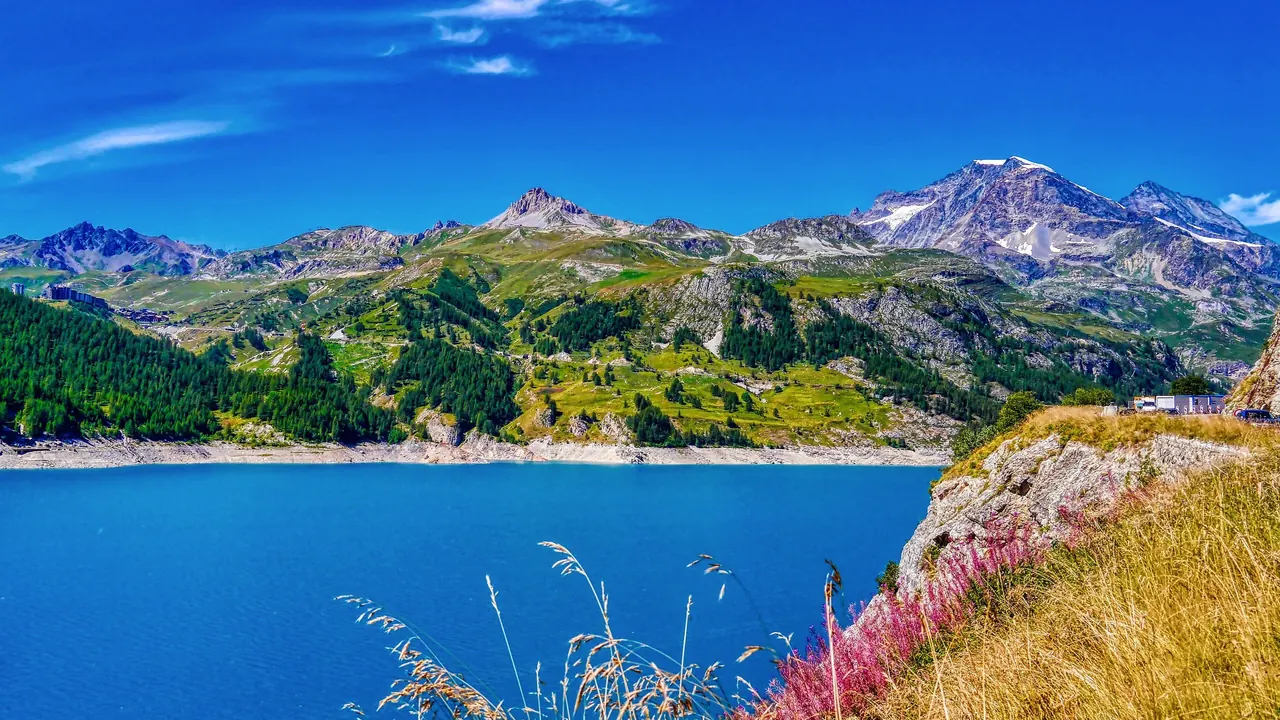
Photos: Leukerbad by LIUCemmi05, CC BY-SA 4.0, cropped; Tignes by Zairon, CC BY-SA 4.0, cropped.
Leukerbad or Tignes?
Our verdict in twelve categories, each scored against the same fixed benchmark cities, and the climate month by month, so you can choose for your trip.
Choose Leukerbad for
- wellness
- day trips
- getting around
Leukerbad is the choice for rest. Its hot springs feed a large public thermal centre and the pools of many hotels, and the evenings are so quiet that a soak outdoors under the cliffs is the main entertainment. It also makes a better base for exploring. The postbus and the Valais rail line put Sion's castles, the Salgesch vineyards and even Lake Geneva within a day's reach, which Tignes, at the end of its long road, can't match.
Choose Tignes for
- nightlife
- beaches
- nature and the outdoors
Pick Tignes if the mountain itself is the point and you want company after dark. Its lifts link with Val d'Isère to reach high, snow-sure pistes and the Grande Motte glacier, and the Vanoise National Park is right beside it in summer. In the ski season the bars of Val Claret and Le Lac stay loud past midnight. It suits groups of skiers and active families who want to be on the slopes early, not anyone after a slow spa week.
Scoreboard
Twelve categories on one fixed scale from 0 to 100. The shaded stretch is the gap between the two.
Your match
Pick a travel style or drag the sliders, and both match scores follow your weighting.
Wins on wellness and day trips with your weighting.
Wins on nightlife and beaches with your weighting.
What matters to you?
Category by category
What the scores mean for a trip.
Beaches & swimming
Neither has a beach, but Tignes at least lets you swim in open water. In July and August the Lac de Tignes has a supervised bathing area with a small sandy shore, although snowmelt keeps the water bracing. Its indoor aquatic centre with slides is open in every season.
Leukerbad's mountain lakes, such as the Daubensee up on the Gemmi, are too cold to swim in. Swimming there means the thermal pools, which are warm and pleasant but are no substitute for a lake shore.
Food & drink
Both kitchens are built on Alpine cheese, with raclette and fondue on almost every menu, and both offer a narrow range. Tignes has a little more variety. Le Lac and Val Claret have pizzerias, crêperies and a few modern Alpine kitchens, there are long terrace lunches on the slopes, and the delicatessens sell Savoie cheeses such as Beaufort and Reblochon.
Leukerbad's strength is its wine. The vineyards around Salgesch are close, so Cornalin and Petite Arvine are on most lists. Most meals are eaten in hotel dining rooms, which suits a spa stay but gets repetitive over a longer one.
Culture & sights
Neither is a sightseeing destination, but they lack sights for different reasons. Leukerbad has an old core of sun-blackened wooden houses and granaries and a bathing history that goes back to Roman times, though you can see it all in half an hour. Tignes was built at altitude in the 1960s and 1970s after the Chevril dam flooded the old village. Its heritage is that story, told at the dam with its giant mural, plus a few chapels in Les Brévières and Les Boisses.
Nightlife
In the ski season Tignes is in a different league. Après-ski starts on mountain terraces in the late afternoon and moves on to the bars of Val Claret and Le Lac, where a young, loud crowd dances in ski boots and the small clubs stay open until well after midnight.
Leukerbad has a few après-ski bars and hotel lounges in winter and nothing open late. Most guests end the evening in the warm pools. Outside winter both places go quiet, so the difference matters mainly on a ski trip.
Nature & outdoors
Both are serious mountain bases, and Tignes has the bigger playground. Its lifts link with Val d'Isère to form one of the largest ski areas in the Alps, and the Grande Motte glacier extends the season into autumn. In summer the Vanoise National Park offers hiking, mountain biking and paragliding, with ibex and marmots along the trails.
Leukerbad's ski area at Torrent is modest. Its real draw is the cliffs: via ferratas up the Daubenhorn, the wooden ladders to Albinen and the cable car up to the Gemmi Pass and the Daubensee. It suits climbers and walkers better than keen skiers.
Day trips
Leukerbad is far better placed for outings. The postbus down to Leuk station connects with the Valais rail line, which makes Sion's castle hills, the wine villages around Salgesch and Brig's Stockalper Palace easy trips. Zermatt, Montreux and Bern are possible on a long day.
Tignes sits at the end of a long valley road. Apart from neighbouring Val d'Isère, most outings, such as Conflans or the cheese village of Beaufort, need a car. Aosta, over the Little St Bernard Pass, is an option in summer only.
Good for families
For families the two offer much the same: mountains, a pool with slides and little else built for children. Tignes is better for a ski week. It has children's ski schools, beginner slopes right beside the villages and ski-in, ski-out apartments, though the altitude can tire very young children.
Leukerbad suits a gentler stay, with beginner slopes at Torrent, a flat lake walk on the Gemmi and warm outdoor pools for wet afternoons. Some of its smarter spas, however, don't welcome small children.
Getting around
Leukerbad is easier to get around and easier to leave. The baths, hotels, cable car and old core are all a few minutes apart on foot, and a regular postbus reaches the main rail line in about half an hour.
Tignes is spread over several villages, but free shuttles and the lifts connect them well, and in winter many people ski from their door. The hard part is getting in and out. The nearest station, at Bourg-Saint-Maurice, is about forty minutes down a winding road, and beyond the valley you need a car or a transfer.
Shopping & style
The thing to carry home is wine in Leukerbad and cheese in Tignes. In Leukerbad that means a bottle from the vineyards around Salgesch. In Tignes it is a wedge of Beaufort, some cured sausage or a jar of mountain honey from the delicatessens. Otherwise the shops in both villages sell ski and outdoor gear and groceries, and a few sportswear boutiques in Tignes are about as close as either comes to fashion.
Affordability
Both are expensive, and neither has real bargains. Tignes is a little easier on the budget because much of it is self-catering apartments, early and late season weeks cost less, and lodging is cheaper in summer.
Leukerbad charges Swiss resort prices for hotels, meals, bath entry and lift passes. The usual way to soften the cost is a hotel package that includes the baths.
Live music & performing arts
Leukerbad's one cultural event is a summer literature festival, with readings held outdoors and in hotels, and otherwise there is the occasional church concert. Tignes is louder but no deeper: bands in après-ski bars, DJs on mountain terraces and free outdoor concerts during resort events in winter and summer. Neither has a theatre or a concert hall. If you want a proper performance, Leukerbad is better placed, because Sion is within reach by train.
Wellness & relaxation
This is Leukerbad's great strength. Hot springs at about 51°C feed a large public thermal centre, a Roman-Irish bath sequence and many hotel pools, and sitting outdoors in warm water with snow all around is the classic Leukerbad experience. The whole village keeps a spa pace.
Tignes has saunas, steam rooms, a hammam and massage at the aquatic centre and in hotel spas, mostly aimed at tired legs after skiing. It has no bathing culture of its own, and for real thermal waters you would go an hour down the valley to Brides-les-Bains.
When should you go?
Pick your month. The climate figures are measured averages, not a forecast.
Leukerbad in July
Tignes in July
Daytime high, °C
Rainfall in the month, mm
Where the figures come from
Leukerbad has no weather station within reach, so its figures come from a gridded climate model rather than a measured record, and read a broad area rather than one spot.
Tignes has no weather station within reach, so its figures come from a gridded climate model rather than a measured record, and read a broad area rather than one spot.
Temperature and rainfall are climate normals, averaged over the years shown. Leukerbad: 2001-2020 normals, NASA POWER reanalysis grid, no weather station within 90 km. Tignes: 2001-2020 normals, NASA POWER reanalysis grid, no weather station within 90 km.
Both villages peak at around 18°C in July and August, which is good walking weather but too cool for lazy days beside a lake. From December to February daytime highs stay below freezing in both, and Tignes, sitting higher, is a degree or two colder through the winter and slower to warm in spring. Winter belongs to the snow in both places, and in Leukerbad it is also the season for sitting in hot outdoor pools in freezing air. April and November fall between the seasons and are too cold for comfortable hiking.
The bigger difference is rain, and it shows most in summer. In Leukerbad, May to August are the wettest months, each with more than 120mm, so summer walks need a waterproof and a flexible plan. September is drier and still reaches about 14°C, which often makes it the better month. Tignes is drier for most of the year, and its wettest month, May, gets about 100mm. Its hiking season from June to September is the more settled of the two, though by November the two are about equally wet.
Which traveller are you?
For a relaxing and wellness trip, Leukerbad is the clear choice. Hot springs fill a large public thermal centre and many hotel pools, the Roman-Irish bath sequence takes up an afternoon, and the village is silent at night. Tignes has saunas and hot tubs, but its rhythm is energetic.
On a food and nightlife trip, Tignes wins, at least in the ski season. Après-ski starts on mountain terraces and ends in the small clubs of Val Claret after midnight, and the villages have a wider range of places to eat. In Leukerbad, evenings end with dinner and a warm pool.
For an outdoors trip, Tignes comes out ahead. It has a huge ski area shared with Val d'Isère, the Grande Motte glacier and the Vanoise National Park for summer hiking and biking. Leukerbad's answer is climbing: via ferratas on the Daubenhorn, the Gemmi Pass and the cliff ladders to Albinen.
Before you go
| Measure | Leukerbad | Tignes |
|---|---|---|
| Official language | French, German, Italian, Romansh | French |
| Currency | Swiss Franc (CHF) | Euro (EUR) |
| Sockets | CJ230 V, 50 Hz | CE230 V, 50 Hz |
| Driving side | Right | Right |
| Time zone | UTC+1, UTC+2 in summer | UTC+1, UTC+2 in summer |
| Emergency number | 112 | 112 |
| Elevation | 1,402 m | 1,440 m |
| Main airport | Geneva International Airport (GVA)118 km from centre150 non-stop destinations | Geneva International Airport (GVA)105 km from centre150 non-stop destinations |
| Public holidays this year | 9 days | 11 days |
By the numbers
| Measure | Leukerbad | Tignes |
|---|---|---|
| Population | 1,368 | 1,919 |
| People per km² | 20 | 24 |
| Museums within 10 km | 0 | 0 |
| UNESCO World Heritage sites within 50 km | 1 | 0 |
Where else could you go?
Every comparison below shares a destination with this one, so you can follow Leukerbad or Tignes somewhere new.
- Val d'Isèrevs Tignes
- Crans-Montanavs Leukerbad
- Adelbodenvs Leukerbad
- Les Arcsvs Tignes
- La Rosièrevs Tignes
- La Plagnevs Tignes