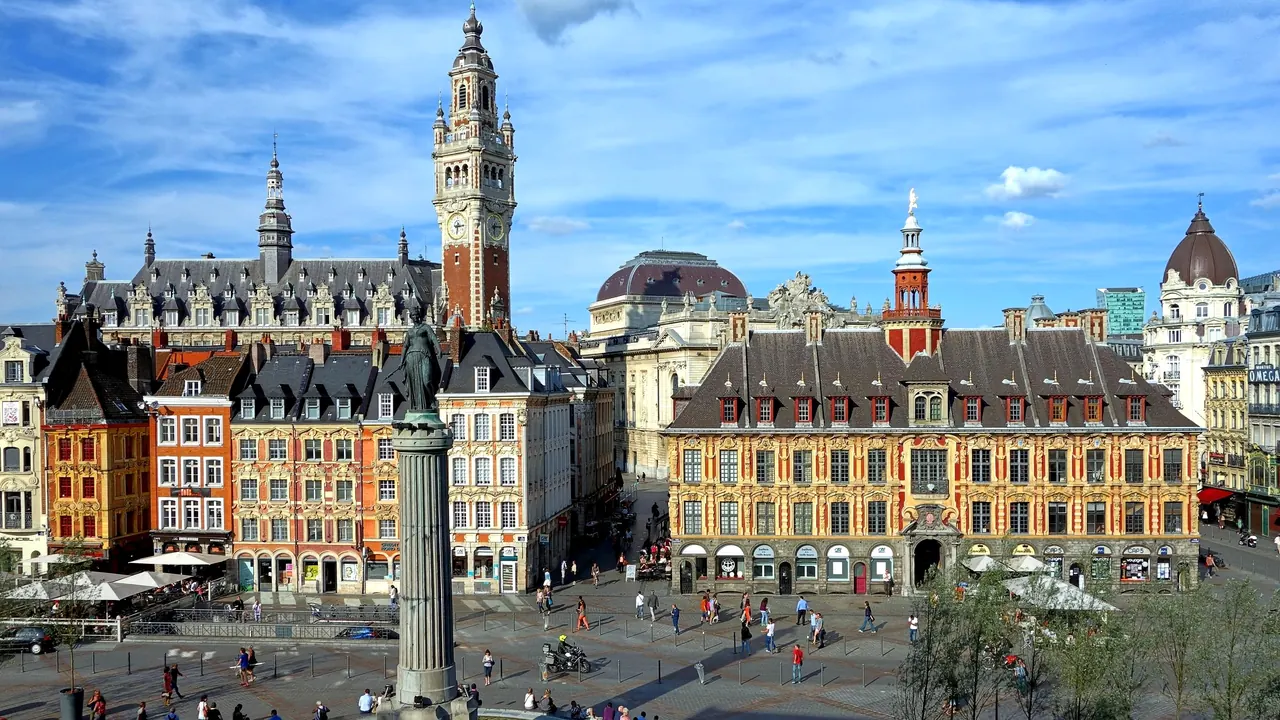
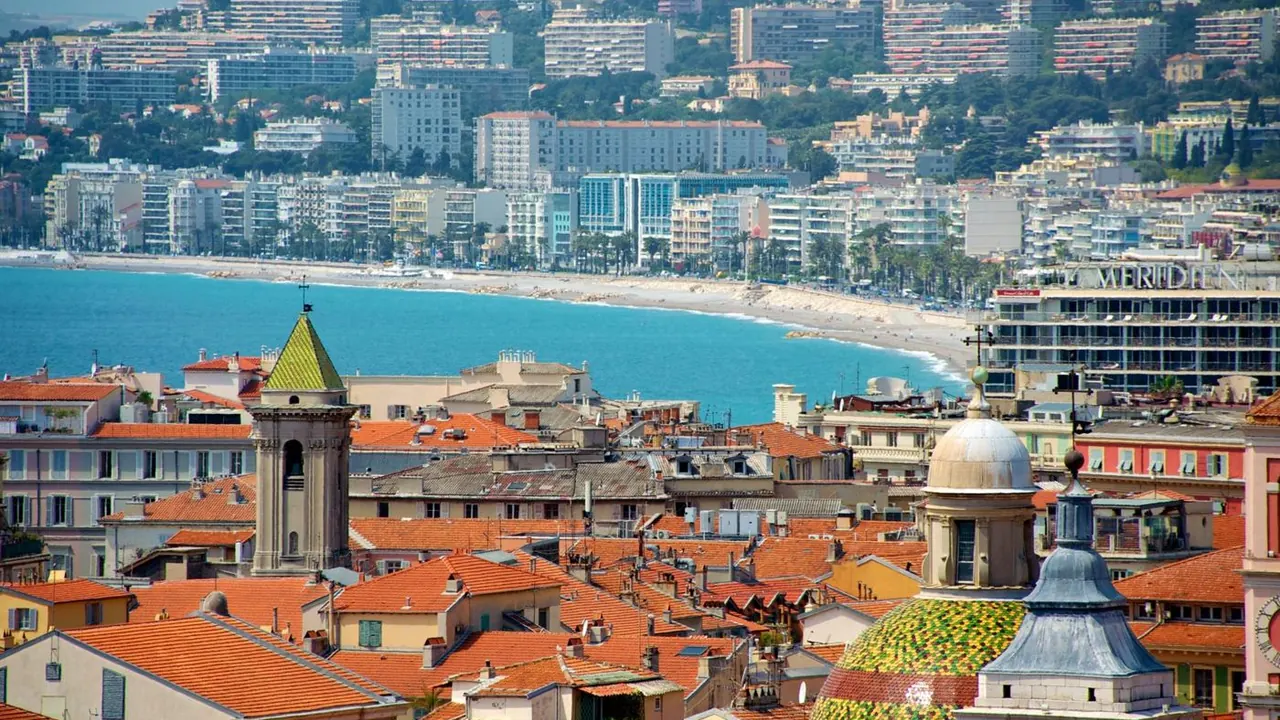
Photos: Lille by Velvet, CC BY-SA 3.0, cropped; Nice by Daniel Stockman, CC BY-SA 2.0, cropped.
Lille or Nice?
Our verdict in twelve categories, each scored against the same fixed benchmark cities, and the climate month by month, so you can choose for your trip.
Choose Lille for
- prices
- nightlife
- live music and the arts
Lille suits travellers who want a city break with a wide reach. Paris, Brussels, Ghent and Bruges are all close by fast train, and the old masters at the Palais des Beaux-Arts are on your doorstep. Evenings go to Flemish taverns and beer cafés, and the student crowd keeps the bars busy. It costs less than the Riviera and is easy to get around, though you don't come here for sun or the sea.
Choose Nice for
- beaches
- nature and the outdoors
- wellness
Nice is the choice when the sea and the landscape matter most. You can swim from the city's own shore through summer and early autumn, the Alps rise just behind the coast, and Matisse and Chagall hang in the hills of Cimiez. A string of Riviera towns lies along the railway. It asks more of your budget and its nights are quieter, but for warmth, light and the outdoors, Lille has nothing like it.
Scoreboard
Twelve categories on one fixed scale from 0 to 100. The shaded stretch is the gap between the two.
Your match
Pick a travel style or drag the sliders, and both match scores follow your weighting.
Wins on prices and nightlife with your weighting.
Wins on beaches and nature and the outdoors with your weighting.
What matters to you?
Category by category
What the scores mean for a trip.
Beaches & swimming
Swimming is no reason to come to Lille. The nearest sand is at Dunkirk, about an hour away by train, and the North Sea there is fine for a brisk walk but cold for swimming even in August. The Opal Coast dunes further on suit walking and sand yachting better than swimming.
In Nice the beach is part of daily life. Pebbles run for about 7km below the Promenade des Anglais, and the water is clear and warm for much of the year. Loungers and water shoes make the stones easier. If you want sand, Villefranche, Paloma beach and Juan-les-Pins are all a short ride away.
Food & drink
Nice comes out a little ahead, mainly because its cooking suits the way you eat on a warm-weather trip. Socca hot from wood ovens, pissaladière, stuffed vegetables and the Cours Saleya market make it easy to eat well and simply outdoors, and the Bellet wines from the hills are rarely found elsewhere. The thing to avoid is the set-menu terraces on the promenade.
Lille's food is heavier Flemish fare, best in the wood-panelled estaminets of Vieux-Lille: carbonnade in beer, potjevleesch, the welsh, and Maroilles in almost everything. Beer comes before wine. Wazemmes market and the waffles from Meert add a sweet and multi-ethnic side.
Culture & sights
The two are equally rich in culture, but in different eras. Lille is the place for old masters and northern architecture: Flemish and Dutch painting, Goya and the relief maps at the Palais des Beaux-Arts, the carved brick of the Vieille Bourse, Vauban's citadel, and La Piscine in Roubaix, an art museum in a former Art Deco pool.
Nice is about light and modern art. Matisse among the Roman ruins of Cimiez, Chagall's biblical cycle and the Yves Klein works at MAMAC sit alongside an Italianate old town and the Belle Époque villas of the resort years. Both fill two or three days well.
Nightlife
Lille has the better night out, thanks to one of France's largest student populations. Rue Masséna and Rue Solférino are packed on Thursday nights, and the cellar bars and beer cafés of Vieux-Lille offer something calmer. For proper clubbing, people have long crossed the nearby Belgian border.
In Nice the evening is usually dinner and drinks in the lanes of Vieux Nice, with a few more grown-up bars at the port. Beach clubs keep things going in summer, but the city quietens down outside the season, and the glossier Riviera nights happen in Monaco and Cannes.
Nature & outdoors
Here the two cities could hardly differ more. Nice sits where the Alps meet the sea. Castle Hill and Mont Boron are walks from the centre, there are coastal paths around Cap Ferrat, and the Mercantour's lakes and larch forests are within about two hours. In winter you can ski at Isola 2000 and be back by the sea the same day.
French Flanders around Lille is flat, farmed and densely settled. The Citadel park, towpath cycling along the Deûle and the low Monts de Flandre make for pleasant afternoons. For real scenery you need a long day out to the chalk cliffs of Cap Blanc-Nez.
Day trips
Lille's day trips cross borders and reach other countries' great cities. Brussels is about half an hour by fast train, Ghent and Bruges around an hour, Paris an hour by TGV, and London is just possible by Eurostar for an ambitious day. Closer to home, Amiens has its great Gothic cathedral, Arras its arcaded Flemish squares, and the First World War memorials around Ypres, Vimy and the Somme make sobering days out.
Nice offers a string of smaller towns along one stretch of coast, each with its own character and most under an hour away without a car. Monaco's palace and casino, lemon-coloured Menton, Èze on its rock, the Picasso Museum in Antibes and the Fondation Maeght at Saint-Paul-de-Vence could fill a week. Sanremo, over the border in Italy, is an easy train ride away.
Good for families
Nice is the slightly easier place with children. The flat promenade suits pushchairs and scooters, the Promenade du Paillon has water jets for hot days, and Parc Phoenix and the Oceanographic Museum in Monaco make good outings. The downsides are pebbles that hurt small feet and the summer heat.
Lille has the zoo and playgrounds of the Citadel park and the hands-on Forum des Sciences, reached by metro. The big attractions, Pairi Daiza and the Nausicaá aquarium, need a longer trip, and the cobbles of Vieux-Lille are hard going with a pushchair.
Getting around
Both are flat and easy to explore on foot, with no need for a car. Lille's big advantage is its stations: Lille Flandres and Lille Europe stand side by side, a walk from the old town, and the automated VAL metro and the tram reach Roubaix and Tourcoing.
In Nice the tram runs straight from the airport to the centre and the port, and buses climb to the museums in Cimiez. Regional trains serve the coast, though they can be packed in summer, and you only need a car for the mountains.
Shopping & style
Shopping is about equal in both, and the differences are in what you buy. Lille's best browsing is the independent fashion, design shops and delicatessens of Vieux-Lille, and every September the Braderie turns the whole city into an enormous flea market.
Nice is better for things to take home from Provence, such as olive oil, soaps, fabrics and candied fruit from the old town, plus the Monday antiques market on the Cours Saleya. Serious luxury buyers tend to head on to Monaco or Cannes.
Affordability
Lille is noticeably kinder to a budget. Hotel rooms are reasonable except during the Braderie and the big trade fairs, and estaminet meals, beer and the metro are fairly priced.
Nice is expensive, especially from June to September, when rooms near the sea and private beach loungers cost the most. Cheap trams and coastal trains, inexpensive museums and socca for lunch claw some of it back, and spring and late autumn are easier on the wallet.
Live music & performing arts
Lille has the fuller programme across the year. The Opéra de Lille, the Orchestre National de Lille and the Théâtre du Nord, one of France's national theatres, run full seasons, Roubaix and Tourcoing add contemporary dance, and the Aéronef brings touring bands.
Nice has its nineteenth-century opera house and a national theatre, but its highlights are a few dates in the calendar: the Nice Jazz Festival in July and the Carnival in February. The rest of the year, live music mostly means small bars in the old town.
Wellness & relaxation
Neither city has a bathing tradition, but Nice is the more restful of the two. You can take an early swim before the crowds, have a long lunch and walk the promenade at dusk, with thalassotherapy centres along the coast. It is calmest out of season, as high summer is hot and busy.
In Lille, relaxing means hotel spas and slow afternoons in the tea rooms of Vieux-Lille. The nearest real thermal bath is a short train ride away in Saint-Amand-les-Eaux.
When should you go?
Pick your month. The climate figures are measured averages, not a forecast.
Lille in July
Nice in July
Daytime high, °C
Rainfall in the month, mm
Temperature and rainfall are climate normals, averaged over the years shown. Lille: 1991-2020 normals, Lille (7.8 km from centre). Nice: 1991-2020 normals, Nice (8 km from centre).
Lille has a northern climate, so its season is short. From May to September the days are mild enough for walking the old town and getting out on day trips, peaking around 24°C in July and August. The sea is never warm enough to make a beach trip worth it. Rain comes steadily all year rather than in one wet season, and from November to February the days are cold, short and grey, though a museum-led stay still works then.
Nice runs on a different calendar. The sea reaches about 25°C in August and you can swim comfortably from June to September, and often into October. Summer is very dry and sunny, but at 28°C the middle of the day is too hot for long walks, so May, June and September are the best balance. Autumn brings the heaviest rain, peaking at about 138mm in November. Winter is mild at around 13°C and far sunnier than in Lille, which makes it pleasant for sightseeing.
Which traveller are you?
For a beach and sun trip, Lille is the wrong city, since its nearest sand is a windy North Sea strand an hour away. Nice has pebbles along its whole seafront, sandy coves a short ride east and a sea that stays warm for months.
On an outdoors trip, Lille gives you level towpath cycling and short walks in the low Monts de Flandre. Nice is far better. You can cycle the corniches, hike the red rocks of the Esterel and reach the Mercantour's high lakes without changing base.
On a tight budget, base yourself in Lille. You can walk the compact centre, have a Sunday lunch at Wazemmes market and spend a full day in the Palais des Beaux-Arts. In Nice, swim from the public beaches, climb Castle Hill and picnic with food from the Cours Saleya.
Before you go
| Measure | Lille | Nice |
|---|---|---|
| Official language | French | French |
| Currency | Euro (EUR) | Euro (EUR) |
| Sockets | CE230 V, 50 Hz | CE230 V, 50 Hz |
| Driving side | Right | Right |
| Time zone | UTC+1, UTC+2 in summer | UTC+1, UTC+2 in summer |
| Emergency number | 112 | 112 |
| Elevation | 17 m | 0 m |
| Main airport | Lille Airport (LIL)8 km from centre61 non-stop destinations | Nice-Côte d'Azur Airport (NCE)6 km from centre130 non-stop destinations |
| Public holidays this year | 11 days | 11 days |
By the numbers
| Measure | Lille | Nice |
|---|---|---|
| City population | 238,246 | 357,737 |
| People per km² | 6,846 | 4,975 |
| Museums within 10 km | 23 | 17 |
| UNESCO World Heritage sites within 50 km | 6 | 2 |
| Swim season, months above 21 °C | - | 4 months |
Where else could you go?
Every comparison below shares a destination with this one, so you can follow Lille or Nice somewhere new.