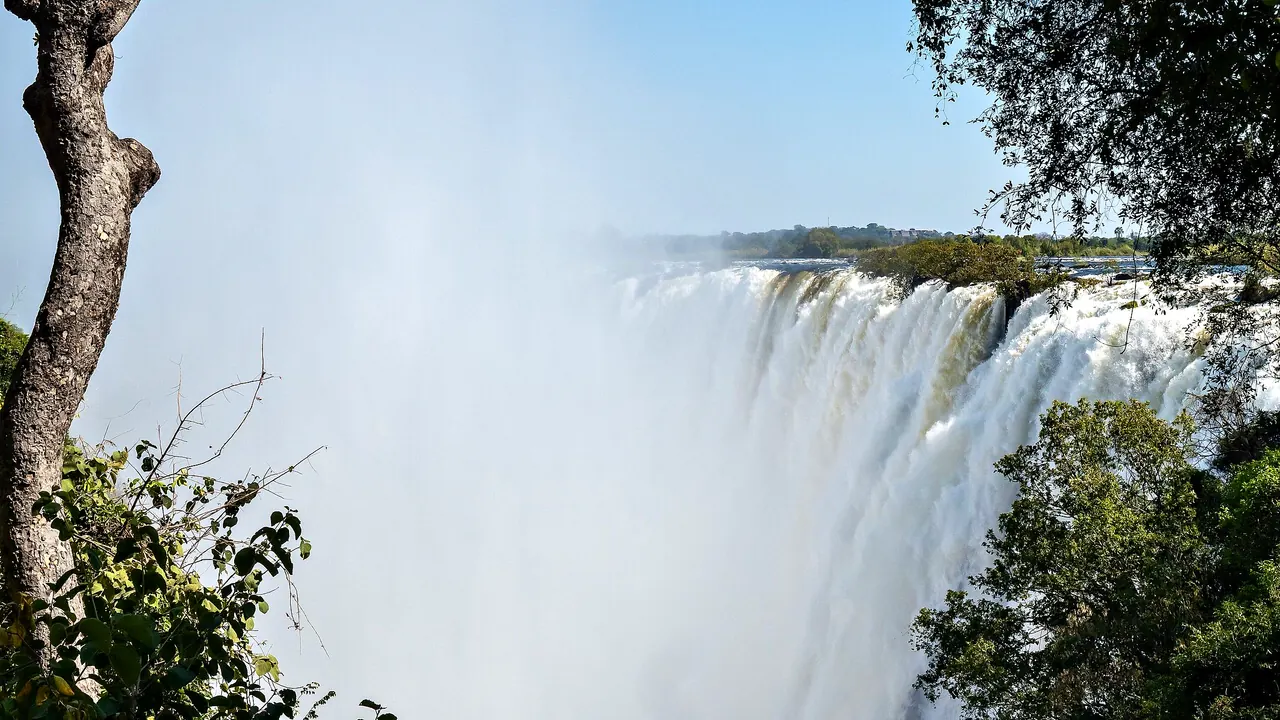
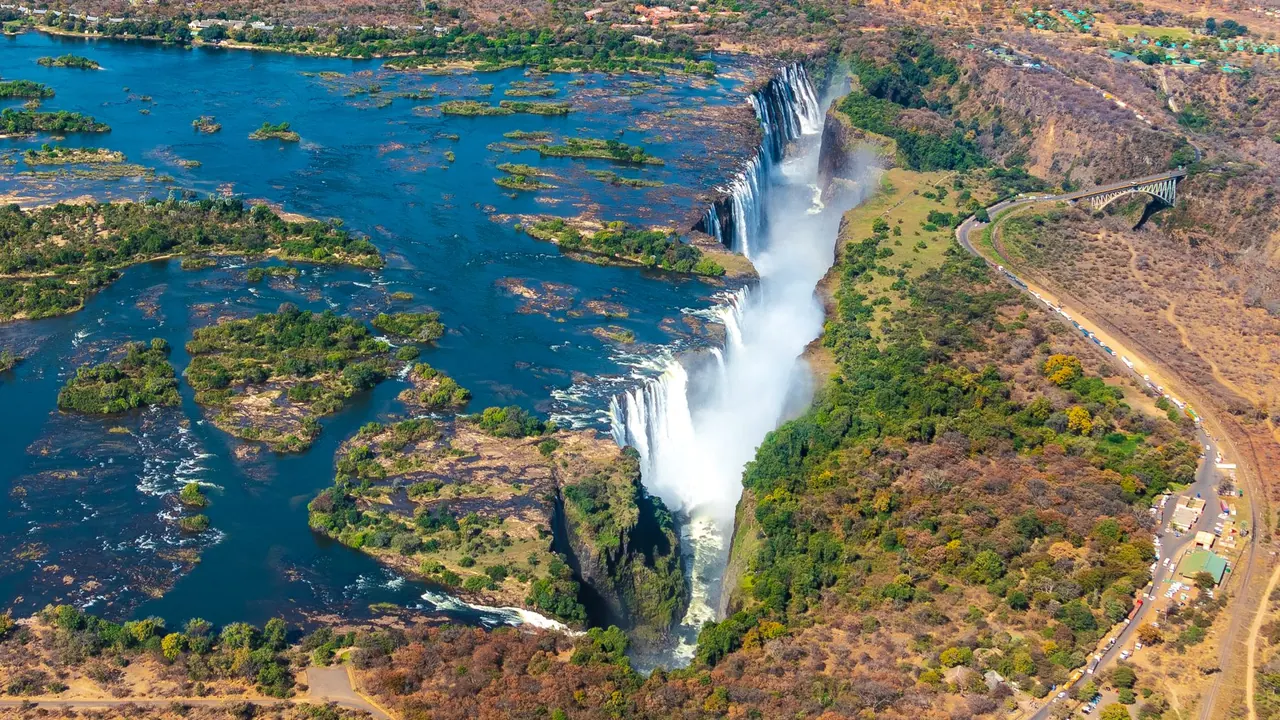
Photos: Livingstone by Matti Blume, CC BY-SA 4.0, cropped; Victoria Falls by Murray Foubister, CC BY-SA 2.0, cropped.
Livingstone or Victoria Falls?
Our verdict in twelve categories, each scored against the same fixed benchmark cities, and the climate month by month, so you can choose for your trip.
Choose Livingstone for
- culture and sights
- prices
- nightlife
Livingstone suits travellers who want the falls with a real town attached. It has the better museums and a main road of colonial verandas, and it has a little more life after dinner. Your money goes further here, and a quiet lodge on the upper Zambezi makes for proper rest between excursions. It is also the side of the river from which Devil's Pool is reached in the low-water months.
Choose Victoria Falls for
- getting around
- families
- food and drink
Families, and anyone who wants to walk out of the hotel and be at the falls, should lean towards Victoria Falls. The falls entrance, the bridge and the main hotels are close together, so a short stay needs less organising, and the town is easier to manage with children of about eight and up. The trade-off is a higher bill, and once the gorge and the park are done, there is less to see in town.
Scoreboard
Twelve categories on one fixed scale from 0 to 100. The shaded stretch is the gap between the two.
Your match
Pick a travel style or drag the sliders, and both match scores follow your weighting.
Too close to call, level with your weighting
Wins on culture and sights and prices with your weighting.
Wins on getting around and families with your weighting.
What matters to you?
Category by category
What the scores mean for a trip.
Beaches & swimming
Neither town has a beach. The Zambezi, with its crocodiles, hippos and strong current, is no place for a swim, so on both sides the lodge pool does the work.
The one difference favours the Zambian bank. Devil's Pool and Angel's Pool, the rock basins on the lip of the falls, are reached from the Livingstone side, so guests staying in Victoria Falls have to cross the bridge for them at low water.
Food & drink
Both towns eat mainly in lodges and a short run of restaurants aimed at visitors, and both have a stiff maize porridge as the staple: nshima in Zambia, sadza in Zimbabwe. In Livingstone the dish to look for is whole Zambezi bream, grilled or fried, and the best meals are dinners on a lodge deck above the river.
Victoria Falls leans more on game meat: kudu, warthog and crocodile grilled over open fires at large dinners with drumming, plus mopane worms for the brave. It also has the classic afternoon tea or sundowner on the terrace of the Victoria Falls Hotel, looking out to the bridge.
Culture & sights
Livingstone has the real sightseeing. The Livingstone Museum, Zambia's oldest and largest, covers archaeology and ethnography and holds the explorer's letters and belongings. A railway museum keeps steam locomotives, and the main road still has its tin-roofed colonial buildings.
Victoria Falls has less to show. There is the bridge, completed in 1905 for Rhodes's Cape to Cairo railway and walkable with a small display, the Edwardian Victoria Falls Hotel in its gardens and the Big Tree baobab. Visitors there who want museums cross the gorge to Livingstone.
Nightlife
Both are early-to-bed places built around the sundowner on a cruise or a lodge deck, and neither has clubs. Livingstone has a little more after dinner: a couple of backpacker hostel bars with life in them, plus a handful of local pubs and taverns in town.
In Victoria Falls, the evening after dinner means hotel bars, a couple of pubs and the backpacker lodge bar. Elephants and buffalo move through town after dark, so you take a taxi between bars rather than walk.
Nature & outdoors
Both towns share Mosi-oa-Tunya, the Batoka Gorge rapids, canoeing on the upper Zambezi and an easy run to Chobe's elephant herds. For the outdoors, choosing between them is about which bank you start from, not about quality. From Livingstone you can take a walking safari to see white rhino in Mosi-oa-Tunya National Park, or hike down to the Boiling Pot.
Victoria Falls has the rainforest path along the rim opposite the drop, and sometimes a lunar rainbow in the spray at full moon. Zambezi National Park, with lion, elephant and buffalo, starts at the edge of town, and Hwange is within reach for a longer safari.
Day trips
For each town, the best day out is the other one, a short crossing of the bridge with border formalities at each end. From Livingstone you go for Victoria Falls town, its Edwardian hotel, its craft market and a second view of the falls. From Victoria Falls you go for Livingstone's colonial main street and its museum.
Mukuni village and Kasane, the gateway to Chobe, are within reach of both. Beyond them, the region offers wildlife rather than towns.
Good for families
Neither town is easy with toddlers: both lie in a malaria area, the big thrills have minimum ages and nothing is built for small children. Victoria Falls is the simpler choice for families with children of about eight and up, because the falls entrance, the bridge and the main hotels are close together and operators collect you from the lodge.
Livingstone also works for older children and teenagers, with rhino walks and lodges with gardens and pools. But nearly everything is reached by vehicle from lodges spread along the river, so days with children involve more time in the car.
Getting around
Victoria Falls is easier on foot. The falls entrance, the bridge and the main hotels are within walking distance of each other, and you can walk across the bridge into Zambia. Livingstone's centre is walkable too, but the falls are well out of town and most lodges are spread along the river upstream. Taxis, shuttles and operator pick-ups therefore handle almost every outing.
Neither town has public transport a visitor would use. In both, elephants on the roads mean no walking at dusk or beyond the edge of town.
Shopping & style
Both offer crafts and little else, and bargaining is expected on both sides of the river. In Livingstone the better buy is bright chitenge cloth from the fabric shops, alongside soapstone, copper and beadwork.
Victoria Falls has a larger curio market strong on Shona-style stone sculpture and a few fixed-price gallery shops with better-made pieces. It also has more traders working the main road near the falls.
Affordability
Livingstone is easier on the wallet. Local meals, minibuses, taxis and town guesthouses are cheap, and a stay that keeps to the town and the falls walkways stays modest. Victoria Falls prices nearly everything for international visitors, much of its food is imported and its river lodges charge safari rates.
In both towns, the activities, from rafting to Chobe safaris, are what make the bill large. Seeing the falls from both banks means paying two entrance fees, whichever town you sleep in.
Live music & performing arts
Neither town has a theatre, concert hall or regular music venue, so performance on both banks means traditional dance. Livingstone's is more rooted in ceremony: troupes perform at cultural centres, sometimes with masked Makishi dancers, and the Toka-Leya people's Lwiindi ceremony is the main event of the year. In Victoria Falls, drummers and dancers perform at the big game-meat dinners and marimba bands play at hotels, as entertainment around a meal.
Wellness & relaxation
Livingstone makes rest easier to find. Its lodges line the upper Zambezi some way from both the town and the falls, so a quiet stay is what you get by default, and the rafting and gorge swings stay at a distance until a pick-up takes you to them.
In Victoria Falls the main hotels sit close to the falls entrance, where traders and tour vehicles keep the road busy, so a calm stay means choosing a lodge in a private concession upstream. Those lodges are very peaceful, and some have spa rooms open to the bush that use marula oil. Neither bank has a bathing tradition, so pampering on both sides of the river means a lodge spa.
When should you go?
Pick your month. The climate figures are measured averages, not a forecast.
Livingstone in July
Victoria Falls in July
Daytime high, °C
Rainfall in the month, mm
Temperature and rainfall are climate normals, averaged over the years shown. Livingstone: 1991-2020 (sunshine 1981-2010) normals, Livingstone (6.5 km from centre). Victoria Falls: 1991-2020 (sunshine 1981-2010) normals, Livingstone (13.1 km from centre).
The two towns face each other about 10km apart across the gorge and share one climate, so the season does not change which of them is better. The rains run from November to March and peak in January at 154mm. May to September is almost rainless and very sunny. June and July are the most comfortable months for walking, with daytime highs around 26°C. October, at 35°C before the rains break, is the hardest month for heat on both sides of the river.
What the calendar changes is the falls themselves. From roughly March to May the river is in full flood: spray soaks the rainforest paths and can hide the view. In the late dry season the flow drops and bare rock shows on the face. The views are then clearer, and the rapids and the rock pools on the lip come into their own. Neither town has a beach season, so in the hot months the lodge pool is where you cool off.
Which traveller are you?
For a culture and arts trip, Livingstone is the clear pick. Its national museum on the explorer and the region's peoples, then the steam engines at the railway museum, fill a day. Across the gorge, Victoria Falls offers little beyond its bridge and old hotel.
On a tight budget, base yourself in Livingstone. A hostel bed, simple local food and a walk along the falls paths make a satisfying stay for little outlay. Across the bridge, beds and meals cost more, so on either side choose excursions sparingly.
On a family trip with children of about eight and up, Victoria Falls has the edge. Game drives start minutes from town, elephants are often seen from the road, and a small, compact base keeps the days simple. Plan malaria precautions carefully for either bank.
Before you go
| Measure | Livingstone | Victoria Falls |
|---|---|---|
| Official language | English | English, Xhosa, Ndau, Venda, Chewa, Khoisan, Kalanga, Shona, Tonga, Tswana, Tsonga, Sesotho, Northern Ndebele, Nambya, Zimbabwe Sign Language, Barwe |
| Currency | Zambian Kwacha (ZMW) | Zimbabwe Gold (ZWG) |
| Sockets | CG230 V, 50 Hz | G220 V, 50 Hz |
| Driving side | Left | Left |
| Time zone | UTC+2 | UTC+2 |
| Emergency number | 991 or 999 | 999 |
| Elevation | 931 m | 961 m |
| Main airport | Harry Mwanga Nkumbula International Airport (LVI)6 km from centre6 non-stop destinations | Victoria Falls International Airport (VFA)18 km from centre12 non-stop destinations |
| Public holidays this year | 16 days | 13 days |
By the numbers
| Measure | Livingstone | Victoria Falls |
|---|---|---|
| City population | 177,393 | 33,060 |
| Museums within 10 km | 2 | 2 |
| UNESCO World Heritage sites within 50 km | 1 | 1 |
Where else could you go?
Every comparison below shares a destination with this one, so you can follow Livingstone or Victoria Falls somewhere new.
- Johannesburgvs Victoria Falls
- Johannesburgvs Livingstone
- Windhoekvs Livingstone
- Swakopmundvs Victoria Falls
- Swakopmundvs Livingstone
- Cape Townvs Victoria Falls