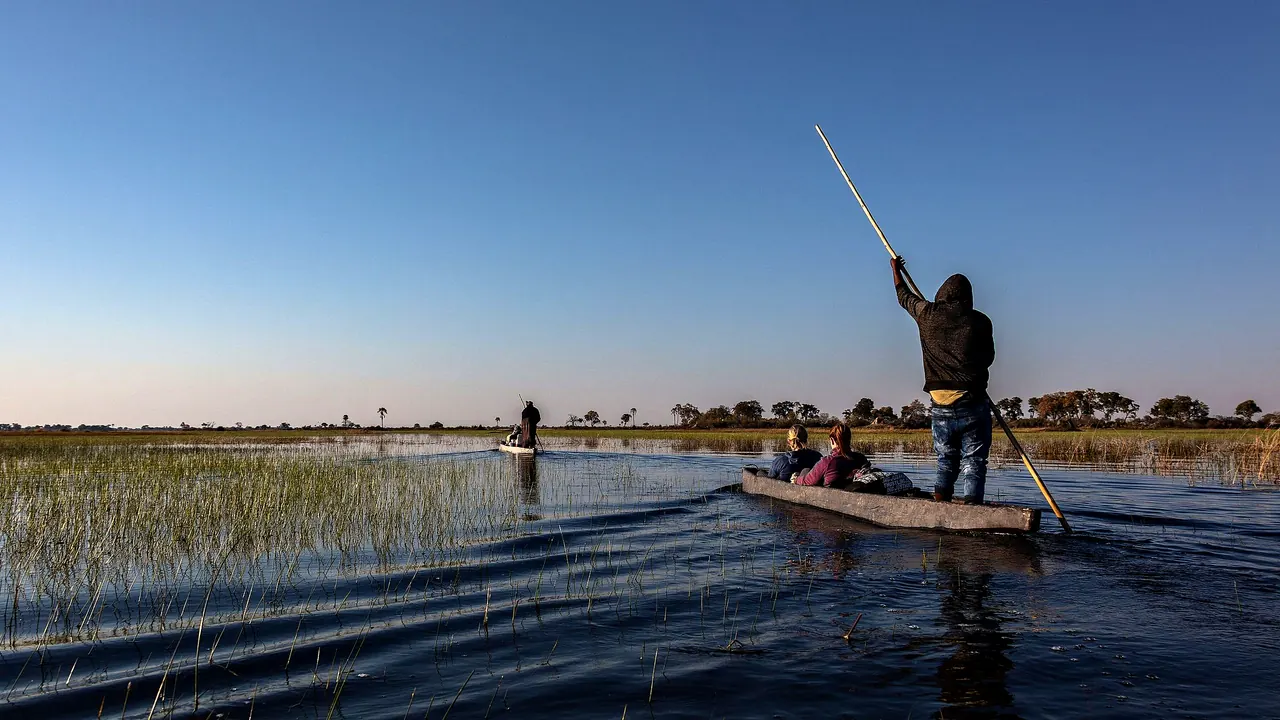
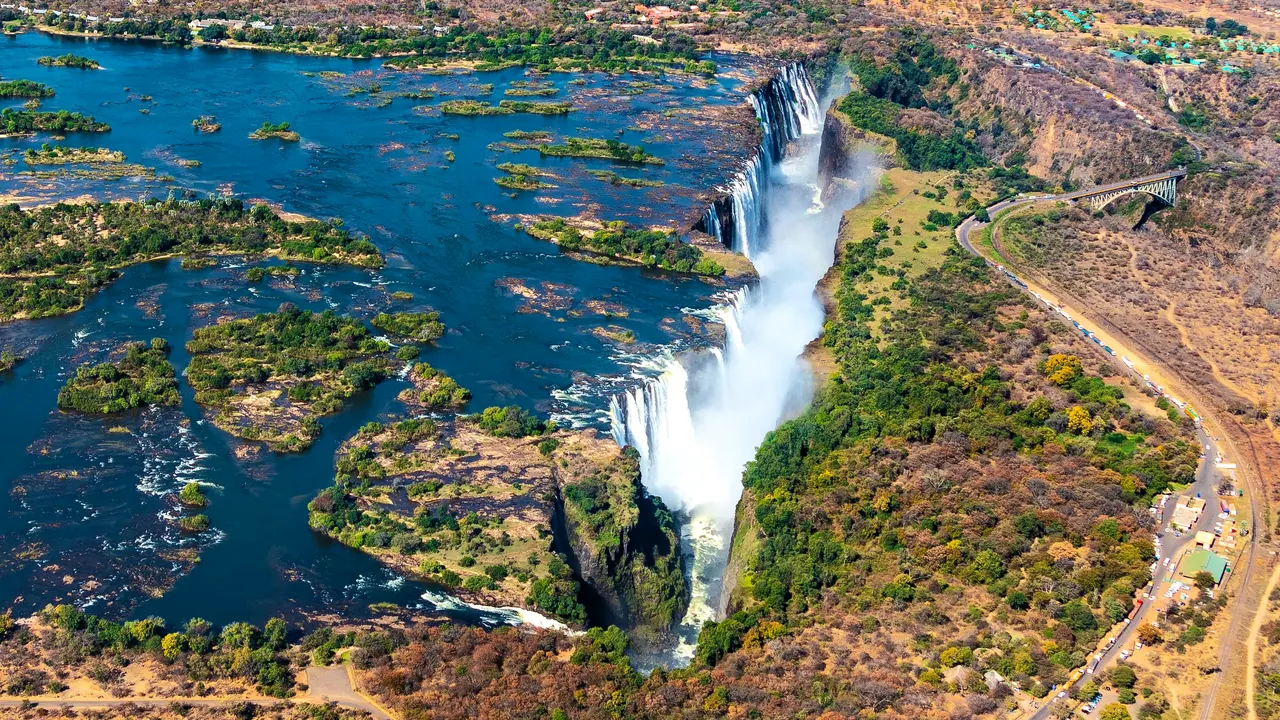
Photos: Okavango Delta by Diego Delso, CC BY-SA 4.0, cropped; Victoria Falls by Murray Foubister, CC BY-SA 2.0, cropped.
Okavango Delta or Victoria Falls?
Our verdict in twelve categories, each scored against the same fixed benchmark cities, and the climate month by month, so you can choose for your trip.
Choose Okavango Delta for
- nature and the outdoors
The Okavango Delta suits the traveller whose whole trip is the wildlife. You fly from camp to camp over a flooded maze of channels and palm islands, pole through the reeds in a mokoro, walk the islands with an armed guide and fall asleep to lions and hippos. It asks a lot in return. It is among the costliest trips in Africa, you cannot move about on your own, and there is nothing to do except be out in the landscape. For the people who choose it, that is exactly the point.
Choose Victoria Falls for
- getting around
- prices
- day trips
Victoria Falls works better for a shorter, more varied trip built around one tremendous sight. From a small town base you can reach the falls, the bridge, rafting in the Batoka Gorge, river cruises and game drives at the edge of town, with Livingstone across the border and Chobe close enough for a day. It is still expensive, but you can choose a guesthouse and one or two activities, and families with children of about eight and up will find it far easier to manage.
Scoreboard
Twelve categories on one fixed scale from 0 to 100. The shaded stretch is the gap between the two.
Your match
Pick a travel style or drag the sliders, and both match scores follow your weighting.
Wins on nature and the outdoors with your weighting.
Wins on getting around and prices with your weighting.
What matters to you?
Category by category
What the scores mean for a trip.
Beaches & swimming
Neither has a beach, and in both places the rivers belong to crocodiles and hippos, so swimming means a pool. In the delta that is usually a small plunge pool on a deck that looks out over the floodplain.
Victoria Falls has the one swim worth travelling for. At low water, guided groups from the Zambian side get into Devil's Pool and Angel's Pool, right on the lip of the drop. It is a short, supervised thrill, but the delta has nothing like it.
Food & drink
In both places you eat mostly where you sleep, and neither is a reason to travel. The delta's camps include meals in the package: early breakfasts, sundowners out in the bush and dinners by the fire. Back in Maun you might find seswaa, the pounded beef served with pap.
Victoria Falls gives a little more choice outside your lodge. There are big game-meat dinners of kudu and warthog with drumming, sadza with stews, and afternoon tea on the terrace of the Victoria Falls Hotel above the gorge. Neither place has street food or a café scene.
Culture & sights
Culture is thin in both, but it takes a different form in each. The delta's one heritage site of real weight is the Tsodilo Hills, with their San rock paintings. They lie far to the north-west and rarely fit into a safari, so in practice culture means what Bayei and Hambukushu guides tell you about life on the water.
Victoria Falls has colonial history rather than ancient art. There is the bridge of 1905, built for the Cape to Cairo railway, the Edwardian hotel and the Livingstone statues, and the Livingstone Museum is a short trip across the border.
Nightlife
Evenings in the delta end at the campfire. After dinner a guide walks you back to your tent because animals move through camp, and the only bars are back in Maun, where guides and pilots drink.
Victoria Falls stays up a little later. A sundowner on a river cruise starts the evening, then there are hotel bars and the backpacker lodges, where rafting crews and overland travellers sometimes keep going. There are no clubs, and with elephants in the streets after dark you take a taxi between bars.
Nature & outdoors
Both are among Africa's great natural sights, but they are very different experiences. The delta is a whole ecosystem, a seasonal flood spread across the Kalahari. You explore it for days by mokoro, on foot and by vehicle, among lions, wild dogs and red lechwe, in concessions that see few people.
Victoria Falls is one overwhelming spectacle: the Zambezi plunging into a basalt gorge, with plenty of action around it, from the Batoka rapids and the bridge bungee to flights over the spray. Its wildlife, in Zambezi National Park and nearby Chobe, adds to the falls rather than being the main event.
Day trips
Victoria Falls has two real outings within reach, and the delta cannot match that. In the delta you spend each day in the landscape and move on by light aircraft. The Makgadikgadi pans and Chobe are separate legs of a safari, not trips out from your camp.
From Victoria Falls, Livingstone is about 10km over the bridge in Zambia, with its colonial main street and Mukuni village, where you can learn about Leya chieftaincy, close by. Chobe's elephant herds, reached through the riverside town of Kasane, are about an hour and a half away by road.
Good for families
Victoria Falls is the easier choice for families. Its activities are short and varied, from the spray walk to river cruises past hippos. Lodge pools fill the hot afternoons, and the small town keeps things simple for children of about eight and up.
The delta suits teenagers who love animals, travelling in the dry season and staying at camps that welcome them. With younger children it is hard: the camps are unfenced, walks and mokoro trips have age limits, and transfers are by small plane with tight luggage limits. Both places carry a malaria risk.
Getting around
Victoria Falls gives you far more freedom. By day the falls entrance, the bridge and the main hotels are within walking distance, operators collect you from your lodge, and you can walk across the border into Zambia.
In the delta you go wherever the camp's plane, vehicle or boat takes you, always with a guide, because walking alone outside camp is unsafe. You can self-drive into Moremi, but only with a well-equipped 4x4 and real experience of deep sand and flooded crossings.
Shopping & style
In both places shopping comes down to crafts, but Victoria Falls has a real market. Its curio market sells Shona-style stone sculpture, carvings, baskets and beadwork. Bargaining is expected, and a few fixed-price galleries sell better pieces.
The delta has one outstanding craft, the palm-fibre baskets of the Ngamiland villages, which you buy in Maun before flying out. After that there are only camp curio shops.
Affordability
Neither is cheap, but the delta costs far more. Its camps charge some of the highest rates in African safari travel, and light-aircraft transfers add more on top. Even the self-drive camping route is costly once park fees and equipment are counted. Rates are lower in the green season, from November to March.
Victoria Falls can be done on a moderate budget if you stay in backpacker lodges, eat simply and choose one or two activities. The bill grows with every rafting trip, flight and game drive, and seeing the falls from both sides means paying two entrance fees.
Live music & performing arts
In the delta the music comes from the camp staff, who sing in close harmony in Setswana to greet arriving guests or after dinner, sometimes with a little dancing. It is brief and unplanned, and it is often the most moving part of the evening.
At Victoria Falls there are shows you can book, but all of them are put on for visitors: dance troupes and drummers at the big game-meat dinners, and marimba bands at some hotels. Neither place has a theatre or a concert venue.
Wellness & relaxation
Both offer rest rather than a bathing tradition, and spa treatments are found only at the better lodges. The delta gives the deeper quiet: tiny remote camps, no traffic, often no signal, and the hot middle of the day spent on a deck while elephants drink below. The early starts, though, keep you on a fixed schedule.
Victoria Falls has more spa choice, including treatment rooms on decks above the Zambezi that use marula oil. The town itself runs on adrenaline, traders and tour vehicles, so if you want rest, stay at a lodge upstream along the river.
When should you go?
Pick your month. The climate figures are measured averages, not a forecast.
Okavango Delta in July
Victoria Falls in July
Daytime high, °C
Rainfall in the month, mm
Temperature and rainfall are climate normals, averaged over the years shown. Okavango Delta: 1961-1990 (rainfall 1991-2020) normals, Maun (0.5 km from centre). Victoria Falls: 1991-2020 (sunshine 1981-2010) normals, Livingstone (13.1 km from centre).
Both follow the southern African pattern of a dry winter and a wet summer, and neither has a swimming season beyond a lodge pool. In the delta, May to September is almost rainless. June and July are the gentlest months, with highs around 25°C that make walks and open-vehicle drives comfortable, and this is also when the flood is at its highest and the animals gather. October is the hardest month, hot and dry before the rains, which build from November and are heaviest in January.
Victoria Falls has the same rhythm but a wetter summer, with about 154mm in January against the delta's 130mm. Its October reaches 35°C, which is too hot for much walking in the middle of the day. The dry winter is also its sunniest stretch, peaking at over 320 hours in August. The falls are fullest, and wettest underfoot, in the months after the rains, while late in the dry season the rock face shows and the views are clearer. May and June suit a trip that takes in both places: dry, warm days, the delta's flood rising and the falls still running high.
Which traveller are you?
For an outdoors trip where the animals are the point, choose the Okavango Delta. Plan several nights split between a water camp and a land camp, so you see the flood from the channels and on drives in Moremi. At Victoria Falls, wildlife is an extra.
On a family trip with children of primary-school age, Victoria Falls is the safer bet. You can keep the days short and mixed, with rest at the lodge in between, and add bigger outings as the children grow. Save the delta for when they are teenagers.
On a trip on a tight budget, go to Victoria Falls. The town's great sight costs only an entrance fee, and you can add other activities one at a time as the money allows. The delta has no truly cheap version and is better saved for another time.
Before you go
| Measure | Okavango Delta | Victoria Falls |
|---|---|---|
| Official language | English | English, Xhosa, Ndau, Venda, Chewa, Khoisan, Kalanga, Shona, Tonga, Tswana, Tsonga, Sesotho, Northern Ndebele, Nambya, Zimbabwe Sign Language, Barwe |
| Currency | Pula (BWP) | Zimbabwe Gold (ZWG) |
| Sockets | GM230 V, 50 Hz | G220 V, 50 Hz |
| Driving side | Left | Left |
| Time zone | UTC+2 | UTC+2 |
| Emergency number | 911 | 999 |
| Elevation | - | 961 m |
| Main airport | Maun International Airport (MUB)9 non-stop destinations | Victoria Falls International Airport (VFA)18 km from centre12 non-stop destinations |
| Public holidays this year | 11 days | 13 days |
By the numbers
| Measure | Okavango Delta | Victoria Falls |
|---|---|---|
| Population | - | 33,060 |
| Museums within 10 km | - | 2 |
| UNESCO World Heritage sites within 50 km | - | 1 |
Where else could you go?
Every comparison below shares a destination with this one, so you can follow Okavango Delta or Victoria Falls somewhere new.
- Livingstonevs Victoria Falls
- Johannesburgvs Victoria Falls
- Krugervs Okavango Delta
- Swakopmundvs Victoria Falls
- Cape Townvs Victoria Falls
- Arushavs Victoria Falls