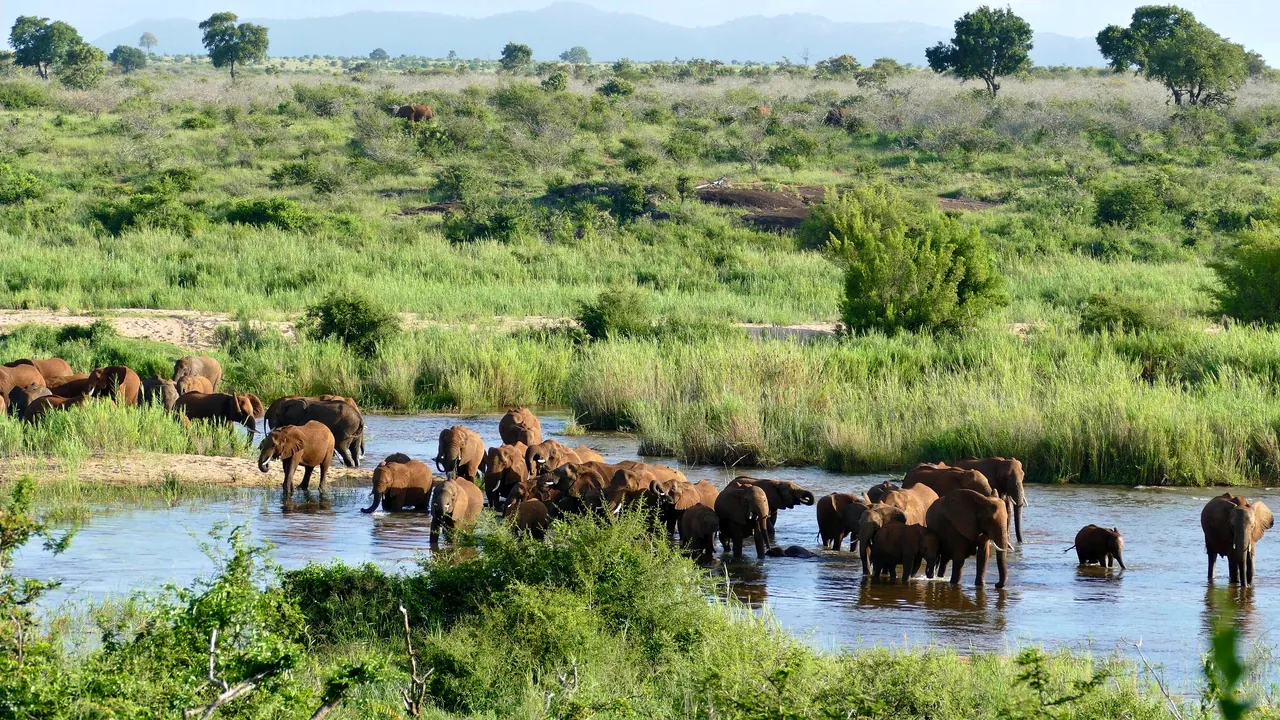
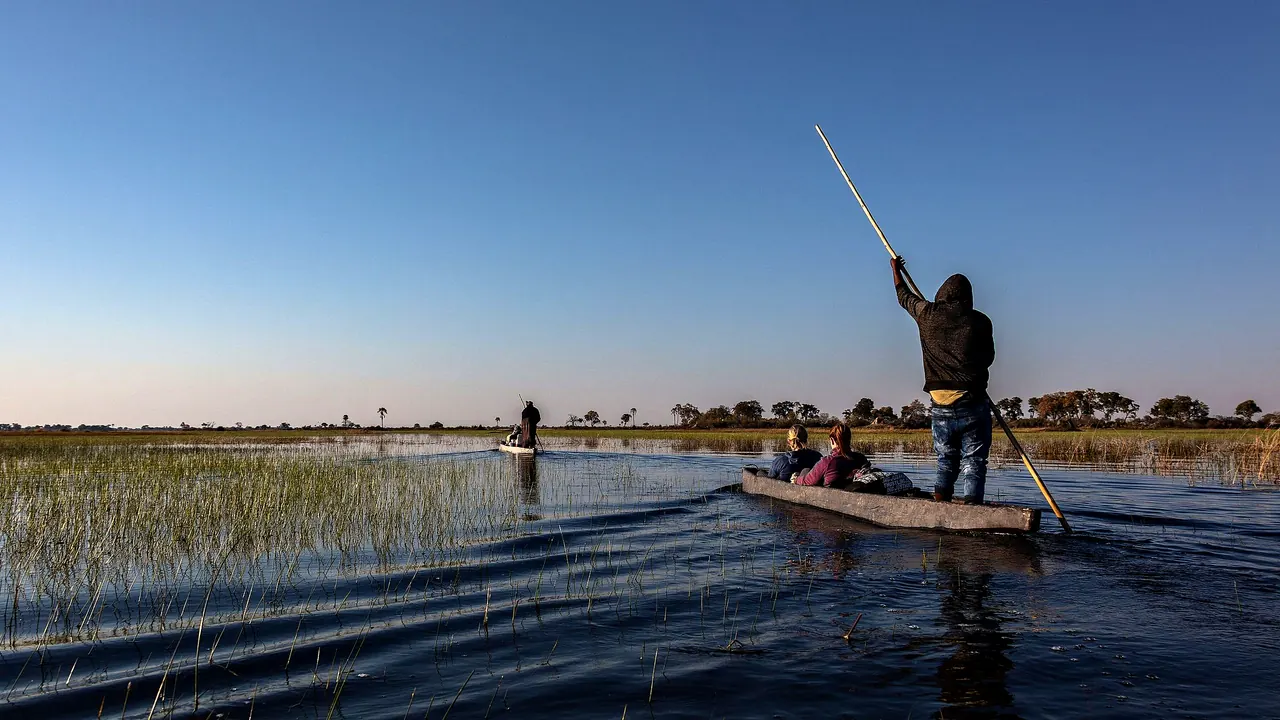
Photos: Kruger by Bernard DUPONT from FRANCE, CC BY-SA 2.0, cropped; Okavango Delta by Diego Delso, CC BY-SA 4.0, cropped.
Kruger or Okavango Delta?
Our verdict in twelve categories, each scored against the same fixed benchmark cities, and the climate month by month, so you can choose for your trip.
Choose Kruger for
- prices
- day trips
- getting around
Kruger suits travellers who want a first-rate safari on their own terms. You can hire a car, drive the park roads around Skukuza and Lower Sabie, sleep in national park rest camps and cook your own dinner at a braai for far less than a lodge costs, or spend heavily in Sabi Sand if you prefer. It is the easier choice for a first safari, for families with older children, and for anyone who wants the Blyde River Canyon and Pilgrim's Rest as a break from game drives.
Choose Okavango Delta for
- nightlife
- nature and the outdoors
The Okavango Delta is for people who can pay for remoteness and want wilderness without roads or other cars. You fly between small camps in private concessions, see the animals from a mokoro or on foot across palm islands, and everything is arranged for you. You lose independence and flexibility, it is very expensive, and it is harder with young children. For couples and seasoned safari-goers, though, it offers a wild, water-based safari that a park built around roads cannot match.
Scoreboard
Twelve categories on one fixed scale from 0 to 100. The shaded stretch is the gap between the two.
Your match
Pick a travel style or drag the sliders, and both match scores follow your weighting.
Wins on prices and day trips with your weighting.
Wins on nightlife and nature and the outdoors with your weighting.
What matters to you?
Category by category
What the scores mean for a trip.
Beaches & swimming
Neither has any sea or water you can swim in, because crocodiles and hippos live in the rivers and channels of both. Kruger's rest camps have proper pools set on open lawns, and you can add the Mozambique coast as a separate leg of the trip. In the delta, swimming means a small plunge pool on a deck above the floodplain, and landlocked Botswana has no coast within reach.
Food & drink
Food is secondary in both, but the way you eat is different. In Kruger's rest camps most visitors cook for themselves, grilling boerewors on the braai outside the bungalow, and farm stalls around White River and Hazyview sell macadamias and avocados. In the delta nearly every meal is included in the camp stay: brunch after the drive, sundowners in the bush and dinner by the fire, with Maun's few grill restaurants and a chance to try seswaa as the only alternatives.
Culture & sights
Kruger has more to fill a break between drives. In the far north of the park there is Thulamela, an Iron Age stone citadel, and Masorini, a reconstructed iron-smelting site. Skukuza has a small museum, and the gold-rush town of Pilgrim's Rest on the escarpment survives almost whole. All of them fit easily into a self-drive route.
The delta has one site of real weight, the San rock paintings of the Tsodilo Hills. They lie far off near the panhandle and need a long drive or a charter flight. Otherwise, culture there means hearing from Bayei and Hambukushu guides how people have fished and poled the waterways.
Nightlife
Both are early-to-bed places where the evening ends with a drink by the fire. What differs is what comes after. Kruger offers guided night drives with spotlights to look for leopards and hyenas. In a delta camp you are walked to your tent after dark and fall asleep to hippos. Maun's few bars, where guides and pilots gather, are no livelier than the pubs of the Lowveld towns.
Nature & outdoors
Both are among the finest wildlife areas in Africa, and the difference is in how you see the animals. Kruger is a park about 350km long with tarred and gravel roads. You can drive yourself, join ranger drives or walk the bush, and the densest game is in the south around Lower Sabie. The unfenced Sabi Sand and Timbavati reserves add private lodge drives, and the Blyde River Canyon and the waterfalls of the escarpment add hiking.
The Okavango is a landscape of water: channels, lagoons and palm islands, fed by a flood that peaks in the dry winter. You glide in a mokoro, walk islands with a guide, take boats in the panhandle or fly over the floodplain. The private concessions get so few visitors that they feel more remote than Kruger's busier south.
Day trips
From Kruger you can take a real day out of the park. The Panorama Route links the canyon viewpoints with Graskop, Sabie and Pilgrim's Rest, and Hoedspruit has wildlife rehabilitation centres. The delta has nothing like it. Maun is the only town, and the salt pans and Chobe are separate safari legs reached by plane, so you spend each day in the country around your camp.
Good for families
Kruger is the more practical choice with children. South African families drive themselves here and stay at rest camps such as Skukuza, Berg-en-Dal and Lower Sabie, which have pools and lawns. The malaria risk is lower in the dry winter, though many private lodges turn away young children.
In the delta the obstacles add up. The camps are unfenced and animals walk through them, there are minimum ages for mokoro and walking outings, there is malaria, and the small planes have tight luggage limits. It works best with teenagers, at camps known for welcoming them.
Getting around
Kruger can be done independently. You can drive from Johannesburg on good highways or fly into Mbombela, Hoedspruit, Phalaborwa or Skukuza, then use an ordinary car on the park roads. The catch is the size of the park: low speed limits and gate times mean you explore one section at a time.
In the delta you hand over control. Light aircraft carry you from Maun to grass airstrips, and from there the camp's guides take you everywhere by vehicle, boat or mokoro. Driving yourself into Moremi needs a well-equipped 4x4 and experience on deep sand, and many tracks become impassable at high water.
Shopping & style
Neither is a place to shop, and what each offers is souvenirs. The delta has one standout craft, the palm-fibre baskets woven in Ngamiland villages and sold in Maun. Kruger adds roadside carvings and fabrics along the Panorama Route, and Mbombela has malls where self-drivers can stock up on practical supplies.
Affordability
This is where the two differ most. Kruger can be done cheaply if you drive yourself, sleep in national park rest camps or guesthouses around Hazyview and Malelane, and cook with inexpensive groceries. Car hire and the daily conservation fee for international visitors are the main extra costs. The all-inclusive lodges in Sabi Sand, Timbavati and the other private reserves along the park boundary are the exception, and they rank among the most expensive stays in Africa.
The delta has no cheap version. Botswana's model of few visitors paying a lot means all-inclusive camps, with light-aircraft transfers on top. The green season from November to March brings lower rates, and even self-drive camping in Moremi adds up once fees and equipment are counted.
Live music & performing arts
Neither has a theatre or concert stage, and in both places live performance means song and dance at your camp or lodge. In Kruger some lodges and cultural villages put on Shangaan song and dance for guests. In the delta the camp staff sing in close harmony in Setswana, often to welcome you, and it feels more informal and spontaneous.
Wellness & relaxation
Kruger offers more pampering between drives. The private lodges in Sabi Sand and the nearby reserves have proper spas, often with open-sided treatment rooms looking over a dry riverbed. The delta has massage at some upmarket lodges and little else, but its small camps are deeply quiet, with no traffic and often no phone signal. In both places the dawn wake-up for the morning drive means the stay rests your mind but leaves no room for lie-ins.
When should you go?
Pick your month. The climate figures are measured averages, not a forecast.
Kruger in July
Okavango Delta in July
Daytime high, °C
Rainfall in the month, mm
Temperature and rainfall are climate normals, averaged over the years shown. Kruger: 1991-2020 (rainfall 1981-2010) normals, Skukuza (1.6 km from centre). Okavango Delta: 1961-1990 (rainfall 1991-2020) normals, Maun (0.5 km from centre).
Both are hot places where the rain falls in summer, and both are at their best in the dry southern winter. In Kruger the rain comes mostly from November to March and reaches about 100mm a month in December and January. From May to September it is almost dry, with warm, comfortable days that suit long hours in an open vehicle. Summer days reach around 33°C, which is manageable if you rest by the pool at midday.
The delta's seasons are sharper. June to August bring almost no rain and the coolest days, about 25°C. September and October stay dry but heat up quickly, and October and November are the hottest months at around 34°C before the storms arrive. January is the wettest month, at about 130mm. The delta's best window is May to September. Kruger's spring is gentler, so it stays pleasant a little longer into October.
Which traveller are you?
On a tight budget, Kruger is the only realistic choice. If you self-drive, stay in national park rest camps and cook for yourself, you see the same lions and leopards. In the delta, even camping in Moremi gets costly once fees and a 4x4 are added.
On a family trip with children, Kruger is much easier. The large rest camps such as Berg-en-Dal have pools, lawns and family bungalows, and with a car you set your own pace. Delta camps are unfenced, many set minimum ages, and you need light-aircraft transfers.
For an outdoors trip, both offer world-class wildlife, but the Okavango Delta gives the wilder version. You pole a mokoro through papyrus channels, walk islands with an armed guide and see few other vehicles in the concessions. Kruger answers with self-drive freedom and hiking on the escarpment.
Before you go
| Measure | Kruger | Okavango Delta |
|---|---|---|
| Official language | English, Zulu, Xhosa, Afrikaans, Venda, Northern Sotho, Swazi, Tswana, Tsonga, Sesotho, Southern Ndebele, South African Sign Language | English |
| Currency | Rand (ZAR) | Pula (BWP) |
| Sockets | CMN230 V, 50 Hz | GM230 V, 50 Hz |
| Driving side | Left | Left |
| Time zone | UTC+2 | UTC+2 |
| Emergency number | 112 | 911 |
| Main airport | Kruger Mpumalanga International Airport (MQP)8 non-stop destinations | Maun International Airport (MUB)9 non-stop destinations |
| Public holidays this year | 13 days | 11 days |
Where else could you go?
Every comparison below shares a destination with this one, so you can follow Kruger or Okavango Delta somewhere new.
- Victoria Fallsvs Okavango Delta
- Garden Routevs Kruger
- Cape Townvs Kruger
- Serengetivs Okavango Delta
- Masai Maravs Okavango Delta
- Serengetivs Kruger