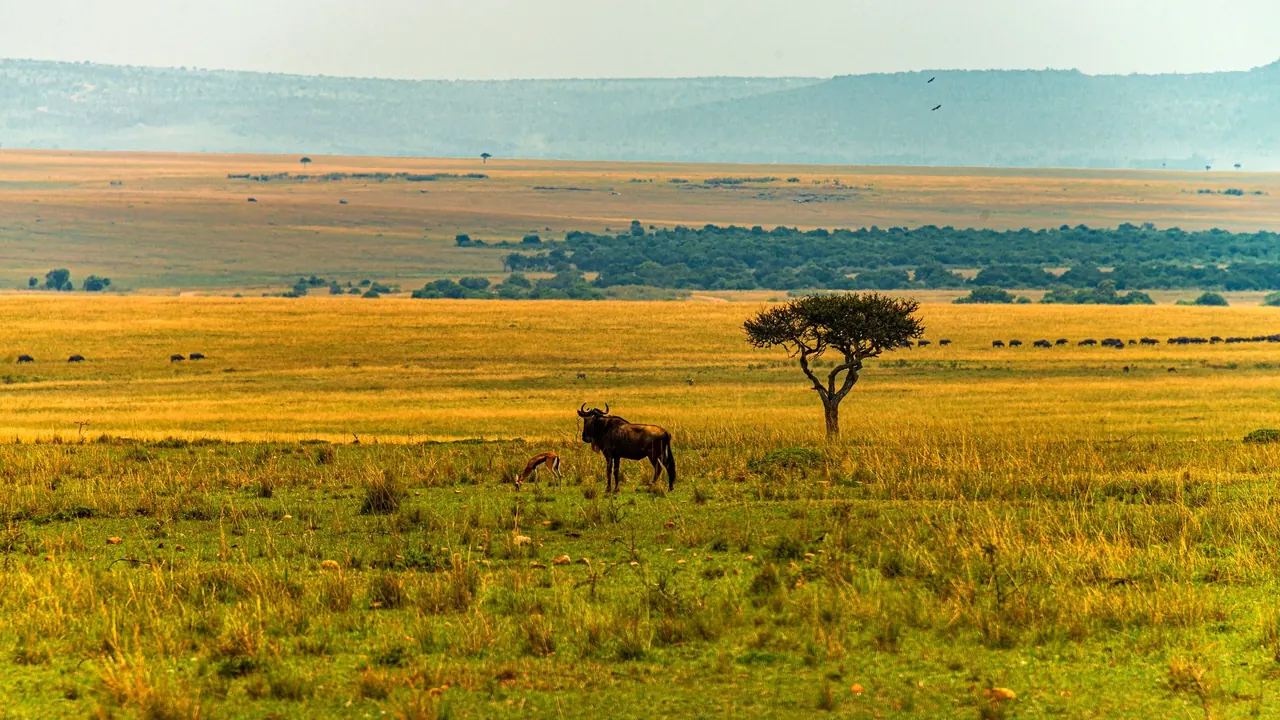
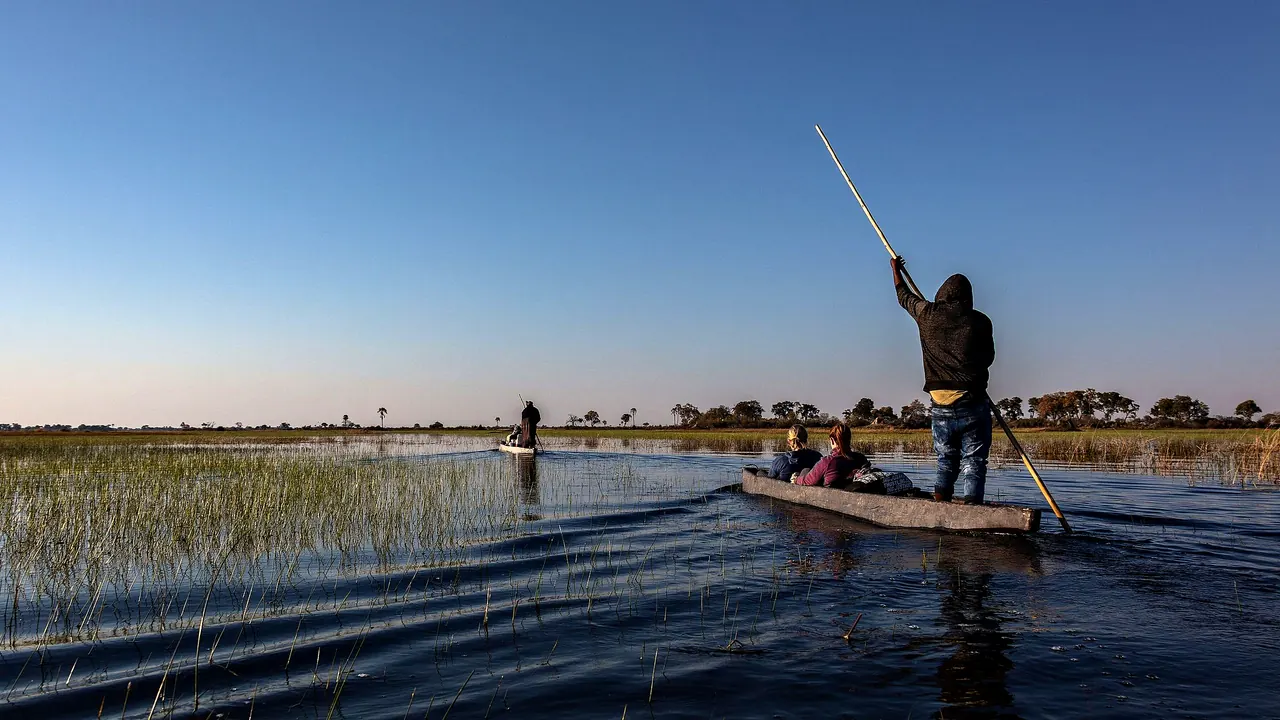
Photos: Masai Mara by Daniel Case, CC BY-SA 4.0, cropped; Okavango Delta by Diego Delso, CC BY-SA 4.0, cropped.
Masai Mara or Okavango Delta?
Our verdict in twelve categories, each scored against the same fixed benchmark cities, and the climate month by month, so you can choose for your trip.
Choose Masai Mara for
- families
- prices
- getting around
The Masai Mara suits a first safari, a family with children of about eight and over, or anyone who most wants big cats on open grassland and the river crossings of the migration. It is a little easier to reach, since a road from Nairobi is possible as well as a short flight. It is far from cheap, but it costs clearly less than the delta, and the Maasai conservancies around the reserve add a human side to the stay.
Choose Okavango Delta for
- nature and the outdoors
- food and drink
- day trips
Choose the Okavango Delta if the budget can stretch and you want wilderness at its most remote. Here water shapes the experience: poling a mokoro through papyrus channels, walking across palm islands with an armed guide, and watching elephants drink below a camp deck in the dry winter. It rewards adults and teenagers who value very few other visitors and are happy to fly from camp to camp.
Scoreboard
Twelve categories on one fixed scale from 0 to 100. The shaded stretch is the gap between the two.
Your match
Pick a travel style or drag the sliders, and both match scores follow your weighting.
Too close to call, 2 points apart
Wins on families and prices with your weighting.
Wins on nature and the outdoors and food and drink with your weighting.
What matters to you?
Category by category
What the scores mean for a trip.
Beaches & swimming
Neither place has anywhere to swim. The rivers of both hold crocodiles and hippos, and the only water you can get into is a camp pool. In the Mara some tented camps have no pool at all, but Kenya's Indian Ocean coast makes an easy second leg for anyone who wants sand afterwards. The delta lies in landlocked Botswana, so its plunge pools, often on a deck facing the floodplain, are the only swimming there is, with no coast to add.
Food & drink
Food is much the same in both: full board in camp, with the setting more memorable than the cooking. The Mara adds Kenyan touches such as ugali, chapati and sukuma wiki greens, and its signature meal is a picnic breakfast on the plains after the morning drive. The delta's lodges lean towards South African wine and generous brunches. Maun also gives you a short chance to eat out at a few grills and to try seswaa, which the Mara's gate towns cannot really match.
Culture & sights
Both are about wildlife rather than heritage, but they offer people and history in different ways. In the Mara, Maasai culture is part of the stay itself: the Maasai own most of the border conservancies, and a manyatta visit is easy to arrange. The best visits go through conservancy camps, because some others feel staged.
The delta's one major heritage site, the San rock paintings of the Tsodilo Hills, is a long journey from the main safari areas, so few visitors get there. In practice, culture in the delta means time with Bayei and Hambukushu guides, learning how people have fished and poled through the delta.
Nightlife
Evenings are the same in both: a drink by the fire, dinner, and an escort to your tent because animals walk through the camps. The only difference is that Maun has a few bars where guides and pilots meet, which gives you one evening out before or after the delta. The Mara's gate towns offer nothing of the kind.
Nature & outdoors
These are two of the finest wildlife areas anywhere, and the difference is in the landscape. The Mara is open, rolling grassland below the Oloololo Escarpment, where lion, leopard and cheetah are seen unusually reliably. From about July to October, the wildebeest crossings of the Mara River are the great spectacle. Game drives are the main way to see it, with balloon flights at dawn, and walks and night drives in conservancies such as Naboisho.
The delta is a maze of floodwater, with channels, lagoons and palm islands. Its peak comes from June to August, when the flood is highest and the animals gather around it. You see more of it from water and on foot: by mokoro, by motorboat in the panhandle, and on guided island walks. Wild dogs, red lechwe and the birdlife give it a different cast of animals.
Day trips
Neither works as a base for outings. Around the Mara there are only Narok and the trading centres at the gates, and the Rift Valley lakes and the Serengeti belong to separate legs of a trip. In the delta, the next places of interest are the Makgadikgadi salt pans and the Chobe riverfront, which are further wilderness reached by light aircraft. In practice, the delta lends itself to a multi-camp circuit, while a Mara stay usually stays put.
Good for families
The Mara is clearly the better place for children. Several camps cater to families with connecting tents, private vehicles that can turn back when a child tires, and tracking and bead-making with Maasai guides. It works from about the age of eight.
The delta is harder. Camps often set minimum ages for mokoro trips and walks, or for staying at all, and light-aircraft transfers come with strict luggage limits. Few camps run activities for children, so it suits teenagers who already love animals. Both areas carry a malaria risk.
Getting around
The Mara is the easier of the two to reach. A light aircraft from Nairobi's Wilson Airport takes under an hour, and if you are willing to spend most of a day on rough roads, you can also go by road. Once there, distances in the reserve are large, and a river crossing can mean hours on bumpy tracks.
The delta depends almost entirely on small planes, first from Maun and then between camps, with boats and mokoros for moving around once you arrive. Self-driving into Moremi is only for experienced 4x4 drivers, and high water closes many tracks.
Shopping & style
There is little to buy in either, but each has one craft worth taking home. In the Mara it is Maasai beadwork, often sold by the women who made it at village visits and roadside stalls by the gates. In the delta it is the palm-fibre baskets of the Ngamiland villages, among the finest in southern Africa. You buy them in Maun on the way in or out, because the camps only have curio shops.
Affordability
Both are expensive, but the Mara is noticeably easier on the wallet. Its costs come from daily reserve or conservancy fees and full-board camps. Rates rise in the migration months and fall in the green seasons, and group camping safaris by road from Nairobi give a genuine lower-cost route in.
The delta is among the costliest safari destinations in Africa, because Botswana has long chosen few visitors paying high rates, and the light-aircraft transfers add a good deal more. Rates fall from November to March, but even self-drive camping is expensive once park fees and equipment are counted.
Live music & performing arts
Neither has a stage, and what you hear is part of camp or village life. In the Mara it is the adumu, the Maasai leaping dance with chanting, shown on village visits and sometimes after dinner. In the delta it is camp staff singing in close harmony in Setswana, a quieter and more personal moment. Neither is something to plan a trip around.
Wellness & relaxation
Both give you deep quiet rather than pampering. Each has massage rooms only at the pricier lodges, no bathing tradition, and days framed by early drives. The Mara's long midday rest is on a tent veranda above the grassland. Many visitors finish with a few days on the Kenyan coast.
The delta has its own gentle pace on the water: a mokoro glides almost silently through the reeds, and the camps are very small. Its fixed daily schedule and the hot months before the rains make it less lazy than it looks.
When should you go?
Pick your month. The climate figures are measured averages, not a forecast.
Masai Mara in July
Okavango Delta in July
Daytime high, °C
Rainfall in the month, mm
Where the figures come from
Masai Mara has no weather station within reach, so its figures come from a gridded climate model rather than a measured record, and read a broad area rather than one spot.
Temperature and rainfall are climate normals, averaged over the years shown. Masai Mara: 2001-2020 normals, NASA POWER reanalysis grid, no weather station within 90 km. Okavango Delta: 1961-1990 (rainfall 1991-2020) normals, Maun (0.5 km from centre).
The Mara sits near the equator at altitude, so days stay warm and even all year, with highs between about 25°C and 29°C. Rain decides the timing. The long rains run from March to May, and April is the wettest month at around 173mm. The short rains return in November and December. June to October is the dry stretch, with July the driest, and it lines up with the migration months, when the tracks are at their firmest.
The delta changes much more through the year. Its winter, from May to September, is almost completely dry and pleasant by day, about 25°C in June, which makes it the most comfortable time for walks and mokoro outings. The heat builds from September and peaks at around 34°C in October and November. Then come the summer rains from November to March, wettest in January. In July and August both are dry. In October the Mara is the milder of the two, and from March to May the delta is drying out while the Mara has its heaviest rain.
Which traveller are you?
On a family trip with children, the Masai Mara is the easier choice. More camps take families, offering connecting tents, private vehicles and junior ranger activities with Maasai guides. In the delta, minimum ages, unfenced camps and small aircraft with tight luggage limits make it a better fit for teenagers.
For a trip on a tight budget, neither is cheap, but the Mara is the realistic option. Group camping safaris by road from Nairobi and lower green-season rates bring it within reach. The delta's budget route, self-drive camping in Moremi, still costs a lot and calls for real 4x4 experience.
On an outdoors trip, both are world-class, and the choice depends on the kind of wildlife experience you want. The Mara means big cats on open plains, balloon flights and the migration crossings. The delta adds water and foot: mokoro trips, island walks, boat trips and wild dogs.
Before you go
| Measure | Masai Mara | Okavango Delta |
|---|---|---|
| Official language | English, Swahili | English |
| Currency | Kenyan Shilling (KES) | Pula (BWP) |
| Sockets | G240 V, 50 Hz | GM230 V, 50 Hz |
| Driving side | Left | Left |
| Time zone | UTC+3 | UTC+2 |
| Emergency number | Police 112/999, ambulance 112/999, fire 112/999 | 911 |
| Main airport | Jomo Kenyatta International Airport (NBO)60 non-stop destinations | Maun International Airport (MUB)9 non-stop destinations |
| Public holidays this year | 10 days | 11 days |
Where else could you go?
Every comparison below shares a destination with this one, so you can follow Masai Mara or Okavango Delta somewhere new.
- Serengetivs Masai Mara
- Victoria Fallsvs Okavango Delta
- Krugervs Okavango Delta
- Serengetivs Okavango Delta
- Krugervs Masai Mara