Photos: Okavango Delta by Diego Delso, CC BY-SA 4.0, cropped; Serengeti by DipaliLath, CC BY-SA 4.0, cropped.
Okavango Delta or Serengeti?
Our verdict in twelve categories, each scored against the same fixed benchmark cities, and the climate month by month, so you can choose for your trip.
Choose Okavango Delta for
- food and drink
- wellness
- culture and sights
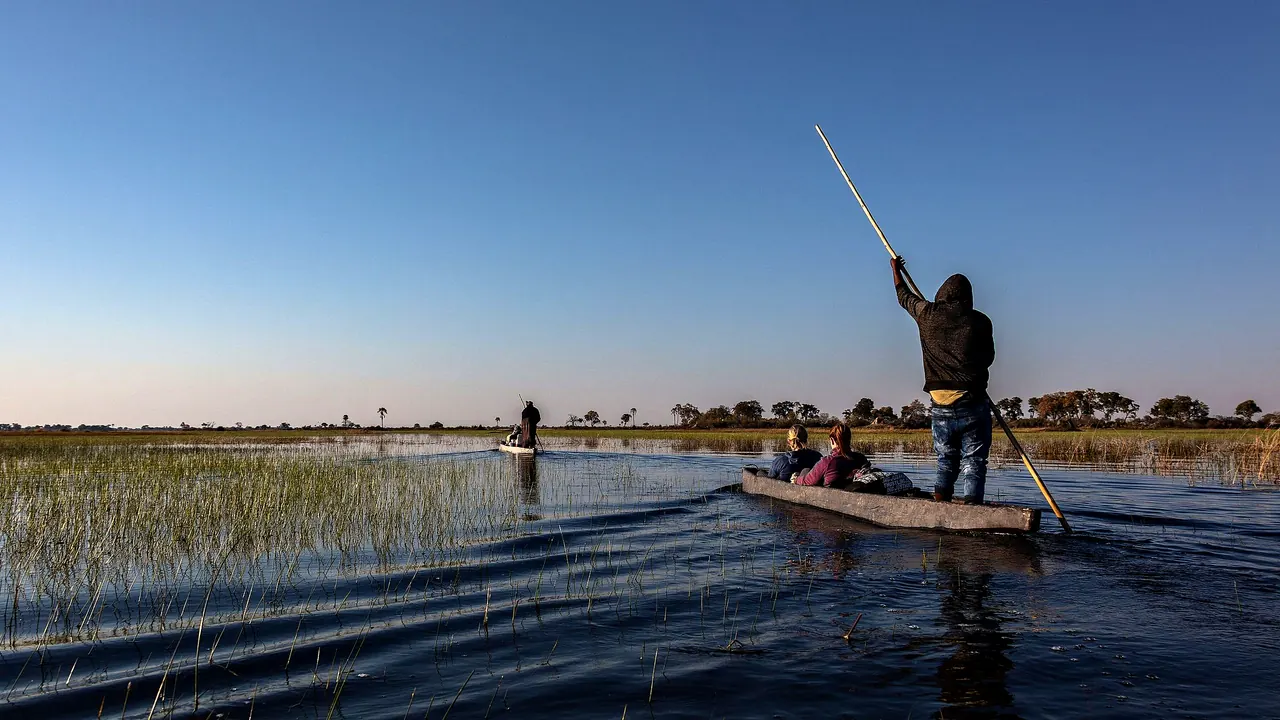
The Okavango Delta suits travellers who want a safari on water and in silence. You fly between small, remote camps, glide through papyrus channels in a mokoro, walk across palm islands with an armed guide and spend the hot middle of the day on a deck above the floodplain. The camp cooking is a notch more careful, and the whole trip leaves you more rested. It is best for couples and adults, or families with teenagers, who want wilderness with very few other people in it.
Choose Serengeti for
- day trips
- families
- prices
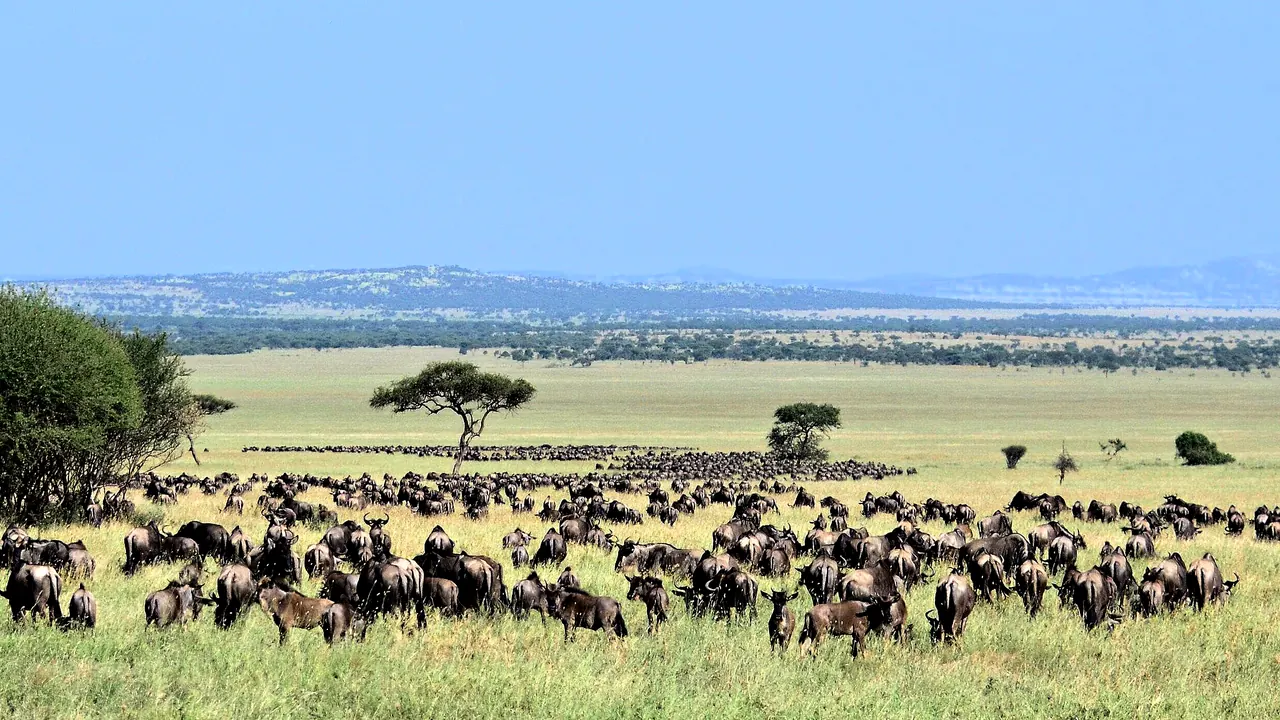
Choose the Serengeti if the great migration and big cats on open plains are the point. Herds of wildebeest calve in the south, cross rivers in the north and draw lions and cheetahs after them, and you follow it all by vehicle, with a dawn balloon flight if you like. There is also a little more to see beyond the park, such as Olduvai Gorge and Maasai homesteads, and it works slightly better for families with children of about eight and up. It also sits naturally before a few days on Zanzibar or the coast.
Scoreboard
Twelve categories on one fixed scale from 0 to 100. The shaded stretch is the gap between the two.
Your match
Pick a travel style or drag the sliders, and both match scores follow your weighting.
Too close to call, 1 point apart
Wins on food and drink and wellness with your weighting.
Wins on day trips and families with your weighting.
What matters to you?
Category by category
What the scores mean for a trip.
Beaches & swimming
Neither has anywhere to swim beyond a pool. The delta is deep in landlocked Botswana and its lagoons hold crocodiles and hippos, so you cool off in a camp plunge pool facing the floodplain.
The Serengeti has the same lodge pools, and Lake Victoria to the west is off limits because of freshwater parasites. What it does have is an easy beach add-on: many visitors fly on to Zanzibar or the Indian Ocean coast once the safari is over.
Food & drink
Both feed you in camp, but the delta does it better. The good lodges there cook carefully and generously, with brunch after the morning drive, sundowners in the bush and South African wines at dinner. Maun also has a few cafés and grills, where you can try seswaa, pounded beef with pap.
Serengeti camps tend to serve set menus or buffets of international dishes with pilau or ugali on the side, and breakfast is often a packed box eaten in the vehicle. To eat Tanzanian food properly, you have to wait for Arusha or the coast.
Culture & sights
Culture is thin in both, and each has one modest draw. In the delta it is the Tsodilo Hills, with thousands of San rock paintings, but they are so far out in the north-west that most visitors skip them, so culture usually means talking with Bayei and Hambukushu guides about life on the water. In the Serengeti it is the faded Maasai paintings and the gong rock at the Moru Kopjes, plus the visitor centre at Seronera, and both are easy to fit around a game drive.
Nightlife
Evenings are much the same in both: a drink by the fire, dinner and bed, because drives leave at dawn. In the delta, staff walk you to your tent after dark, and Maun has a few bars where pilots and guides drink. Inside the Serengeti there is not even that, only lions calling under a very dark, starry sky.
Nature & outdoors
These are two of the finest wildlife areas on earth, and the difference is water against grass. The delta is a flooded maze of lagoons, reed channels and palm islands, explored by mokoro, on foot, by motorboat and from the air. Its private concessions keep visitor numbers very low, and the flood is highest from June to August, when animals crowd onto the islands.
The Serengeti is open plains, kopjes and acacia woodland, crossed by more than a million migrating wildebeest. Most viewing is by vehicle, with dawn balloon flights. The Seronera valley is famous for big cats, and you pick where to stay by where the herds are in the month you travel.
Day trips
Neither is a base for outings, but the Serengeti has a little more within reach. From its southern edge you can visit Olduvai Gorge and its site museum, call at Maasai villages near the boundary, or make a long drive west to the shores of Lake Victoria.
In the delta, the places beyond camp, such as the Makgadikgadi pans or Chobe, are separate safari legs rather than outings. Days are spent in the landscape itself, and you move on by light aircraft.
Good for families
Both are hard with young children: camps are unfenced, malaria precautions are needed and many lodges set minimum ages. The Serengeti copes a little better, with junior ranger activities and private vehicles at some lodges, and it suits children from about eight.
The delta is really for teenagers who already love animals. Light-aircraft transfers come with tight luggage limits, and mokoro and walking outings often carry age limits, so families should choose camps known for welcoming children.
Getting around
You cannot move around on your own in either, and the difference is air against road. In the delta almost everyone flies from Maun to grass airstrips beside each camp, then goes out by guided vehicle, boat or mokoro. Self-driving in Moremi needs a serious 4x4 and experience on deep sand.
In the Serengeti, the classic approach is a full day by road from Arusha through the Ngorongoro highlands, followed by long drives on corrugated tracks. Flights to Seronera, Kogatende or Ndutu save hours, but the park is so big that most people stick to one or two areas.
Shopping & style
Shopping is minimal in both, and each has one craft worth buying. In the delta it is the fine palm-fibre baskets of Ngamiland villages, sold in Maun, and there is nowhere to buy anything once you fly out to camp. In the Serengeti it is Maasai beadwork and blankets at villages and roadside stops, though Arusha is the place for Tanzanian textiles and tanzanite.
Affordability
Both are among the costliest safaris anywhere, though the costs are built differently. In the delta you pay all-inclusive camp rates with some of the highest nightly prices in Africa, plus light-aircraft transfers, and self-drive camping in Moremi is the only cheaper route, which needs real experience.
In the Serengeti the cost comes from per-person daily park fees, a guided vehicle and remote lodges. Simple camping safaris at public campsites make it a little easier to get in for less. In both places the green season brings lower lodge rates.
Live music & performing arts
Neither has a stage or a concert of any kind, only music from the people around you. In the delta it is camp staff singing in close Setswana harmony to welcome guests or after dinner. In the Serengeti it is Maasai song and the jumping dance, at some lodges or on a village visit.
Wellness & relaxation
The delta is the more restful trip. Its camps are small and often have no phone signal, and the long hot middle of the day is spent on a deck above the floodplain while elephants come to drink. A few upmarket lodges have massage rooms.
The Serengeti has the same midday break by the pool, but the hours on rough tracks wear you out. Many visitors who want real rest go to the coast afterwards. Neither place has a spa or bathing tradition to speak of.
When should you go?
Pick your month. The climate figures are measured averages, not a forecast.
Okavango Delta in July
Serengeti in July
Daytime high, °C
Rainfall in the month, mm
Where the figures come from
Serengeti has no weather station within reach, so its figures come from a gridded climate model rather than a measured record, and read a broad area rather than one spot.
Temperature and rainfall are climate normals, averaged over the years shown. Okavango Delta: 1961-1990 (rainfall 1991-2020) normals, Maun (0.5 km from centre). Serengeti: 2001-2020 normals, NASA POWER reanalysis grid, no weather station within 90 km.
In the Okavango Delta the dry season runs from May to September, and June to August get no rain at all. June and July are the coolest months, with highs around 25°C, and the most comfortable for long days out in the open. May and August are a little warmer. From September the heat builds sharply, reaching about 34°C in October and November. The rains start in November and bring afternoon storms through to March, with the wettest weather in January, at about 130mm.
The Serengeti stays mild all year, with highs in the mid to high 20s, so heat is rarely a problem and rain shapes the calendar. It is wet from November to January and again in March and April, at around 142mm a month, and February is only a short, partly dry break between the two. June to September is the dry window in both places. In September the delta is already turning hot, but the Serengeti stays comfortable for being out all day.
Which traveller are you?
On a family trip with children, the Serengeti is the slightly easier choice. Some lodges run junior ranger activities and lend private vehicles so families can set their own pace, and it suits children from about eight. The delta's unfenced fly-in camps and strict luggage limits work best with teenagers.
For a relaxing and wellness trip, the Okavango Delta restores you more. Camps are tiny, there is often no phone signal, and midday means resting on a deck while elephants drink below. Long, bumpy Serengeti drives leave fewer truly quiet hours in the day.
On an outdoors trip, both are world-class wildlife country, and the real choice is between kinds of landscape. The delta means poling a mokoro through lagoons, walking with a guide and taking boats in the panhandle. The Serengeti offers the migration, river crossings and balloon flights over open grassland.
Before you go
| Measure | Okavango Delta | Serengeti |
|---|---|---|
| Official language | English | English, Swahili |
| Currency | Pula (BWP) | Tanzanian Shilling (TZS) |
| Sockets | GM230 V, 50 Hz | G230 V, 50 Hz |
| Driving side | Left | Left |
| Time zone | UTC+2 | UTC+3 |
| Emergency number | 911 | Police 112, ambulance 115, fire 114 |
| Main airport | Maun International Airport (MUB)9 non-stop destinations | Kilimanjaro International Airport (JRO)14 non-stop destinations |
| Public holidays this year | 11 days | 13 days |
Where else could you go?
Every comparison below shares a destination with this one, so you can follow Okavango Delta or Serengeti somewhere new.
- Masai Maravs Serengeti
- Victoria Fallsvs Okavango Delta
- Zanzibarvs Serengeti
- Krugervs Okavango Delta
- Masai Maravs Okavango Delta
- Krugervs Serengeti