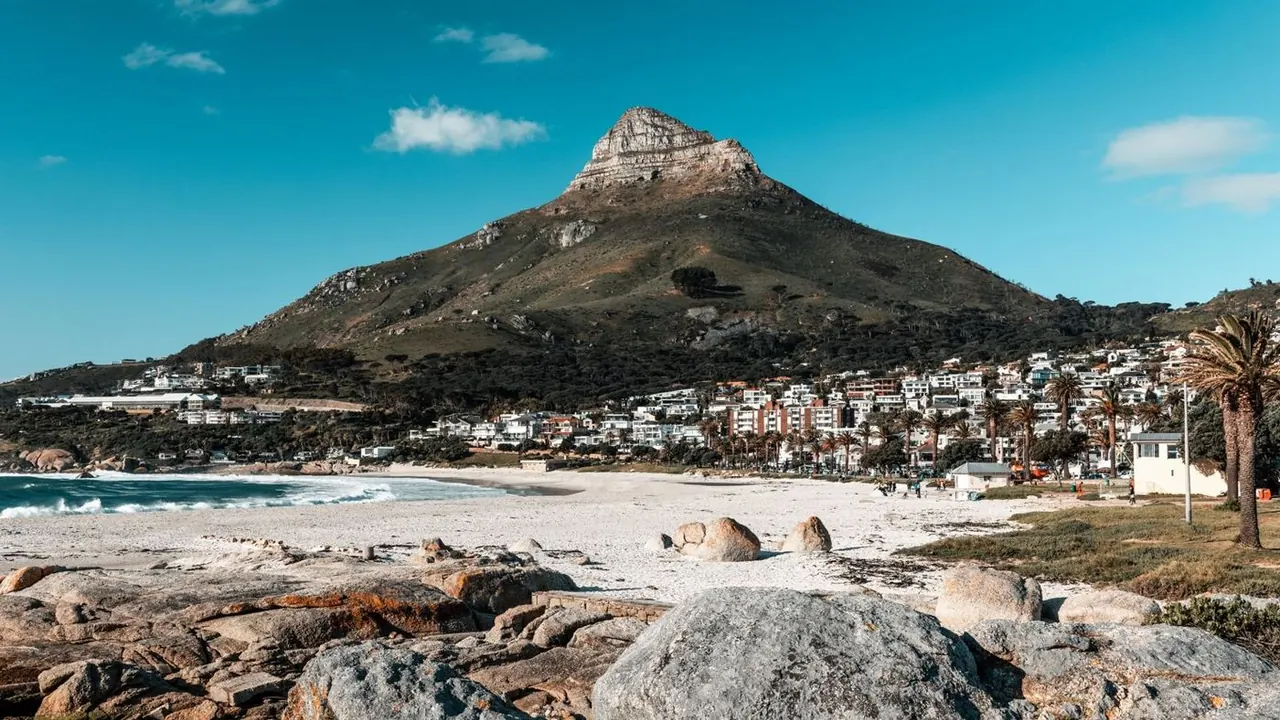
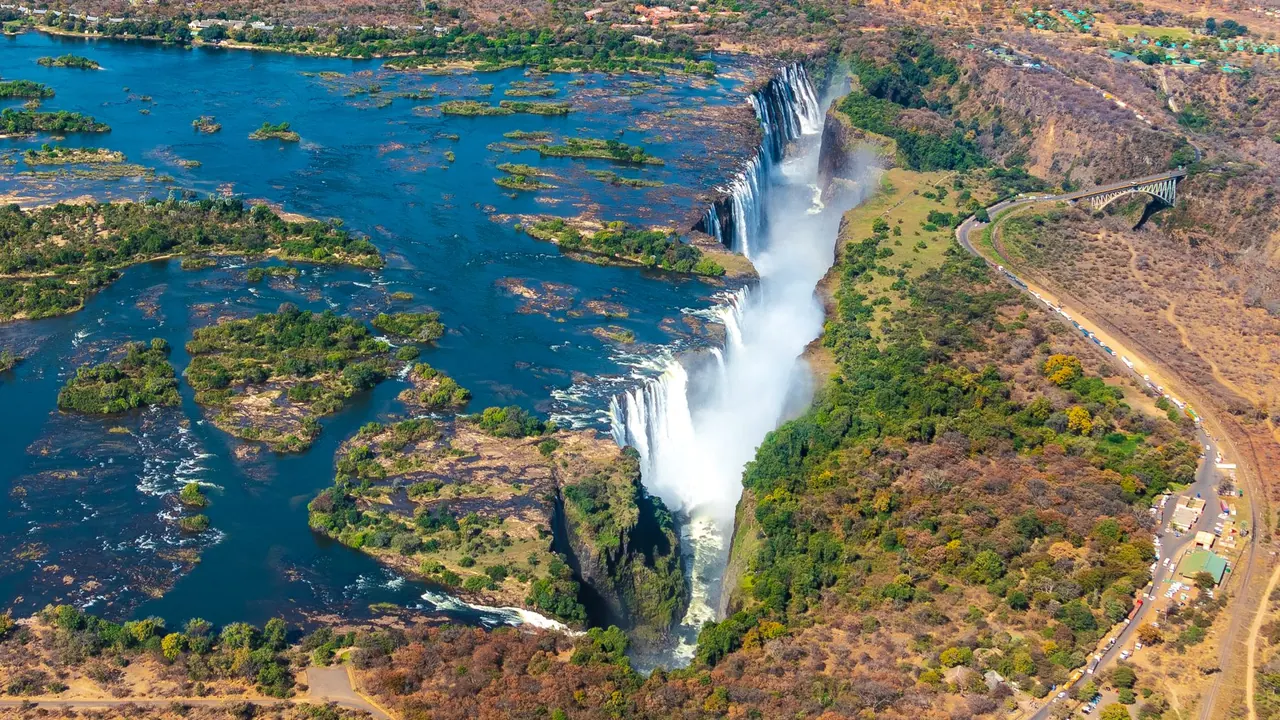
Photos: Cape Town by Stephan Louis, Pexels License; Victoria Falls by Murray Foubister, CC BY-SA 2.0, cropped.
Cape Town or Victoria Falls?
Our verdict in twelve categories, each scored against the same fixed benchmark cities, and the climate month by month, so you can choose for your trip.
Choose Cape Town for
- nightlife
- beaches
- food and drink
Cape Town is the better choice for a full, varied vacation. It has a mountain behind the city, two coasts, the Winelands under an hour away, a serious food and wine culture, real nightlife and a sobering history to learn about at Robben Island and the District Six Museum. It also costs much less day to day. It suits travellers who want a week or more with something different each day, and who don't mind driving or using ride-hailing to get between places.
Choose Victoria Falls for
- getting around
Victoria Falls is a place you go to for one great experience. You come for the falls, the Batoka Gorge and the big game upstream, then fill the days with rafting, river cruises and game drives, and go to bed early. It suits adventurous couples and families with older children who want Africa's wildlife and adrenaline in a compact setting, and who accept that it is expensive and that there is little to do in the evenings or on a rest day.
Scoreboard
Twelve categories on one fixed scale from 0 to 100. The shaded stretch is the gap between the two.
Your match
Pick a travel style or drag the sliders, and both match scores follow your weighting.
Wins on nightlife and beaches with your weighting.
Wins on getting around with your weighting.
What matters to you?
Category by category
What the scores mean for a trip.
Beaches & swimming
Cape Town has real beaches, though the two coasts are very different. Clifton and Camps Bay are beautiful places to lie on the sand, but the Atlantic is too cold for more than a quick dip. False Bay, with Muizenberg, St James and the tidal pools, is where you go to swim in summer.
Victoria Falls is landlocked, and the Zambezi is full of crocodiles and strong currents, so swimming means a lodge pool. The only exception is Devil's Pool at low water, a supervised moment on the edge of the falls rather than a beach day.
Food & drink
Cape Town is one of the better places in the southern hemisphere to eat. It has its own creole cooking in Cape Malay curries and bobotie, line fish at Kalk Bay and Hout Bay, ambitious chefs around Bree Street and Woodstock, and Winelands estates within easy reach.
At Victoria Falls you mostly eat in your lodge. Game meat grilled over open fires at big drumming dinners, sadza with stews and tea on the Victoria Falls Hotel terrace are all worth trying once, but there are no markets and no cafés, and a few nights covers what there is.
Culture & sights
Cape Town gives you several days of meaningful history: the ferry to Robben Island, the District Six Museum, the Castle of Good Hope, the museums around the Company's Garden, the Bo-Kaap's mosques and Zeitz MOCAA in its grain silo. The history is the hard history of apartheid rather than grand architecture.
Victoria Falls has very little. The 1905 bridge from the Cape to Cairo railway, the Edwardian hotel and statues of Livingstone are worth an hour or two. For a proper museum you cross into Zambia to visit Livingstone.
Nightlife
Cape Town's evenings often start with a sundowner on the Camps Bay beachfront or a rooftop as the sun sets over the Atlantic. From there you can move on to the cocktail and wine bars of Bree and Kloof Streets, the late clubs of Long Street or the long-established gay quarter of De Waterkant. The bars and clubs are spread across the city, so people get between them by ride-hailing, and nights out are liveliest from December to March.
At Victoria Falls, the drink on a river cruise or lodge deck is most of the night. Afterwards there are hotel bars, a couple of pubs and a backpacker bar that fills up with rafting crews, but no clubs. Elephants walk through town after dark, so people take taxis rather than walk, and most are asleep early before a dawn game drive.
Nature & outdoors
Both are outstanding, in very different ways. Cape Town's wild landscape is right beside the city. You can climb Table Mountain and Lion's Head, walk among the fynbos of a whole floral kingdom down to Cape Point, see penguins at Boulders and whales in False Bay, and surf at Muizenberg.
At Victoria Falls one great natural sight and a big-game landscape surround the town. You can walk through the spray of Mosi-oa-Tunya, raft and bungee in the gorges below, and find elephant, buffalo and lion in Zambezi National Park, with Chobe's herds close enough for a day out.
Day trips
From Cape Town you can head out for several days without repeating yourself. Stellenbosch, Franschhoek, Paarl and Constantia offer old Cape Dutch towns and wine tastings, and Hermanus, Tulbagh and the West Coast villages add more. You will need a car or a tour for nearly all of them.
Victoria Falls has less to offer beyond its wildlife. Livingstone, just over the bridge, has its museum and colonial main street, and Kasane is mostly a way into Chobe. Beyond those, the distances in this part of Africa are too long for a day out.
Good for families
Cape Town works for children of any age. The Two Oceans Aquarium, the penguins at Boulders, the cableway, picnics at Kirstenbosch and the calm tidal pools at St James give plenty of variety. Its main drawbacks are the driving between sights and the need for normal city street sense.
Victoria Falls can be thrilling for children of about eight and up, with game drives and hippos on the river. But it is a malaria area, medical care is basic, and many activities and lodges have minimum ages, which rules it out for most families with toddlers.
Getting around
Victoria Falls is the simpler place to get around. The falls entrance, the bridge and the main hotels are within walking distance by day, activity operators collect you from your lodge, and you can cross into Zambia on foot. You only need taxis for the outlying lodges and after dark.
In Cape Town the centre and the Waterfront are walkable, and MyCiTi buses reach the Atlantic beaches. But the peninsula, False Bay and the Winelands mean driving on the left or using ride-hailing almost every day, and taking a car door to door at night.
Shopping & style
Cape Town has the wider range, with chains and local labels at the V&A Waterfront, South African design, ceramics and leather in Woodstock and on Bree Street, and wine and rooibos to take home. It is good for browsing, though not a reason to visit.
At Victoria Falls, shopping is the curio market and the traders on the road. You will find stone sculpture, carvings and baskets, which you bargain for, and a few fixed-price galleries. There is nothing in the way of fashion or design.
Affordability
Cape Town is much easier on the budget. Tasting menus, estate wine, car hire and ride-hailing all cost far less than in Europe or North America. Rooms by the Atlantic beaches in December and January are the main exception.
Victoria Falls is expensive even before the activities. Lodges charge safari rates, much of the food is imported, and park fees on both sides, cruises, rafting and flights quickly add up. Staying in a backpacker lodge and choosing one or two activities helps, but only so much.
Live music & performing arts
Cape Town has a musical tradition of its own in Cape jazz, a major annual jazz festival, and summer sunset concerts on the Kirstenbosch lawns. For more formal evenings there is opera and ballet at Artscape and South African drama at the Baxter.
At Victoria Falls, the drumming, dance troupes and marimba bands you will hear play at dinners and lodges for visitors. They can be fun, but there is no theatre or concert hall.
Wellness & relaxation
Neither has a bathing tradition, but Cape Town is easier for a slow, restful stay. You can have long lunches on wine estates, take morning swims in the False Bay tidal pools, spend quiet afternoons in Kalk Bay, and use good spas in the Winelands.
At Victoria Falls, the calm is in the private lodges upstream, with treatment decks above the Zambezi and pool afternoons between game drives. The town itself is busy with rafting and bungee crowds, and with traders.
When should you go?
Pick your month. The climate figures are measured averages, not a forecast.
Cape Town in July
Victoria Falls in July
Daytime high, °C
Rainfall in the month, mm
Temperature and rainfall are climate normals, averaged over the years shown. Cape Town: 1991-2020 normals, Cape Town Airport (17.5 km from centre). Victoria Falls: 1991-2020 normals, Livingstone (13.1 km from centre).
Cape Town is at its best from December to March. Days are warm, around 27°C, rain is rare, and the sun shines for long hours. This is the season for the False Bay beaches, although even then the sea rarely gets much above 18°C. Winter is from June to August. It is cool and wet, with close to 100mm of rain in the wettest month, so it is better for whale watching and museums than for the beach.
Victoria Falls follows the opposite pattern. The rains fall from November to March, peaking in January, and they fill the falls to full flow. From May to September it is almost completely dry. June and July are the most comfortable months for walking and game drives, at about 26°C. By October the heat builds to around 35°C before the rains break, so it is a hard month for long days outdoors.
Which traveller are you?
For a food and nightlife trip, choose Cape Town. Cape Malay cooking in the Bo-Kaap, inventive tasting menus on Bree Street and wine estates on the doorstep lead on to bars on Kloof Street and clubs on Long Street. Victoria Falls offers lodge dinners and an early night.
On a trip on a tight budget, Cape Town also wins. Restaurant meals, wine and ride-hailing are inexpensive, and the national park costs little to enter. At Victoria Falls almost everything worth doing, from park fees to rafting and game drives, is priced at safari rates.
For travellers who want wildlife and adrenaline, Victoria Falls is the place. Elephants, buffalo and lion live minutes from town, Chobe's herds are within a day trip, and you can raft the Batoka Gorge and bungee from the bridge. Cape Town's penguins and whales are wonderful, but it has no big game.
Before you go
| Measure | Cape Town | Victoria Falls |
|---|---|---|
| Official language | English, Zulu, Xhosa, Afrikaans, Venda, Northern Sotho, Swazi, Tswana, Tsonga, Sesotho, Southern Ndebele, South African Sign Language | English, Xhosa, Ndau, Venda, Chewa, Khoisan, Kalanga, Shona, Tonga, Tswana, Tsonga, Sesotho, Northern Ndebele, Nambya, Zimbabwe Sign Language, Barwe |
| Currency | Rand (ZAR) | Zimbabwe Gold (ZWG) |
| Sockets | CMN230 V, 50 Hz | G220 V, 50 Hz |
| Driving side | Left | Left |
| Time zone | UTC+2 | UTC+2 |
| Emergency number | 112 | 999 |
| Elevation | 5 m | 961 m |
| Main airport | Cape Town International Airport (CPT)18 km from centre45 non-stop destinations | Victoria Falls International Airport (VFA)18 km from centre12 non-stop destinations |
| Public holidays this year | 13 days | 13 days |
By the numbers
| Measure | Cape Town | Victoria Falls |
|---|---|---|
| City population | 3,776,313 | 33,060 |
| People per km² | 1,538 | - |
| Museums within 10 km | 22 | 2 |
| UNESCO World Heritage sites within 50 km | 3 | 0 |
| Swim season, months above 21 °C | None | - |
Where else could you go?
Every comparison below shares a destination with this one, so you can follow Cape Town or Victoria Falls somewhere new.