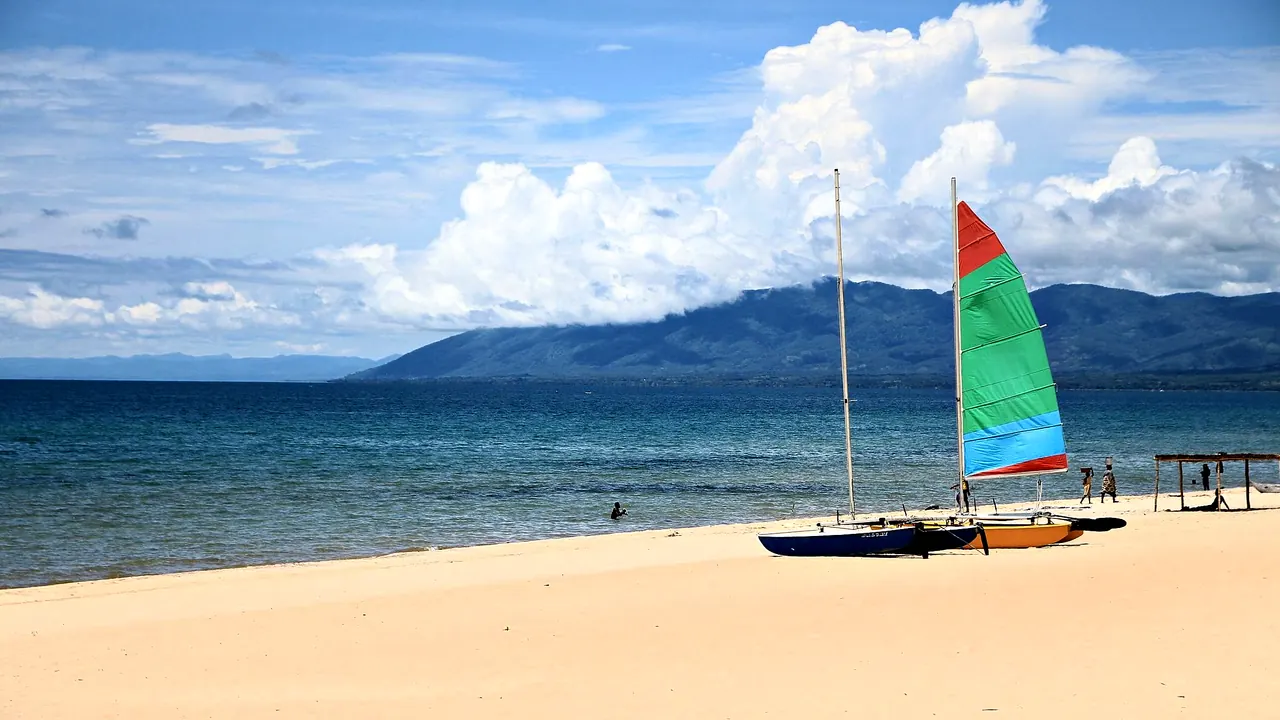
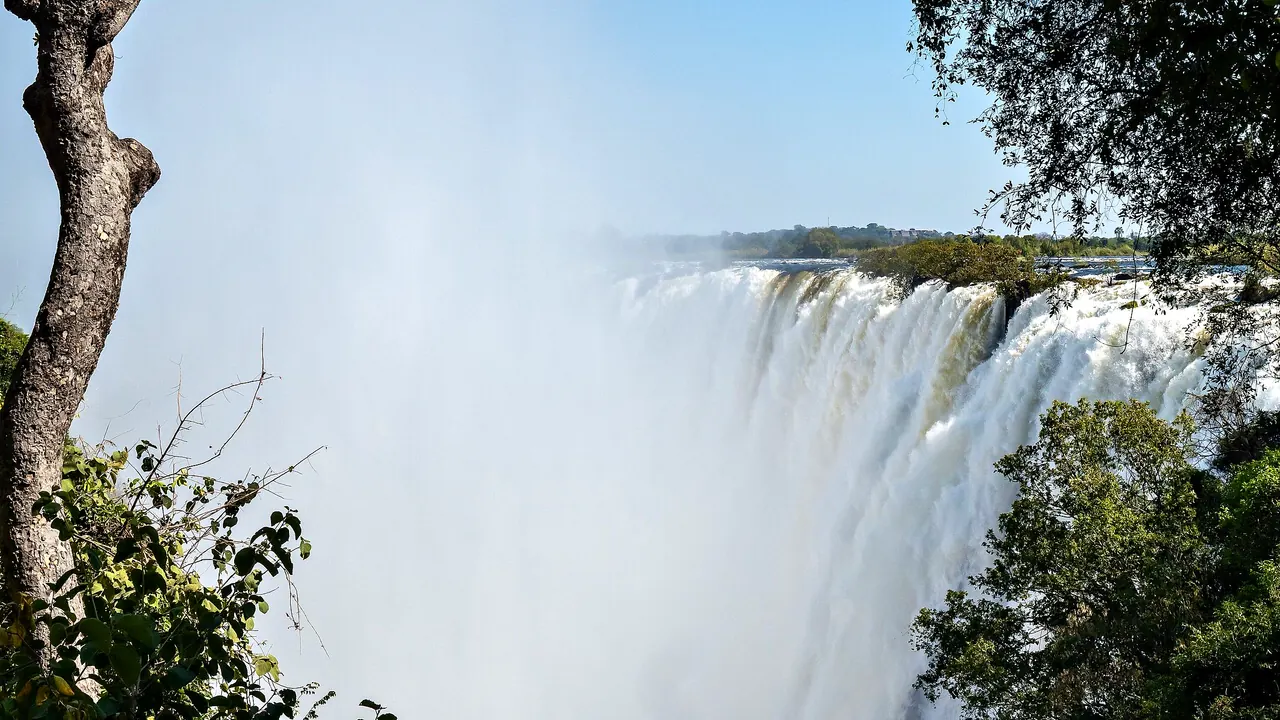
Photos: Lake Malawi by Ros NL, Pexels License; Livingstone by Matti Blume, CC BY-SA 4.0, cropped.
Lake Malawi or Livingstone?
Our verdict in twelve categories, each scored against the same fixed benchmark cities, and the climate month by month, so you can choose for your trip.
Choose Lake Malawi for
- beaches
- prices
- day trips
Lake Malawi suits a slow trip built around water. You stay at a lodge on golden sand, swim and snorkel among the cichlids off Cape Maclear or Nkhata Bay, and let the days run together. It is also the cheaper of the two by some way, as long as you keep to simple lodges and local transport. The price is time: the bases are far apart, the roads are slow, and moving between them takes up whole days.
Choose Livingstone for
- nature and the outdoors
- getting around
- shopping
Livingstone is the better pick for a short, full itinerary. Victoria Falls is a short drive from town, the Batoka Gorge rapids are just below it, and rhino walks, Zambezi cruises and a day in Chobe are all close by, with transfers usually included. There is no beach, and filling each day with activities gets expensive quickly. In return you get the region's most dramatic landscape and very little time lost on the road.
Scoreboard
Twelve categories on one fixed scale from 0 to 100. The shaded stretch is the gap between the two.
Your match
Pick a travel style or drag the sliders, and both match scores follow your weighting.
Wins on beaches and prices with your weighting.
Wins on nature and the outdoors and getting around with your weighting.
What matters to you?
Category by category
What the scores mean for a trip.
Beaches & swimming
This is where the two differ most. Lake Malawi is in effect an inland coast. Lodges sit a few steps from calm, warm freshwater, and you can choose between Cape Maclear's rocky islands, the coves below wooded hills at Nkhata Bay and Likoma's quiet shore facing Mozambique. You do need to avoid reedy shallows because of bilharzia and keep clear of the southern river mouths.
Livingstone has nothing comparable. The Zambezi is off limits because of crocodiles and the current, so daily swimming happens in a pool. The exception is a guided half-hour in Devil's Pool on the lip of the falls when the river runs low, which is a thrill rather than a beach day.
Food & drink
Neither place is a food destination, and the meals are close cousins: the same stiff maize porridge (nsima by the lake, nshima across the border) eaten by hand with whole grilled or fried fish. At the lake the fish is chambo, and you will see usipa drying in silver heaps along the shore.
The difference is in where you eat. At the lake you eat almost every meal at your lodge, cooked with whatever the supply run brought. Livingstone has a short row of town restaurants serving game meat and grills, and its best meals come with a view from a deck above the Zambezi.
Culture & sights
Sightseeing is a sideline in both places, and Livingstone's sights are slightly fuller and much easier to reach. The Livingstone Museum, with the explorer's letters and belongings, the railway museum's steam locomotives and the Victoria Falls Bridge make a tidy afternoon close to town.
Lake Malawi's heritage is spread thinly along the shore. It is mainly missionary: the outsized St Peter's Cathedral on Likoma Island, the stone church and small museum at Livingstonia on the escarpment, and missionary graves at Cape Maclear. Each one means a separate journey, so you see them along the way rather than planning a trip around them.
Nightlife
Nights are short in both. At the lake, the backpacker hubs of Nkhata Bay and Cape Maclear have the most going on, with reggae, pool tables, bonfires on the sand and the odd beach party.
Livingstone's evening centres on the sundowner, on a river cruise or a lodge deck. Apart from a couple of hostel bars and a few local taverns, most people head to bed early because rafting and game drives start at dawn.
Nature & outdoors
Both are strong for the outdoors, but Livingstone has the bigger spectacle. Mosi-oa-Tunya is more than 1.7km wide and drops into a basalt gorge, and below it the Batoka Gorge offers serious one-day rafting, bungee and the hike down to the Boiling Pot. Add canoeing among hippos on the upper Zambezi, walking safaris to see white rhino, and Chobe's elephant herds a day's outing away.
Lake Malawi's best scenery is underwater. Hundreds of brightly coloured cichlid species found nowhere else live along its rocky shores, and you can snorkel or learn to dive in calm freshwater around Cape Maclear's national park. Above water, it offers kayaking to the islands and the climb to Livingstonia and the Manchewe Falls. Big game means the long drive to Liwonde.
Day trips
Both offer only a handful of outings. From the lake, those outings are towns reached by long, slow roads: Zomba's colonial buildings and plateau from the south, Lilongwe from Senga Bay, and Mzuzu or the Livingstonia escarpment in the north.
Livingstone's outings mostly mean crossing a border. You can walk over the bridge to Zimbabwe's Victoria Falls town, which needs a visa, or drive to Kasane in Botswana as the gateway to safaris there. Closer to home, Mukuni village, whose chief is the custodian of the falls, makes a guided morning out.
Good for families
Neither is easy with young children, and malaria is present all year in both. At the lake, the appeal is calm, warm water, shallow beach fronts and a relaxed pace. Against that come bilharzia, long bumpy transfers from the airport and basic medical care.
Livingstone works better with teenagers. Rhino walks, hippo cruises and the spray of the falls will thrill them, though rafting, gorge swings and Devil's Pool all have minimum ages. Distances are short, which helps, but the heat of October and November can be hard on children.
Getting around
Livingstone is far simpler. Everything worth seeing lies within a short drive of town, taxis are easy to find, and activity operators collect you from your lodge. The one rule is not to walk the roads at the park edges, where elephants roam.
Lake Malawi's bases are hundreds of kilometres apart along a slow lakeshore road, with rough tracks down to places like Cape Maclear. Most visitors rely on lodge transfers or a car with a driver, because local transport means crowded minibuses. The lake steamer and the small planes to Likoma run only now and then, so most visitors choose one or two bases and stay put.
Shopping & style
Shopping is limited in both, with a slight edge to Livingstone. Its curio markets in town and at the falls entrance sell a wider range, including soapstone, copper, beadwork and baskets, and a small mall covers basic needs.
At the lake you mostly buy from roadside stalls and beach sellers, who offer carved figures, bao boards and chief's chairs. In both places the best thing to take home is a length of brightly printed cloth.
Affordability
Lake Malawi is the cheaper of the two, mainly because of how a typical stay is spent. Most visitors settle at one lakeshore base and spend the days swimming, snorkelling off the rocks and walking to the nearest village, and very little of that comes with a bill. Costs climb with comfort and distance: private transfers along the long lakeshore road, diving courses, park entry, imported drinks, and the island lodges on Likoma and off Cape Maclear, which are run as a luxury product.
In Livingstone the extra cost comes with the trip itself. Rooms, taxis and meals in town are modest, but a typical stay adds an entry fee or an excursion almost every day: the falls and the national park, a rafting day in the Batoka Gorge, a helicopter flight or a Chobe safari, plus a visa if you cross the bridge into Zimbabwe. Riverside lodges upstream also cost more than a guesthouse in town. If you keep to the falls walkways, the bill stays moderate. Once you book an excursion for each day, it rises fast.
Live music & performing arts
Neither has theatres or concert halls, so performance means traditional dance in both. By the lake, it is village drumming and dancing hosted by lodges, plus choirs if you go to church on a Sunday. The Chewa's masked Gule Wamkulu belongs to funerals and is rarely seen by visitors.
Livingstone puts on more organised shows, with troupes at cultural centres in town that sometimes include the masked Makishi dancers. The Toka-Leya's Lwiindi ceremony is the main event in the local calendar.
Wellness & relaxation
Both offer stillness rather than a spa culture. The lake's version is hammocks under the trees, early swims in flat water and nothing to do after sunset. Massage and yoga decks are mostly found at the quieter lodges on Likoma and the Cape Maclear islands.
Livingstone's bigger riverside hotels have proper spa treatments, but the town is also an adrenaline base. For rest, pick a quiet lodge on the upper Zambezi, where the hours between a dawn walk and an evening cruise are yours.
When should you go?
Pick your month. The climate figures are measured averages, not a forecast.
Lake Malawi in July
Livingstone in July
Daytime high, °C
Rainfall in the month, mm
Where the figures come from
Lake Malawi has no weather station within reach, so its figures come from a gridded climate model rather than a measured record, and read a broad area rather than one spot.
Temperature and rainfall are climate normals, averaged over the years shown. Lake Malawi: 2001-2020 normals, NASA POWER reanalysis grid, no weather station within 90 km. Livingstone: 1991-2020 (sunshine 1981-2010) normals, Livingstone (6.5 km from centre).
Both places share the same rhythm of a hot, wet summer and a long dry season, and both are at their best from about May to September. On the lakeshore where most visitors stay, the rains are heavy from December to March, with January reaching 308mm. They stop almost completely from May, and June and July are the mildest months for walking at about 25°C. Swimming works all year, but the dry months bring calm, settled days. October and November climb to 33°C, which is hot but softened by the water.
Livingstone runs a few degrees warmer all year, and its wet season is lighter than the lake's. June to August is completely dry and very sunny, and these are the most comfortable months for rafting and game walks. The falls are at their fullest just after the rains, from March to May. October peaks at 35°C, which makes the time before the rains punishing for anything on foot.
Which traveller are you?
On a beach and sun trip, Lake Malawi is the only choice of the two. Its lodges sit right on sand above warm, clear freshwater, from Cape Maclear's sheltered bays to Chintheche's empty strands. In Livingstone, swimming means a lodge pool.
For an outdoors trip, Livingstone has the bigger draw. The falls, a full day of white water in the Batoka Gorge, rhino on foot and Chobe's elephants are all within easy reach. The lake answers with snorkelling, kayaking to Thumbi Island and the Livingstonia trails.
On a trip on a tight budget, Lake Malawi stretches money much further. Campsites, simple lodges, local meals and minibuses cost little, and lying on the beach is free. In Livingstone, most of what people come for is a paid activity priced for international visitors.
Before you go
| Measure | Lake Malawi | Livingstone |
|---|---|---|
| Official language | English, Chewa, Tumbuka | English |
| Currency | Malawi Kwacha (MWK) | Zambian Kwacha (ZMW) |
| Sockets | G230 V, 50 Hz | CG230 V, 50 Hz |
| Driving side | Left | Left |
| Time zone | UTC+2 | UTC+2 |
| Emergency number | Police 990/997, ambulance 998, fire 999 | 991 or 999 |
| Elevation | - | 931 m |
| Main airport | Kamuzu International Airport (LLW)9 non-stop destinations | Harry Mwanga Nkumbula International Airport (LVI)6 km from centre6 non-stop destinations |
| Public holidays this year | 11 days | 16 days |
By the numbers
| Measure | Lake Malawi | Livingstone |
|---|---|---|
| Population | - | 177,393 |
| Museums within 10 km | - | 2 |
| UNESCO World Heritage sites within 50 km | - | 1 |
Where else could you go?
Every comparison below shares a destination with this one, so you can follow Lake Malawi or Livingstone somewhere new.
- Victoria Fallsvs Livingstone
- Lilongwevs Lake Malawi
- Johannesburgvs Livingstone
- Zanzibarvs Lake Malawi
- Windhoekvs Livingstone
- Dianivs Lake Malawi